Most advice on how to choose a name hands you a list and wishes you luck. This page does the opposite: it gives you a seven-stage decision framework that works whatever names you like, so you can tell a good choice from a merely pleasant one. Along the way it shows which facts you can check (popularity data, spelling rules, registration deadlines), which claims you should doubt, and where taste is the only honest judge.
The short version
- Define the job before you browse. Write down where the name will live, which languages will say it, and which family or cultural conventions apply. Most dead ends come from skipping this.
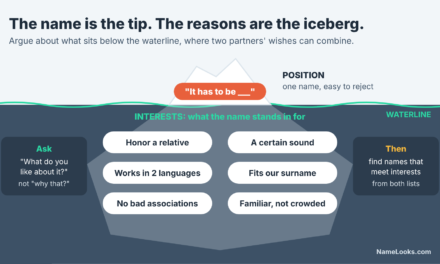
- Separate hard filters from preferences. A filter (it has to work with a two-part surname, it has to honor a grandparent) removes names. A preference (we like soft sounds) only ranks them. Mixing the two causes most arguments.
- Verify instead of trusting. Popularity claims need a dataset, a place, a year and a metric. Meaning claims need a real source. Pronunciation should come from speakers of the language, not from English spelling.
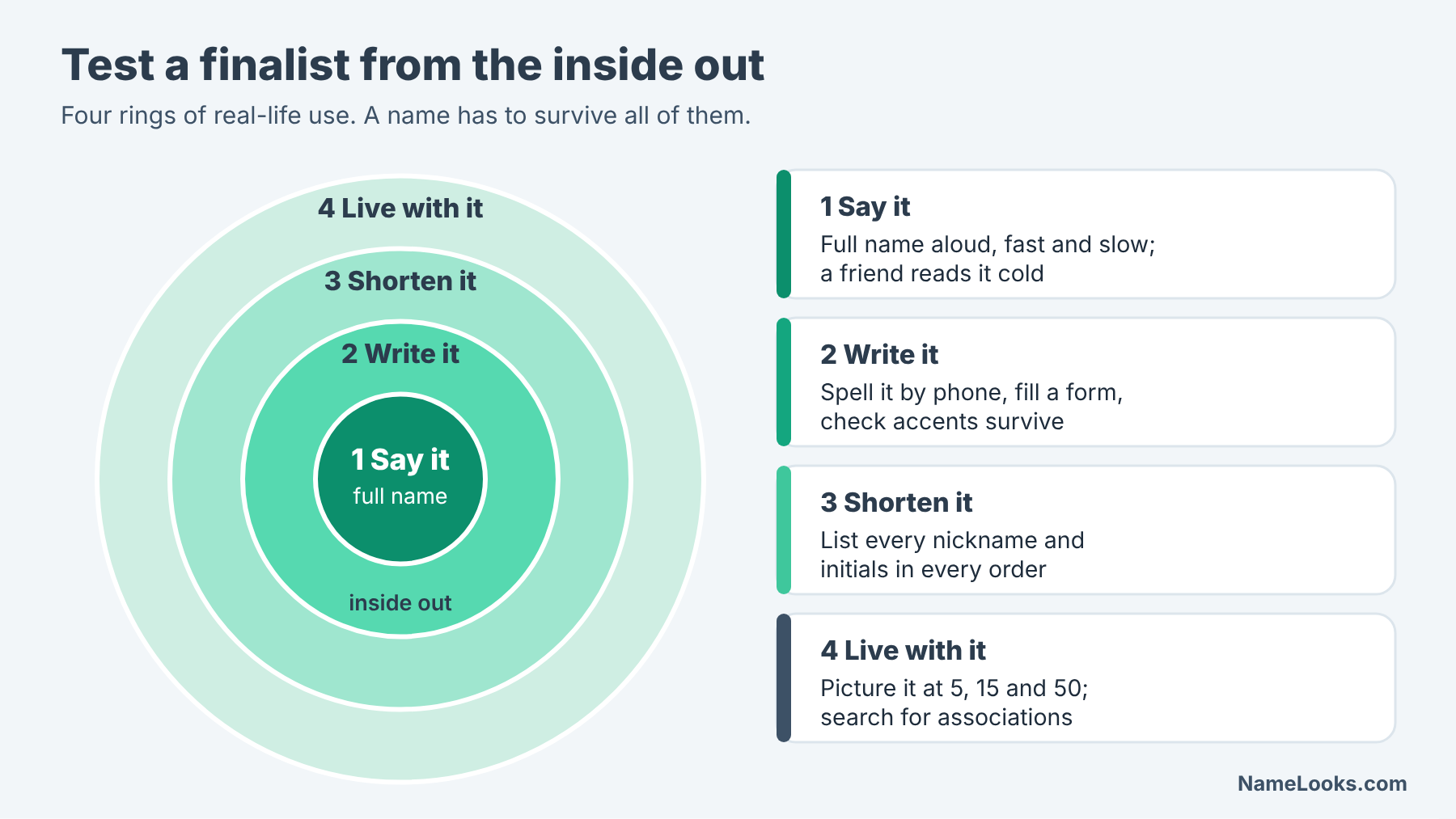
- Test the name in real life. Say the full name, write it on a form, spell it over the phone, try the nicknames. Ten minutes of testing beats ten hours of scrolling.
- Decide with a small shortlist and a deadline. Know who has a veto, how many finalists you will compare, and when the paperwork is due where you live.
- Accept a trade-off on purpose. No name wins on every dimension. Pick the one whose weakness you can live with, and know what would make you reopen the decision.
1How to choose a name without drowning in lists
Here’s the core answer to how to choose a name, up front. You choose well by deciding what the name has to do, filtering candidates against real constraints, checking the facts you are relying on, testing the survivors in everyday use, and then picking among a handful of finalists with the people who share the decision. That’s it. Everything below is detail on how to do each part without guessing.
The details matter because the usual approach fails in a predictable way. People open a site with thousands of names, sort by letter or “style,” and keep scrolling until something feels right. The feeling is real, but it’s doing two jobs at once: generating ideas and judging them. When one gut reaction does both, you end up with forty “maybes” and no reason to prefer any of them.
What a decision framework does that a list can’t
A list is a pile of options. A framework is a set of questions that turns options into a choice. The difference shows up most clearly when you get stuck, which almost everyone does at some point.
Lists answer the wrong question
A list answers “what names exist?” That question was never your problem. There are more names in circulation than anyone could read: the U.S. Census Bureau’s tabulations from the 2020 Census alone include 53,615 first names that occurred 100 or more times in census returns, according to the bureau’s 2020 names data page. Nobody needs more supply.
When people look up how to choose a name, their actual question is “which of these is right for this person, this family and this life?” A list can’t answer that, because the answer depends on things the list doesn’t know: your surname, the languages spoken at home, a grandmother’s wishes, the town you live in, and what you can tolerate hearing mispronounced for decades. A framework puts those things first.
There’s a second problem with lists. Many of them attach a one-word “meaning” to every name with no source, and some quote popularity without saying which country or year. You can’t make a careful decision on top of unverified claims. We’ll come back to how to check them in Stage 4.
The seven stages in one breath
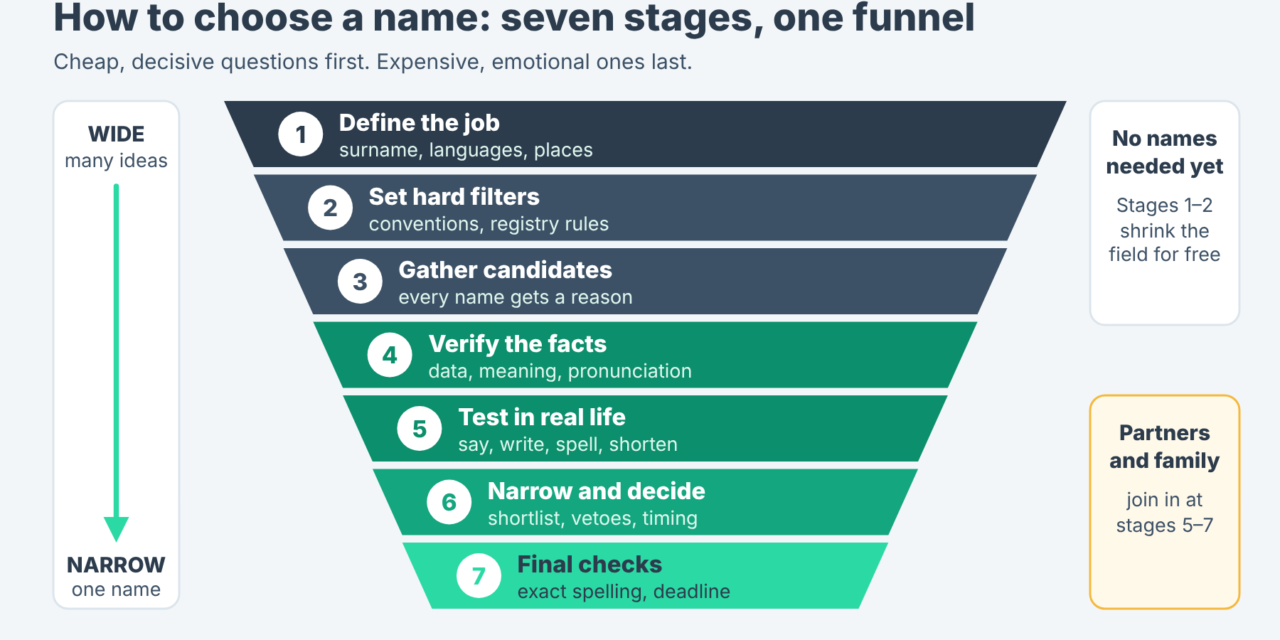
Our answer to how to choose a name has seven stages. You can move back and forth between them, and some families will spend a weekend on one stage and five minutes on another. That’s fine. The order exists so that cheap, decisive questions come before expensive, emotional ones.
- Define the job. Where will this name be used, by whom, in which languages and with which surname?
- Set hard filters. Family conventions, cultural or religious naming practices you follow, and practical limits such as registration rules.
- Gather candidates from sources. Family, languages, places, books and history, with a note on why each name is on the list.
- Verify the facts. Popularity in the right dataset, meaning and origin from real references, pronunciation from real speakers.
- Test in real life. Say it, write it, spell it, shorten it, and imagine it at five, fifteen and fifty.
- Narrow and decide together. Cut to a small shortlist, handle vetoes fairly, and agree on timing.
- Final checks and commitment. Confirm the exact spelling for documents, know your deadline, and decide what would make you reconsider.
Who this framework is for, and when you can skip it
The framework was built around the most common version of the problem: choosing a first and middle name for a baby. But the logic of how to choose a name is general. The same questions apply when an adult picks a new name, when a writer names a character, or when someone chooses a name for a pet that will be shouted across a park. We cover those adaptations near the end.
Babies, adults and everyone in between
Choosing for someone else carries a particular weight: the person who lives with the name isn’t in the room. That’s why the framework leans on things that will matter to them later, such as whether the name is easy to spell for a teacher, whether it works in the languages of both sides of the family, and whether it has a usable short form.
Choosing for yourself flips some of that. You can test a name in real life before you commit, by using it socially for a while. You also face different paperwork, which varies by jurisdiction. If you’re an adult renaming yourself, read the framework anyway, then jump to the section on adults for the parts that change.
When you don’t need a framework at all
Some people already know. A family tradition settles the first name, or a single name has been “the one” for years and survives every test you throw at it. If that’s you, you don’t need seven stages. Skip to the pre-decision naming checklist, run the practical checks, and get on with your life.
The framework is for the much more common situation: a long list, mixed feelings, maybe two people with different tastes, and a nagging sense that something important might be missed. If you recognize that, keep reading.
How the rest of this guide is organized
Each stage gets its own section with the reasoning, a practical method and the most common mistakes. Where one decision deserves a full treatment of its own, such as testing a name aloud or deciding with a partner, we summarize it here and link to the dedicated NameLooks guide. You can read straight through or jump to the stage where you’re stuck.
2Stages 1 and 2: Define the job the name has to do
If you remember one thing about how to choose a name, make it this: the first two stages cost almost nothing and save the most time. Before you look at a single candidate, you describe the life the name will lead and the rules it has to follow. Done well, this step quietly removes a large share of the names you would otherwise agonize over.
Map the name’s real-world context
A name isn’t used in a vacuum. It’s spoken by specific people, written on specific forms, and combined with a specific surname. Map those things first.
The languages and places the name will live in
Start with a plain inventory. Which languages are spoken at home? Which languages do grandparents speak? Where are you likely to live in the next ten or twenty years, as far as you can guess? A name that is easy in one language can carry sounds that don’t exist in another, or letters that a keyboard or form in another country won’t handle well.
This isn’t about avoiding names from any language. It’s about knowing in advance which trade-offs you are accepting. A family that speaks two languages might deliberately want a name that works in both. Another family might happily choose a name that is natural in the heritage language and accept that some English speakers will need to learn it. Both are good decisions if they are made on purpose.
The full name structure you’re working with
Many naming discussions quietly assume a “first, middle, last” structure. Plenty of families don’t use it. The Unicode Consortium’s CLDR person-names specification, which software uses to format names across languages, notes that the order of name parts, the spacing and the punctuation differ across languages. It points out that some languages, such as Spanish, use two surnames, and that a second given name may be a middle name in the West but a patronymic in Slavic regions.
The same document notes that in Japanese, the display order depends on the origin of the name: Japanese and Hungarian names are customarily shown surname first, while American and French names are shown given name first. The practical lesson: describe your own structure explicitly. Will the child carry one surname or two? Will a patronymic be added automatically? Will the name be written surname first in some settings? Each answer changes which candidates fit.
Quick exercise
Write your surname (or surnames) on a sheet of paper exactly as it will appear on a birth certificate. Under it, write the order in which the full name will be spoken at home, at school, and on official forms. If those three lines differ, you have learned something important before choosing anything.
Turn constraints into hard filters
Stage 2 is where you write down the rules that are not up for debate. A hard filter removes names from consideration. It doesn’t rank them. Keeping filters separate from preferences is the single most useful habit in the whole process.
Family, cultural and religious conventions
Many families follow naming conventions, and those conventions vary enormously, even within one country, one language or one faith. Some families name children after living relatives; others avoid exactly that. Some use a set order of honor names for first, second and third children. Some have traditions about the timing of a naming ceremony. You know your family’s practice better than any website does, and no single “rule for culture X” applies to every family in it.
The useful move is to state the convention in your own words and decide whether it’s a filter or a preference. “The middle name must honor my father” is a filter. “It would be nice if the name worked for my mother’s side too” is a preference. If you’re not sure whether a convention is binding for your family, ask the relative who cares most, early, before you fall for anything. That conversation is far easier at the filter stage than after you’ve announced a favorite.
Registration and document realities
There is also a practical deadline in most places. In England, Wales and Northern Ireland, GOV.UK states that all births must be registered within 42 days of the child being born. Other jurisdictions set their own timelines and their own rules about which characters a name may contain. Find the rule for where you live before you need it, because it shapes how long you have to decide and whether you can postpone the choice until after you meet the baby.
Character rules matter too. Some registries and agencies handle accents, apostrophes or hyphens differently, and some limit characters on certain records. Rules change, and they differ by country, state and agency, so check the official guidance in your jurisdiction rather than relying on what someone else experienced. Treat this as general information rather than legal advice.
Don’t confuse “unusual” with “not allowed”
A registrar’s rule and a stranger’s opinion are not the same thing. The first is a hard filter you must check with the official source. The second is just a preference somebody else holds. Keep them in separate columns.
Write a one-paragraph naming brief
By the end of Stage 2 you should be able to describe your situation in a single paragraph. Professional namers in branding call this a brief. It works just as well for people.
What goes in the brief
A good brief has five parts: the surname structure, the languages that matter, the hard filters, the preferences you already know about, and the deadline. It doesn’t name any candidate names. Its purpose is to make the later stages faster and to give both partners, if there are two of you, the same starting point.
- Structure: surname or surnames, middle-name habits, any automatic name parts.
- Languages: who will say this name most often, and in which languages.
- Filters: conventions and rules that remove options.
- Preferences: sounds, lengths or feelings you lean toward, labeled as preferences.
- Deadline: the official registration window where you live, plus any family ceremony date.
A hypothetical brief, start to finish
Picture a couple, purely as an illustration, who live in the United States. One partner grew up speaking Portuguese, and the other speaks only English. Their child will carry both surnames. Their brief might read: “Two surnames, Portuguese then English. The name must be easy to say in both languages and should not need a different spelling in each. The middle name honors a grandparent on the English-speaking side. We both prefer names of two or three syllables. We’d like to decide before the birth but are willing to wait a few days.”
Notice what that paragraph already does. It rules out names whose spelling would be read differently in the two languages, it fixes the middle name slot, and it sets a timing preference. The couple hasn’t looked at a single list, and they’ve already narrowed the field more than a week of scrolling would. For a full treatment of the factors that feed into a brief, the guide to baby name criteria breaks down meaning, sound, family fit, popularity, spelling and practical use one by one.
3Stages 3 and 4: Gather candidates, then verify what you think you know
Now you can go looking for names. The trick is to gather widely and judge later, and to keep a note of where each idea came from. Then, before any name becomes a favorite, you check the facts you are leaning on. This is the part most guides skip, and it’s where many regrets begin.
Gather candidates from sources, not from scrolling
Every name on your long list should have a reason for being there. “It came up on page nine of a list site” is a weak reason. “It was my great-aunt’s name,” “we heard it in a language we speak,” or “it’s the name of a place that matters to us” are strong ones. A reason gives you something to talk about when you compare names later.
Where good candidates come from
The richest sources are usually personal. Family trees, old letters and the names of people who shaped you tend to produce names with built-in meaning that no dictionary can supply. Languages you speak, or that your family speaks, are another deep source. So are books, music, history and places, as long as you check that the association is the one you think it is.
Popularity tables can be a source too, but use them carefully. They show what other families chose recently in one country. That’s useful context, and it can jog your memory, but it says nothing about whether a name suits your brief. Treat them as one input among several, not as the menu.
Keep a source note for every name
Next to each candidate, write one short line: where it came from and why it’s there. This takes seconds and pays off twice. First, it shows you patterns in your own taste (“half our list is from one side of the family”). Second, when you start cutting, the source note helps you remember what you’d lose. A name with a strong reason is harder to drop casually, and that’s exactly the friction you want.
If your long list grows past a hundred names, don’t panic. That’s normal. The shortlist method for turning 100 favorites into a final five walks through how to cut a big list down without inventing arbitrary scores. For now, just collect.
Check popularity data the right way
In almost every conversation about how to choose a name, popularity comes up early. It is the most quoted and most misquoted fact about names. It’s also one of the easiest to verify, because two large official datasets publish it every year. The catch is that each dataset measures something specific, and the details change what the numbers mean.
What the U.S. and England and Wales datasets actually measure
In the United States, the Social Security Administration publishes baby-name data from Social Security card applications. Its background page says the data come from card applications for births in the United States after 1879, that names with fewer than five occurrences in any geographic area are excluded to protect privacy, and that different spellings of similar names are not combined: each spelling is a separate name with its own rank. National figures cover the 50 states and the District of Columbia.
In England and Wales, the Office for National Statistics publishes rankings from birth registrations. The ONS quality and methodology information says the statistics use the exact spelling on the birth certificate, do not group names, use only the first name recorded at registration, and do not release names with counts of fewer than three in England and Wales as a whole. The current edition of the ONS dataset covers 1996 to 2025 and was released on 9 July 2026.
Those design choices have real consequences. Because neither dataset merges spellings, a name that’s spread across several spellings can look less common in the rankings than it sounds on a playground. If you want to know how many children share a spoken name, you’d have to add up the spellings yourself. Both agencies leave that to the user.
Rank, count and share are three different things
A rank tells you a name’s position relative to other names. A count tells you how many babies received it. A share tells you what fraction of all babies that count represents. They move differently. A name can hold the same rank for years while its count falls, simply because the most popular names in general are given to a smaller slice of babies than they once were. When someone says a name is “number one,” ask: in which dataset, in which place, in which year, and by which metric?
For a concrete example of how to phrase this properly: in the SSA’s national data for 2025 births in the United States, the top-ranked names were Liam for boys and Olivia for girls, according to the SSA’s table of the top five names by year. In the ONS data for 2025 births in England and Wales, the top-ranked names were Muhammad for boys and Olivia for girls, as widely reported from the ONS release. Two different countries, two different data sources, and a different number one for boys. Neither ranking says anything about any individual child.
The most common popularity mistake
Treating a U.S. ranking as if it described the UK, or the reverse. The SSA covers U.S. births; the ONS covers births in England and Wales. Scotland and Northern Ireland publish their own figures. A name’s standing in one place doesn’t transfer to another.
Check meaning, origin and pronunciation
Meaning is where online advice on how to choose a name is least reliable. Many sites attach a neat one-word definition to every name, and those definitions get copied from site to site until they look authoritative. Some are well supported. Some are guesses. Some confuse what a name’s source word meant centuries ago with what people associate with the name today.
Four different things people call “meaning”
When someone says a name “means” something, they could be talking about four different things, and it helps to keep them apart.
- Etymology: the literal meaning of the word or words the name came from, often in an old form of a language.
- Historical usage: who actually used the name, when and where, which can differ a lot from the source word.
- Related forms: cognates in other languages, variants, diminutives, short forms and transcriptions from other scripts.
- Modern association: what the name evokes now, from a famous bearer, a character, or a symbolic reading.
All four are legitimate reasons to like a name. Problems start when an association is presented as an etymology, or when a disputed origin is presented as settled. If a name has more than one proposed origin, a careful reference will say so. If the meaning matters to your decision, look for a source that names its own sources. Behind the Name, for example, publishes a list of the references it uses, grouped by language, which lets you follow a claim back toward scholarly dictionaries. Treat it as a secondary index and cross-check anything you plan to rely on.
Pronunciation comes from speakers, not from spelling
English spelling is a poor guide to pronunciation, even for English words. For names from other languages, it’s worse. Don’t guess how a name is said from how it looks. Ask a speaker of the language, use a reliable pronunciation dictionary, or find clearly labeled audio from a native speaker. If the name is written in another script, remember that romanization is a choice. The Unicode CLDR transliteration guidelines describe transliteration as converting characters from one script to another, distinguish it from translation, and note that the same text can be transliterated in many different ways depending on the system used.
That last point is practical. A name from a non-Latin script may have two or three accepted Latin spellings, and each will be counted separately in the SSA and ONS data. It may also be read differently by people who know different romanization systems. Choosing a spelling is part of choosing the name.
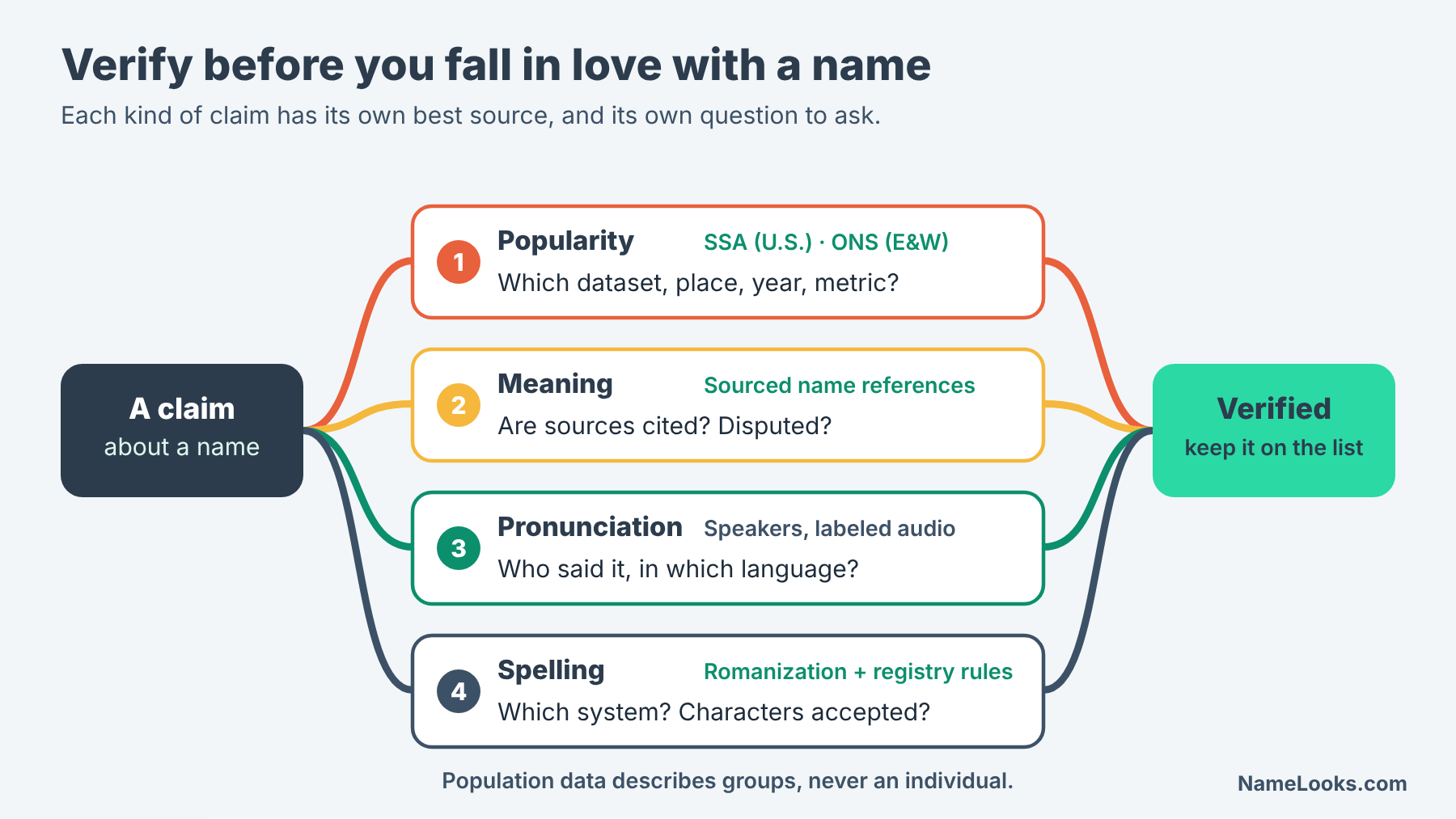
A decision-support table for the facts you’ll rely on
The table below pulls the verification stage together. For each factor, it shows where trustworthy evidence comes from, what that evidence lets you conclude, where it stops being useful, and the question worth asking yourself. It’s meant to be printed and kept next to your list.
How to read the table
Read across each row. The “limitation” column matters as much as the “evidence” column, because most naming mistakes come from stretching a good source past what it can tell you. When a row says “no dataset,” that’s not a gap in our research; it means the question is genuinely a matter of judgment.
| Naming factor | Evidence or source | Practical implication | Limitation | Question to ask |
|---|---|---|---|---|
| U.S. popularity | SSA baby-name data from Social Security card applications, 1880 onward | Shows how many U.S. babies got an exact spelling in a given year | Spellings are not merged; names under 5 occurrences are excluded; U.S. only | Do I care about this spelling, or about the spoken name across spellings? |
| England and Wales popularity | ONS baby-name statistics from birth registrations, 1996–2025 | Shows rank and count for exact spellings of first names | First name only; counts under 3 not released; excludes Scotland and Northern Ireland | Is England and Wales the community my child will actually grow up in? |
| Adult population frequency | U.S. Census Bureau 2020 Census names files | Shows how common a first or last name is across the whole U.S. population | Only names occurring 100+ times; describes populations, not individuals | Am I thinking about babies born now, or everyone my child will meet? |
| Etymology | Scholarly name dictionaries and etymological lexicons | Tells you what source words a name likely came from | Many names have disputed or multiple proposed origins | Does this source name its own sources, and does it mention disputes? |
| Pronunciation | Native speakers, pronunciation dictionaries, labeled native audio | Tells you how the name is said in its source language | English speakers may still say it differently in daily life | Which pronunciation will I correct people toward, and how often? |
| Spelling across scripts | Unicode CLDR transliteration guidance and the romanization system you choose | Clarifies that several Latin spellings can be equally valid | Different systems produce different spellings; none is the single “correct” one | Which spelling will work on documents in every country that matters to us? |
| Name structure | Unicode CLDR person-names specification | Reminds you that name order and parts vary by language | Describes formatting, not what your family should do | How will this full name be ordered and shortened in each setting? |
| Registration rules | Official government sources for your jurisdiction | Sets your deadline and which characters are accepted | Rules vary by place and change over time | What does the official source say today, for where we will register? |
| Sound and fit | No dataset; your own testing | Reveals rhythm, run-together sounds and initials | Purely a matter of judgment | Have we actually said and written the full name, many times? |
Where the table runs out
The last row is the honest one. Sound and fit have no dataset behind them, and no amount of research will turn them into facts. That’s why the table sits in Stage 4 and not at the end: verification narrows the field and protects you from false claims, but it hands the final say back to the people who will use the name every day.
Notice too that several rows point to the same habit: write down which source you used. A popularity figure without its dataset and year, or a meaning without its reference, is hard to recheck later when a relative challenges it. A short note next to each fact keeps your shortlist defensible.
When sources disagree or run out
Sometimes you’ll find two references giving different origins for the same name, or a name that doesn’t appear in either popularity dataset. Neither situation is a crisis. Both are information.
When two references disagree
If two careful sources give different origins, the honest conclusion is usually “the origin is disputed” or “there are several proposed origins.” You don’t have to resolve the dispute to choose the name. Ask whether your reason for liking it depends on one particular origin. If it does, and the origin is shaky, you may want a stronger reason. If your reason is that it was your grandmother’s name, the etymology debate doesn’t touch it.
A reference that gives a single confident meaning with no source, while others note uncertainty, is the one to trust least. Confidence isn’t evidence.
When a name isn’t in the data
A name might be absent from the SSA files because fewer than five babies in an area received that exact spelling, or absent from the ONS files because fewer than three did. Absence tells you the spelling was given rarely in that year and place. It doesn’t tell you the name is new, unknown elsewhere, or hard to use. It also doesn’t tell you anything about the people who carry it. If rarity is part of your goal, the guide to how much uniqueness you actually want explains how to think about the popular-versus-uncommon question without using the data to make claims it can’t support.
4Stage 5: Test each finalist the way it will actually be used
A name that looks lovely on a screen can trip over itself when spoken with a surname, collapse into awkward initials, or invite a nickname you hate. None of that shows up in a list. It only shows up when you use the name, which is why this is the part of how to choose a name that no list can teach. Stage 5 is about using it, deliberately, before anyone else does.
Sound, rhythm and the full name
The first name never travels alone. It’s said with a surname at every roll call, doctor’s appointment and graduation. So test it in that company.
Say the whole thing, many times, in different moods
Say the full name aloud at normal speed, then quickly, then the way you’d call it across a crowded room. Say it lovingly and say it the way you would if the child had just drawn on the wall. Listen for places where the end of one name runs into the start of the next and blurs the boundary, and for stress patterns that feel lopsided to you. Some people like a name and surname with contrasting rhythms; others like them to match. There’s no universal rule here, only what sounds right to the people who’ll say it most.
Then hand it to someone else. Ask a friend to read the full name from a card, cold, without hearing you say it first. Their first attempt is a preview of every substitute teacher, receptionist and barista your child will meet.
Initials, monograms and abbreviations
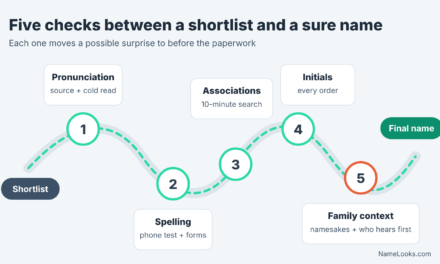
Write out the initials in every order they might appear: first-middle-last, first-last, and, if relevant, with two surnames. Check them against common words and abbreviations in every language the family uses. This takes two minutes and is the kind of thing that’s obvious in hindsight and invisible in advance. The full method for this, along with rhythm, stress and real-life use, is in our guide to testing a full name out loud.
Spelling, forms and everyday friction
A name is also a string of characters that gets typed, misheard and auto-corrected. Everyday friction isn’t a reason to reject a name you love, but it’s worth measuring before you decide how much of it you are willing to accept.
The phone test and the form test
Spell the name over the phone to someone who hasn’t seen it. Count how many letters you have to clarify. Then fill out a mock form: a paper form with a box per letter, an online form, and a name badge. Does the name fit? Do accents or apostrophes survive? Does the surname order look right?
Some friction is a fair price. A name with a diacritic that matters to your family may be worth correcting on a coffee cup for life. The point is to choose that price knowingly. If you already spend a lot of time spelling an unusual surname, you might decide you want a first name that needs no explanation, or you might decide the family is used to it and one more won’t hurt. Either is reasonable.
Nicknames you’ll get whether you want them or not
List every short form the name might produce: the obvious ones, the ones other kids might invent, and the ones that exist in other languages the family speaks. If you love the full name but dislike its most natural short form, take that seriously. You can’t fully control what friends will call your child, but you can avoid choosing a name whose most likely nickname you’d hate.
The reverse works too. Some families pick a longer formal name precisely because they love one of its short forms and want the flexibility of both. That’s a perfectly good strategy, as long as you’ve tested both versions with the surname.
Associations, timing and regret risk
The last part of testing is the hardest to do alone: catching associations you didn’t know about and imagining the name across a whole life.
Search the name and ask a few trusted people
Search the full name and the first name on its own. You’re looking for strong associations you didn’t know about: a notorious public figure, a common joke, a brand or product, a character. Most names will turn up nothing alarming. If something does turn up, decide whether it’s likely to matter in the places your child will live, and for how long. Public associations fade, and new ones appear; nobody can predict them reliably.
Then ask two or three people you trust, ideally from different generations and, if relevant, from both language communities. Ask a narrow question, “does anything about this name strike you as odd?”, rather than “do you like it?” You want information, not votes.
Picture the name at five, fifteen and fifty
Imagine the name on a preschool cubby, on a teenager’s sports jersey, on a professional email signature and on a retirement card. Not to find a name that’s “serious” or “fun” enough, but to check that it can be both, because the person will be both. If one stage makes you wince, note which one and why.
Regret about names tends to cluster around a few predictable issues: constant mispronunciation, constant misspelling, an association that surfaced late, initials nobody checked, and family friction that wasn’t addressed beforehand. Our guide to preventing name regret takes each of those in turn and shows how to check for them while you still have time to change course.
What the research on names can and can’t tell you
It’s tempting to hope that science has settled how to choose a name and can tell you which one is “best.” There’s interesting research on how people respond to names, but it’s narrower than headlines suggest, and it describes averages in specific study settings, not what will happen to your child.
The pronunciation-fluency research
One widely cited paper is Laham, Koval and Alter’s 2012 study in the Journal of Experimental Social Psychology, “The name-pronunciation effect: Why people like Mr. Smith more than Mr. Colquhoun.” Across five studies, the authors report that easy-to-pronounce names, and the people who bear them, were judged more positively than difficult-to-pronounce names. They also found that, in one real-world sample, people with easier-to-pronounce surnames held higher-status positions in law firms (see the publication record at Australian Catholic University).
How should that shape a decision? Carefully. “Easy to pronounce” depends on who’s doing the pronouncing, so the finding is about fluency for a particular audience, not about any language being better than another. It also describes average first impressions among study participants, not destiny. A reasonable takeaway is modest: if you expect a name to be mispronounced often in your community, consider how you’ll handle that, such as a clear spelling or a confident habit of teaching it. It’s not a reason to abandon a name that carries family or cultural meaning.
The fast-rise research
Another frequently cited paper is Berger and Le Mens’s 2009 article in the Proceedings of the National Academy of Sciences, “How adoption speed affects the abandonment of cultural tastes.” Analyzing more than a century of first-name data from France and the United States, the authors report that names which rose quickly in popularity tended to decline faster, and that expectant parents were more hesitant about names that had recently risen sharply (see the publication page at the Barcelona School of Economics).
The practical use is simple. If you care about a name feeling tied to a specific moment, check its trajectory in the official data for your country, not just its current rank. A name that has climbed steeply in a few years may feel more “of its time” later. Whether that’s a drawback depends entirely on you. Some families like a name that clearly belongs to its generation.
5Stage 6: Narrow the field and decide together
By now you have a long list of names with reasons attached, you’ve checked the facts that matter, and you’ve tested the strongest candidates. Stage 6 is about getting from “several good options” to “this one.” For many families, it’s also where the decision stops being a solo project.
Cut to a shortlist you can actually compare
People compare well when they have a few options side by side and compare badly when they have dozens. The goal of narrowing isn’t to find the perfect number. It’s to reach a set small enough that you can hold every name in your head at once and say clearly why each one is still there.
Cut by filters first, then by tests, then by taste
The cheapest cuts come first. Run every name against the hard filters from your brief; anything that fails goes, no debate. Next, drop names that clearly failed the real-life tests in Stage 5, such as a full name that kept tangling or initials you can’t unsee. Only then let taste do the cutting. That order matters because it keeps preference arguments for the names that genuinely deserve them.
A useful rule for the taste round: for each name, try to finish the sentence “we’d be sad to lose this one because…” If you can’t finish it, the name is probably there out of habit. The step-by-step shortlist method goes further, with rounds for cutting a long list down to five without pretending that a numerical score settles matters of taste.
How many finalists is enough?
There’s no evidence-based magic number for a final shortlist, and anyone who gives you one is offering a rule of thumb. What matters is decision quality: can you explain each finalist’s strengths and weaknesses, and are the finalists genuinely different from one another? Three nearly identical names give you less real choice than two very different ones.
If you keep adding names back after cutting them, the list may be serving as a comfort blanket rather than a tool. Our piece on how many names belong on a final shortlist explains how to judge that and when a longer or shorter list makes sense.
Deciding with a partner without a winner and a loser
When two people share a decision, naming can surface differences in taste, family loyalty and cultural expectations that neither person had to articulate before. That’s not a sign something is wrong. It’s the decision doing its job.
Agree on the process before arguing about names
Most naming fights are really process fights. One partner thinks a veto should be absolute; the other thinks it should be rare. One wants to decide early; the other wants to wait. Settle those questions first, ideally while writing the brief together. Agree on how vetoes work, whether each person gets a protected favorite, how family input will be handled, and what you’ll do if you’re still stuck at a certain date.
It helps to name the trade-off out loud. If one partner cares most about honoring family and the other about sound, a name that does both partially might beat a name that does one perfectly. The guide to choosing a name with your partner covers veto rules, turn-taking and ways to resolve differences so that neither person feels they simply lost.
Hypothetical: two partners, two short lists, one overlap problem
Imagine two partners who each independently write down their top ten names, purely as an illustration. They compare and find no overlap at all. That feels like failure, but it’s useful. Instead of fighting over individual names, they can look for what each list has in common: maybe one list is full of short names and the other full of family names. A short family name, or a family name with a short everyday form, might satisfy both.
The move here is from “your names versus my names” to “what are we each trying to protect?” That’s a question you can answer together, and the answer often points to names neither person had on their original list.
Choosing before the birth or after meeting the baby
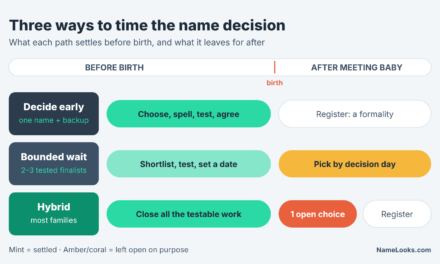
Timing is its own decision. Some families want the name settled months ahead; others want to meet the baby first. Both are legitimate. The constraints that matter are the official registration window where you live and how much uncertainty each of you can tolerate.
What the deadlines allow
In England, Wales and Northern Ireland, as mentioned above, GOV.UK sets a 42-day window to register a birth. Other jurisdictions have their own timelines and procedures, and some hospitals start paperwork shortly after delivery. Check the official source for your location so you know how much room you actually have. In the United States, for example, the SSA explains on its blog how parents can apply for a newborn’s Social Security number: parents are usually asked about it at the hospital when they provide birth-certificate information, which is one more reason to know the exact spelling you’ll use.
Waiting is also easier if you’ve done Stages 1 to 5 first. A family that arrives at the birth with two tested finalists can comfortably decide after meeting the baby. A family arriving with forty untested maybes is in a much harder spot.
A middle path: decide the shortlist early, the name late
One common compromise is to fix the shortlist before the birth and make the final choice afterward, within a deadline you both agree on. That keeps the benefit of waiting while removing the risk of panic decisions in a sleep-deprived week. For a full look at the pros and cons of each approach, see our guide to choosing a name before birth or after meeting the baby.
A script for the “we still can’t agree” moment
“Let’s each pick the one name we’d be most upset to lose, and the one name on the other person’s list we could genuinely live with. Then let’s test those two side by side, out loud, for a week.” It’s not magic, but it shifts the conversation from defending positions to testing options.
6Trade-offs: why no name wins on every dimension
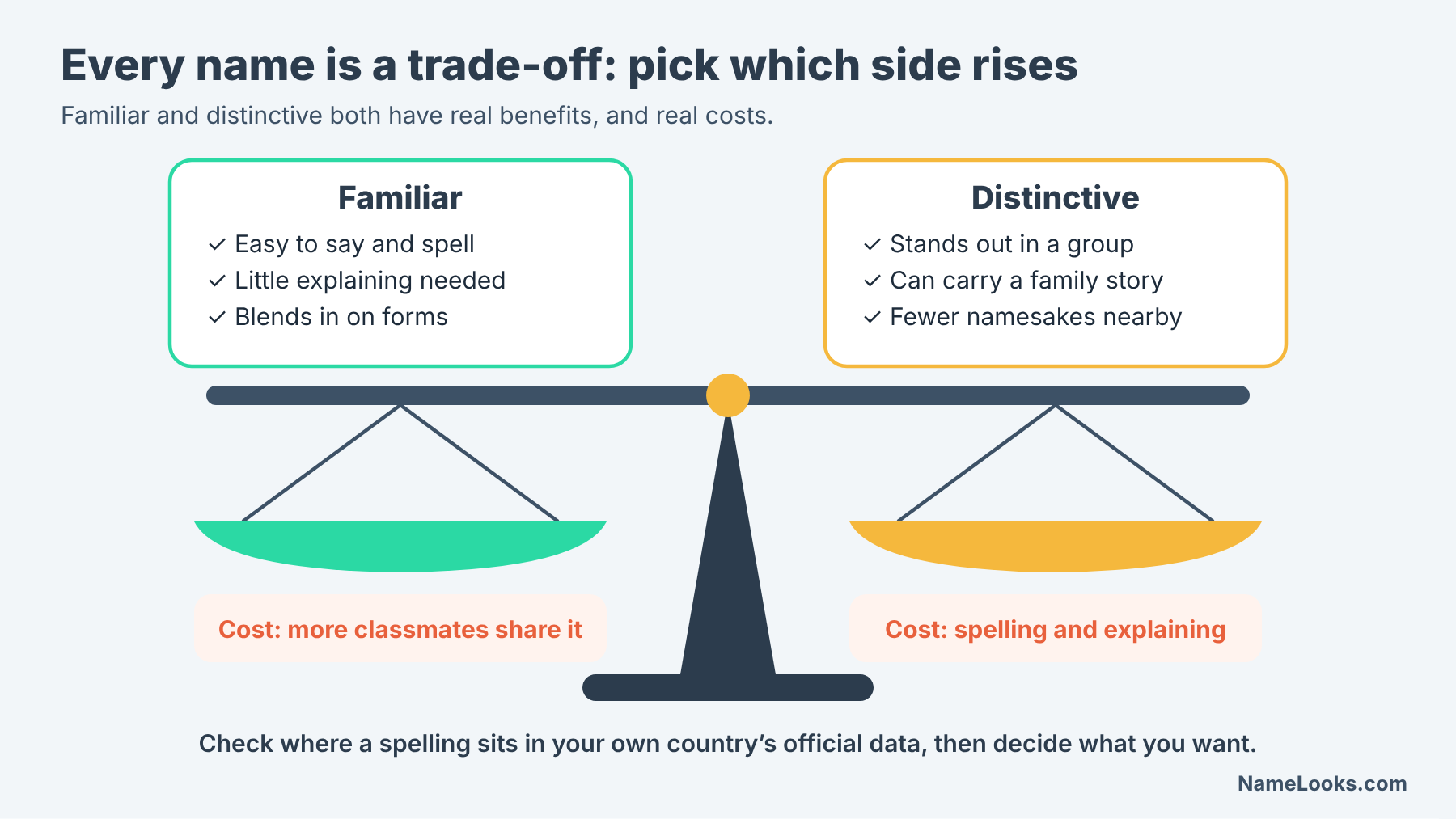
By the time you reach two or three finalists, each one will usually be strong on some dimensions and weaker on others. That’s not a flaw in your list. It’s the nature of the problem, and any honest account of how to choose a name has to admit it. A name that’s easy to spell everywhere may feel less personal; a name rich in family history may need explaining. The aim is to choose your trade-off on purpose instead of pretending you don’t have one.
The trade-offs that come up most often
A handful of tensions show up in almost every naming decision. Naming them makes them easier to discuss, especially between partners or across generations.
Familiarity versus distinctiveness
A widely used name is easy for others to say and spell, but your child may share it with classmates. A rarely used name stands out, but may need spelling and explaining. The data can tell you roughly where a specific spelling sits in your country’s recent birth records. It can’t tell you how much distinctiveness you want, or how your child will feel about it. That’s a values question, and the popular versus uncommon guide helps you answer it without overreading the numbers.
One nuance worth remembering: because both the SSA and ONS rank exact spellings separately, a spoken name can be more common than any single spelling’s rank suggests. If you’re trying to avoid sharing a name, look at the sound, not just your preferred spelling.
Heritage versus ease in the local language
Families who use more than one language often weigh a name that is natural in a heritage language against one that is effortless in the local language. Some choose a name that works in both. Some give a heritage name as the first name and teach it confidently. Some use a heritage name as a middle name. None of these is the “right” answer for a whole culture or community; families within the same community make different choices for good reasons.
What helps is deciding, together, which matters more to you and how you’ll handle the downside. If you choose the heritage name, decide in advance how you’ll teach the pronunciation. If you choose the locally easy name, decide how the heritage will be carried in other ways, perhaps through the middle name or a family nickname.
Shortcuts that feel efficient but backfire
Some common habits feel like progress but quietly make the decision worse. Recognizing them saves time.
Scoring spreadsheets that pretend taste is arithmetic
It’s tempting to rate every name from one to ten on a dozen criteria and add up the totals. Spreadsheets are useful for keeping notes and tracking which tests a name has passed. They’re less useful for producing a winner, because the weights you assign are themselves guesses, and a single total hides the trade-offs you actually need to discuss. If a spreadsheet’s winner leaves you both cold, believe your reaction, not the sum.
A better use of a spreadsheet: one column per hard filter (pass or fail), one column per real-life test (notes), and one free-text column for “why we love it.” No totals.
Outsourcing the decision to a meaning, a trend or a poll
Three other shortcuts deserve a warning. Choosing primarily on a one-word “meaning” from an unsourced site risks building the decision on a claim that may not hold up. Choosing because a name is “trending” uses a moving target as your anchor. And polling a large group of friends or relatives tends to favor the least objectionable option, which isn’t the same as the best one for your family. Each of these can be an input. None should be the decider.
Table 2: Matching naming options to real situations
The matrix below shows how different naming options play out in specific, common situations. It doesn’t recommend names. Instead, it shows the kind of option a family might consider, what it buys them, what it costs, and the verification step that keeps the decision honest.
How to use the matrix
Find the row closest to your situation and read across. If two rows describe you, read both: real families rarely fit one box. The “verification step” column is the part to act on, because it turns a general option into a decision checked against your own facts.
| Situation | Naming option | Benefit | Drawback | Verification step |
|---|---|---|---|---|
| Bilingual household | A name spelled and said the same way in both languages | No translation or respelling needed between family sides | Narrows the field considerably | Ask a fluent speaker of each language to read the written name aloud, cold |
| Strong honor tradition | Honor name in the middle slot, free choice in the first | Respects family without dictating daily use | Some relatives may expect the honor name first | Confirm with the relative who cares most before announcing |
| Long or hard-to-spell surname | A short, phonetically clear first name | Reduces total spelling burden on forms and calls | May feel plainer than other candidates | Spell the full name over the phone and count clarifications |
| Two surnames | A first name that’s brief enough to fit with both | Works on forms with limited space | Rules out longer favorites | Fill out a mock form with a box per letter |
| Name from a non-Latin script | Choose one romanization and use it consistently | Consistent records across documents | Other romanizations may be “expected” by some readers | Check how the spelling appears on your jurisdiction’s documents and records |
| Wish to avoid sharing a name | A name used rarely in recent official data | Distinctive in school and daily life | More explaining and spelling | Check the official dataset for your country, adding up all spellings of the spoken name |
| Partners with clashing tastes | A name neither had first, built from what each wanted to protect | Neither partner “loses” | Requires more conversation | Each partner states their non-negotiable in one sentence before proposing names |
| Adult choosing a new name | Use the name socially for a while before making it official | Real-world test before paperwork | Slower; some people will keep using the old name | Read the official name-change guidance for your jurisdiction |
When your situation sits between rows
Most families will recognize themselves in two or three rows at once, and the options can pull in different directions. A bilingual household with a long surname, for example, might find that the name spelled identically in both languages is also long. When rows conflict, go back to the brief and its hard filters: whichever constraint is a filter wins, and the other becomes a preference you trade off.
The matrix also leaves out one honest option: choosing a name that ignores the usual advice because it matters deeply to you. That’s allowed. Run the verification step anyway, so the cost is one you chose rather than one that surprised you.
7Stage 7: Final checks, commitment and when to reopen the question
You have a winner, or at least a front-runner. Before it goes on any document, run a short set of final checks. Then decide, explicitly, what would make you reconsider, so the doubt that sometimes follows a big decision has somewhere sensible to go.
The final checks before paperwork
The final checks are boring on purpose. They catch the kind of mistake that’s trivial to fix today and annoying to fix later.
Confirm the exact spelling and character set
Write the full name exactly as it will appear on the birth certificate or other official record, including any accents, hyphens, apostrophes and capitalization. Have both partners, if there are two of you, read it back and confirm. Check that the characters you plan to use are accepted by the registry and agencies in your jurisdiction. Rules on special characters vary by country and sometimes by agency, so look at the current official guidance; this paragraph is general guidance only.
The spelling you register is the spelling official datasets will count, the spelling schools will print and the spelling that will follow the person onto future documents. Make sure it’s the one you meant.
Run the pre-decision checklist once, all the way through
Go through every category one last time: data, family, culture, documents and everyday use. Have you checked the right popularity dataset? Has the relative who cares most heard the name? Does the spelling work across the languages that matter? Do you know the deadline? Have you said the full name aloud a hundred times? The naming checklist before you decide lays these out as a printable list so nothing slips through.
Keep a one-page record
Write down the name, the spelling, why you chose it, and any family stories attached. It takes ten minutes, and the person who carries the name may value it more than you’d expect when they’re older.
Update triggers: what should make you reconsider
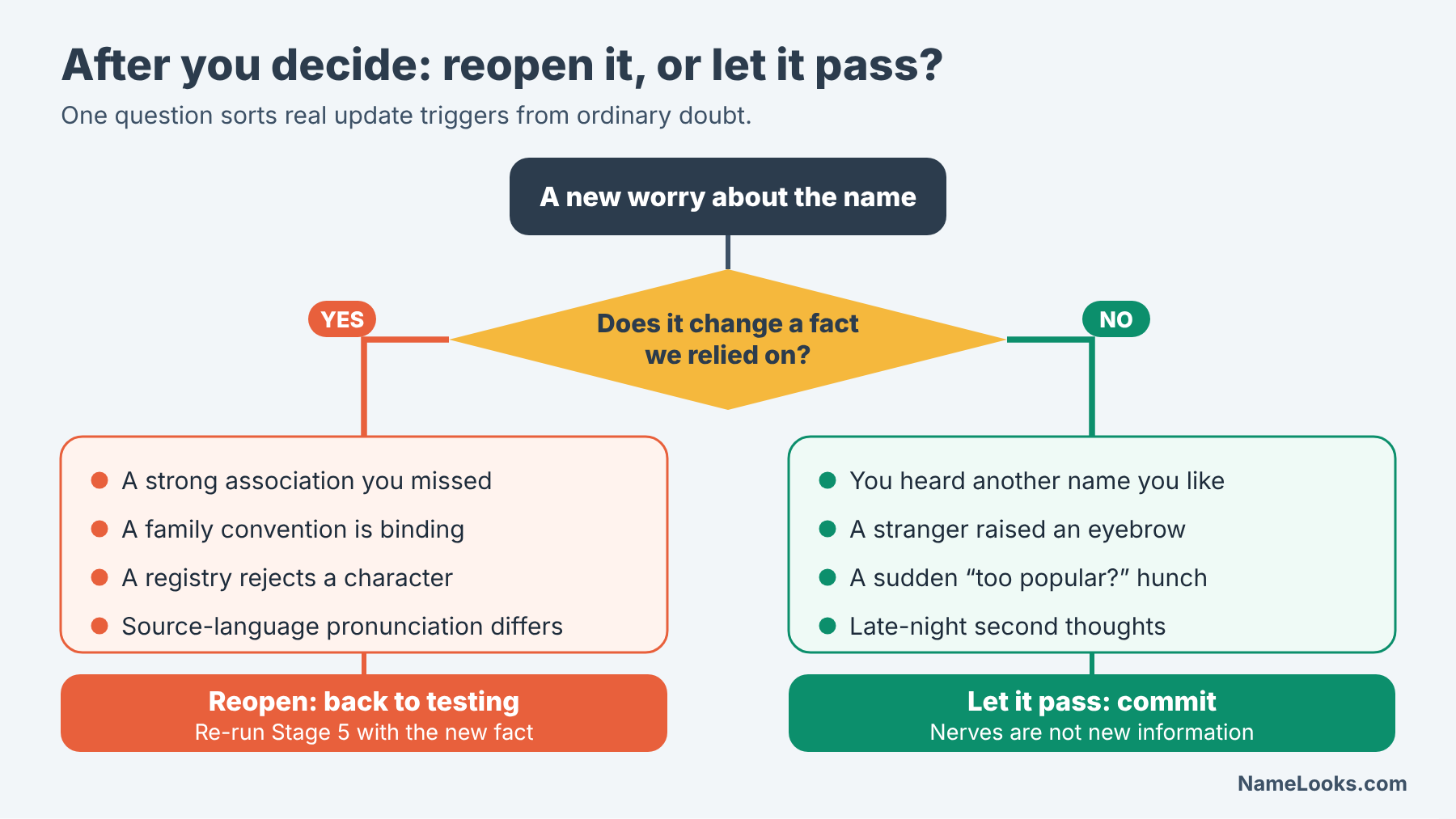
Second-guessing is common after any important choice. Most of it is just nerves. A small number of things, though, are legitimate reasons to reopen a decision, and it helps to name them in advance.
Real triggers versus ordinary doubt
Real triggers are new facts. You discover a strong association you missed, a family convention turns out to be binding after all, a registration rule rules out a character you planned to use, or you learn the name is pronounced in a way you didn’t know by speakers of its source language. Each of these changes the decision’s inputs and deserves a fresh look.
Ordinary doubt is different. Hearing a name you also like, a stranger’s raised eyebrow, or a sudden worry that it’s “too popular” or “not popular enough” are usually not new information. If you set update triggers in advance, you can check a worry against them: does this change any fact we relied on? If not, let it pass.
What the official sources say about changing a name later
If a genuine problem surfaces after registration, most jurisdictions have a procedure for changing or correcting a name, though the steps, documents and fees differ. In the United States, the SSA explains that to change the name on a Social Security card you need to provide evidence of your identity, your new legal name and the name-change event, and you may also need to prove citizenship or lawful status.
In England and Wales, GOV.UK explains how adults can change their name by deed poll, with separate guidance for children, and lists names you cannot adopt, such as ones that can’t be pronounced or that include numbers or symbols. Procedures change, so always check the current official guidance, and get qualified advice for anything unusual.
Knowing a fix exists shouldn’t make you casual about the choice. Changing a name later involves paperwork, time and explanations. But it may ease the feeling that one decision is irreversible forever.
8Putting the framework to work: a walkthrough and other naming jobs
Advice on how to choose a name is easier to trust once you’ve seen it run from start to finish. This section follows a single hypothetical family through all seven stages, then shows how the same logic adapts when the person being named is an adult, a fictional character or a pet.
A hypothetical walkthrough from brief to decision
The family below is invented for illustration. The names in it are placeholders chosen to show decision logic, not recommendations, and nothing here describes real people or real data.
Stages 1 to 4: brief, filters, candidates, facts
Picture two partners in England expecting their first child. The surname is long and is regularly misspelled. One partner’s family has a tradition of giving the first grandchild a grandparent’s name somewhere in the full name. They write a brief: one surname, English as the main language with Welsh spoken by one grandparent, an honor name required in the middle slot, a preference for first names of two syllables, and the 42-day registration window as the outer deadline.
Their filters immediately set the middle name, and the long surname nudges them toward first names that are easy to spell. They gather about sixty candidates from family records, favorite books and a Welsh-speaking grandparent’s suggestions, with a source note next to each. When they check popularity, they use the ONS data for England and Wales rather than U.S. lists, and they add up spellings for the two candidates where several exist. For the Welsh suggestions, they ask the grandparent how each one is said, rather than guessing from the spelling.
Stages 5 to 7: testing, narrowing and committing
Testing knocks out several names quickly. One produces initials they dislike once the honor middle name is added. Another runs into the surname so that the boundary between the two disappears when spoken quickly. A third has a short form one partner can’t stand. After cutting by filters, then tests, then taste, they have three finalists that are genuinely different: one familiar, one Welsh, and one rarely used in recent ONS data.
They agree a process: each names one finalist they’d be most upset to lose, they say all three aloud for a week, and they’ll decide within ten days of the birth. They also set update triggers in advance: a new association, a family objection on grounds they hadn’t heard, or a spelling problem with the registry.
When the baby arrives, they choose the Welsh name, having decided they’re happy to teach its pronunciation. They confirm the spelling, register within the window and write a one-page record of why they chose it. That’s what knowing how to choose a name looks like in practice: nothing about it was effortless, but at no point were they choosing blindly.
Adapting the framework when an adult chooses a name
Adults change their names for many reasons, including marriage, divorce, gender transition, religious conversion, reconnecting with heritage, or simply disliking the name they were given. Learning how to choose a name as an adult uses the same framework, with a few important differences.
You can test in real life before you commit
An adult can use a new name socially for weeks or months before making it official, in a way a newborn obviously can’t. That’s the most powerful test available. Use it at work if you’re comfortable, with friends, in a coffee order, in an email signature. Notice whether you respond to it, whether you like hearing it, and whether the short forms people reach for feel right.
The brief also changes. An adult’s context includes an established professional record, existing documents and people who already know the old name. Write those into the brief so the paperwork stage doesn’t surprise you.
The paperwork is more involved, and it varies
Adult name changes usually involve several agencies, each with its own procedure. In the United States, Social Security records are updated through the SSA process described above, and passports and state documents have their own procedures.
In England and Wales, the deed poll route on GOV.UK distinguishes between an unenrolled deed poll, available to people 16 and over, and an enrolled deed poll, available to people 18 and over, which puts the change on public record; GOV.UK notes some organizations may only accept the enrolled version. Requirements differ by jurisdiction and change over time. Check the official guidance for where you live, and consider qualified legal advice if your situation is complex. Nothing here is legal advice.
Adapting it for characters, pets and other naming jobs
How to choose a name for a character, a pet or a handle runs through the same seven stages, even though none of them involves a birth certificate. Only the filters and tests change.
Fictional characters
For a character, the “job” is the story: setting, period, the character’s family and how often the reader will see the name. Hard filters might include historical plausibility for the setting and avoiding names too close to other characters in the same book. The verification stage still matters: if a name is meant to signal a period or a place, check that it was actually in use there, using historical sources rather than assuming. The testing stage becomes “read the dialogue aloud” and “check that no two main characters share an initial or a sound pattern that confuses readers.”
Pets, handles and brands
For a pet, the job is mostly practical. You’ll call the name across a park, often in a hurry, so the testing stage dominates: short, clear and distinct from common commands and from the names of other people and animals in the house. For an online handle, the question of how to choose a name shifts to the screen: the brief includes the platforms you’ll use and how the handle will look in print. Availability on any platform can only be checked on that platform, and it can change at any time.
Brand names are a different discipline with legal layers that personal names don’t have. The USPTO’s trademark process overview states that registering a domain name with a registrar doesn’t give you any trademark rights, and that using a business name doesn’t necessarily qualify as trademark use. It suggests searching the USPTO database for similar marks before applying. A domain being available doesn’t mean a name is clear to use as a brand. If a brand name matters commercially, talk to a qualified trademark attorney.
Questions people actually ask
How long should it take to choose a name?
There’s no standard timeline for how to choose a name, and there’s no data showing that a longer search produces a better result. A practical approach is to work backward from your deadline: the registration window where you live, minus enough time to test your finalists properly. Many families find that the brief and filters take an evening, while gathering and testing take a few weeks of on-and-off conversation.
Should we tell family the name before the birth?
It’s a personal choice, and families handle it differently. Sharing early lets you hear objections while you can still act on them, which is useful if a family convention might apply. Keeping it private avoids unsolicited opinions. A middle path is to share only with the one or two relatives whose input you actually want, and to ask them a narrow question rather than for a vote.
Can we use popularity data from another country?
You can look at it, but it describes births in that country, not yours. The SSA covers U.S. births and the ONS covers England and Wales. Scotland and Northern Ireland publish separate statistics. If your child will grow up in one place but family lives in another, it’s reasonable to check both, as long as you label which is which.
Is it a problem if a name has no clear meaning?
No. Many widely used names have uncertain or disputed origins, and a name doesn’t need a dictionary definition to be meaningful to a family. If meaning is important to you, it can come from a person you’re honoring, a place or a story. Be wary of sites that assign a confident one-word meaning to every name without citing sources.
What if the grandparents dislike the name we chose?
First, find out whether the objection is about a real issue, such as a family convention, an association you didn’t know about, or a pronunciation problem in their language. Those are worth considering as new facts. If it’s simply taste, you can acknowledge their feelings without reopening the decision. Our partner guide’s advice on stating non-negotiables applies here too.
Do official records accept accents and other special characters?
It depends on the jurisdiction and the agency, and practice can differ between documents. Some systems store accented characters; others may simplify them. Check the current official guidance for where you’ll register the birth and for the documents you expect to need, and decide in advance how you’ll write the name when a system can’t handle the characters.
Sources and further reading
- SSA: Background information on baby-name data — how the U.S. data are collected, the five-occurrence threshold and why spellings are separate.
- SSA: Top five names by year, 1926–2025 — the quickest official check on U.S. top-ranked names by year.
- ONS: Baby names quality and methodology information — exact-spelling rules and the three-count threshold for England and Wales.
- U.S. Census Bureau: 2020 Census names files — first- and last-name frequency across the U.S. population.
- Unicode CLDR: Person names specification — how name order and parts differ across languages.
- Unicode CLDR: Transliteration guidelines — why one name can have several valid Latin spellings.
- Behind the Name: References used — a secondary index whose sources you can follow toward scholarly dictionaries.
- Laham, Koval and Alter (2012), the name-pronunciation effect — research on how pronunciation fluency affects first impressions.
- Berger and Le Mens (2009), adoption speed and abandonment — research on fast-rising names and their later decline.
- GOV.UK: Register a birth — the 42-day registration window in England, Wales and Northern Ireland.
- GOV.UK: Change your name by deed poll — the adult name-change route and naming restrictions.
- SSA: Changing the name on a Social Security card — what evidence the SSA asks for after a name change.
- USPTO: Trademark process — why domains and business names are not trademark rights.
NameLooks provides general information about names and naming decisions, not legal advice. Popularity data describes populations, not individuals, and legal or trademark specifics depend on your jurisdiction and change over time; check the official source where you live.