
Should you choose baby name before or after birth? For most families the honest answer is “both”: do the slow, testable work before the birth, and leave one small, bounded decision for the day you meet the baby. This page compares the two approaches on the things that actually differ (paperwork clocks, what a newborn’s face can and can’t tell you, family timing, and the cost of changing your mind) instead of treating it as a personality quiz.
The short version
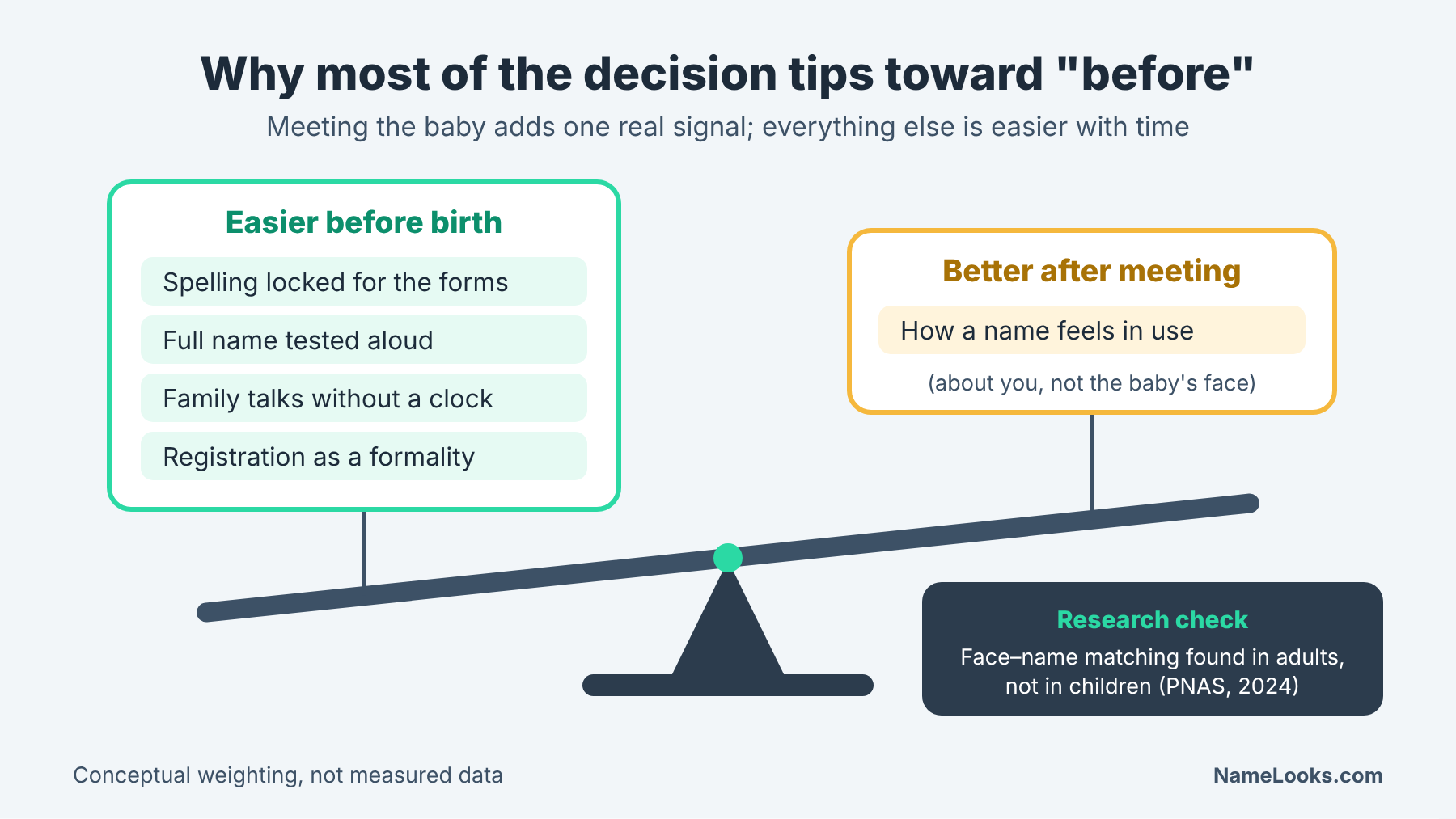
- The real choice is about what you leave open, not when you start. Spelling, full-name sound, initials and family conversations can all be settled before the birth. Only the final pick between finalists genuinely benefits from waiting.
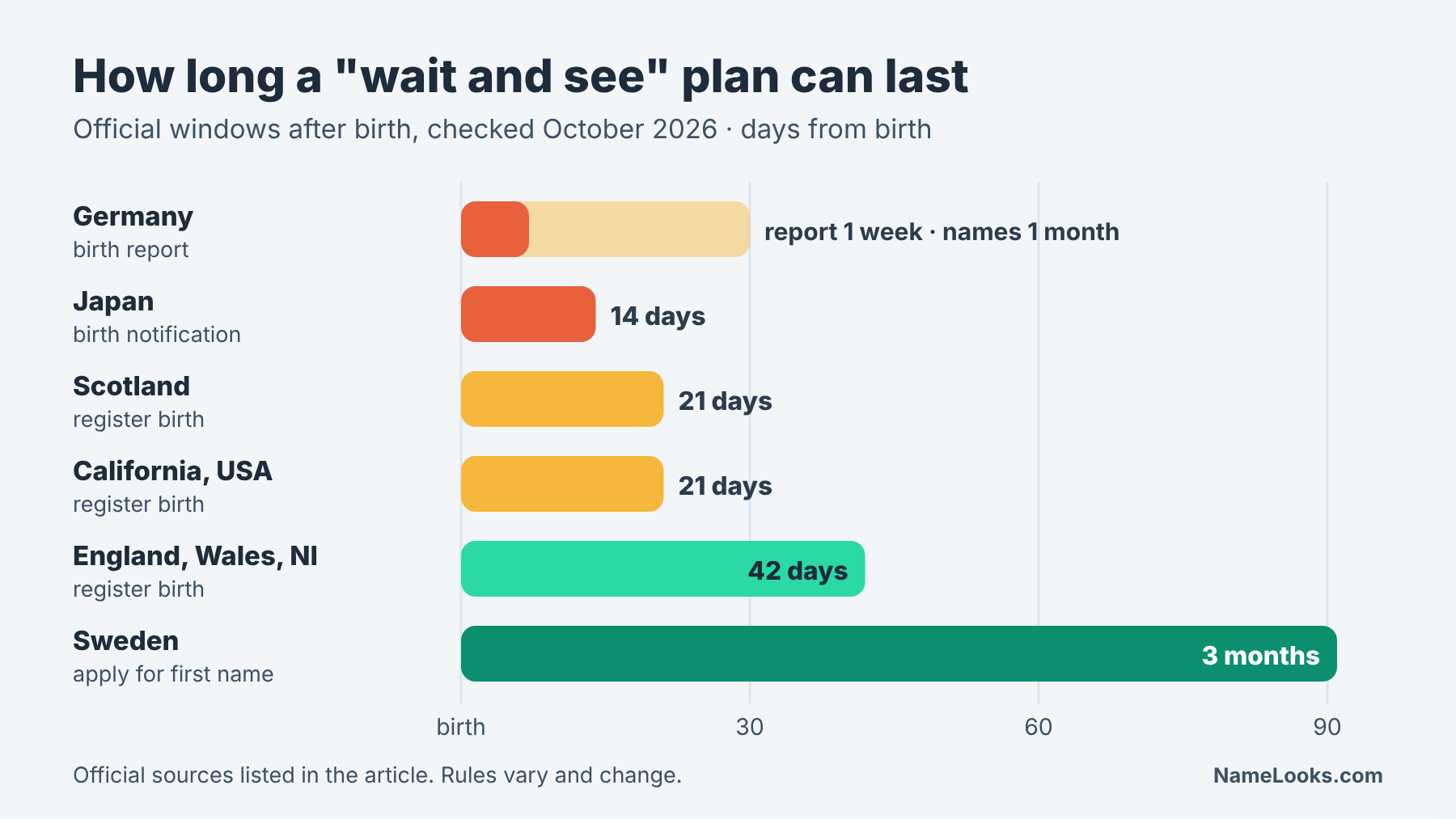
- Registration clocks are short and they vary. England, Wales and Northern Ireland allow 42 days to register a birth; Scotland allows 21. Germany expects a missing first name within a month, and Sweden gives three months to apply for one. Check your own jurisdiction.
- No study shows a newborn “looks like” a name. Research from the Hebrew University of Jerusalem found people could match adult faces to names above chance but could not do the same with children’s faces.
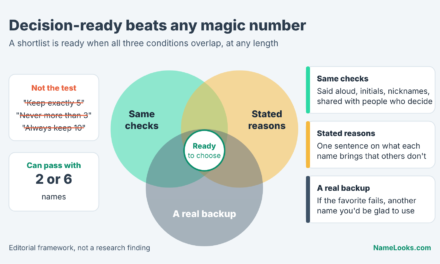
- Waiting works best with two or three finalists and a written deadline. An open list plus “we’ll know when we see them” is how families end up naming a baby in a hospital corridor at the last minute.
- Changing a registered name is possible but uneven. Some systems give a fairly easy first-year route; others treat any change as a formal amendment. That difference should shape how firmly you commit before the birth.
1When to choose baby name before or after birth: what you’re actually comparing
People frame this as two camps. One couple has a name picked by the second trimester, monogrammed on a blanket. Another couple arrives at the hospital with a shortlist and a vague promise to “see who shows up.” The framing is tidy, but it hides what’s really being compared.
Nobody names a baby from a blank page after the birth. Even the “wait and see” families have a list, and the list was built before labor started. So when people ask whether to choose baby name before or after birth, the actual question is narrower: how much of the decision do you close before the birth, and what are you hoping the first days will add?
That’s useful, because it turns a vague preference into something you can plan. If you know what you expect to learn from meeting the baby, you can check whether that expectation is realistic. If it isn’t, you can stop waiting for it. For the broader picture of how a naming decision is built, the full decision framework for choosing a name covers the stages this page assumes you’ve already started.
Option A: deciding before the birth
“Before” usually means you leave for the birth with one name agreed, spelled and tested. Some families keep a backup in reserve for a surprise (a different sex than expected, or a baby who arrives very early), but they’re not planning to deliberate in the hospital.
The appeal is obvious. You make the decision rested, with time to talk to relatives, look things up and sleep on it. The baby gets called by name from the first hour. And the paperwork, which tends to arrive faster than new parents expect, becomes a formality instead of a pressure point.
What the paperwork rewards
Birth registration is the part that quietly favors deciding early. On GOV.UK, the rule for registering a birth in England, Wales and Northern Ireland is that it must happen within 42 days of the birth, and the page lists the baby’s name, surname and sex among the things you’ll need. National Records of Scotland states that you must register a birth in Scotland within 21 days.
In the United States, birth registration is run by the states, so there’s no single national deadline. What is national is the Social Security piece. The SSA’s own Enumeration at Birth FAQ explains that parents can request a Social Security number for the baby during the birth registration process at the hospital, and the state vital statistics office then sends that registration information to SSA electronically. The FAQ, dated July 2026, gives a national average of about two weeks to process, plus up to two more weeks for the card to arrive by mail.
The practical upshot: in the hospital-birth path, the name you give on the registration paperwork tends to flow into more than one record at once. Deciding early means that moment carries no drama.
Where deciding early goes wrong
The risk of deciding early isn’t that you’ll pick the “wrong” name for the baby’s face. It’s that an early decision can harden before it’s been tested. A name chosen at twenty weeks and repeated for twenty more weeks starts to feel inevitable, and people stop checking it.
Picture a couple who settle on a first name early and only work out the middle name in the last week. Nobody says the initials aloud until a grandparent spots them on a card. That’s not a timing problem; it’s a testing problem, and it can happen on either path. The fix is to run the checks deliberately: saying the full name out loud in real situations, writing the initials, imagining the name called in a waiting room.
The other early-decision trap is social. Once a name is announced, it collects opinions. Some families find that useful feedback; others find it corrosive. If you know which kind of family you have, you’ll know whether “decided” should also mean “public.”
Option B: deciding after meeting the baby
“After” rarely means starting over. It usually means arriving with a short list, often two or three names, and deferring the final pick until you’ve held the baby for a while. Some parents want a day. Some want a week. A few want to use the full registration window.
The reasons people give are worth taking seriously, because they’re not all the same reason. Some want to see whether the baby “looks like” a particular name. Some want the name to feel like a response to a real person rather than a plan for a hypothetical one. Some simply couldn’t agree before the birth and are hoping the moment breaks the tie.
What research on faces and names does and doesn’t say
The “they’ll look like a name” idea has a real research thread behind it, and it points somewhere unexpected. In 2017, Yonat Zwebner and colleagues published “We look like our names” in the Journal of Personality and Social Psychology. Across eight studies, participants shown an unfamiliar adult face picked the person’s true name from a list at better-than-chance rates. The authors read this as a self-fulfilling prophecy: people may grow into the expectations attached to their names, partly through things they control, like hairstyle.
A 2024 follow-up in PNAS by Zwebner, Miller, Grobgeld, Goldenberg and Mayo tested the obvious next question. According to the Hebrew University’s summary of the study, both adults and children could match adult faces to names above chance, but neither group could match children’s faces to names better than chance. Machine-learning analysis found the same pattern: name-linked similarity among adults, none among children.
Two cautions. These studies used specific name sets in specific countries, and they measured matching, not whether parents choose better names after birth. Nothing here tells you which name suits your baby. What the research does suggest is that if there’s any face-name fit at all, it seems to develop over years, not show up in the delivery room.
What this means in plain terms
“Waiting to see if the baby looks like a Rose” is not a research-backed strategy. Waiting to see how a name feels when you say it to a real person is a different thing, and a perfectly legitimate reason to keep the final call open.
The version of “after” that works
The workable form of waiting is bounded. You arrive with two or three finalists, each already spelled, tested aloud with the surname and checked for initials. You agree a date by which you’ll decide, well inside your local registration window. And you agree, in advance, what happens if you still can’t choose.
That last part matters more than the others. “We’ll know” is a prediction, and it doesn’t always come true. A tie-break rule made calmly at 36 weeks is far kinder than one improvised at 3 a.m. on day four. How long that finalist list should be is its own question; how many names belong on a final shortlist walks through why two or three is often the right size for this kind of plan.
The hybrid most families end up using
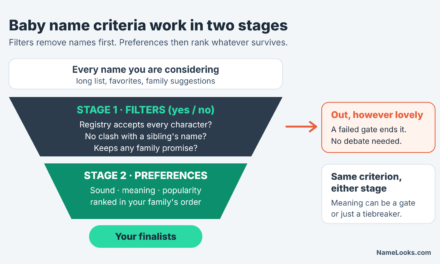
Put the two options side by side and a third one appears. You decide almost everything before the birth and reserve exactly one thing for afterward. That might be the choice between two finalists, the order of first and middle names, or which nickname you’ll actually use at home.
The hybrid has a structural advantage: every check that doesn’t need the baby gets done while you have time. The one open question is small enough to settle in a day or two, so the paperwork clock never becomes the deciding factor.
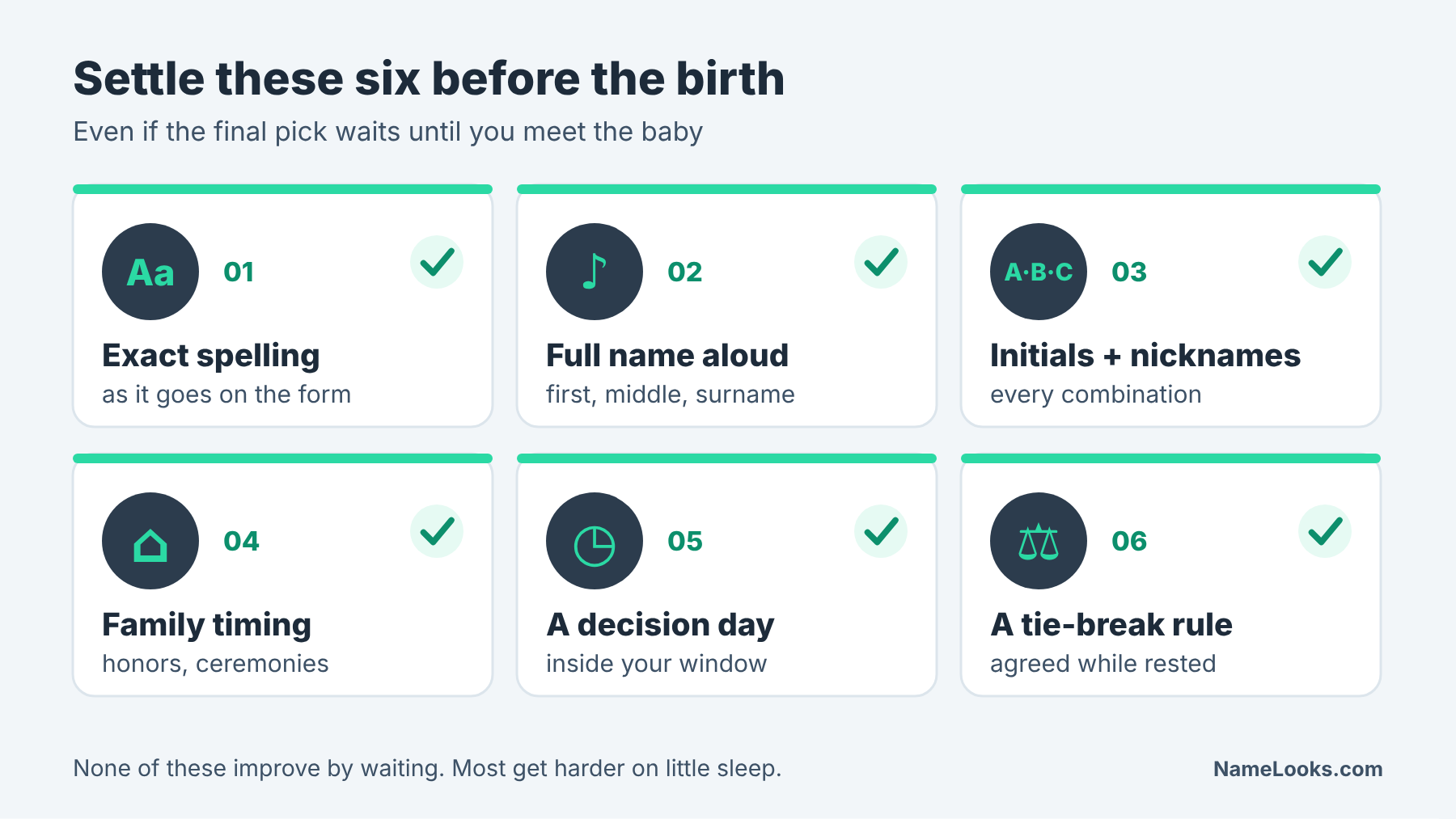
What to close before the birth, even if you plan to wait
- The exact spelling of every finalist, written the way it will appear on documents.
- Each finalist said aloud with the middle name and surname, in full and shortened.
- Initials and the obvious nicknames for each combination.
- Any family or cultural obligations, such as honoring a relative or a ceremony that sets its own timing.
- Who decides if you disagree, and by when.
None of these improve by waiting. Most of them get harder when you’re short on sleep. If you need a structured way to work through them, the pre-decision naming checklist covers data, family, culture, documents and everyday use in one pass.
What genuinely benefits from meeting the baby
Less than you’d think, but not nothing. Saying a name to a real baby, over and over, in the ordinary rhythm of feeds and diaper changes, is a test you can’t run beforehand. Some parents find one finalist suddenly feels like a costume and the other feels like a person. That’s a legitimate signal, even though it’s about you, not about the baby’s features.
The baby’s arrival can also change facts. An unexpected sex, twins, an early arrival, or a family event around the birth can shift which name feels right. Keeping one decision open gives you room to absorb that without starting from zero.
2How the two approaches really differ
A cosmetic comparison says “before is organized, after is romantic” and stops. A useful comparison asks what changes in practice: which deadlines you’re up against, what it costs to change your mind, how the name enters official records, and what the decision does to the people around you. Those differences are concrete, and they vary a lot by where the baby is born.
One note before the details. Everything below about registration and amendments is general information drawn from official pages we checked in October 2026, not legal advice. Rules change, and local offices often add their own procedures. Treat it as a map of what to ask, then confirm with the registrar or vital records office that will actually handle your baby’s birth.
Deadlines, records and the cost of changing your mind
The single most important practical difference between the two approaches is how much room your jurisdiction leaves between “the baby is here” and “the name is on a legal record.” That gap ranges from about a week to a few months, and what happens after it closes ranges from easy to genuinely bureaucratic.
What official sources say, jurisdiction by jurisdiction
Here’s what we could verify directly from government or statutory sources. It’s a sample, not a survey, and it’s chosen to show how widely the rules differ.
England, Wales, Northern Ireland
Register within 42 days of the birth (GOV.UK). In England, council registration pages describe a route to change a child’s forenames within 12 months of the original registration, by baptism or a naming certificate, for a statutory fee.
Scotland
Register within 21 days of the birth, according to National Records of Scotland and mygov.scot. Amendments go through the local registrar.
California, USA
Each live birth must be registered within 21 days (Health and Safety Code § 102400). A blank name field can be filled later with CDPH form VS 107; changing a name already listed requires a court-ordered name change.
Germany
A birth is reported within one week (§ 18 PStG). If first names can’t be given then, they must be reported within one month (§ 22 PStG).
Sweden
Guardians apply for the child’s first name within three months of the birth, per Skatteverket. Missed deadlines bring reminders and can lead to a penalty fee (vite).
Japan
The birth notification is due within 14 days of the birth, according to the Ministry of Justice (three months for births abroad).
Look at the spread. A German family gets a short, explicit window to add a first name after reporting the birth. A Swedish family has a whole season. A Californian family can technically register with a blank name field and add it later, but changing a name that’s already been entered is a court matter. Those are very different environments for a “let’s wait and see” plan.
The English route deserves a closer look, because it’s often misdescribed. Surrey County Council’s page on changing a child’s forename explains that the change must happen within 12 months of the birth registration, that the new names supersede the old ones while the original entry still shows what was first registered, and that after 12 months the new name can’t be added to the register (a deed poll is suggested instead). At the time we checked, Surrey listed the statutory fee as £44. Other councils publish their own versions of the same process, so check the one that holds your baby’s registration.
California works differently. CDPH’s Supplemental Name Report (VS 107) says a first, middle or last name may only be added to blank fields. Within a year of the birth, registering that amendment carries no fee beyond any certified copies you order; after a year, there’s a registration fee. To change a name that was already written in, the form points you to the court process.
What this means for a “wait” plan
Take the same hypothetical couple and drop them into three places. In England, if they register on day 30 with a name they later regret, they still have a defined first-year route to change the forename. In California, if they write a name on the hospital worksheet and change their minds, they’re looking at a court order; if they’d left the field blank, they could have added the name later with a supplemental report. In Sweden, they’d have three months to apply for a name in the first place.
So before you choose an approach, find out three things about your own jurisdiction:
- How long you have to register the birth, and whether the name has to be on that first registration.
- Whether a name can be added later to a blank field, and if so, until when and at what cost.
- What it takes to change a name already registered, and whether there’s an easier route in the first months or year.
If the answer to the third question is “a court,” the hospital paperwork deserves more caution than many parents give it. In the U.S., the name on that paperwork can also travel on to the Social Security record through Enumeration at Birth. Correcting a Social Security record later is possible, but the SSA’s name-change FAQ asks for evidence of identity, the new legal name, and the name change event itself. It’s paperwork you can avoid by not rushing the first entry.
A rule that varies more than people expect
“You can always change it in the first year” is true in some places and simply false in others. Don’t plan around something a friend in another state or country did. Ask the office that will register your baby.
How official name data records the decision
There’s a quieter difference that matters if you care about popularity data, or if you’re the kind of person who looks a name up in the official statistics before using it. The datasets record the name at a specific moment, and the moment isn’t the same everywhere.
SSA and ONS capture names at different points
The U.S. Social Security Administration’s background notes on its baby-name data say the names come from Social Security card applications for U.S. births, tabulated from the “First Name” field without editing. National figures cover the 50 states and D.C., and a name has to occur at least five times to be listed. The latest year on the SSA site as of October 2026 is births in 2025.
The Office for National Statistics builds its England and Wales baby-name statistics from first names recorded at birth registration. According to its quality and methodology notes, names are counted by exact spelling (not grouped), accents are removed in processing, names with fewer than three occurrences aren’t released, and revisions made after the dataset is finalised aren’t reflected. The 2025 release came out on 9 July 2026.
Why that’s relevant to timing
Neither dataset tells you anything about whether parents chose before or after birth. Nobody collects that. But they do tell you that the official record of “what this baby was called” is usually the first name entered, captured early. A forename changed months later through re-registration may never show up in the published count for that year, since ONS says post-finalisation revisions aren’t included. SSA’s notes don’t address later corrections either way.
For most families this is trivia. It matters if you’re using the data to decide how common a name is, because the numbers reflect names as first entered and spelled, not names as eventually used. Spelling variants are separate entries in both datasets. If you want to go deeper on reading these numbers well, the guide to popular versus uncommon names covers what rank and count can and can’t tell you.
The trade-offs side by side
The matrix
Here’s the comparison in one place, for anyone weighing whether to choose baby name before or after birth. It doesn’t rank names or invent statistics; it lays out where each approach tends to help and where it tends to cost you.
| Factor | Decide before birth | Decide after meeting the baby | Practical trade-off |
|---|---|---|---|
| Meaning and origin research | Time to check reputable sources and resolve disputed origins calmly | Research must be finished beforehand or squeezed into the newborn days | Waiting adds nothing here; do it early either way |
| Sound and spelling | Can be tested aloud for weeks with surname, initials and nicknames | Can be tested on the actual baby, but only after the spelling is already chosen | Spelling should be locked before birth on both paths |
| Popularity data and usage | Time to read SSA or ONS data carefully and understand rank vs count | Data doesn’t change in a week; checking it postpartum adds stress | Neutral, as long as the checking happens before the birth |
| Family and culture | Space for sensitive conversations, such as honoring a relative | Fits traditions that name at a ceremony after birth; can soften disagreement | Depends on your family’s customs and on who expects a say |
| Paperwork | Registration becomes a formality | Works only if the local window leaves room and you know the amendment rules | Short or strict windows favor deciding before |
| Emotional fit | Name has weeks to feel familiar; risk of attachment before testing | Name responds to a real person; risk of indecision or a rushed pick | Bounded waiting captures most of the benefit with less risk |
| Surprises | A single name may not suit an unexpected sex or circumstances | Absorbs surprises easily if finalists cover them | Keep a backup name even if you decide early |
What the matrix leaves out
Read down the right-hand column and a pattern shows: most rows either favor deciding early or come out neutral, provided the research and testing happen before the birth. Only two rows, family custom and emotional fit, give waiting a genuine edge, and both of those can be captured by keeping a single choice open rather than the whole decision.
What the matrix can’t show is how much each row weighs for you. A family whose tradition names at a ceremony will rightly treat that row as decisive. A couple who already disagree may find the “emotional fit” row matters less than having a tie-break agreed. Use the table to see the trade-offs, not to add up a score.
Where the before-or-after comparison breaks down
The matrix above assumes a fairly standard situation: one baby, a hospital or registered birth, two parents who both get a say, and no tradition that fixes the timing. Plenty of families don’t fit that picture, and for them the question of whether to choose baby name before or after birth either changes shape or barely applies.
When tradition sets the timing
Some religious and cultural traditions place the naming itself at a ceremony after the birth. Harvard’s Pluralism Project, for example, describes the brit milah as taking place eight days after birth, after which the baby boy formally receives his Jewish name. Families who follow a custom like this may have a civil name decided well before the ceremony, or they may keep the name private until it’s announced there. Practice varies between communities and between families, so the ceremony doesn’t tell you what any particular family does.
Other traditions consult elders, religious leaders or astrological calendars, or follow sibling-order or family naming patterns. We’re deliberately not listing customs by culture here, because no country, language or religion has one uniform rule, and a summary of “what group X does” would flatten real variation. If a tradition applies in your family, the person who knows it best is usually a relative or community leader, not an article.
The practical point is that a ceremony can create a gap between the civil record and the name as it’s used socially. If your registration deadline falls before the ceremony, you may need a name for the paperwork first. Check whether your jurisdiction lets you leave the name blank, add it later, or requires it on the first entry.
Twins, early arrivals, adoption and other exceptions
Twins and triplets turn a single decision into a set of linked ones. Names that sound fine alone may clash or rhyme when called together, and siblings will be compared for life. Most of that testing can happen before the birth, though which baby gets which name is sometimes left for the day.
A premature arrival or a stay in neonatal care can compress or stretch the timeline in ways nobody planned for. Parents in that situation sometimes want a name quickly so staff and family can use it; others feel unable to think about it at all. Neither reaction is wrong. If you were planning to decide afterward, it’s worth knowing in advance whether your registration deadline can be extended in special circumstances, since rules differ.
Adoption sits outside this comparison almost entirely. Many adopted children already have a name, sometimes one they know and answer to, and the decision is about keeping, adding to or changing it. That’s a different question with its own legal process, and the rules depend heavily on the jurisdiction and the child’s age.
3Scenarios: which approach fits which situation
Abstract trade-offs are only useful when they land on a real decision. The scenarios below are hypothetical, built to show how specific facts tip the balance one way or the other. They’re not drawn from interviews or case files, and the names are placeholders chosen for their sound, not for any meaning.
Scenario one: two finalists and a short registration window
Imagine a couple in Scotland who have narrowed things down to two names they both like, say “Isla” and “Freya” with a three-syllable surname. They’d like to meet the baby before choosing. Their registration window is 21 days, and they’ve heard that a second baby in the family often means less free time than the first.
What the facts say about this situation
Scotland’s 21-day window is half the length of England’s 42, according to the official guidance from National Records of Scotland and GOV.UK. Twenty-one days sounds like a lot until you subtract the first week, when sleep is scarce and visitors arrive, and allow time to book a registration appointment. The real decision window may be closer to ten days.
We couldn’t verify a simple national route in Scotland for changing a forename after registration that matches the English first-year process, so this couple shouldn’t assume one exists. The registrar will be able to tell them what’s possible locally.
What we’d suggest for this couple
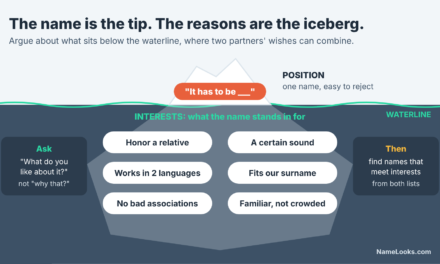
Waiting is reasonable here, but only in its bounded form. Both names are already spelled and tested with the surname, so the open question really is small. We’d suggest they set a decision day around day seven, book the registration appointment early so the date is fixed, and agree a tie-break now: perhaps whichever name they’ve found themselves using naturally by day five, or the one the partner who didn’t give birth slightly prefers, if that’s what they’d agreed. The partner conversation is its own skill; resolving naming disagreements with a partner goes through methods that don’t turn one person into the loser.
What would change our view? If either name failed a full-name test (an awkward set of initials, say, or a rhyme with the surname), the right move would be to drop it before the birth, not to hope the baby resolves it.
Scenario two: a name already chosen, and a family that wants a say
Now picture a couple in California who decided on a name early, partly to honor a grandparent. They love it. But one side of the family has strong opinions about names and has hinted that they’d like to “help” choose.
What the facts say about this situation
California’s statute requires a live birth to be registered within 21 days. Under CDPH guidance, a name left blank can be added later through a supplemental name report, but once a name is entered, changing it usually needs a court order. In the hospital path, that registration can also feed the baby’s Social Security application through Enumeration at Birth, so one entry touches several records.
That makes the first entry consequential in a way it isn’t in England, where a defined first-year change route exists. A rushed or pressured hospital decision is more expensive to undo here.
What we’d suggest for this couple
Deciding before the birth suits them, and they’ve done the hard part. The remaining question is whether to make the name public before the birth. If they expect family pressure to grow once the name is known, they might keep it private until registration is done, and then announce it as settled. “We’ve registered it” ends debates that “we’re thinking of” invites.
If instead they’d like family input, they can invite it on something genuinely open, such as the middle name or a nickname, and keep the first name off the table. Family dynamics are one of the main sources of later regret, and preventing naming regret covers how associations and family context tend to surface after the fact.
A script that helps
“We’ve chosen the first name and we’re really happy with it. We’d love your ideas for the middle name, though.” It’s warm, it’s final about the part that’s decided, and it gives people something real to contribute.
More situations, in brief
Two worked scenarios can’t cover every family, so here’s a wider sweep. Each row names the goal that seems to be driving the choice, the approach that fits it, the main reason, the main downside, and the single fact that would most likely change the answer.
Scenario table
| Chooser goal | Approach favored | Reason | Main downside | Fact that changes the choice |
|---|---|---|---|---|
| Avoid any postpartum decision | Before birth | Registration becomes routine; no decisions while exhausted | Name may harden before it’s been tested | A surprise (sex, twins) that the single name doesn’t fit |
| Name should respond to the real baby | Bounded after | Two or three finalists tested on the actual child | Risk of indecision near the deadline | A registration window too short for comfort |
| Break a deadlock between partners | Hybrid | Agree the shortlist before birth, decide between finalists after | The tie may just move to the hospital | No agreed tie-break rule |
| Honor a relative | Before birth | Time for family conversations and checking how the name will be used | Early announcement invites debate | Family custom that names at a ceremony after birth |
| Follow a post-birth naming ceremony | After (by tradition) | Timing is set by the custom, not the parents | Possible gap between civil record and ceremony | A registration deadline that falls before the ceremony |
| Keep the name private | Before, announced after | Decided calmly, revealed when settled | Relatives may feel excluded | Family members who expect to be consulted |
| Keep options open for a premature or complicated birth | Before, with backup | A name ready if staff and family need one quickly | Some parents feel it’s tempting fate | Whether local rules allow extended or later naming |
Reading the table honestly
Notice that “after” only wins outright where tradition sets the timing. Everywhere else, the strongest version of waiting is the hybrid: settle almost everything early, keep one choice open, and fence it with a date. That’s not because waiting is bad. It’s because the benefits of meeting the baby are real but narrow, and the costs of an open-ended wait land at the worst possible moment.
The fact in the last column is the one to check first. If it’s true for you, the recommended approach probably flips.
4A timeline that works whichever way you lean
Most of the advice above points to the same practical shape: front-load the testing, keep any open question small, and fence it with a date. Here’s how that looks as an actual timeline, and it holds up whether you choose baby name before or after birth. You can stop at any stage once you’ve decided; the later stages only matter if you’re keeping something open.
Before the birth: close everything that doesn’t need the baby
The months before a birth are the only period when you have time, energy and a fairly predictable schedule at once. Use them for the work that rewards patience.
Second trimester: build and cut the list
This is when the long list exists and needs pruning. The goal isn’t to pick a winner yet; it’s to get from “everything we’ve ever liked” to a handful of names you’d both be glad to use. If you’re stuck with forty favorites, the shortlist method for cutting 100 favorites to five is built for exactly this stage.
It’s also the right moment to do any research that takes time. If a name’s origin matters to you, check it in a reputable reference and note where sources disagree. If you want to know how common a name is, look it up in SSA or ONS data and note the year and whether you’re reading rank or count. If a relative’s name is in play, start that conversation now, while there’s no urgency.
For anyone unsure which of those factors to weigh, the guide to baby name criteria lays out meaning, sound, family fit, popularity, spelling and practical use as separate questions.
Third trimester: finalize spellings, test, and write down the rules
By about 30 to 36 weeks, aim to have one name decided or two or three finalists. Whichever it is, each name should be fully tested:
- Write each finalist exactly as it will appear on the registration form, including middle names, hyphens and any accented letters. Ask your registrar or vital records office whether the system accepts the characters you want.
- Say each full name aloud in ordinary situations: called across a playground, read from a waiting-room list, introduced on a phone call.
- Write the initials and the obvious nicknames for every combination, including middle names.
- Agree your decision day, comfortably inside your local registration window.
- Agree the tie-break if you’re still split on that day.
- Agree who you’ll tell, and when.
Writing the last three down sounds excessive. It isn’t. Postpartum memory is famously unreliable, and “I thought we agreed…” is not a conversation anyone wants on day five.
After the birth: make the open decision small and dated
If you’ve kept a choice open, the first days are when you use it. The aim is to let the experience of meeting the baby inform the decision without letting fatigue make it.
Days one to five: use the names, then notice
Try each finalist for real. Say it when you pick the baby up, when you talk to the baby during a feed, when you introduce the baby to a visitor. Some parents alternate names by day; others just use whichever comes out naturally and see which one keeps appearing.
What you’re listening for is your own reaction. Does one name start to feel like the baby’s name and the other like a label you’re trying on? That’s a real signal. What you’re not listening for is whether the baby “looks like” a name; the research covered earlier gives no reason to expect that signal to exist in a newborn.
Decision day: choose, register, announce
On the day you agreed, decide. If you’re still split, use the tie-break you wrote down. Then register promptly, before second thoughts have time to grow.
Announcing after registration has a useful side effect: it presents the name as settled, which tends to reduce the “are you sure?” comments. If you’ve decided to involve family earlier, that’s fine too; the point is to choose the order deliberately.
And if you miss your own decision day? Nothing breaks. Set a new one, closer to the legal deadline, and tell each other plainly what’s making the choice hard. Often it turns out the two names aren’t really tied; one partner is reluctant to give up a favorite, which is a different problem from not knowing which name fits.
If you change your mind after registering
Some parents do. A name that felt right on paper sounds wrong in daily use, or a nickname nobody predicted sticks, or a family situation changes. Regret in the first months is not unusual, and it isn’t always a sign the name was a mistake; sometimes it fades as the name becomes familiar.
Give it a few weeks before acting
New-parent doubt attaches to everything, and the name is an easy target because it’s one of the few things that feels fixable. Before starting any paperwork, live with the name for a few more weeks, and try to separate “I don’t like this name” from “I’m overwhelmed and this is the thing I can change.” If the feeling persists and has a specific cause (mispronunciation, an association you missed), it’s worth acting on.
Know which route applies where you live
If you do decide to change it, the route depends entirely on jurisdiction. In England, as covered above, councils describe a forename change within 12 months of registration. In California, a name already entered on the birth certificate generally requires a court-ordered change, while a blank field can be filled through the supplemental report. In the U.S., you would also need to update the Social Security record separately once the legal name changes; the SSA asks for evidence of identity, the new legal name and the change event.
Elsewhere, ask the office that holds the birth record. Don’t assume a rule from another country or state applies, and don’t let the paperwork alone decide whether a change is worth making. This is general information, not legal advice.
5Common mistakes on both paths
Neither approach is foolproof. Whichever way you choose baby name before or after birth, each path has a characteristic way of going wrong, and most of those failures come from skipping a step rather than choosing the wrong timing.
Mistakes families make when they decide early
Deciding early feels responsible, and it usually is. The risks are subtle because they look like diligence.
Mistaking repetition for testing
Saying a name to each other for five months makes it familiar, and familiarity feels like confirmation. But you’ve been testing it in one context: the two of you, in private, about a baby who doesn’t exist yet. Real testing means other contexts, such as a teacher reading a register, a stranger spelling it over the phone, a sibling shouting it across a park.
A good check is to ask someone outside the family to read the full name cold and say it back. If they stumble, that’s information.
Locking in a name and forgetting the backup
Even certain parents can be surprised. A prenatal prediction can turn out wrong, and some circumstances around a birth can make a planned name suddenly feel wrong. A backup name, agreed and tested, costs almost nothing and removes a potential crisis.
The backup doesn’t need to be a close second. It just needs to be a name you’d both be content with if the first one suddenly didn’t fit.
Mistakes families make when they wait
Waiting has a different failure pattern: it tends to turn a small question back into a big one under pressure.
Arriving with too many names
“We’ll decide when we meet the baby” works with two finalists. It struggles with six. A long list invites re-litigating names you’d already set aside, and every extra name adds a round of discussion on the least restful days of your life.
If you can’t get below four before the birth, that’s worth knowing early. It may mean the problem isn’t really timing but disagreement on what you’re looking for.
Letting the deadline make the choice
The worst version of waiting is the one where nobody decides and the registration appointment decides for you. The name chosen in the last hour is often just the one that’s least objectionable to whoever is most tired.
Setting your own decision day well before the legal deadline protects against this. So does making sure both of you know the actual deadline; in our checks, it’s 42 days in England, Wales and Northern Ireland, 21 in Scotland and California, and much shorter or longer elsewhere.

Questions people actually ask
Can we leave the hospital without naming the baby?
Often, yes, but what happens next depends on where you are. Hospitals usually start the registration paperwork, and some systems allow a blank name field that can be filled in later, as California’s supplemental name report does. Others expect the name at registration. Ask the hospital’s birth registration staff what your state or country requires before you’re discharged.
Is it bad luck to name a baby before it’s born?
Some families and communities hold customs about not naming or announcing a name before the birth, and others hold none at all. There’s no evidence either way on outcomes, so this is a matter of family belief and comfort rather than fact. If it matters to someone close to you, it’s a good reason to keep a decided name private until after the birth.
What if we tell everyone the name and then change it after the birth?
That’s allowed, and it happens. The practical cost is mostly social: some relatives will keep using the first name for a while. A short, warm message (“We met her and she’s a Clara, not an Ada”) usually does more than a long explanation. If you think you might switch, consider not announcing until registration.
Does the name we use at home have to match the registered name?
No. Plenty of children go by a middle name or a nickname. What matters is that the legal name, the one on the birth record and later documents, is the one you’re happy to see on passports and school forms. If you know you’ll use a middle name day to day, test that combination as carefully as the first name.
Do hospitals ever pressure parents to choose a name quickly?
Hospital staff need some way to identify the baby on records and wristbands from the first hour, which can make a name feel urgent. That identifier is a records practice, not a legal deadline. Your actual deadline is set by the registration rules of your state or country, which can be much longer than your hospital stay.
We registered the name and now regret it. How long should we wait before changing it?
There’s no research-based answer, but a few weeks of living with the name is a sensible minimum, because early doubts often fade. If a specific problem persists, check the deadline for any simpler change route where you live; in England, councils describe a 12-month window from registration. After a window closes, the process is usually more formal.
Sources and further reading
- GOV.UK: Register a birth — the 42-day registration rule for England, Wales and Northern Ireland and what you need to bring.
- National Records of Scotland: Registering a birth — the 21-day rule and how registration works in Scotland.
- Surrey County Council: Changing a child’s forename — one English council’s description of the 12-month forename change route and its fee.
- CDPH: Supplemental Name Report, Birth (VS 107) — how a name is added to blank fields on a California birth certificate.
- SSA: What is Enumeration at Birth? — how a newborn’s Social Security number is requested during birth registration.
- SSA: Changing or correcting a name on a Social Security card — the evidence needed if a name changes later.
- SSA: Background on baby name data — where the U.S. counts come from and what they exclude.
- ONS: Baby names quality and methodology information — how England and Wales name statistics are built, including spelling and revision rules.
- Zwebner et al. (2017), “We look like our names” — the original face-name matching studies with adult faces.
- Hebrew University summary of the 2024 PNAS study — why face-name matching was not found in children’s faces.
- The Pluralism Project (Harvard): Brit milah — an example of a tradition where naming happens at a ceremony after birth.
- German Civil Status Act (PStG) § 22 — the one-month rule for reporting first names not given at birth registration (§ 18 sets the one-week birth report).
- Skatteverket: Applying for a name for a newborn (Swedish) — the three-month window in Sweden.
- Japan Ministry of Justice: Birth notification (Japanese) — the 14-day notification period.
- California Health and Safety Code § 102400 (via Justia) — the 21-day registration rule; confirm against the official legislature site.
NameLooks provides general information, not legal advice. Registration deadlines and name-change procedures depend on jurisdiction and change over time, so confirm details with your local registrar or vital records office; popularity data describes populations, not individual children.