
Most advice on baby name shortlist size hands you a number: keep three, keep five, never more than ten. This page argues for a different test. The right size is however many names you can genuinely evaluate side by side, and that number shifts with your timeline, your partner, and how far your testing has gone. You’ll get a way to tell whether your list is too loose, too tight, or ready, plus the research people quote on this topic, read carefully and with its limits stated plainly.
The short version
- No study has measured the ideal number of names on a baby-name shortlist. Anyone quoting one is borrowing from research on jam, chocolate and memory tasks, or making it up.
- A better target is a decision-ready list: every name has passed the same checks, each one is there for a reason you can say out loud, and losing your favorite to a failed check wouldn’t leave you with nothing.
- Count idea-families, not entries. Three spellings of one name are one name plus a spelling decision. Your list is often smaller than it looks.
- Too long shows up as untested names and rankings that flip every day. Too short shows up as a single name carrying risks nobody has checked.
- Choice-overload research is real but mixed. A 2010 meta-analysis found an average effect close to zero, and a 2015 one found effects that depend on specific conditions. Use it as a caution, not a rule.
1The short answer: the right shortlist is the one you can actually test
If you came here for a number, here’s the honest version. For many families, a list that is genuinely ready for a decision ends up holding somewhere between two and five names. That range is our editorial observation of how the logic tends to play out. It is not a finding from any study, and it is not a target to hit.
The reason we resist the number is simple. A shortlist is a tool for comparison, and comparison only works when every option has been through the same checks. Five untested names are a weaker shortlist than two tested ones. Two names that are really the same idea in different spellings are, in practice, a shortlist of one.
So the useful question about baby name shortlist size isn’t “how many?” It’s “how many can we compare well, right now, with the testing we’ve done?” That answer changes as you work. Early on it might be eight. A week before the birth it might be three. It can even go up again if every finalist fails the same check.
What people often assume about a “correct” number
Ask around and you’ll hear confident numbers. Three, because it’s easy to hold in your head. Five, because it sounds disciplined but not harsh. Ten, because it feels safe before the baby arrives. Each of these has a little logic behind it, and none of them is wrong for every family. The trouble is treating any of them as the goal rather than a byproduct of good work.
Where the magic numbers come from
Most of the popular numbers trace back to two sources, usually secondhand. The first is a 1956 paper by the psychologist George Miller with the memorable title “The Magical Number Seven, Plus or Minus Two.” The second is a grocery-store experiment from 2000 in which shoppers saw either 6 or 24 jams. Both get cited as proof that people can only handle a handful of options.
We look at what each study actually measured in the next section. The short version: Miller was studying absolute judgment and immediate memory, not decisions, and he himself suspected the recurring seven might be coincidence. The jam study is real but has a complicated replication record. Neither one was about choosing a name for a child.
The third source is plain convenience. Lists of three or five look tidy in a notes app. That’s a fine reason to aim for a short list once your testing is done. It’s a poor reason to cut a name you haven’t evaluated yet.
Why a fixed number fails in both directions
A fixed cap pushes you to cut early. Picture a couple who agree on “five finalists” in month four, then discover in month seven that two of the five share initials with a sibling and one is hard for a grandparent to say. They now have two names left and a feeling that they’ve been rushed. The cap didn’t protect them from overload. It just made them stop testing sooner.
A fixed floor does the opposite damage. “We should keep at least ten, just in case” sounds cautious. In practice it can become a way to avoid hard conversations, because nobody ever has to say “I don’t want that name.” Ten names you never compare closely are not a safety net. They’re an unmade decision dressed up as a list.
What both mistakes share is that they put the number in charge. The number should report on the state of your decision, the way a thermometer reports on a room. You don’t fix a cold room by repainting the thermometer.
Our working answer: a decision-ready shortlist
We use the term decision-ready for a list that is done being explored and is ready to be chosen from. The phrase is ours, not a term from the research. It describes a state of the list, and that state can be reached with two names or with six.
If you want the broader process around this stage, from first brainstorm to final signature, our full decision framework for choosing a name covers it. This page stays on one question: how big the final list should be when you’re close.
The test: same checks, stated reasons, a real backup
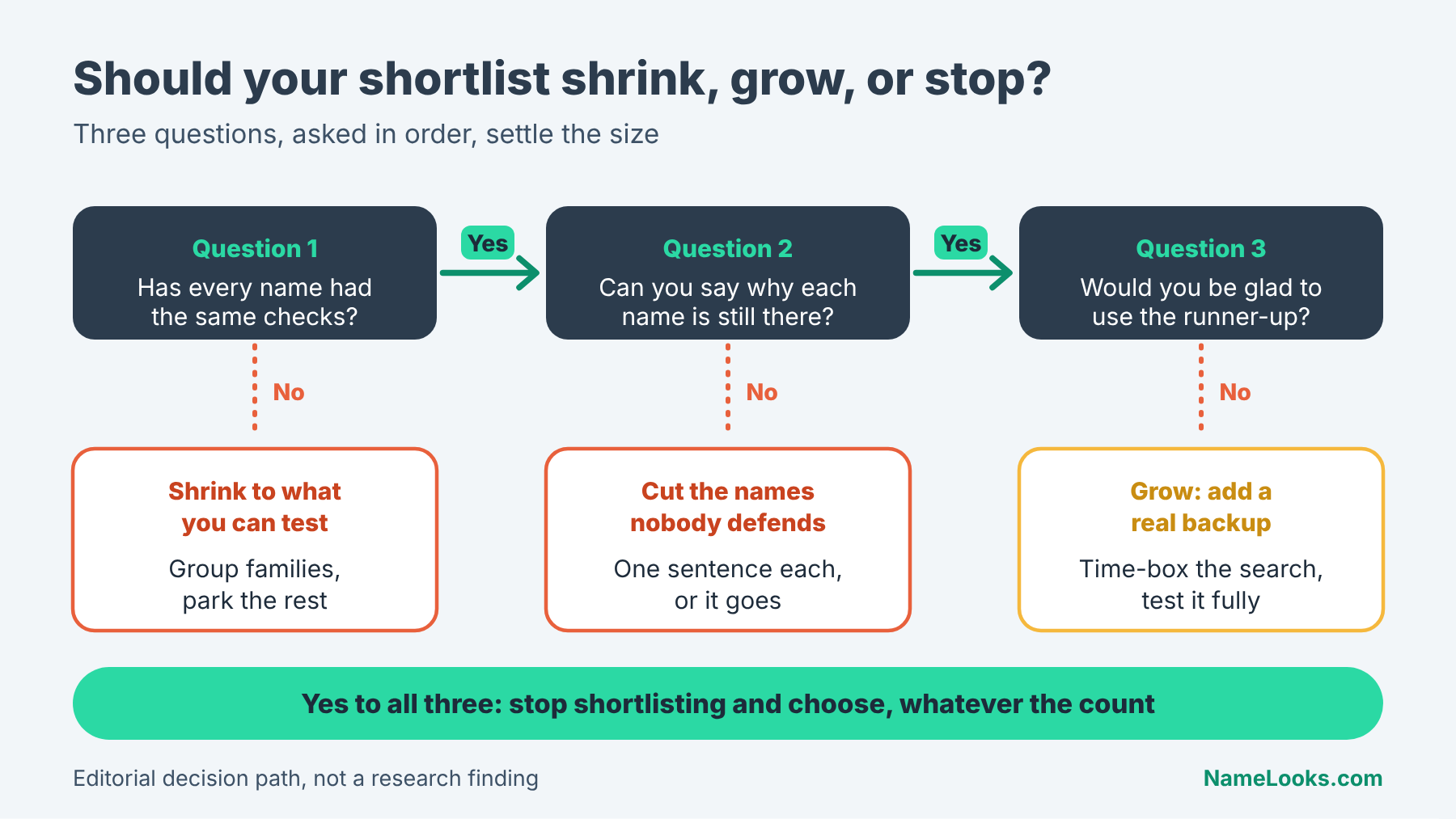
A list is decision-ready when three things are true at once. First, every name on it has passed the same checks: you’ve said each one aloud with the surname, looked at the initials, thought about nicknames, and run it past anyone who has a real stake. Second, you can say in one sentence what each name brings that the others don’t. Third, if your current favorite failed a check tomorrow, there would still be at least one name you’d be glad to use.
Notice that none of these conditions mentions a number. A list of two can pass all three. A list of seven can fail all three. That’s the point.
Fact vs. suggestion
The three-part test above is an editorial framework, built from reasoning about how comparisons work. It hasn’t been validated by a study, because nobody has studied baby-name shortlists this way. Treat it as a structured way to think, and adapt it if your situation calls for something different.
Typical ranges, as a result rather than a target
When families apply that test honestly, lists tend to settle into a small range. Here is how we’d describe the common shapes, as reasoning rather than data.
One name means the decision may already be made, or it may mean nobody has stress-tested it yet. Two or three names usually means real alternatives that have been compared closely. Four or five names can be fine if each is distinct and tested, but often signals that some comparing is still to come.
Beyond that, a list is typically still in the exploring stage, which is a perfectly good stage to be in, as long as you don’t mistake it for the end.
If your list is longer than that and you need a way to bring it down without arbitrary point scores, our method for cutting a long list to a final five walks through the cutting itself. The rest of this article is about knowing when you’ve cut enough, and when you’ve cut too much.
2What the research actually says about how many options people can handle
Articles about baby name shortlist size love to cite psychology. Some of that research is solid and relevant. Some of it gets stretched well past what it measured. Here we go through the studies people mention most, describe what each one did, and say where it stops being useful for naming a child.
A ground rule for this section: we only describe studies we read in this session, through the original paper, the publisher’s abstract, or an author-hosted copy. Where we could only read an abstract, we say so.
Choice overload: the jam study and what came after
“Choice overload” is the idea that a bigger set of options can make people less likely to choose, or less happy with what they chose. It’s a real research topic with a real debate behind it. The debate matters more for your shortlist than the headline does.
The 2000 study everyone quotes
Sheena Iyengar and Mark Lepper published “When Choice Is Demotivating: Can One Desire Too Much of a Good Thing?” in the Journal of Personality and Social Psychology in 2000 (volume 79, pages 995–1006). It reported three studies. In the best-known one, a tasting table at an upscale grocery store showed either 6 or 24 jams. More shoppers stopped at the larger display, but a much smaller share of them went on to buy. As the 2010 meta-analysis described below summarizes it, about 30% of shoppers who saw six jams bought with the coupon, versus 3% of those who saw 24.
The other two studies used extra-credit essay topics (6 versus 30) and chocolates (6 versus 30). In the chocolate study, people enjoyed choosing from the larger set more but were less satisfied with what they picked. We could not open the full original paper in this session, so we’re relying on the 2010 meta-analysis and published summaries for these details, not on the paper’s own tables.
What the meta-analyses found
A decade later, Benjamin Scheibehenne, Rainer Greifeneder and Peter Todd pulled together the available experiments in a meta-analysis published in the Journal of Consumer Research (2010, volume 37, pages 409–425). It covered 63 conditions from 50 experiments with 5,036 participants. The average effect of offering more options was close to zero (d = 0.02), with a lot of variation between studies. The authors also found that people with prior preferences or expertise tended to benefit from more options, not fewer.
In 2015, Alexander Chernev, Ulf Böckenholt and Joseph Goodman published a second meta-analysis in the Journal of Consumer Psychology, covering 99 observations (N = 7,202). They found that assortment size does matter, but through four moderators: how complex the choice set is, how difficult the decision task is, how uncertain people are about their preferences, and whether they’re mainly trying to minimize effort. Their conclusion runs against the “virtually zero” headline of 2010, which tells you something on its own: careful researchers reading similar evidence still disagree about how strong this effect is.
Where this research stops fitting
Almost all of these experiments involved small, low-stakes choices: jam, chocolate, pens, magazines, music. The 2010 authors note that the options were often hedonic with “few long-term consequences.” The typical small set averaged about seven options and the typical large set about 34. Nobody in these studies was choosing a name that another person will carry for life, usually with a partner, over months. The findings can suggest which conditions make choosing harder. They can’t hand you a number.
Memory limits: Miller’s seven and Cowan’s four
The second strand of research people borrow is about working memory: how many things you can hold in mind at once. This one is even further from naming decisions, but it shows up constantly, so it’s worth getting right.
What Miller actually measured
George Miller’s 1956 paper in Psychological Review, “The Magical Number Seven, Plus or Minus Two,” reviewed experiments on absolute judgment (telling apart tones or other stimuli on a single dimension) and on immediate memory span. He also showed that grouping items into “chunks” lets people get around those limits. And he was openly skeptical of his own title. After discussing the recurring sevens, he said he would withhold judgment and suspected it was “only a pernicious, Pythagorean coincidence.”
So a list of “seven names, because the brain can hold seven things” misreads the source twice. Miller wasn’t studying decisions, and he didn’t think seven was a magic quantity.
The later estimate, and why it doesn’t settle anything for you
In 2001, Nelson Cowan argued in Behavioral and Brain Sciences that when rehearsal and chunking are prevented, adult short-term memory holds about four chunks on average, with individuals ranging roughly from two to six. Cowan himself presents this as debated, with competing theories in play.
You might be tempted to say “four, then.” But a shortlist isn’t held in memory. It’s written on a phone, a fridge, a piece of paper. You can look at it whenever you want. What working-memory research hints at, by our reasoning, is narrower: comparing many names at the same moment, in conversation, without the list in front of you, gets harder as the list grows. That’s an argument for doing comparisons in pairs or small groups, not for capping the list itself.

What nobody has measured
This is the part most articles skip. As far as we could find in this session, there is no published study on the optimal baby name shortlist size. We searched for one. Absence of evidence isn’t proof, and a study may exist that we missed, but we couldn’t locate anything that measures it.
No naming-specific study, so we argue from reasoning
That means everything practical in this article, including the decision-ready test and the ranges above, is editorial reasoning. We built it from what the research suggests about conditions that make choosing harder, plus the structure of the naming problem itself. We label it that way throughout, and you should weigh it that way too.
We’d rather tell you that plainly than borrow authority from a jam table. A confident-sounding “studies show five is optimal” would be easier to write. It would also be invented.
What the name datasets can and can’t tell you here
Official name data doesn’t speak to shortlist size directly either. The SSA’s background notes for its baby-name data say the U.S. figures come from Social Security card applications for U.S. births after 1879, that names with fewer than five occurrences are excluded, and that different spellings of similar names aren’t combined. The SSA’s own example is Caitlin and Kaitlyn, which get separate ranks.
For England and Wales, the ONS released its 2025 baby names on 9 July 2026, with ranks and counts based on birth registrations and a dataset covering 1996 to 2025. These sources tell you how often names were given. They say nothing about how many names parents considered. That spelling rule, though, turns out to matter for how you count your own list, which we come back to in the next section.
| Claim people make | Source | Setting and year | What was measured | Limitation | Editorial takeaway |
|---|---|---|---|---|---|
| “Too many choices make people stop choosing” | Iyengar & Lepper, JPSP | U.S. grocery store and classroom, 2000 | Purchases and essay completion with 6 vs 24 or 30 options | Low-stakes choices; replication record is mixed | Plausible caution, not a rule for names |
| “Choice overload is a reliable effect” | Scheibehenne, Greifeneder & Todd, JCR | Meta-analysis of 50 experiments, 2010 | Average effect of larger assortments | Mean effect near zero, high variation | The effect depends on conditions, so the conditions matter more than the count |
| “More options hurt under certain conditions” | Chernev, Böckenholt & Goodman, JCP | Meta-analysis, 99 observations, 2015 | Moderators of assortment size | Consumer products, not life decisions | Complexity, difficulty and unclear preferences are the risk factors to manage |
| “People can only hold seven things in mind” | Miller, Psychological Review | Lab tasks, 1956 | Absolute judgment, memory span, chunking | Not about decisions; author doubted the “seven” | Don’t use as a cap on list length |
| “The real limit is four” | Cowan, BBS | Review, 2001 | Short-term memory with chunking blocked | Debated; written lists aren’t held in memory | Compare names in pairs or small groups, not all at once |
| “Spelling variants are different names” | SSA background notes | U.S. births, data as of March 2026 | Rank and count by exact spelling | Describes populations, not your choices | Count spelling variants as one idea plus a spelling decision |
3What changes the right shortlist size for your family
If the research can’t give you a number for baby name shortlist size, your circumstances can at least tell you which direction to lean. Several factors push the right size up or down, and they often pull against each other. None of them is a rule. They’re the confounders, the reasons two sensible families can end up with very different list lengths and both be right.
Timing, partners, family and stage of testing
The biggest influences on baby name shortlist size aren’t psychological. They’re practical: how much time you have, how many people have a real say, and how much testing has already happened.
Time left and how much testing is done
A list’s length should roughly track how much testing it has had. Early, untested names are cheap to keep, because you haven’t invested in comparing them. Late in the process, every name you carry costs real effort: another round of saying it aloud, another conversation with family, another check of initials and nicknames.
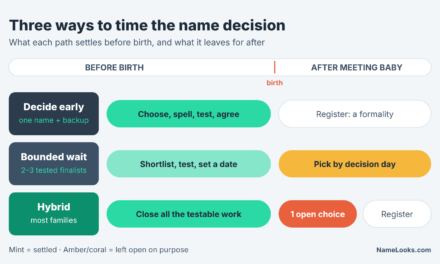
Some families also plan to wait and meet the baby before deciding. That’s a legitimate choice with its own trade-offs, which our piece on deciding before birth or after meeting the baby works through. For list size, the implication is narrow. If you’re deciding afterward, you’ll want a slightly roomier list going in, because you’re adding a new input you can’t test in advance. But every name on it should still be fully checked before the due date. The hours after a birth are a bad time to discover an unfortunate set of initials.
Two deciders, or more
When two people share the decision, the list does two jobs at once. It holds names, and it holds a negotiation. That tends to make lists longer, because each person may keep names partly as markers of what they care about.
That isn’t wrong, but it’s worth seeing clearly. A shared list often needs a stage where each person can veto without explaining, followed by a stage where reasons get discussed. Our guide to choosing a name with your partner without a winner and a loser goes deeper on that process. Here the takeaway is that a shared list being longer isn’t automatically a problem. A shared list where neither person can say why each name is still there is.
Some families also include grandparents, elders or religious advisers in the decision, or follow naming customs where a name is chosen or announced at a particular ceremony or by a particular person. Practices vary widely between and within cultures and faiths, so we won’t generalize about any of them. The practical point is that if someone else will choose from your list or approve it, the list’s size and contents are partly a question of respect for that process, not only of decision efficiency.
Counting the list honestly
Before you worry about whether your list is too long, check how you’re counting it. Many lists are shorter than they look, and a few are longer.
Idea-families, not entries
Remember the SSA rule above: Caitlin and Kaitlyn are separate entries in the national data. That’s correct for counting births. For your shortlist, though, those two entries usually represent one idea with a spelling still to choose. The same goes for a full form and its common short form, or a name and a closely related variant.
We suggest grouping your list into idea-families: clusters of names that share a sound, a source, or a reason you like them. A list of nine entries might turn out to be four families. That’s a very different decision than nine distinct names. Once you see the families, you can make two smaller choices in sequence: which idea, then which form.

Middle names and combinations
Combinations quietly multiply a list. Three first names and three middle names are not six options. They’re up to nine full names, and each one sounds different with your surname. If you’re comparing combinations, count the combinations you’re actually considering, not the pieces.
A practical move: settle the first name first, then build middle-name options around the winner. Comparing every first-and-middle pairing at once is exactly the kind of complex, effortful comparison the 2015 meta-analysis flagged as a risk condition. Testing how each finalist sounds as a complete name is its own skill, which our guide to testing a full name out loud covers in detail.
Why a single rank or anecdote can mislead
Two kinds of evidence distort shortlist decisions more than any other: one-off stories and one-off numbers. Both feel concrete, which is exactly why they’re persuasive.
The friend who picked from two
You’ll hear things like “we only ever had two names and it was easy.” Maybe it was. But a single story tells you nothing about how their two names were chosen, how much comparing happened before the list got that short, or whether they’d have been happier with more options. We don’t have survey data on how shortlist size relates to parents’ satisfaction, and as far as we can tell, nobody else does either.
If someone’s experience resonates, borrow the method, not the number. Ask what they did to get there. “We each wrote our top three privately and only kept names on both lists” is a reusable idea. “We had two” isn’t.
One year’s rank, one spelling’s count
Popularity data often enters shortlist decisions through a single rank. “It’s in the top 20, so it’s out.” The problem is that a rank is one number for one spelling, in one country, in one year. In the SSA data, spelling variants are ranked separately, so a name spread across several spellings can look less common than the sound actually is in classrooms. Rank also isn’t count, and count isn’t share of births.
Whether that matters to you is a separate question, and our article on how much uniqueness you actually want deals with it properly. For list size, the lesson is to avoid using a quick rank glance as a cutting tool. If popularity is a real criterion for you, check every finalist the same way, with the same dataset and year, so the comparison is fair.
| Stage | Typical form of the list | What should change | Caveat | Implication for size |
|---|---|---|---|---|
| Exploring | Loose collection, many idea-families | New names still come in | Nothing tested yet | Size doesn’t matter much; don’t cap it |
| Grouping | Entries clustered into families | Variants merged into one idea | Spelling choices postponed, not dropped | The real count often falls sharply |
| Testing | One representative per family | Each name gets the same checks | Testing takes time per name | Keep only what you can test properly |
| Comparing | Finalists side by side | Pairwise choices, stated reasons | Preferences can flip for a while | Small enough to compare in pairs |
| Decision-ready | Tested finalists plus a real backup | No new names unless one fails | Meeting the baby can still shift things | Often two to five, by our reasoning |
Situations that change the math
A few circumstances change what “decision-ready” has to mean, and so change the baby name shortlist size you can realistically manage. They don’t call for a different method, just a different idea of what each name has to survive.
Twins, siblings and names that must work as a set
When you’re naming twins, or naming a child who will be introduced alongside older siblings, each name gets tested twice: on its own and as part of a pair or group. That changes the counting. Two shortlists of three names each don’t give you six options. They give you up to nine pairings, and some of those pairings will clash in ways neither name does alone, like shared initials, a rhyme, or two names that sound too similar shouted across a park.
By our reasoning, the practical move is to test pairings, not names, once you’re close. Keep a short list of pairings you’d be happy with, and make sure there’s a backup pairing, not just a backup name. If one name in your favorite pair fails, you may need to replace both, not just the one that failed.
Two languages, two scripts, or two countries
Families who live between languages often need a name to work in more than one setting: on documents in one country, spoken by relatives in another, written in more than one script. Each extra setting is another check, and that means each name takes longer to test. A shortlist that’s “only three names” can be a lot of work if each name has to be checked for spelling, pronunciation and transliteration in two systems.
We can’t generalize about how any particular language or culture handles this, because practices vary so much. The structural point holds anyway: the more settings a name has to work in, the fewer names you can test properly in the time you have. Transliteration, the process of writing a name in another script, can produce different spellings depending on which romanization system is used. The Unicode CLDR transliteration guidelines explain why there’s rarely one correct answer. That is worth knowing before you assume a name will look the same on every document.
4A baby name shortlist size check: too long, too short, or ready?
Here’s where the reasoning becomes a tool. Instead of asking whether your list hits a number, check it for symptoms. A list that’s too long and a list that’s too short fail in recognizable ways, and both are fixable.
Everything in this section is editorial guidance. It’s built from the research conditions described above (complexity, task difficulty, unclear preferences) and from the structure of the naming problem. It’s not drawn from studies of parents.
Signs the list is still too long
A list is too long when it’s bigger than your testing. Length on its own isn’t the problem. Untested length is. That’s why we think of baby name shortlist size as a measure of progress rather than a goal.
Symptoms you can notice this week
- Names you haven’t said aloud with the surname. If any finalist has only ever existed on a screen, it hasn’t been compared yet.
- Rankings that flip daily. Some movement is normal. If your top choice changes every time you look, you may be comparing too many things at once.
- “Placeholder” names. Names nobody would actually choose, kept because cutting them feels rude or final.
- Conversations that loop. You keep revisiting the whole list rather than settling any part of it.
- One partner has stopped engaging. When the list is overwhelming, the less invested person often checks out, and the list becomes one person’s project.
None of these, alone, proves the list is too long. Two or three together usually do. The 2015 meta-analysis found that difficulty and preference uncertainty make larger sets harder to choose from. A flipping ranking is a sign of both.
A worked scenario: eleven names, four ideas
Imagine a couple with eleven names on a shared note, two months before a due date. On paper, that’s a long list. When they group it into idea-families, they find three spellings of one name, a full form and two short forms of another, two names that share an opening sound and a reason, and four genuinely separate ideas. That’s seven families, and two of the four “separate” ideas turn out to be names one partner added months ago and no longer cares about.
After one honest pass, they’re holding five idea-families. They pick one representative form for each and test those five properly over two weeks. That’s not a cut made to hit a number. It’s what the list looked like once they counted it honestly.
Signs the list is too short
Short lists get less attention because they feel decisive. Most conversations about baby name shortlist size worry only about lists that are too big. But a list can be shorter than its testing, too. That shows up as a single name carrying risks nobody has checked.
When one name is carrying too much weight
If you have one name and you love it, that may be fine. The question is whether you love it because it’s passed every check or because nothing has challenged it yet. A few signals that a one-name list is fragile:
- You haven’t checked the initials, or how it sounds with every name it will sit beside.
- Someone with a real stake hasn’t heard it yet, and you’re a little nervous about telling them.
- You’ve avoided looking up how common it is, or what it might be associated with, because you don’t want to know.
- Thinking about the name failing makes you feel panicked rather than disappointed.
The last one is the most telling. A list with a real backup lets you test your favorite without fear. Our guide to preventing name regret covers the specific checks: pronunciation, spelling, associations, initials and family context. Running them is easier when losing the favorite wouldn’t leave you with nothing.
The backup test
Here’s a quick self-check we use. Imagine your top name is suddenly unusable, for a reason you can’t argue with. Now look at the rest of your list. Is there a name there you’d be genuinely glad to use, not just willing to settle for?
If yes, your list has a real backup, whatever its length. If no, the list is effectively one name long, even if it has five entries. In that case, it’s worth adding back, or reopening the search briefly, before you commit. A deliberate backup is not a lack of conviction. It’s what lets conviction be tested.

How to resize without starting over
Once you know which way you’re off, the fix is usually smaller than people expect. You don’t need a new process. You need one or two specific moves.
Shrinking a list that’s grown past your testing
- Group into idea-families. Merge spellings and forms of the same idea. Postpone the spelling choice; don’t lose it.
- Name the reason for each family. One sentence each. If nobody can say why a name is there, it’s a candidate to drop.
- Run the same first check on all of them. Saying each with the surname is a good first pass. Drop names that clearly fail.
- Compare in pairs, not all at once. Pick two names and choose between them, then bring in the next. Pairwise comparison keeps each decision small, which is exactly the opposite of the complex comparisons the research flags as harder.
- Stop when the list matches your testing. If you have time to properly test four names before the birth, four is your list. That’s your number, found from your situation rather than borrowed.
These steps cover the stage where the list is already fairly short. If you’re facing a hundred favorites, start with the fuller cutting process in our shortlist method, then come back here once you’re near the end.
Growing a list that’s too thin
Adding names late can feel like going backward. It isn’t, as long as you add with intention. A few ways to do it without reopening the floodgates:
- Add from the same family. If your one name has a related form you’d also be glad to use, that may be the simplest backup.
- Add from what you already rejected. Names that were cut for weak reasons (“too long,” “I wasn’t sure”) can come back for a proper test.
- Set a time box. Give yourselves a weekend to find one or two serious candidates, not an open-ended new search.
- Test new arrivals to the same standard. A late addition that skips the checks just recreates the original problem.
A useful phrase if you’re the one asking to add: “I’m not doubting our favorite. I want us to be choosing it, not stuck with it.” That framing makes the backup about protecting the decision, not undermining it.
5Turning the evidence into a final decision
You now have the research on baby name shortlist size, its limits, and a way to check your list. This last section pulls those together into the takeaways we’d actually stand behind, and is honest about what stays subjective no matter how carefully you work.
The takeaways we’d defend
These are the conclusions we think the evidence and the reasoning support. Each one is labeled for what it is.
What the evidence supports
From the research we read: choice overload is not a universal law. The 2010 meta-analysis found an average effect near zero. The 2015 meta-analysis found real effects that appear under specific conditions, including complex option sets, hard decision tasks and unclear preferences. The 2010 authors also found that people with clear prior preferences tend to benefit from more options.
From the memory research: Miller’s “seven” was never about decisions, and he doubted its significance. Cowan’s estimate of about four chunks applies when chunking and rehearsal are blocked, a condition that doesn’t describe looking at a written list.
From the name datasets: SSA ranks spelling variants separately, so a single entry in the data isn’t a single idea on your list. National ranks and counts describe populations in a given country and year. They don’t tell you how many names you should consider.
What we suggest, as editorial judgment
Based on that, here is what we’d suggest. Treat these as reasoning, not findings.
- Manage the conditions, not the count. Reduce complexity (group into idea-families), reduce task difficulty (compare in pairs) and reduce preference uncertainty (state why each name is there). These map onto the moderators the 2015 research identified.
- Let testing set the size. Your list should be no bigger than what you can test properly in the time you have.
- Always keep a real backup. A list that collapses when the favorite fails isn’t finished.
- Expect a small range near the end. In our reasoning, the baby name shortlist size that works at the decision-ready stage is often two to five names. If yours holds more and passes the decision-ready test, it’s ready. If it holds fewer and passes, that’s fine too.
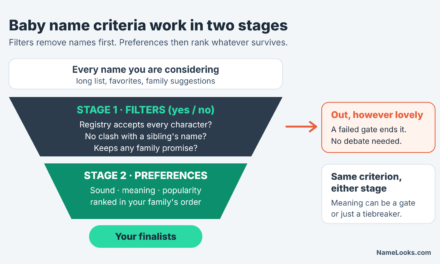
For a broader set of checks before you sign the paperwork, including family, culture, documents and everyday use, our pre-decision naming checklist is the natural final step. And if you want to revisit which criteria should matter most in the first place, see our guide to baby name criteria.
What stays subjective, and how to live with it
Some parts of this decision won’t yield to analysis, and pretending they will usually makes things worse. Here’s what we think stays genuinely open.
Tolerance for an open question
People differ in how comfortable they are with an undecided choice. Some feel calmer with three tested options right up to the birth. Others feel anxious until one name is settled, even months early. Neither is more rational. The research on maximizing versus satisficing exists, but we didn’t review it for this piece, so we won’t make claims about it here.
What we can say from reasoning: if an open list keeps you up at night, it may be worth reaching a decision earlier, with a named backup, and simply living with that choice for a while. If an early decision would feel like a door closing too soon, a small tested list is a reasonable place to stay. Your list size can reflect your temperament without that being a flaw.
When “we just knew” is the right call
Sometimes a family looks at two tested names and one simply feels right. That isn’t a failure of method. If the name has passed the checks, choosing it on feeling is completely legitimate. Analysis is there to clear away avoidable problems, not to override a preference you hold for good reasons.
The one thing we’d watch for is “we just knew” arriving before the checks rather than after. Feeling right about an untested name is enthusiasm. Feeling right about a tested one is a decision. If you want help structuring the rest of the process, the NameLooks decision framework lays out how this stage fits with everything before and after it.
A sentence you can use
If you’re stuck in a debate about whether your list is the “right” size, try saying: “Let’s not worry about the number. Can we each say why every name on here is still here, and would we both be glad to use the one in second place?” If the answer is yes, you’re done shortlisting. If not, you know what to work on next.
Questions people actually ask
Is it a bad sign if we still have ten names a month before the due date?
Not necessarily. Check whether those ten are really ten ideas or a few idea-families with variants. If they’re distinct and you haven’t tested most of them, the issue is time, not count. Pick the ones you can test properly in the weeks left and park the rest; parked names can return if your finalists fail.
Should we each keep a separate shortlist, or one shared list?
Many couples find it useful to start separate and merge later, because a private list lets each person say what they like without negotiating in real time. Once you merge, keep a record of who added what. That isn’t about scorekeeping. It helps you see which names have genuine support from both of you and which are one person’s hope.
Do middle names count toward our baby name shortlist size?
Usually not. It’s easier to choose the first name, then build a short list of middle names around it. Middle names have different jobs, often honoring someone or smoothing the rhythm of the full name, so they’re tested differently. Keeping them on a separate, later list stops combinations from multiplying your main list.
Can a shortlist be too short if we’re both certain?
Certainty and a short list are fine together, as long as the name has been checked. The risk is certainty arriving before the checks. If you’ve said the full name aloud, looked at initials, considered nicknames and shared it with people who matter to you, a list of one is simply a decision.
Is there research showing parents regret names more when they had more options?
We couldn’t find any study that links shortlist size to later name regret, and we didn’t want to guess. The chocolate study from 2000 found lower satisfaction after choosing from a larger set, but it involved chocolate, not names, and the wider research on choice overload is mixed. Treat any claim that “more options means more regret” for baby names as unproven.
What if a relative adds names to our list?
That depends on your family’s customs and who has a say. If a relative has a real role in the decision, their suggestions belong on the list and should be tested like any other. If they don’t, you can thank them, note the name, and keep it out of the decision-ready list. Being clear about who decides tends to prevent more friction than it causes.
Sources and further reading
- Scheibehenne, Greifeneder & Todd (2010), Journal of Consumer Research — meta-analysis of choice overload; useful for its near-zero average and its discussion of when the effect might appear.
- Chernev, Böckenholt & Goodman (2015), Journal of Consumer Psychology — later meta-analysis identifying four moderators of choice overload.
- Miller (1956), Psychological Review, via Cogprints — the original “magical number seven” paper, worth reading for what it does and doesn’t claim.
- Cowan (2001), Behavioral and Brain Sciences — the argument for a short-term memory capacity of about four chunks, with the competing views.
- SSA baby names background notes — how U.S. name data is compiled, including the five-occurrence threshold and separate spellings.
- ONS: Baby names in England and Wales, 2025 — the July 2026 release of rankings and counts.
- ONS dataset: baby names 1996 to 2025 — long-run ranks and counts for England and Wales.
- Unicode CLDR transliteration guidelines — why a name can be romanized in more than one valid way.
NameLooks provides general information, not professional advice. Popularity data describes populations, not individuals, and any official or legal naming requirements depend on your jurisdiction.