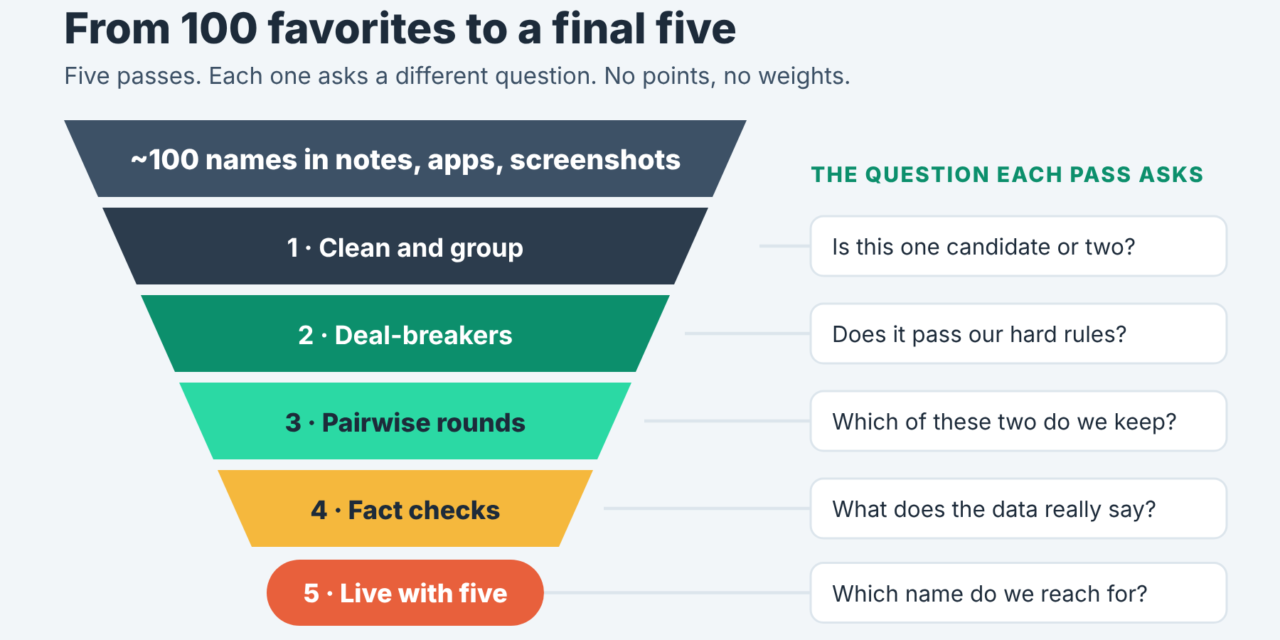
A list of 100 baby names you like doesn’t mean you’ve failed to decide. It means you’re ready for a method. This baby name shortlist method gets you from 100 favorites to a final five in five passes, without a points spreadsheet. Every cut needs a reason you can say out loud, and every reason is either a fact you checked or a judgment you openly own.
The short version
- Write the rules before you cut. Deal-breakers, grouping rules for spellings, and what counts as “one candidate” should be on paper before any name leaves the list.
- Cut with reasons, not points. A name leaves when you can finish the sentence “We’re cutting this because…” with something specific. Totals and weights hide the reasons you’d actually use.
- Compare in pairs. Two names side by side is a question people can answer. Ranking forty names at once is not.
- Keep facts and taste in separate columns. SSA and ONS data can tell you how many babies got a spelling in a given year and place. They can’t tell you whether a name is “too popular” for you.
- Write down the method’s limits. Honor names, family languages, and names the datasets don’t cover need their own handling, and the numbers go stale every spring or summer.
1How the baby name shortlist method works: five passes, no points
Here’s the whole thing before the detail. You run the list through five passes, and each pass asks a different kind of question. The early passes are about tidying and about you. The later ones are about the name out in the world, with real data and real people.
- Clean the list. Merge duplicates, decide how spelling variants and sibling pairs count, and note where each name came from. Nothing is judged yet.
- Apply deal-breakers. Run the hard rules you wrote in advance. A name either passes or it doesn’t. No “mostly passes.”
- Compare in pairs. Put two survivors side by side and keep the one you’d rather say every day for years. Record a one-sentence reason for each cut.
- Check what can be checked. Look up the exact spelling in the right dataset, test the full name out loud, and turn vague worries into questions with answers.
- Live with five. Use the final five in ordinary life for a week or two. Watch which ones you reach for and which ones you start explaining away.
Nothing in that sequence asks you to give “flow” a 7 out of 10, and that’s what separates a baby name shortlist method from a scoring sheet. That’s deliberate. If you want the broader picture first, the full decision framework for choosing a name covers where shortlisting fits among the other naming decisions. This page is only about the cutting.
Why a points spreadsheet feels rigorous and isn’t
The scoring sheet is the default advice for big lists, and it’s the thing any baby name shortlist method has to beat. It’s easy to see why it’s popular. Columns feel fair. Numbers feel neutral. A total at the bottom seems to settle arguments before they start.
The trouble is what goes into those numbers. Most naming scorecards ask you to rate fuzzy qualities like “sound,” “meaning,” or “uniqueness” on a 1–10 scale, then multiply by weights you also invented. The arithmetic is exact. The inputs are guesses.
Weights are guesses wearing decimals
Say you decide sound is worth 30% and family connection 20%. Where did those figures come from? Usually from a few seconds of gut feeling on a Tuesday night. Shift each weight by five points and the ranking can reshuffle, which means the “winner” was partly a product of your weighting mood.
There’s a second problem. Ratings drift. The fortieth name you score gets judged against the thirty-nine before it, not against a fixed standard. Names rated early and names rated late aren’t on the same scale, even though the spreadsheet treats them as if they were.
Totals hide the reason you’d actually cut a name
A total of 71 versus 68 tells you nothing about why. Maybe one name lost three points on “uniqueness” when the real issue was that your partner can’t stand it. The spreadsheet buried the one fact that mattered under a pile of small ones that didn’t.
Real naming decisions often turn on a single decisive reason: it clashes with the surname, a close relative already has it, it’s hard to say in a language the family speaks at home. A compensatory score lets a big pile of minor positives outvote one real deal-breaker. That’s the opposite of how most families end up deciding.
When numbers are fine
Counting isn’t the enemy. Counting how many babies got a spelling, from an official dataset, is useful. What we’re steering you away from is turning taste into pseudo-measurements and then trusting the sum more than your own stated reasons.
The five passes at a glance
In this baby name shortlist method, each pass has one job, and the order matters. If you start pairwise comparisons before agreeing on how spelling variants count, you’ll argue about whether two spellings of the same name are one candidate or two. That argument belongs in pass one.
Passes one and two: cleaning and deal-breakers
Pass one is clerical. You’re turning a messy pile from notes apps, screenshots and conversations into a clean list where every line is one candidate. Usually it shrinks noticeably, just through duplicates and agreed groupings.
Pass two is the first real cut, and it’s the most efficient one. Decision researchers call this pattern elimination by aspects. Amos Tversky described it in 1972 as removing options that fail an important attribute, then moving to the next attribute (a plain summary of elimination by aspects cites the original in Psychological Review, volume 79). For names it works well because your deal-breakers are usually few and clear.
Passes three to five: comparison, checks, living with it
Pass three is pairwise comparison, where the real narrowing happens. It’s slower per name, but by this point the list is short enough to handle that. Pass four is fact-checking: data lookups, the full-name test, spelling and pronunciation questions you can actually answer.
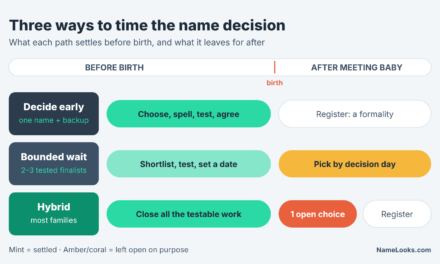
Pass five isn’t a cut, strictly. It’s a trial. You live with five names for a short stretch and notice your own behavior. Some families finish the decision there; others carry five names to the birth and decide after meeting the baby. Both are legitimate, and choosing before birth versus after meeting the baby covers that timing question in depth.
What the research on choice can and can’t promise
You’ll see “choice overload” invoked to argue that 100 names is “too many.” The research is more interesting, and less tidy, than that slogan.
The jam study and what came after
The famous version comes from Sheena Iyengar and Mark Lepper’s 2000 paper in the Journal of Personality and Social Psychology. In one field study, a grocery-store tasting booth offered either 24 or 6 jams. The bigger display drew more shoppers to stop, 60% versus 40%. But about 30% of people who saw six jams bought one, compared with 3% of those who saw twenty-four (Iyengar and Lepper, 2000).
Later work complicated the story. A 2010 meta-analysis by Benjamin Scheibehenne, Rainer Greifeneder and Peter Todd pooled 63 conditions from 50 experiments, with 5,036 participants. It found “a mean effect size of virtually zero but considerable variance between studies” (Journal of Consumer Research, 2010). In other words, more options sometimes hurt, sometimes didn’t, and sometimes helped.
Why that matters for a list of 100
A 2015 review by Alexander Chernev, Ulf Böckenholt and Joseph Goodman identified four factors that shape when overload shows up: choice set complexity, decision task difficulty, preference uncertainty, and decision goal (Kellogg School summary of the review). Picking a name ticks several of those boxes at once. It’s a hard, high-stakes task, and many parents start out unsure what they even prefer.
So our editorial read, not a research finding: the number 100 isn’t the problem. An unstructured 100 is. A clear sequence of passes cuts complexity and forces your preferences into the open. That’s the bet this baby name shortlist method makes. For how small the final list should end up, we’ve written separately on how many names belong on a final shortlist. The short answer there is “it depends on decision quality,” and five is a sensible default here, not a law.
2Define the rules before the first name leaves the list
Most shortlist fights aren’t about names. They’re about rules nobody stated. One person thinks two spellings are the same candidate; the other thinks they’re two. One person sees “Grandpa’s middle name” as a must-keep; the other sees it as one option among many. Settle the rules first and the cutting gets almost boring, in a good way. Every baby name shortlist method that works starts here.
This section covers the inputs (where the names came from and which sources you’ll trust for what) and the grouping rules (how you’ll count spellings, variants and related forms). Write both down. A shared note is plenty.
Your inputs: where the 100 names came from
A long list is usually a mix of sources: names you’ve loved for years, names from family, names spotted on a playground roster or in credits, names suggested by apps, and names that turned up while scrolling ranking tables. Those inputs aren’t equal, and knowing where a name came from changes how you test it.
Which dataset answers which question
When a pass needs a fact, use the source that measures that fact. For U.S. births, the Social Security Administration’s baby names data is the standard. Its background notes say the names come from Social Security card applications for U.S. births after 1879. National figures cover the 50 states and the District of Columbia, with territories reported separately.
For England and Wales, the Office for National Statistics publishes ranks and counts for boys’ and girls’ names from birth registrations. Its most recent release, Baby names in England and Wales: 2025, came out on 9 July 2026. The ONS dataset from 1996 to 2025 lets you follow a spelling across three decades.
The U.S. Census Bureau’s 2020 Census names files answer a different question. They count first and last names across the whole enumerated population, not just babies born in one year. The tabulations include names that occur 100 or more times in 2020 Census returns. That’s useful if you want to know how common a name is among adults your child will grow up around, not just among newborns.
None of these is a meaning or origin source. For etymology, a secondary index such as Behind the Name’s published reference list at least shows which dictionaries and lexicons sit behind its entries. Even then, cross-check anything that matters to you, and treat disputed origins as disputed.
Tag each name with its origin story
Before cutting, add a short tag to every name: family, long-held favorite, partner’s pick, found while browsing, suggested by someone else. It takes ten minutes and pays off twice.
First, it shows you whose list this is. If 70 of 100 names are “found while browsing,” the list may reflect whatever ranking table you scrolled most, not settled taste. Second, it lets you treat certain names gently. A family name may deserve a conversation before it’s cut, even if it would lose a straight pairwise contest. Tagging makes that exception visible instead of letting it quietly bend the rules.
A clean list, line by line
One line per candidate, then three short fields: the exact spelling you’d put on a birth certificate, the origin tag, and who added it. If you’re choosing with a partner, the “who added it” column stops a lot of quiet resentment later.
Grouping rules: spellings, variants and sibling sets
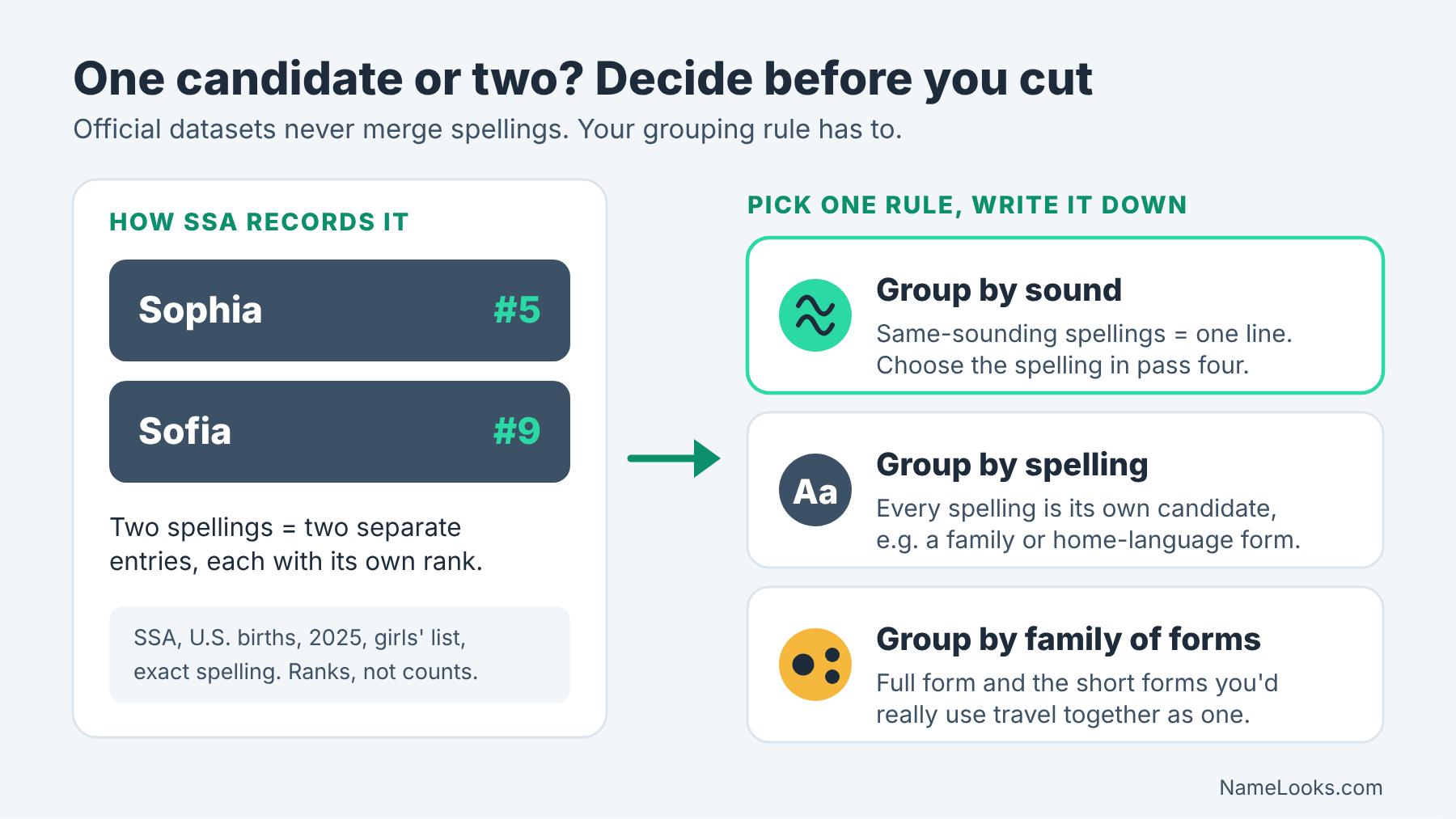
Here’s where a list of 100 often turns out to be 80. People write down three spellings of what feels like one name, plus a short form and a longer form. Whether those count as one candidate or several is your call. But it has to be one call, made once, before the cutting starts.
How the official datasets handle spelling
The datasets don’t group spellings for you, and that’s a feature, not a flaw. SSA’s background page says it plainly: “Different spellings of similar names are not combined.” Each spelling carries its own rank and count. Its rankings are also done separately by sex, so the same spelling can rank differently on the boys’ and girls’ lists.
SSA also removes some detail for privacy. It excludes names with fewer than 5 occurrences in any geographic area, and it tabulates only given names at least 2 characters long, with spaces and hyphens removed. A hyphenated double name is stored as one run-together string.
The ONS ranks exact spellings too. Press coverage of its 2025 release reported that similar names with different spellings are counted separately. If you’re wondering how “popular” a name is across all its spellings, neither office will add those up for you. Any combined figure you see elsewhere is somebody’s own grouping choice.
Writing your own grouping rule
Pick one of three rules and write it at the top of your list:
- Group by sound. Spellings that sound the same to you count as one candidate. You decide the spelling later, in pass four.
- Group by spelling. Every spelling is its own candidate. That makes sense when the spelling itself is part of the appeal, such as a family spelling or one tied to a language you speak.
- Group by family of forms. A full name and its usual short forms travel together as one candidate, because you’d use them interchangeably.
Group by sound is the easiest default for most families. It keeps spelling from cluttering the early passes. The exception is a family spelling or a form tied to a particular language or script. Keep those separate, because “the same name, spelled our way” is a reason in its own right.
One more rule worth deciding now: if you’re also choosing a middle name, are you shortlisting first names alone or full combinations? We suggest first names first. Combinations multiply fast. Ten first names and ten middles make a hundred pairings, and you’ll want testing the full name out loud to happen in pass four, on survivors only.
Deal-breakers you can apply without arguing
A deal-breaker is a rule a name must pass, full stop. The test of a good one: two people applying it to the same name would reach the same answer. “Must sound nice” fails that test. “Must not share a first name with a living first cousin” passes.
Hard rules versus soft preferences
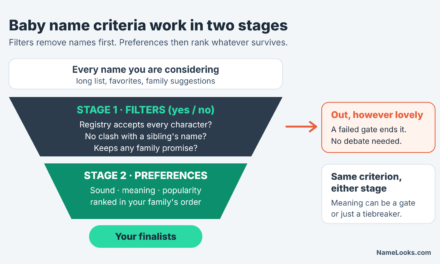
Write hard rules as yes-or-no questions with a factual answer. Soft preferences (“leaning toward shorter names,” “I like softer sounds”) belong in pass three, where they guide pairwise choices without automatically deleting anything.
Keep the hard rules few. Three to six is typical. If you have twelve, several are probably preferences in disguise, and you’ll end up with three survivors and a lingering sense that the rules picked the name instead of you. That feeling has a way of turning into second-guessing later. Our guide to preventing name regret goes into that risk from the other side.
Examples of deal-breakers that work
These are patterns, not recommendations. Use the ones that fit your family and ignore the rest:
- Family overlap: not the first name of a living close relative, unless it’s a deliberate honor name.
- Initials: the initials with the surname don’t spell a word either of you would mind on a backpack.
- Languages at home: the name can be said comfortably by the people who’ll say it most, in every language the family uses daily.
- Script and documents: if the family writes in more than one script, the name has a spelling you’re both happy to use on official records.
- Partner veto: either parent can remove any name, once, without explaining. Vetoes are final.
The veto rule deserves a note. It works only if both people use it sparingly and nobody campaigns to bring a vetoed name back. If you expect a lot of disagreement, the approach in choosing a name with your partner handles conflict more carefully than a single veto can.
Don’t make “rank” a deal-breaker without a dataset
“Nothing in the top 10” is a valid rule only once you name the list: SSA, U.S., 2025, girls’ names, exact spelling. Leave any of those out and the rule can quietly mean different things to different people.
3From survivors to a final five: pairs, checks and a trial run
After the rules have done their work, you’ll usually have somewhere between thirty and sixty names left. That’s a guess, not a statistic; it depends entirely on how strict your deal-breakers were. Whatever the number, it’s now short enough for the slower, more personal work of comparing names directly.
Pairwise rounds: the core of the method
Pairwise comparison is the heart of this baby name shortlist method: you look at two names at a time and ask which one you’d keep. It sounds almost too simple. That’s the point. “Do I prefer this one or that one?” is a question people answer reliably. “How many points out of ten does this name deserve for sound?” isn’t.
How to run a round
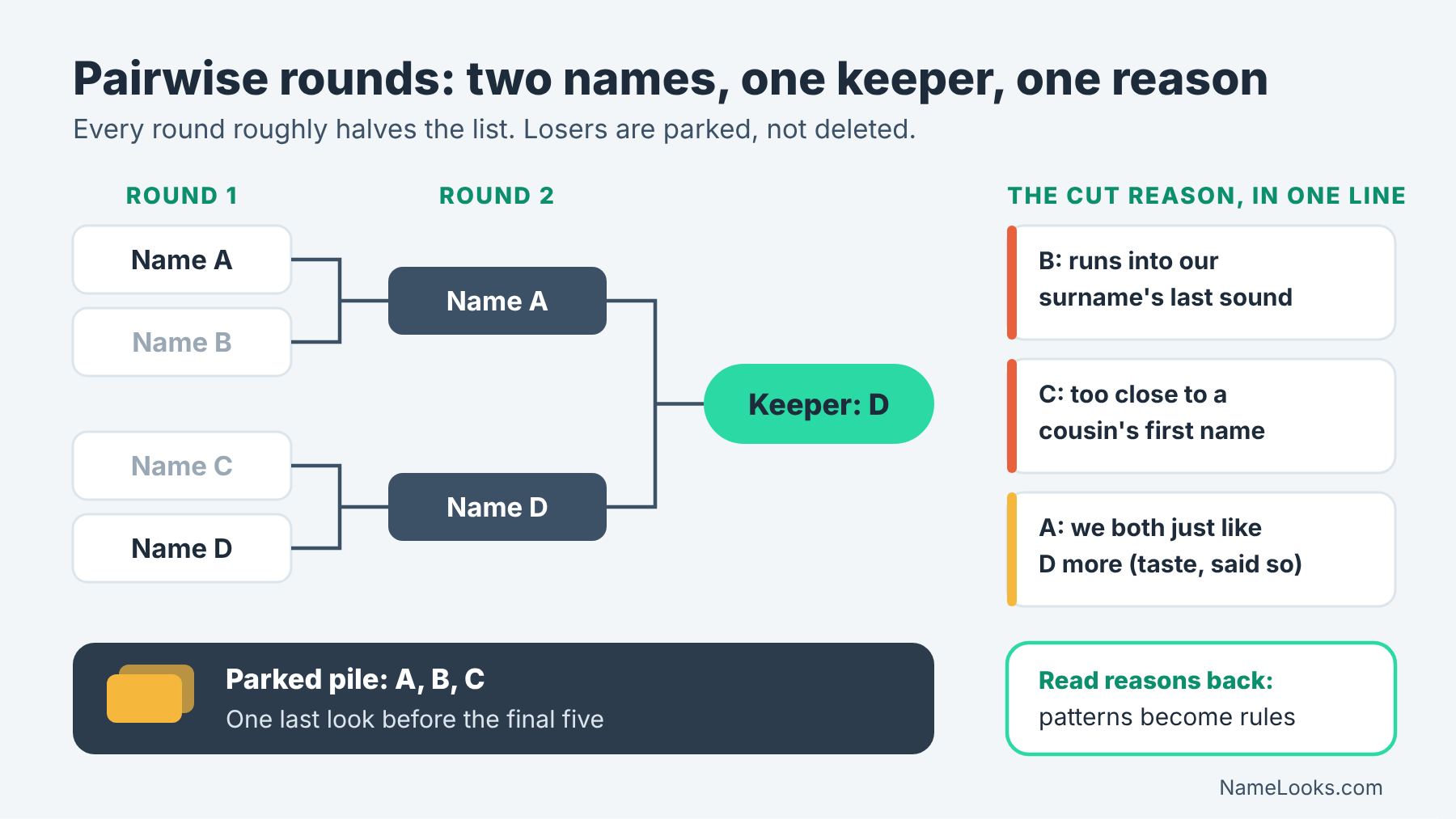
Write each surviving name on its own card or line. Shuffle them, so alphabetical order or the order you added them doesn’t nudge you. Then work through them in pairs:
- Draw two. Say both out loud, ideally with the surname, in a normal speaking voice.
- Pick a keeper. Ask: if we could only keep one of these, which would it be? Don’t look for a tie. Choose.
- Write the reason. One sentence on why the other one lost, such as “too close to her cousin’s name” or “I keep wanting to shorten it to something I don’t like.”
- Move the loser to a “parked” pile. Not deleted, parked. You’ll look at that pile once more before you finish.
- Repeat with new pairs. Keepers face other keepers in later rounds, so each round roughly halves the list.
The parked pile is a small kindness to your future self. People cut names in round one that they’d fight for in round four. One look back before the final five, asking “does anything here beat our weakest finalist?”, catches those cases without reopening the whole list.
Getting the matchups right
Random pairing is fine for the first round. After that, try pairing names that are similar in style: two long names, two short ones, two from the same language tradition. Comparing like with like forces the real distinction out. Comparing a short punchy name with a long ornate one mostly tells you which style you’re in the mood for tonight.
If you’re doing this as a couple, each person can run rounds alone first and then compare piles. A name that survives both people’s solo rounds is a strong candidate. A name that one person keeps and the other cuts every time is worth a conversation, not a tiebreak.
Cut reasons: the paper trail that keeps you honest
The one-sentence reason is what separates a baby name shortlist method from just going with your gut. It costs almost nothing, and it does three jobs at once.
What a good cut reason looks like
A good reason is specific and repeatable. “Our surname also ends in that sound and the two run together” is good: anyone can say the full name and hear what you mean. “Doesn’t feel right” isn’t wrong, exactly, but it’s a placeholder. Push on it once. Ask “what about it?” and see if a more specific reason turns up.
Sometimes the honest answer stays vague. That’s allowed. Taste is a legitimate reason to cut a name; you don’t owe anyone a linguistic analysis of why you dislike one. Just write it down as taste (“we both just don’t like it”) rather than dressing it up as a fact (“it’s too trendy”) that you haven’t checked.
Reading your reasons back
After two or three rounds, read every cut reason in one sitting. Patterns jump out. Maybe eight names lost because they were “too long” with your surname. That’s a rule you didn’t know you had. Promote it to a deal-breaker and apply it to the remaining names at once. That’s faster and fairer than letting it decide one matchup at a time.
The reasons also protect you from the opposite problem: a pattern you don’t believe in. If you notice you’ve cut every name from one parent’s family language, and neither of you meant to, the paper trail lets you catch it. Patterns like that are exactly the ones a spreadsheet total would have hidden.
A script for stuck matchups
When neither of you can pick, try saying: “Imagine it’s five years from now and we chose the other one. Which loss stings more?” It shifts the question from “which is better” to “which would we miss,” and people answer that one surprisingly fast.
Checking what can be checked
Somewhere around fifteen names, the method changes gear. You’re now close enough to the end that facts are worth the effort. Pass four turns each vague worry into a question with a findable answer.
Data checks on the exact spelling
Look up each finalist’s exact spelling, in the dataset for the place you live, for the most recent year. In the U.S. that means SSA’s 2025 data; in England and Wales, the ONS 2025 tables. Note the rank, the count where it’s published, the sex the figure applies to, and the year. If you live elsewhere, use your own national statistics office, if it publishes names. Don’t use U.S. or English data as a stand-in for a different country.
Then decide what the number changes, if anything. A name ranked in the top 10 for its sex in your country isn’t automatically out. It means many children born that year share it, and that’s either fine with you or not. The question of how much uniqueness you actually want is big enough that we gave it its own page: popular versus uncommon names. Here, just record the fact and your reaction to it, in separate columns.
Sound, spelling and everyday-use checks
Next come the things you check with your mouth and ears: the full name said quickly and slowly, initials, likely nicknames, how it sounds called across a park. That’s the territory of the full-name test, which goes through stress patterns and nickname drift in detail. Run it on your fifteen, not your hundred.
Pronunciation deserves particular care when a name comes from a language you don’t speak. Don’t guess from the English spelling. Ask a fluent speaker you trust, or use a reputable dictionary or pronunciation resource for that language. If people the child will meet often say the name differently, decide which version you’ll use and whether you’re happy hearing the others. Our pre-decision naming checklist collects these checks, plus document and family questions, into a single run-through.
Living with five
Five names is where cutting stops being the right tool. The differences between finalists are now often too subtle for a matchup to settle. What you need is real-life exposure.
The one- to two-week trial
For a week or two, use each finalist in ordinary moments. Not in a big ceremony, just in passing: “Has ___ been kicking today?” Write each name on the grocery list. Say it in the voice you use when you’re tired. Some families give each finalist a day or two of its own.
Watch your behavior more than your opinions. Which name do you reach for without thinking? Which one do you find yourself explaining or apologizing for in your head? That reflex tells you something a matchup can’t. It’s not proof of anything. Treat it as one more piece of evidence, from the source that matters most.
Ending with five, four or one
Some families come out of the trial with a clear winner. Others keep three to five finalists into the birth and choose after meeting the baby. A few find the trial knocks a name out and nothing replaces it. That’s fine too. A final four is not a failure of the method.
If you’re choosing before birth and want to stop at one, go back to your cut reasons. Run one more pairwise round among the finalists and write the reason for each loss. The last name standing will have the clearest case. If two finalists stay neck and neck, you may simply have two good names. Keeping one for a middle name, or for a future child, is a perfectly ordinary outcome.
Hypothetical walk-through
Picture a couple starting with 112 names from two notes apps. Pass one merges duplicates and groups spellings by sound, which leaves 84. Pass two applies four deal-breakers, including a living cousin’s name, initials, and comfort in both home languages, and leaves 41.
Three pairwise rounds bring it to 14. Their cut reasons reveal an unspoken rule about length, which they promote to a deal-breaker, and that leaves 11. Pass four’s data and sound checks take it to 6. After a week of trial use one name drops out on its own, and they carry five to the birth. Every number here is invented for illustration. Your list will shrink at its own pace.
4Keep evidence and taste in separate columns
Every name on your list collects two kinds of information as you go. One kind is checkable: a rank in a named dataset, a count, the fact that a relative already has the name. The other is judgment: whether that rank bothers you, whether a sound feels warm or harsh, whether a name “fits” your family. Both are legitimate. Trouble starts when one is passed off as the other.
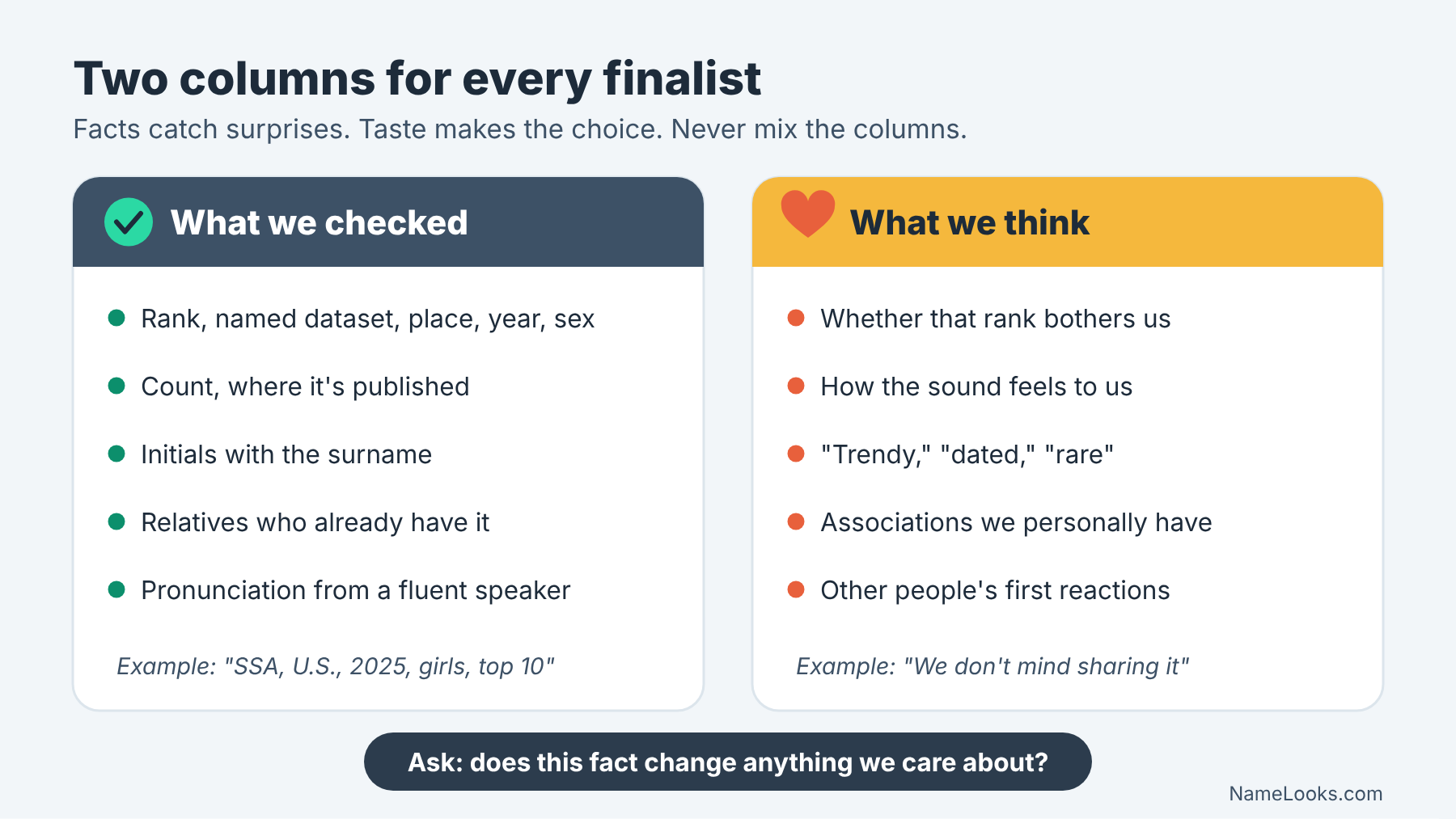
The simplest fix is literal, and it’s the habit we’d keep from this baby name shortlist method even if you dropped everything else. In your notes, give every finalist two columns, “What we checked” and “What we think.” The rest of this section explains what belongs in each, using real figures from the 2025 releases.
What the sources actually establish
Official name data is narrow and precise. It tells you how often an exact spelling was registered, for one sex, in one place, in one year. That’s all, but within that scope it’s very good.
The evidence matrix
Here’s how the main claims you’ll meet in pass four line up with their sources. Use it as a guide to what each lookup can support, and what it can’t.
| Claim you might make | Source / dataset | Geography | Year | Metric | Limitation | Editorial takeaway |
|---|---|---|---|---|---|---|
| “This spelling is in the top 10.” | SSA baby names | U.S. (50 states + DC) | 2025 | Rank by sex, exact spelling | Spellings not combined; names under 5 per area excluded | Say which sex list and which spelling, every time |
| “Lots of babies here get this name.” | ONS baby names | England and Wales | 2025 (released 9 July 2026) | Rank and count, exact spelling | Doesn’t cover Scotland or Northern Ireland | Use only if you live in England or Wales |
| “Adults around us mostly don’t have it.” | U.S. Census 2020 names files | U.S. population | 2020 | Frequency of first and last names | Only names occurring 100+ times; not birth-year data | Good for “how common in everyday life,” not for trend |
| “It’s rising fast.” | SSA or ONS across years | As above | Two or more years | Change in rank or count | Rank moves can be small in count terms near the top | Compare counts where available, not just rank |
| “It means ___.” | Etymological dictionaries; Behind the Name as an index | Language-specific | Not applicable | Source-word meaning | Origins can be disputed or multiple | Keep meaning out of cut reasons unless you’ve verified it |
| “It looks right on forms.” | Unicode CLDR person-name guidance | Locale-specific | Current spec | Name order, spacing, punctuation by locale | Describes formatting, not any single agency’s rules | Check the specific agency if characters or order matter |
On that last row: the Unicode Consortium’s CLDR person-names specification notes that “the ordering of name fields can be different across languages, as well as the spacing (or lack thereof) and punctuation.” That matters if your family uses more than one naming order or script. It’s a reminder, not a ruling on what any particular registry will accept.
A comparison from the 2025 data
Here is what that narrowness looks like in practice. These figures come from SSA’s published top-five and top-ten lists and from ONS 2025 figures as reported at release. Where we don’t have a verified count, we don’t give one.
| Variant or period | Rank / count / source form | Change | Caveat | Naming implication |
|---|---|---|---|---|
| Sophia vs Sofia (girls) | SSA U.S. 2025 girls: Sophia #5, Sofia #9 | Two spellings, two separate entries in the same top 10 | SSA doesn’t combine spellings; any combined rank is someone’s estimate | Decide your grouping rule before reading “popularity” off either line |
| Charlotte, 2024 → 2025 (girls) | SSA U.S.: #4 in 2024, #2 in 2025 | Up two places | Rank only; a two-place move near the top doesn’t tell you the size of the count change | Note the direction, but don’t treat one year as a trend |
| James, 2024 → 2025 (boys) | SSA U.S.: #5 in 2024, #6 in 2025 (Henry #5 in 2025) | Down one place | Tiny rank shifts near the top are normal year to year | A one-place drop isn’t a reason to cut or keep a name |
| Theodore, two countries (boys) | 2025: SSA U.S. #4; ONS England and Wales #9 | Different datasets, not a change | Different populations, registration systems and lists | Use the dataset for where your child will actually grow up |
| Olivia, two countries (girls) | 2025: SSA U.S. #1; ONS England and Wales #1, 2,386 births | Top in both | The count is for England and Wales only | “Most popular” is true in both places, but only per dataset |
| Muhammad (boys) | ONS England and Wales 2025: #1, 5,957 births | Top boys’ name in the 2025 release | Spellings counted separately, so related spellings appear as their own entries | A rank describes one exact spelling, not a name family |
The SSA ranks come from its top five names by year and the 2025 top-ten list on the main page. The ONS 2025 counts for Olivia and Muhammad were stated at release, alongside 585,396 live births in England and Wales in 2025. We couldn’t load the ONS bulletin page directly in this session, so we’ve kept to figures that appeared consistently in release coverage and the ONS release listing.
What is interpretation, preference or inference
Everything else on your list is judgment. That’s not a weakness. A name is a personal choice, and judgment is the main event. It just has to be labeled as judgment, so it doesn’t sneak into the “facts” column and gain unearned authority.
Words that sound like data but aren’t
Watch for three words in particular: trendy, rare and dated. Each sounds like a finding. Each is really an interpretation of a pattern, and it means nothing until you name the pattern. “Trendy” might mean “rose quickly in SSA U.S. data over the past five years,” or it might mean “I’ve heard it twice this month.” Those are very different claims.
The same goes for meaning and association. “It means strength” is a factual claim that needs a verified source. “It feels strong to me” is a preference, and a perfectly good one. When disputes come up, ask yourselves: is this an argument about a fact (look it up) or about a feeling (talk it through)? Many naming arguments are the second dressed up as the first.
Inferences you shouldn’t draw from a name
Some inferences aren’t just shaky; they’re not yours to make. Aggregate popularity data describes populations. It doesn’t tell you anything about the background, religion, ethnicity or personality of any individual who has a name, and a shortlist built on those guesses is built on stereotypes.
The same caution applies to research claiming that names shape life outcomes. Some of it exists, and some of it is contested. Wherever it lands, it describes averages across large groups, not what will happen to your child. If a study like that worries you, look at how it was done before letting it decide a matchup. Usually the better question is plainer: will the people around this child say, spell and use the name comfortably?
The two-column habit in practice
What we checked: SSA U.S. 2025, girls, exact spelling, ranked in the top 10. A cousin born last year has the same first name.
What we think: We don’t mind sharing it with classmates. We do mind sharing it with the cousin. That’s the deciding factor, and it’s a family reason, not a data one.
When the two columns disagree
Sometimes the facts point one way and your feelings point the other. A name you love turns out to be very common where you live. A name you’re lukewarm about checks every factual box. This is where people most often go back to scoring, hoping arithmetic will break the tie. Try this first.
Ask which column the decision should rest on
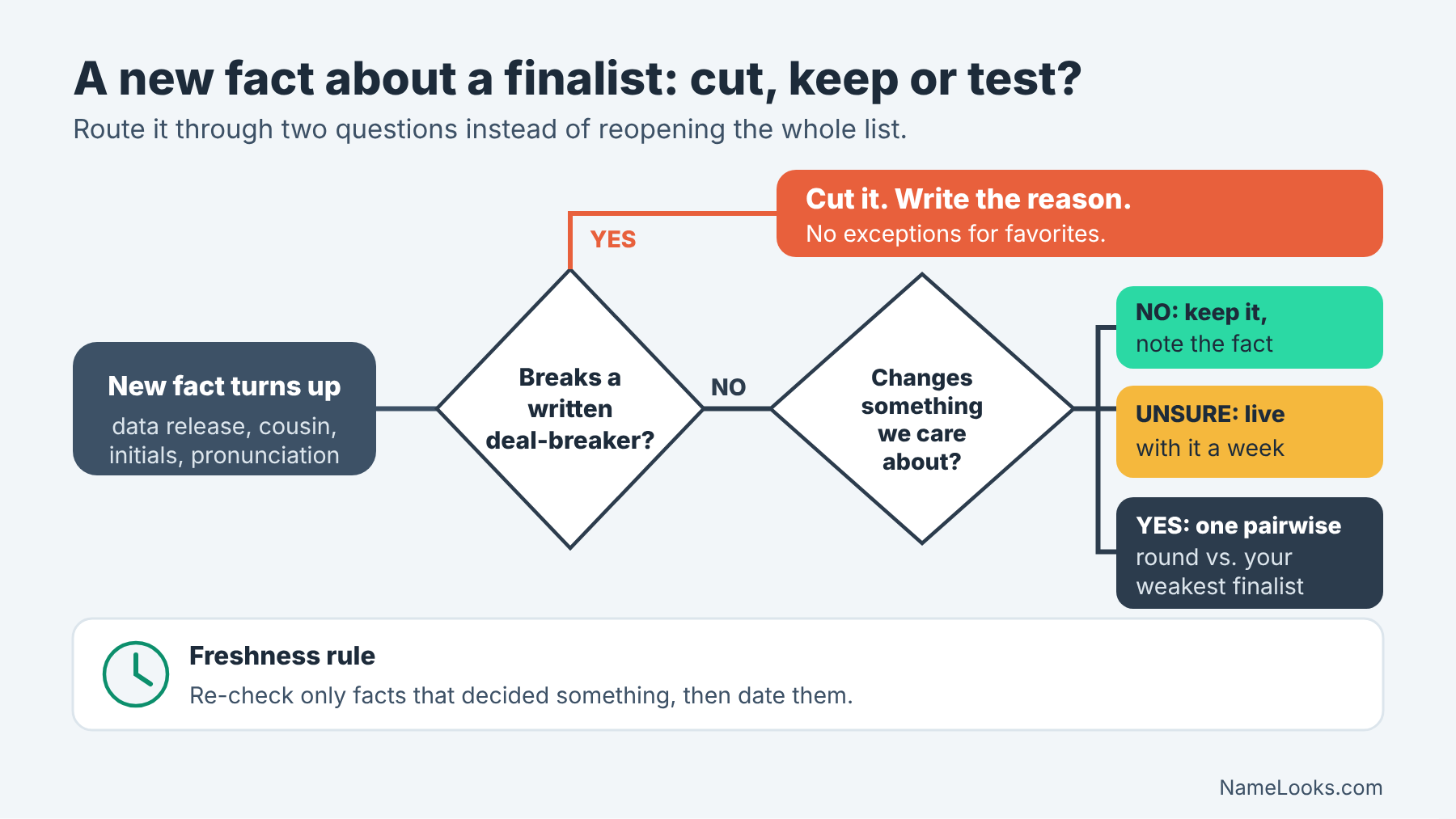
Look at the specific fact and ask: does this change anything I actually care about? If you genuinely don’t mind your child sharing a name with classmates, a top-10 rank is just information. If being one of several in a class would bother you, that same rank is decisive. The number doesn’t change. What it means to you does, and only you can supply that part.
When the honest answer is “I’m not sure whether I care,” that’s useful too. It suggests the fact is a reason to run the name through the pass-five trial, not to cut it on the spot. Live with it for a week, and you’ll often find you care more, or less, than you thought.
Don’t let one column quietly overrule the other
The failure mode runs both ways. Some people let data overrule taste and end up with a name chosen because it was statistically “safe,” which they never loved. Others let taste overrule facts they’d regret ignoring, like an initials problem or a hard-to-say sound in a family language. Each column has its job. Data catches surprises; taste makes the choice.
If you and a partner fall on different sides, write down what each of you is protecting. One of you may be guarding against a future problem; the other may be guarding the feeling of having picked something meaningful. Naming those aims usually helps more than another pairwise round. For a wider look at how sound, meaning, family fit and popularity trade off, see the baby name criteria guide.
5Where this method runs out, and what to do there
No baby name shortlist method fits every family, and pretending otherwise would undo the honesty the rest of this page is asking of you. Below are the known gaps: places where the data says nothing, situations the five passes handle badly, and the simple fact that every number in pass four has a shelf life. Write these down alongside your list, so you know which conclusions are firm and which are provisional.
Missing data and edge cases
The official datasets are excellent within their scope and silent outside it. Many names that families actually consider fall partly or wholly outside that scope.
What the datasets leave out
SSA’s national data excludes names with fewer than 5 occurrences in a geographic area, so a genuinely uncommon spelling may not appear at all. Its absence means “fewer than five recorded,” not “zero” and not “invented.” SSA also strips spaces and hyphens and keeps only the first-name field. That means a double first name or a hyphenated one won’t show up the way your family writes it.
The Census 2020 files only cover names occurring 100 or more times across the population. The ONS tables cover England and Wales only. And none of these sources records pronunciation, so two families who spell a name identically but say it differently are counted as one entry. If your finalist is an uncommon spelling, a compound name, or a name mostly used outside these countries, the honest note in your “What we checked” column may simply be “not covered by this dataset.”
Edge cases that need their own handling
Some situations bend the five passes. They don’t break them, but they call for adjustments:
- Honor names. If a name is on the list to honor someone, pairwise rounds can feel disrespectful. Consider fast-tracking it to pass four and deciding separately whether it’s a first or middle name.
- Multiple languages or scripts. A name may need a version in each. Treat the pair as one candidate, and check both forms in pass four with fluent speakers.
- Naming systems that aren’t “first plus last.” Patronymics, matronymics, compound surnames and naming ceremonies with set timing change what a “full name” is. Adapt pass four’s full-name test to the structure your family actually uses.
- Siblings. If an older child already has a name, compare finalists as pairs with that name, not alone.
- Registration rules. Some places limit characters, length or certain names. Those rules vary by jurisdiction and change over time. Check with the registry where the birth will be recorded, since we can’t summarize them all here.
On that last point, a general note: what we say about records here is general information, not legal advice. If you later want to change a name, the procedures are set by the relevant authorities. In the U.S., for instance, SSA explains how to update the name on a Social Security card. That’s useful context, but no reason to rush the decision now.
Freshness: when your checks go stale
Every fact in pass four has a date on it. Names data comes out once a year, and your shortlist may outlive one release. If you started the list in winter and the baby arrives in autumn, the numbers you checked may have been replaced in the meantime.
When the releases land
SSA updates its national lists once a year, and its site now shows 2025 as the most recent year. ONS released its England and Wales 2025 figures on 9 July 2026, and its dataset page lists the next release as “to be announced.” The Census 2020 names files are a one-off tabulation, not an annual series, and the Census Bureau’s page shows it was last revised in April 2026.
Don’t assume these dates will repeat exactly. Release timing can change, and agencies sometimes revise past figures. Check the source page itself, not a news story about it, when it matters.
A simple update rule for your list
Put a date next to every fact in your “What we checked” column, and note the data year, not the day you looked. Then follow one rule: if a new release comes out before you decide, re-check only the names where the fact mattered to a decision. If a rank was just context, leave it.
This keeps the effort proportionate. Nobody needs to re-run 100 lookups because a new year dropped. But if “it’s not in the top 10” was the reason a finalist survived, it’s worth thirty seconds to see whether that’s still true. Keep in mind that one year’s movement is a single data point. A name rising a few places is interesting, not a verdict.
Your method notes, in four lines
Write these at the bottom of your list: (1) our grouping rule for spellings; (2) our deal-breakers, word for word; (3) datasets used, with geography and data year; (4) what wasn’t covered. If you revisit the list in six months, or hand it to a partner who missed a round, those four lines let anyone see how you got here.
Common ways the method goes wrong
The five passes are simple, but even a simple baby name shortlist method fails in predictable ways. Most come from skipping a pass or blurring two passes together.
Reopening settled questions
The most common failure is relitigating. A vetoed name comes back “just to reconsider.” A deal-breaker gets an exception for one favorite, then another. Each change seems reasonable alone, but together they erase the point of having rules.
The fix is a single, explicit amnesty. Agree that once, after pass three, either of you may bring back one name from the parked pile. Not from the vetoed pile. If it can beat your weakest finalist in a straight pairwise comparison, it’s back. If not, it stays parked for good. That gives regret a safety valve without making every decision provisional.
Fact-checking too early, or too late
Checking data for all 100 names in pass one feels thorough, but it mostly creates noise. Rank anxiety ends up driving cuts that taste should have made. On the other hand, skipping pass four entirely means you might learn about an initials clash or a cousin’s name at the baby shower.
The order exists for a reason. Taste does the heavy lifting while the list is long, because it’s fast and personal. Facts do the precise work once the list is short, because they’re slow and specific. Keep each tool for the stage where it’s cheap.
Letting the process replace the decision
A baby name shortlist method can only narrow the list. It can’t choose the name for you, and any method that claims to is hiding a judgment somewhere inside it. If you reach the final five and still feel stuck, that’s not the method failing. It’s the point where the remaining differences are matters of feeling, and feeling is allowed to decide.
At that stage, the most useful question is often the most ordinary one: which name do you want to call this child, over and over, for years? If the answer is still unclear, the wider naming decision framework can help you step back and look at what you’re actually optimizing for.
Questions people actually ask
Can we use this method if we only have 20 names, not 100?
Yes. The baby name shortlist method scales down well. With a shorter list, passes one and two may barely change anything, and that’s fine. Go straight to pairwise rounds and keep the habit of writing a reason for every cut. The checks in pass four matter just as much at 20 names as at 100.
Isn’t pairwise comparison just scoring with extra steps?
No. A score asks you to rate a name on a scale and then trust a sum. A pairwise choice asks a direct question, which of these two would you keep, and records a reason. Nothing is added up, so a pile of small pluses can’t outvote one serious problem.
How long should the whole process take?
There’s no reliable data on this, so we won’t invent a benchmark. Passes one and two often fit in an evening. Pairwise rounds usually go better spread over several sessions, because fresh ears catch things tired ones miss. The trial in pass five works best over a week or two.
What if a grandparent or friend wants to weigh in?
Decide in advance what their input can do. A common approach is to share a finished five and ask for factual flags, such as “a family member already has that name,” rather than votes. That keeps useful information coming without turning the shortlist into a committee.
Should we look up popularity in more than one country?
Only if the child is likely to grow up across those places, or the family has close ties in more than one. Use each country’s own official data and keep the figures separate. A rank in SSA U.S. data and a rank in ONS England and Wales data describe different populations and shouldn’t be averaged.
Do we have to keep the final five secret?
No rule says so. Some families share finalists to test reactions; others keep them private to avoid unsolicited opinions. If you share, remember that other people’s first reactions are just more taste. Write them in the “What we think” column, not as facts.
Sources and further reading
- SSA Popular Baby Names: U.S. rankings by sex and exact spelling, through 2025; its background notes explain thresholds and grouping.
- SSA top five names, 1926–2025: quick year-over-year comparison at the very top of the U.S. lists.
- ONS: Baby names in England and Wales, 2025: the release listing for the most recent England and Wales figures.
- ONS dataset, 1996 to 2025: ranks and counts for following one spelling over time.
- U.S. Census Bureau 2020 names files: first- and last-name frequency across the population, for names occurring 100+ times.
- Unicode CLDR person names: how name order, spacing and punctuation vary by locale.
- Behind the Name references: the bibliography behind a widely used secondary etymology index.
- Iyengar and Lepper (2000): the original jam study, in the Journal of Personality and Social Psychology.
- Scheibehenne, Greifeneder and Todd (2010): the meta-analysis that found choice overload is far from universal.
- Chernev, Böckenholt and Goodman (2015): the four factors that shape when overload appears.
- Elimination by aspects: a plain summary of Tversky’s 1972 model behind the deal-breaker pass.
- SSA: changing or correcting a name on a Social Security card: U.S. context on what happens if a name changes later.
NameLooks provides general information, not legal advice. Popularity data describes populations, not individuals, and name registration and change rules depend on your jurisdiction.