Most lists of baby name criteria hand you six or seven boxes to tick and stop there, as if every box counted the same. They don’t. This guide covers the six criteria parents actually use (meaning, sound, family fit, popularity, spelling, and practical use) and explains how to check each one against a real source. Then it gives you a rule for deciding which criterion wins when two of them disagree.
The short version
- The six criteria do two different jobs. Some are filters that rule a name out, like a spelling a birth record can’t hold or a clash with a sibling’s name. Others are preferences that only rank the names still standing. Mixing up the two is where most lists go wrong.
- Meaning means three things. A name has an etymology, a history of use, and a modern association. Baby-name sites often blend them together, and only the first can be checked in a dictionary.
- Popularity is a number, so read it like one. SSA and ONS rank exact spellings by sex for a single year in a single country. A rank is not a count, and neither one tells you how many kids at your local school share the name.
- Spelling and practical use are the easiest criteria to verify and the easiest to skip. Spend ten minutes on forms, accents, and how the name sorts in a records system before you get attached.
- When criteria conflict, rank them before you score them. Decide which criterion your family won’t trade away, then let the others break ties. That holds up better than a weighted spreadsheet.
1What baby name criteria are really deciding
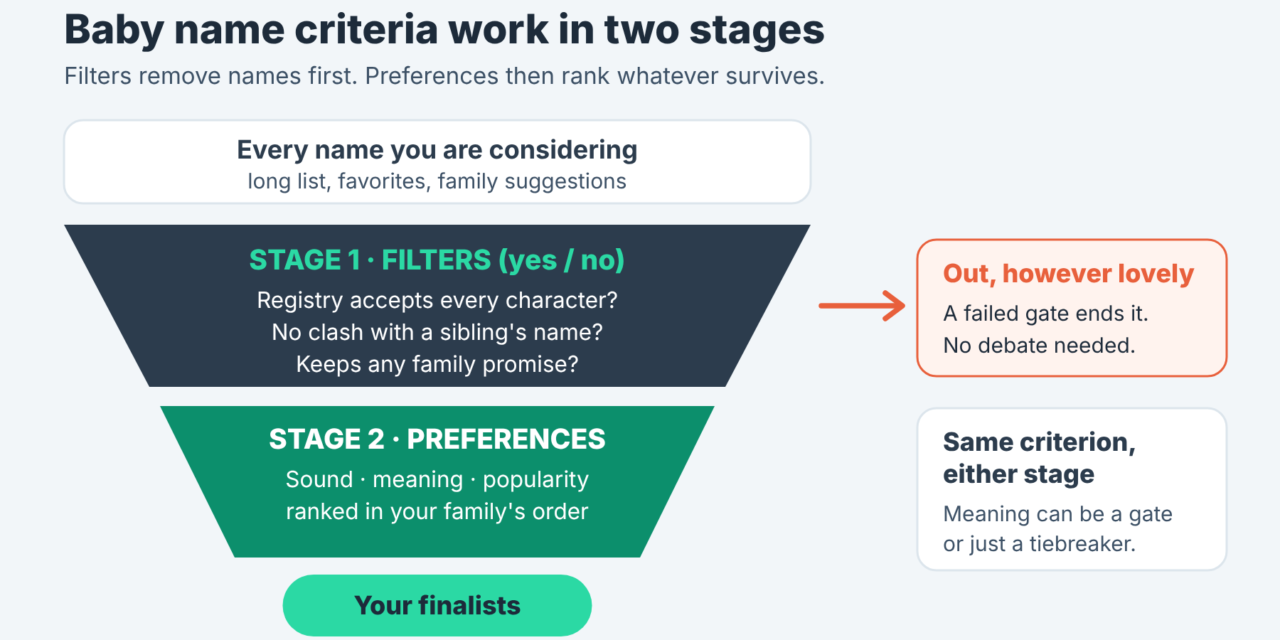
Here’s the core answer. Baby name criteria are the reasons you’d keep or cut a name. They work best in two stages. In stage one, a few criteria act as gates: if a name fails, it’s out, however lovely it is. In stage two, the rest act as preferences that put the survivors in order. Meaning, sound, family fit, popularity, spelling, and practical use can each fall into either stage. Which stage depends on your family, not on a universal rule.
That two-stage split between baby name criteria is the main thing this page adds to the general approach in our broader naming decision framework. The framework covers the whole process, from first brainstorm to final announcement. This article stays narrow and looks at the criteria themselves: what each one measures, where the evidence for it lives, and what to do when two of them pull in opposite directions.
Six criteria, two jobs: filters and tiebreakers
Among baby name criteria, a filter is a yes-or-no question with a defensible answer. “Can this name be written on a birth certificate in our state?” is a filter. So is “Does this name share a first syllable with our older child’s name in a way we’d find confusing at the dinner table?” A tiebreaker is a matter of degree: “Which of these three names sounds better with our surname?”
Parents run into trouble when they treat a tiebreaker as a filter, or the reverse. Cutting every name outside some popularity band turns a preference into a gate, and that can wipe out a family name before anyone has thought it through. Treating a spelling problem as a minor preference lets a name through that will be mistyped on every form for decades.
Hard limits that knock a name out
Some limits come from outside the family. Birth-registration systems set rules on characters, length, and format, and those rules differ by jurisdiction. Social Security’s public name files, for example, only include given names at least two characters long, and they remove hyphens and spaces before counting, according to the SSA background notes on the baby names data. That rule describes how SSA tabulates names. It is not a rule about what you’re allowed to name a child. Still, it’s a useful hint that systems can quietly reshape a name.
Other hard limits are internal. A promise to honor a grandparent, a religious naming practice your family follows, or a language the name has to work in can all be gates. They’re legitimate. Just name them out loud, so nobody mistakes them for taste.
Preferences that rank the survivors
Everything else is preference: how much you like the sound, how common you’d like the name to be, whether its meaning moves you, how well it nicknames. Preferences deserve real attention, but they belong after the gates. Run them first and you’ll spend weeks debating names that a five-minute records check would have removed.
A quick sort you can do tonight
Write each of the six criteria on a sticky note. Each partner (or each person helping decide) moves every note into one of two columns: “rules a name out” or “helps me choose between finalists.” Where you disagree, you’ve found the conversation you actually need to have.
What you’re actually optimizing for
Ask parents what they want in a name and you’ll hear words like “timeless,” “strong,” “unique but not weird,” or “means something.” Those words are fine as starting points. They aren’t baby name criteria yet, because you can’t test a name against them. To make one usable, translate it into a question with an observable answer.
“Unique but not weird” might become: “Outside the top 100 in the latest SSA national list for the baby’s sex, and pronounced the way it’s spelled by most English speakers we test it on.” “Means something” might become: “Its etymology, as given by at least one scholarly name dictionary, connects to something our family cares about.” Now both criteria can actually rule a name in or out.
Evidence you can check vs. taste you can’t
Roughly half of the six baby name criteria can be checked against something outside your own head. Popularity has official datasets. Spelling and practical use have records systems and form behavior you can test. Etymology, the literal source of a name, has dictionaries and onomastic references. The other half (how a name sounds to you, how it fits the family, what it “feels like”) is taste, and taste can’t be outsourced.
Both halves count. The mistake is trying to settle a taste question with data (“it’s ranked 40th, so it must be a good name”) or a data question with taste (“it feels rare to me, so it probably is”). When you notice yourself doing either, stop and ask which kind of question you’re really asking.
A hypothetical couple sorting their criteria
Picture two parents, call them Dana and Sam. Dana’s stated criterion is “meaningful.” Sam’s is “easy.” When they translate, Dana’s “meaningful” turns out to mean “connected to her late father,” which is a family-fit criterion, not a meaning one. Sam’s “easy” turns out to mean “won’t be misspelled at the pharmacy,” which is spelling and practical use.
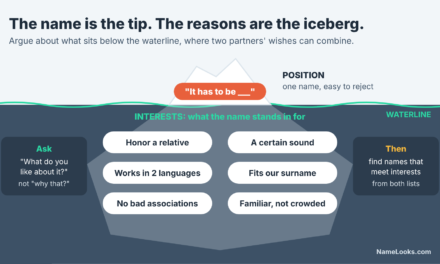
Neither preference blocks the other. A name can honor Dana’s father as a middle name and still pass Sam’s pharmacy test as a first name. Until they translated the words, though, they were arguing past each other. If you’re stuck at that stage with a partner, our guide to resolving naming disagreements with a partner goes much deeper on structured compromise.
What’s still missing before you score anything
Most families start weighing names before they have the facts that would settle half the questions. You don’t need a research project. You need a short list of things to confirm before preferences take over.
Facts you need from sources, not instinct
Before ranking anything, know four things about each serious candidate. First, its popularity in the dataset that matches where you live, for the most recent year available. Second, whether the spelling you want is the one that dataset counts, since variants are listed separately. Third, what a reputable name dictionary says about its origin, including whether that origin is disputed. Fourth, whether your local birth-registration system can hold the exact characters.
For U.S. births, popularity comes from the Social Security Administration’s baby names data, which currently runs through birth year 2025. For England and Wales, the Office for National Statistics published its 2025 baby names on 9 July 2026, and its ranks-and-counts dataset covers 1996 to 2025. Use the one that matches the country where your child will grow up, not the one with the nicer website.
Questions to settle with family first
Some missing information isn’t in any dataset. Does a grandparent expect an honor name? Does your family or community follow a naming custom about timing, about naming after living or deceased relatives, or about religious names? Will the name need to work in two languages? These answers change which criteria act as gates. Getting them early saves you from falling for a name that gets vetoed at a holiday dinner.
One caution: don’t assume what a relative’s tradition requires based on their background or surname. Naming practices vary widely within any single culture, language, or faith. Ask the actual people involved what matters to them.
2Meaning and sound: the criteria you feel first
Of all the baby name criteria, meaning and sound are usually what make someone fall for a name. They’re also the two criteria most likely to be described inaccurately online. Sound is easier to test than people expect. Meaning is harder to verify than baby-name sites let on.
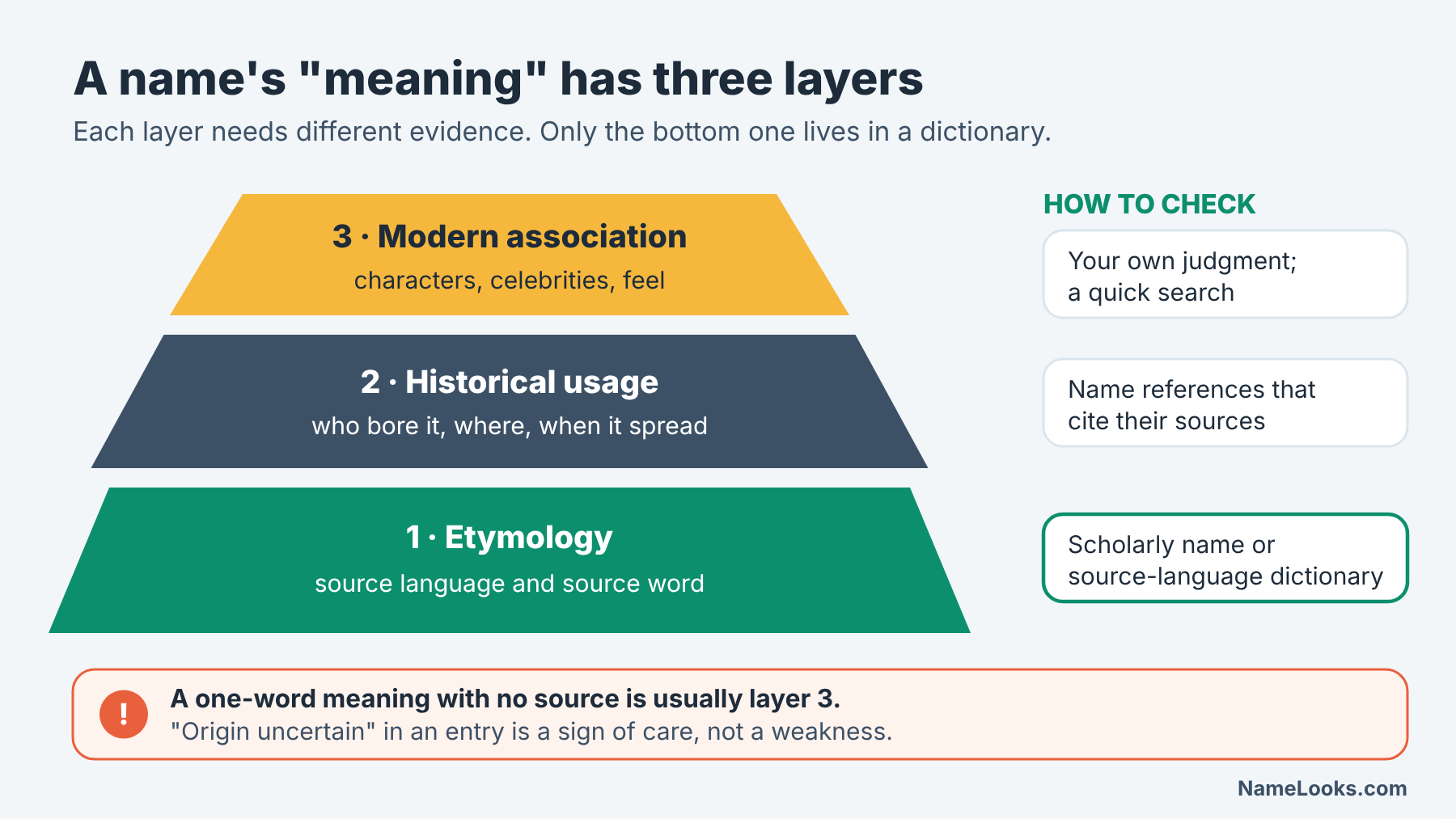
Meaning has three layers, and only one is in the dictionary
When a site says a name “means” something, it might be describing one of three different things. The first is etymology: the word or words the name came from, in a specific source language. The second is historical usage: who bore the name, where, and when it spread. The third is modern association: what the name calls to mind today, like a character, a celebrity, a season, a virtue. Each layer can be strong or weak for a given name, and they don’t always agree.
The trouble is that a lot of name content flattens all three into one confident word. A name ends up “meaning” something because it sounds a bit like an unrelated word, or because a later symbolic reading got passed along as if it were the origin. Treat any single-word meaning with no named source as a modern association until you’ve seen otherwise.
How to check an etymology claim
Start with a reference that tells you where its information comes from. Behind the Name publishes the list of reference works it draws on, which makes it a reasonable secondary index. You can see which dictionaries sit behind an entry and go to them for anything that matters. For a name with real family or religious weight, cross-check with a scholarly dictionary of names or a source-language dictionary.
Look for three things in any entry: the source language, the source word or elements, and any hedge. Hedges are good news. An entry that says “the meaning is not known for certain” is more trustworthy than one that names a single meaning with no qualification.
When the experts disagree
Some of the most familiar names have disputed origins. Behind the Name’s entry for Mary traces it through Latin and Greek forms to the Hebrew Miryam. It then says plainly that “the meaning is not known for certain,” lists several proposed interpretations, and notes that the name was most likely originally Egyptian. Compare that with a name like Sophia, which the same source gives as meaning “wisdom” in Greek, with citations. One name has a settled etymology and the other doesn’t.
If meaning is one of your gates, a disputed etymology doesn’t have to rule a name out. It just changes what you can honestly say about it. “We chose it partly for its long history, and scholars still debate its origin” is accurate. “It means beloved” might not be. For a deeper method on verifying names before you commit, the regret-prevention checks for associations and family context walk through what to look for.
Meaning is a criterion, not a verdict
A pleasant etymology won’t make a name work if it fails on sound or spelling, and a neutral one won’t sink a name you love. For most families meaning works best as a tiebreaker. The exception is when a religious or family tradition makes it a gate.
Sound: rhythm, stress, and how it lands next to your surname
Sound covers how a name feels to say and hear. Part of that is the name alone, and part is the full name in sequence. You’ll say the first name many thousands of times. Other people will hear the full name in classrooms, offices, and waiting rooms. Both deserve a test.
Sound is pure preference for most families, but a few sound issues behave like gates. If a first name ends with the same sound your surname starts with, they can blur together when spoken. If two siblings’ names differ by one vowel, you’ll be correcting people (and yourself) for years. These aren’t matters of taste. You can hear them.
What the research does and doesn’t show about easy names
There is some peer-reviewed evidence on how pronounceability affects first impressions. In a 2012 paper in the Journal of Experimental Social Psychology, Laham, Koval, and Alter reported across five studies that easy-to-pronounce names, and the people who carry them, were judged more positively than hard-to-pronounce names. One study linked easier surnames to higher-status positions at law firms. The authors reported that the effect held independent of name length, unusualness, and foreignness.
Read that carefully before you draw conclusions. The studies measured how participants judged names in specific settings. They don’t predict how a particular child’s life will go, and “easy to pronounce” depends on who is doing the pronouncing. A name that’s effortless in one language community can be hard in another. The fair takeaway is that pronounceability matters some in first impressions. It doesn’t follow that every name should be simplified for the widest possible audience.
A five-minute sound test
You don’t need a lab. Say the full name aloud ten times at normal speed, then call it across a room, then say it fast as if you were annoyed. Ask two people who haven’t seen it written to repeat it back to you. Then show it in writing to two different people and ask them to read it aloud. The mismatches between those tests tell you more than any rule about syllable counts.
We cover this in much more detail in our walkthrough on testing a full name out loud, including stress patterns, initials, and nickname drift. At the criteria stage, all you need to know is whether sound is a gate for you (a hard clash) or a preference (one rhythm you like better than another).
Meaning and sound against each other: a worked comparison
Meaning and sound often conflict, which is where weighing baby name criteria gets interesting. A name with a meaning you love may not fit your surname, and a name that sounds perfect may have an etymology you find flat. Comparing realistic options side by side shows the trade-off more clearly than a list of pros and cons can.
The table below compares two common approaches parents weigh. Option A is an inherited name with family history. Option B is a new choice picked mainly for sound and feel. No name is specified, because the point is the pattern rather than any one name.
| Criterion | Option A: inherited family name | Option B: new name chosen for sound and feel | What to check before deciding | Typical trade-off |
|---|---|---|---|---|
| Meaning / origin | Meaning comes mostly from family history; etymology may be unknown to you | Etymology may be the main appeal, or may not matter at all | A sourced name dictionary for the etymology; family members for the history | A strong personal meaning vs. a cleaner, documented one |
| Sound / spelling | Fixed spelling; may not suit your surname’s rhythm | Picked to fit the surname, so sound is usually strong | Full-name read-aloud test; spelling checked by people who haven’t seen it | Faithfulness to the original vs. a smoother full name |
| Family fit | High for one branch of the family; possibly loaded for another | Neutral; nobody’s claim, nobody’s grievance | Talk early with the relatives most affected | Honoring someone vs. avoiding comparisons |
| Popularity / usage | Often reflects an older era’s naming patterns | Often follows current trends, consciously or not | The latest SSA or ONS year for your country, exact spelling, by sex | Sounding “of a generation” in either direction |
| Practical use | May carry older spellings or characters | Usually chosen with modern forms in mind | Your jurisdiction’s birth-record character rules; a test of common forms | Authentic form vs. frictionless paperwork |
| Fallback if it fails | Move the name to the middle position | Pair it with a family middle name | Whether a middle-name honor satisfies the family | Usually a workable compromise either way |
Reading the matrix: where the real tension sits
The rows that matter most are the ones where your two options sit at opposite ends. For many families that’s family fit against sound: the honor name means a lot but sits awkwardly next to the surname. Once you’ve located the tension, you can ask a much sharper question than “which name is better?” The question becomes “would moving the honor name to the middle feel like keeping the promise or breaking it?”
The middle-name escape hatch, and when it fails
Putting an honor name in the middle position resolves many conflicts between meaning and sound. It fails in two situations. One is when the person being honored, or the tradition involved, expects a first name specifically. The other is in cultures and record systems where middle names aren’t used the same way. The Unicode CLDR specification for person names, for example, notes that in most Slavic languages a patronymic occupies the slot that other systems would label a middle name. Before you count on the middle position as a compromise, make sure it means the same thing to the people you’re trying to honor.
3Family fit and popularity: the criteria other people weigh in on
Meaning and sound are mostly between you and the name. Family fit and popularity bring in everyone else: siblings, grandparents, cultural communities, and the millions of other parents whose choices add up in national statistics. These are the baby name criteria where outside opinions are loudest. They’re also the ones where you most need to know what you think before the opinions arrive.
Family fit covers siblings, honor names, and more than one culture
“Family fit” sounds cozy, but it actually covers several separate tests. Does the name sit comfortably next to your other children’s names? Does it honor or avoid particular relatives? Does it work in every language and naming system your family lives in? A name can pass one of these and fail another, so it helps to score them separately.
Sibling sets: a matching style isn’t required
Plenty of parents worry that siblings’ names should “go together.” There’s no rule saying so, and no data showing that a matched set helps the kids. What does matter is practical: names that are easy to tell apart when shouted, initials that don’t collide on shared accounts or labeled belongings, and no accidental rhymes you’d find silly. Style matching is optional and up to you. Telling the names apart is the part that actually matters.
A good check is to say all the children’s names together in the order you’d most often use them, then in reverse. If one name sounds like an afterthought or a punchline next to the others, you’ll notice. If you only notice when you’re hunting for a problem, it’s probably fine.
Names that have to work in two languages or naming systems
For families who live across languages, family fit often turns into a hard gate. A name may need to be pronounceable by grandparents in one language and by teachers in another. It may need to fit a naming structure that’s different from the one on the local birth certificate. The Unicode CLDR person-names specification is a useful reminder of how much these structures vary. It notes that the order of name fields can be different across languages. It also notes that people may have one name, two, or three or more, and that in some contexts in Mexico only the first surname is used informally.
You don’t need to read a technical standard to name a baby. The practical point is that there isn’t one “normal” name shape, and software and forms built around one shape will mangle others. If your family’s naming system doesn’t map neatly onto first/middle/last, test how the full name will be entered, displayed, and shortened in the systems your child will actually use. That includes schools, clinics, airlines, and anything else with a dropdown menu.
Don’t guess someone else’s tradition
A surname or a family’s background doesn’t tell you what naming customs they follow, or whether they follow any. Within one language or faith, practice varies by region, generation, and household. If a custom matters to the decision, ask the people who practice it.
Popularity: what SSA and ONS numbers can and can’t tell you
Among the baby name criteria, popularity is the only one with large, official, free datasets behind it. That makes it the easiest to measure and, oddly, the easiest to misread. Most mistakes come from treating one kind of number as another: a rank as a count, a national figure as a local one, one spelling as the whole name.
How the datasets count names
In the U.S., the Social Security Administration publishes national and state rankings from Social Security card applications for births in the United States. According to the SSA’s methodology notes, names with fewer than five occurrences in a geographic area are left out to protect privacy. Different spellings of similar names are not combined. Rankings are by sex, so a name given to both boys and girls has two separate ranks. Ties are broken alphabetically, and births in U.S. territories aren’t included in the national data.
In England and Wales, the ONS ranks names from birth registrations using the exact spelling recorded, and similar names with different spellings are counted separately. Its 2025 figures were published on 9 July 2026. For England and Wales in 2025, ONS reported the top boys’ name as Muhammad and the top girls’ name as Olivia. As reported in press coverage of the release, that was Olivia’s tenth year running at the top of the girls’ list.
The U.S. Census Bureau measures something different: how common first and last names are across the whole population, not among new babies. Its 2020 Census names files tabulate names that appear 100 or more times in census returns, covering 53,615 first names in the full dataset. That’s handy if you want to know how common a name is among adults today, which a birth ranking can’t tell you.
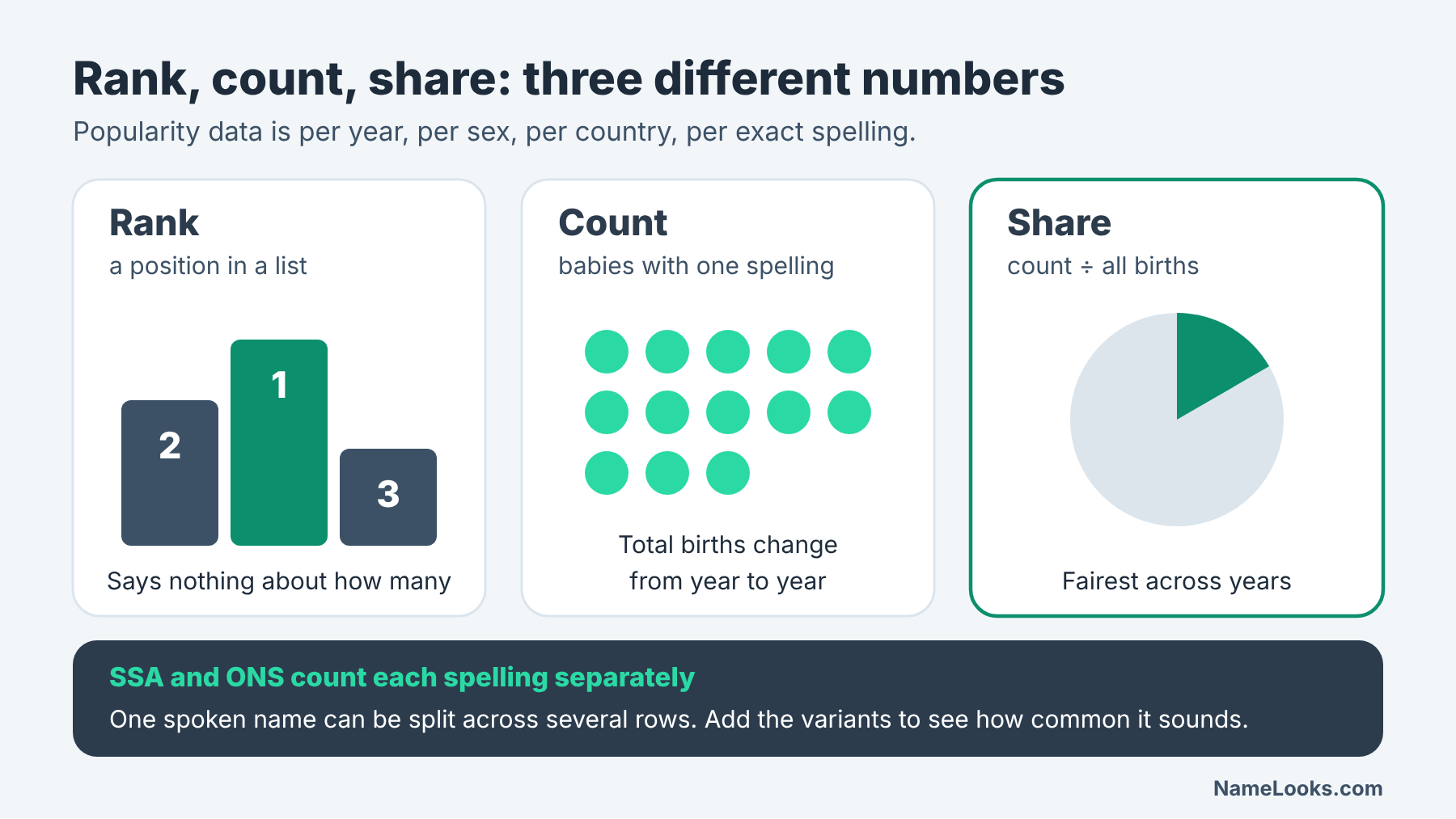
Rank
A name’s position in a list for one year, one sex, one geography. Rank 1 is the most common spelling. It says nothing directly about how many babies got the name.
Count
The number of babies recorded with that exact spelling. Counts let you compare across years, but the total number of births changes too.
Share
Count divided by total births for that sex and year. Share is the fairest way to compare popularity across years with different birth totals.
Reading a rank without fooling yourself
Here’s a concrete example of why rank alone misleads. On the SSA’s table of the top five names by year, Liam has been the No. 1 boys’ name in the U.S. every year from 2017 through 2025, and Olivia the No. 1 girls’ name from 2019 through 2025. Those are rankings. That page doesn’t show how many babies received either name, so you can’t read off from the rank whether a No. 1 name today is as concentrated as a No. 1 name was decades ago. You’d need the count and the total births for each year.
ONS gives a useful hint about how spread out naming has become. Press coverage of the 2025 release, reporting the ONS figures, said the ten most popular boys’ and girls’ names together accounted for 9.1% of births in England and Wales. That’s a share, not a rank, and it tells you that even the top names are given to a modest fraction of babies.
Two more traps. Spelling variants are separate entries in both SSA and ONS data, so a name you think of as one name may be split across several rows. Its combined use can be much higher than any single rank suggests. And national data can’t tell you about your neighborhood, school, or social circle, where a name’s local frequency may be quite different.
When family fit and popularity collide
These two criteria clash in a predictable way. Honor names often come from an older generation’s naming patterns, so they can look dated in current rankings. Trendy names often have no family connection. Neither situation is a problem in itself. It turns into one when a family treats popularity as a gate (“nothing in the top 50”) and an honor name happens to land on the wrong side of it.
What the data adds to a family argument
Data can lower the temperature. If a grandparent worries that a name is “too common,” you can pull the latest SSA or ONS figures for that exact spelling and look together. Sometimes the worry holds up. Often it reflects how common the name was in the grandparent’s own generation, which the Census population data can partly confirm. Showing the figure turns a clash of feelings into a shared look at evidence, even if it doesn’t settle the matter.
Just don’t let the data pretend to answer a values question. Whether you want your child to share a name with classmates is a preference about identity, not a statistical fact. For that debate on its own terms, our guide to how much uniqueness you actually want breaks down the trade-offs.
A hypothetical honor-name dilemma
Imagine parents who want to honor a great-aunt whose name was once very common in their country and is now rarely given. One parent loves the vintage feel. The other worries it will sound old-fashioned at school. Checking the SSA data might show that the name is climbing again, or that it barely registers. Either way, the parents now share a fact instead of trading impressions.
If the name is rare among babies, they can decide together whether that’s charming or a burden. If they can’t agree, the middle-name option from the earlier matrix comes back into play. What they shouldn’t do is let the rarity number make the decision for them. It describes a population, not their daughter.
4Spelling and practical use: the criteria that show up on paperwork
Spelling and practical use are the baby name criteria that rarely come up in the early “we love this name” phase, and they rarely start fights. They are, however, the criteria your child will deal with most often: on every form, at every check-in desk, in every email address. They’re also the easiest to check in advance, which makes skipping them hard to justify.
Spelling choices are trade-offs, not right answers
Every spelling sits somewhere between recognizable and distinctive. A conventional spelling is usually read correctly on the first try. A less common spelling can make a familiar name feel personal, honor an original-language form, or set it apart from a classmate’s. Neither is wrong. Each one costs something, and you should know what you’re paying.
Variant spellings are counted separately, so check each one
As covered above, both SSA and ONS rank each exact spelling as its own entry. That has a practical effect. If you choose a less common spelling of a popular name, it may look rare in the rankings while the sound of the name is as common as ever. In a classroom, kids hear names more than they read them, so the spelling you chose may not make the name any less shared.
The reverse is also true. If you’re drawn to a spelling because it looks distinctive in the data, ask whether you want a distinctive look or a distinctive sound. They’re different goals and need different choices. Pull every spelling variant you can think of from the dataset and add them together to get a rough sense of how common the spoken name really is.
The spelling stress test
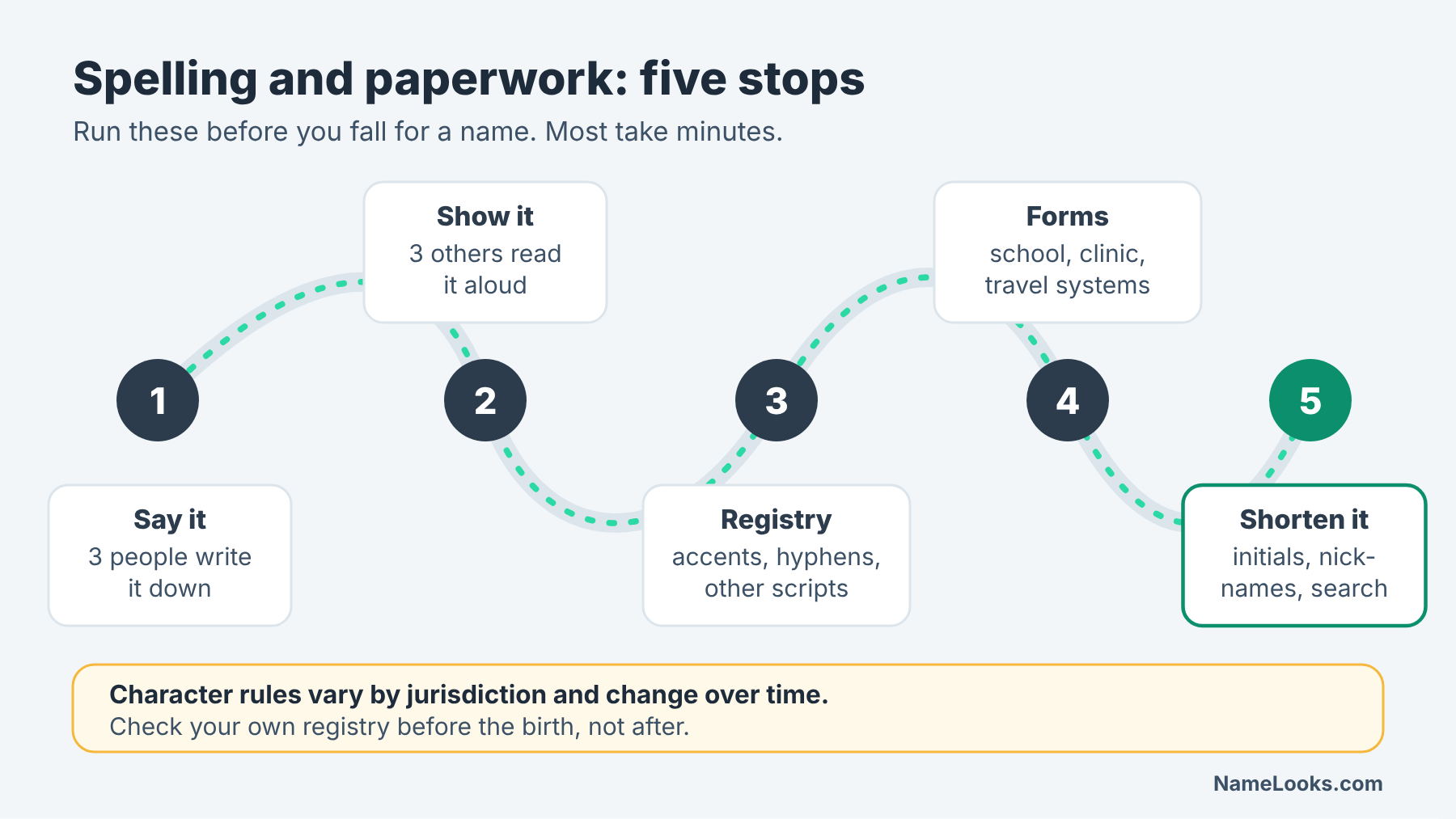
Try this with any spelling you’re considering. Say the name to three people without showing it, and ask them to write it down. Then show the written name to three other people and ask them to say it. Write down every version you get. If most spellings match yours and most pronunciations match yours, the name is low-friction. If neither matches, you’ve found a name that will need correcting in both directions: spelling it out on the phone and correcting how people say it.
That’s not automatically a reason to drop it. Lots of people happily spend their lives spelling out their names. It is a reason to choose with your eyes open, and to think about whether the child, not just the parents, will be the one doing the correcting.
Practical use: forms, characters, and life outside the family
Practical use is the baby name criterion about how a name behaves once it leaves home. It covers birth registration, identity documents, school systems, medical records, and the plain mechanics of being called, typed, sorted, and shortened. Rules here vary by jurisdiction and change over time, so check current official sources rather than relying on what was true for a friend a few years ago. This section is general information, not legal advice.
Diacritics, hyphens, and what records systems accept
Character rules are a real constraint, and they do change. California is a clear recent example. According to a December 2025 letter from the California Department of Public Health, AB 64 (Chapter 662, Statutes of 2025) allows diacritical marks on a certificate of live birth. The state’s vital records office said it would begin amending records to include them starting July 1, 2026. The letter lists ten acceptable marks, including the acute, grave, tilde, and cedilla. Before that change, California’s vital records had excluded diacritical marks since 1986, according to the bill author’s office.
The takeaway isn’t about California in particular. Character rules differ by state and country, and they shift over time. If your chosen name uses accents, apostrophes, hyphens, or a non-Latin script, check your local birth-registration authority before the birth. Then check how other systems you’ll rely on handle the same characters. Recall that SSA’s tabulation strips hyphens and spaces before counting names, so “Julie-Anne,” “Julie Anne,” and “Julieanne” are tallied as one entry. Systems differ even within one country.
For names that are moved from one script to another, keep in mind that transliteration is not translation. The Unicode CLDR transliteration guidelines define it as converting letters from one script to another without translating the words. They also point out that the same text can be transliterated in many different ways depending on the system used. A family name written in another script may have several legitimate Latin spellings, and it’s worth deciding on one before the paperwork decides for you.
When a name needs to change later
Most parents don’t plan to change a name, but knowing the process exists can take some pressure off. Procedures depend entirely on jurisdiction. In the U.S., the Social Security Administration explains that to get a corrected card after a legal name change, you need evidence of identity, of the new legal name, and of the name-change event. Its name correction FAQ walks through the options. Passports are handled separately by the U.S. State Department, which has its own rules, so check its current guidance before you apply for a child’s passport under a changed name.
In England and Wales, GOV.UK explains that a child’s name can be changed by deed poll, and enrolling that deed poll needs the agreement of everyone with parental responsibility or a court order (see the GOV.UK deed poll guidance). Local register offices also describe a separate route for changing a child’s first names within 12 months of birth registration, with conditions and a fee. Lincolnshire County Council, for one, listed a £44 fee when we checked. Fees and details vary, so confirm with your own register office.
None of this makes changing a name trivial. It does mean that a name you’re 90% sure about is not an irreversible gamble. For a fuller list of what to confirm before you register, see the pre-decision naming checklist, which covers documents and everyday-use checks in order.
Initials, nicknames, and digital life
Practical use also includes how a name gets shortened and combined. Initials appear on monogrammed gifts, workplace usernames, and shared family accounts. Nicknames get made up by other people whether you like them or not. Online, a name becomes an email address, a handle, and a search result.
Shortenings you can predict
Write out the full initials (first, middle, last) and the first-and-last initials alone. Read both as if they were a word. Then list every obvious shortening of the first name and ask whether you’d be happy hearing each one. You can’t control nicknames. You can avoid picking a name whose most likely nickname is one you dislike, unless you’re prepared to accept that it will happen anyway.
Search results and handles: what you can and can’t check
Some parents search a candidate full name online to see who else has it. That can turn up a notable namesake you’d rather avoid, or reassure you that the name is clear. It can’t tell you what will be true in twenty years, and it can’t promise any username or domain will be available when your child wants it. Treat it as a quick check for big, obvious associations, not a guarantee. A name being “taken” online by other people is normal and usually harmless. A name shared with one very prominent person is a different situation, and only you can judge whether you’d mind.
5A practical rule for when baby name criteria conflict
By this point you know what each criterion measures and how to check it. The hard part is what happens when a name scores well on three criteria and badly on two. Weighted spreadsheets promise to solve that with arithmetic. In practice they tend to move the argument into the weights, where it’s harder to see. A simpler rule works better for most families.
Rank your criteria before you rank your names
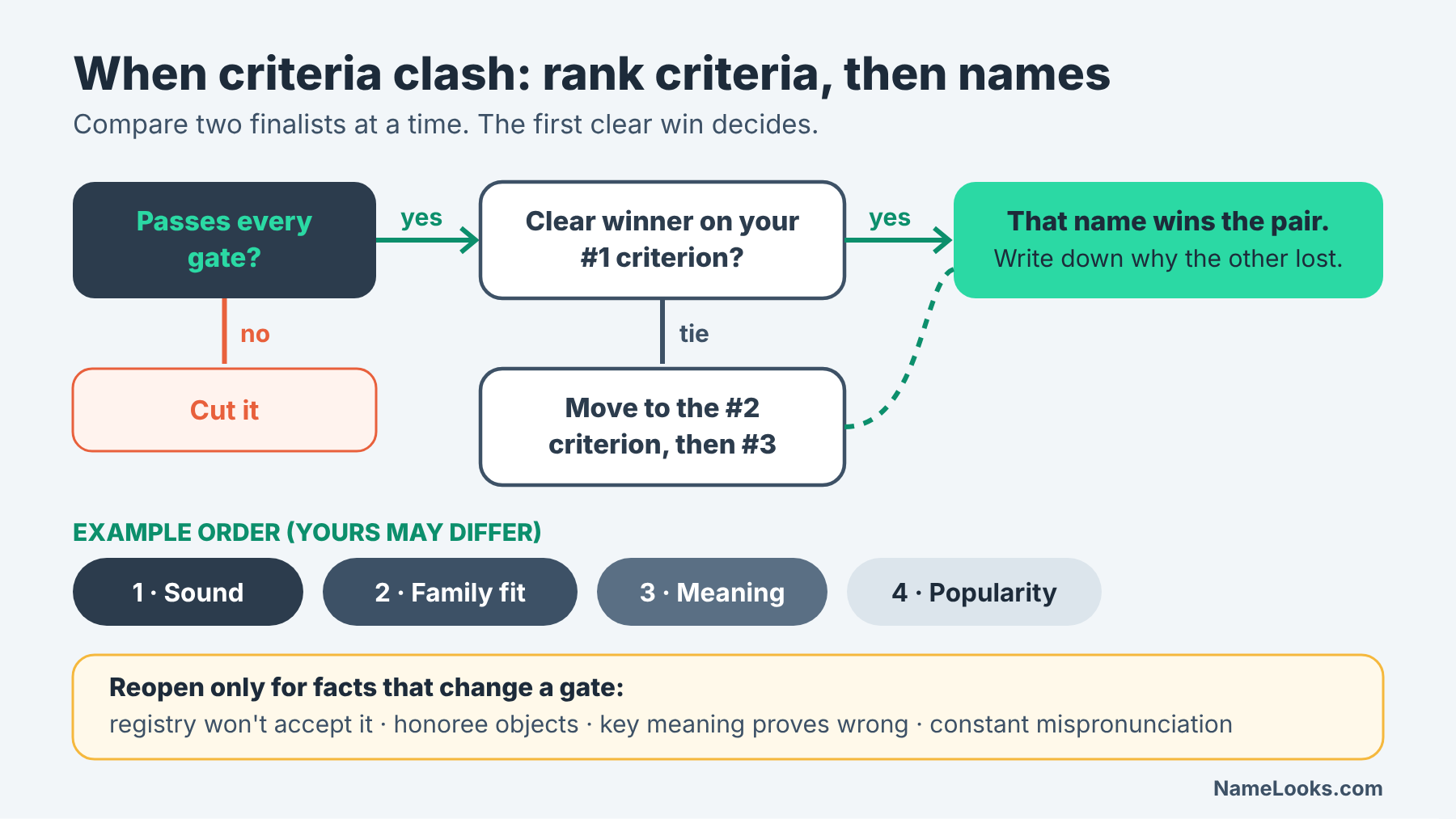
The rule for ordering baby name criteria has three steps. First, apply your gates. Any name that fails a hard limit (a character your registry won’t accept, a clash with a sibling’s name, a broken family promise) is out. Second, agree on the order of your remaining preferences, from “we’d give up almost anything for this” to “nice if we can get it.” Third, compare finalists one criterion at a time in that order. Stop at the first criterion where one name clearly beats the other.
- List your gates. Write down only the criteria that truly rule a name out for your family. Usually there are two to four.
- Order the rest. Each decision-maker puts the remaining criteria in priority order on their own, then you compare lists and settle on one shared order.
- Compare pairs, top criterion first. Take two finalists. Does one clearly win on your top criterion? If so, it wins the pair. If they’re roughly tied, go to the next criterion.
- Record why each name lost. A one-line reason (“lost on spelling friction”) stops old debates from coming back.
- Sleep on the winner. Live with the top name for a few days before you announce it. Notice whether you start using it.
Why ordering beats weighting
Weighting asks you to say that sound is worth, say, 25% and meaning 15%. Few people actually hold preferences that precisely, so the numbers end up adjusted until the spreadsheet produces the name someone already wanted. Ordering asks a question people can answer honestly: “If we had to give one of these up, which would it be?” That’s a judgment call, but it’s an open one, and it can’t be gamed the way a decimal can.
This isn’t a peer-reviewed finding about naming. It’s our editorial view, based on the simple fact that ordering is easier to discuss out loud than weighting. If your family really does think in weights, use them. Just write the weights down before you score any names, not after.
A worked example with three finalists
Picture parents with three finalists: an honor name, a name they both love the sound of, and a name with an etymology that matters to one of them. Their gates are “spellable by grandparents in both family languages” and “no clash with the older sibling.” All three pass. Their preference order is sound, then family fit, then meaning, then popularity.
On sound, the honor name falls behind the other two, which are roughly tied. On family fit, the name with the meaningful etymology also connects to the other parent’s heritage, so it pulls ahead. They choose it as the first name and move the honor name to the middle. The record reads: “Honor name lost on sound with our surname; kept as middle name.” Nothing was scored and nothing was averaged, but the reasoning is clear to anyone who asks later.
If you’re still working down from a longer list, cut to finalists first. The shortlist method for getting to a final five handles that stage. Our piece on how long a final shortlist should be explains why too many finalists make this rule harder to apply.
New evidence that should change your mind
A good rule for weighing baby name criteria should also tell you when to reopen the decision. Most new information shouldn’t move you. A stranger’s raised eyebrow, a single online comment, or a celebrity giving the same name to a baby usually tells you very little. A few kinds of evidence, though, deserve a second look.
Signals that should reopen the decision
Reopen the question if you find that the name or spelling can’t be recorded as you intended where the birth will be registered. Reopen it if someone the name is meant to honor, or a family member with a real stake, objects for a reason you hadn’t known. Reopen it if a reputable source shows that the meaning you were relying on is wrong or disputed and the meaning was one of your gates. And reopen it if your own testing shows that most people mispronounce or misspell the name in a way you find you can’t live with.
Notice what those have in common. Each is a fact that changes whether a gate is passed, not just how you feel about a preference. That’s the line between new evidence and ordinary second-guessing.
Signals that are just noise
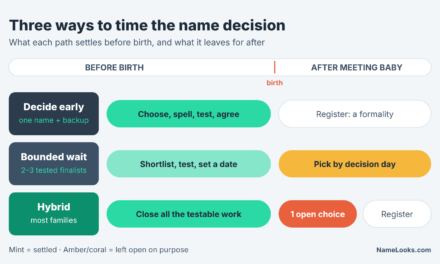
A modest year-to-year change in rank is usually noise for this decision. So is a single person’s dislike, unless that person is the child’s other parent. So is the discovery that another family you know picked something similar, unless the children will be in constant contact. If you’re timing the decision around the birth, our guide on choosing before the birth or after meeting the baby looks at how waiting changes which evidence you can gather.
The table below puts these ideas into scenarios. Each row starts with what a family is trying to achieve and ends with the fact that would flip the choice.
| Chooser’s goal | Option favored | Reason | Downside | Fact that changes the choice |
|---|---|---|---|---|
| Honor a specific relative | Honor name, first or middle | Family fit is a gate here; other criteria break ties | May not suit the surname, or may feel dated to one parent | The relative or tradition expects a first name specifically |
| Avoid sharing a name with classmates | Names outside the current top tier for your country and sex | Popularity data gives a population-level guide | National data misses local clusters; spelling variants hide true frequency | Adding up all spellings shows the spoken name is common after all |
| Work in two languages | Names pronounced and spelled consistently in both | Spelling and sound become gates, not preferences | Narrows the pool, sometimes a lot | One language community’s pronunciation is a stronger priority than the other’s |
| Low paperwork friction | Conventional spellings without special characters | Practical use leads; fewer corrections over a lifetime | May give up an authentic original-language form | The local registry and key systems handle the needed characters |
| Meaning matters most | Names with documented, undisputed etymologies | Meaning can be checked in sourced references | Shrinks the pool; many familiar names have uncertain origins | A scholarly source shows the cherished meaning is a later reinterpretation |
| The name should sound right with the surname | Names that pass the read-aloud and call-across-the-room tests | Sound is used daily and heard by everyone | Can override meaning or family fit if left unchecked | A family gate (an honor promise) ranks above sound for you |
Final checks before the criteria have their say
Once a name has survived your gates and your ordered preferences, do two final passes. The first is a sanity check on the facts you relied on. The second is a short pause to see how the name feels outside the decision process.
Re-verify the facts you used
Go back to every factual claim that shaped the decision. Is your popularity figure from the latest year, for your country, for the exact spelling and sex? Is your etymology from a source that cites its references, and did you note any dispute? Have you confirmed your registry’s character rules for this specific name? It takes ten minutes and catches the occasional mistake that would otherwise follow the name around.
Live with it for a few days
Use the name privately for a few days: in conversation with each other, on a note on the fridge, in an imagined introduction. Watch for two signals. Do you reach for it naturally? Does anything about it bother you more each time? A name that wears well under casual use has passed the one test no checklist captures.
If you’re worried about second thoughts later, our regret-prevention guide covers the late-stage doubts parents report most often and how to tell real red flags from nerves. And for the bigger picture of how these criteria fit into the whole naming process, you can always come back to how to choose a name without endless lists.
Questions people actually ask
What are the most important baby name criteria?
No single ranking is right for every family, so the honest answer is “whichever ones your family won’t trade away.” In practice, spelling and practical use are the most overlooked, because they don’t feel romantic but they shape daily life. Start by sorting the six criteria into gates and preferences, then rank only the preferences.
Should we pick a name based on its meaning?
You can, but check the meaning first. Many meanings repeated online are modern associations rather than documented etymologies. If meaning is central for you, look for a source that cites its references and says when an origin is uncertain, and be ready to describe a disputed meaning honestly.
Does a name’s popularity rank tell me how many kids will share it?
Not directly. A rank is a position in a list for one year, one sex, and one geography. The SSA’s top-five page, for example, shows ranks without birth counts. Classroom overlap depends on local patterns and on how many spelling variants of the same spoken name are in use, which rankings list separately.
Is it a problem if our baby’s name uses accents or special characters?
It depends on where the birth is registered. Rules differ by jurisdiction and change. California, for example, passed a law in 2025 allowing diacritical marks on birth certificates, with records amendments beginning in July 2026. Check your local registry, and then test how schools, clinics, and other systems you’ll use display the name.
How do we choose when one partner cares about meaning and the other about sound?
Translate each word into a testable question first. “Meaning” may turn out to be about a specific person, which is family fit. “Sound” may be about the surname. Once the criteria are concrete, a split solution, like one criterion for the first name and another for the middle, is often easier to see.
Can we use a spreadsheet to score names?
You can, but write down the weights before scoring any names, and treat the result as a conversation starter rather than a verdict. Most families find that agreeing on an order of priorities and comparing finalists in pairs is more transparent than averaging scores.
Sources and further reading
- SSA Popular Baby Names — U.S. birth-name rankings and counts by sex, through birth year 2025.
- SSA baby names background — methodology: the five-occurrence threshold, separate spellings, how hyphens are handled.
- SSA top five names by year — historical No. 1 to No. 5 rankings since 1926 (ranks only, no counts).
- ONS baby names in England and Wales, 1996 to 2025 — ranks and counts from birth registrations.
- U.S. Census 2020 names — how common first and last names are across the whole population.
- Unicode CLDR person names — how name order and structure differ across locales.
- Unicode CLDR transliteration guidelines — why one name can have several legitimate romanizations.
- California Department of Public Health letter on diacritical marks (Dec. 2025) — an example of birth-record character rules changing.
- Behind the Name references — the reference works behind a widely used secondary etymology index.
- Laham, Koval & Alter (2012), the name-pronunciation effect — peer-reviewed research on pronounceability and impressions.
- SSA name correction FAQ and GOV.UK deed poll guidance — official name-change procedures for the U.S. and the UK.
NameLooks provides general information, not legal advice. Popularity data describes populations, not individuals, and rules on names, characters, and name changes depend on your jurisdiction and can change, so confirm with the relevant official authority.