Choosing baby name with partner input from both sides usually stalls for one reason: each of you is defending a name, when what you actually need is a process that protects what each of you cares about. This page treats the disagreement as a design problem, not a contest. You’ll get ground rules, five fair methods, two working tables, and a decision rule built so that nobody walks away feeling they lost.
The short version
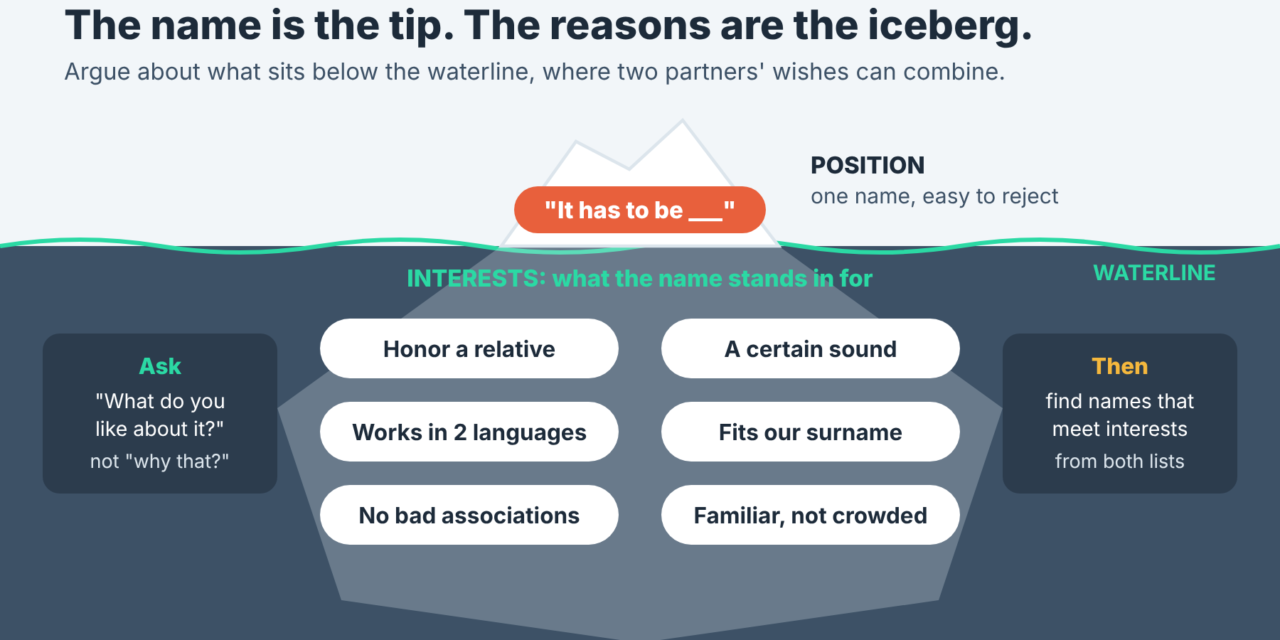
- Argue about reasons, not names. A name is a position. “I want it to work in my parents’ language” is an interest, and interests can usually be combined.
- Agree on the rules before you trade any names. How vetoes work, how many names each of you may bring, and when the decision happens all matter more than any single candidate.
- Settle facts separately from feelings. Spelling counts, popularity ranks, surname rules and registration deadlines can be checked in official sources; nobody needs to win those arguments.
- Use the strongest objection, not the vote count. When two people decide, majority rule doesn’t exist. The name that neither of you objects to strongly beats the name one of you loves and the other tolerates.
- Write down what would reopen the decision. That keeps second-guessing from turning into a permanent rematch.
1The real decision: a name you can both sign, not a match one of you wins
Most couples start in the same place. One person floats a favorite, the other winces, and within a week there are two private lists and a quiet scoreboard. The trouble is that a scoreboard implies a winner. And a name chosen by one partner over the other’s objection tends to carry that history with it, at every school form and every family dinner.
So let’s define the job more precisely. You are not trying to find the best name in the abstract. You are trying to find a name that both of you can say out loud, sign on a birth registration, and defend to relatives without flinching. That is a narrower target, and it’s a more reachable one.
The broader question of how any person, couple or family should weigh a naming decision lives in our decision framework for choosing a name. This article stays on one problem: two people, two sets of preferences, and the need to land on one answer without turning it into a contest. Choosing baby name with partner agreement as the goal changes what counts as success.
Choosing baby name with partner input: what each of you is optimizing for
When a partner says “I just don’t like it,” that sentence is doing a lot of hidden work. It might mean the name sounds harsh to them. It might mean it belonged to someone they’d rather not think about. It might mean it doesn’t fit the family surname, or that it’s hard to pronounce in a second household language. Each of those is a different problem with a different fix.
Positions versus interests: borrowing a tool from negotiation research
Negotiation teaching has a vocabulary for this. The Harvard Program on Negotiation, summarizing the principled-negotiation approach from Getting to Yes by Roger Fisher, William Ury and Bruce Patton, describes positions as surface-level statements and interests as the needs and concerns underneath them. The four elements it lists are separating the people from the problem, focusing on interests rather than positions, inventing options for mutual gain, and insisting on objective criteria. You can read the Program on Negotiation’s overview of principled negotiation for the full framing.
We want to be careful here. That framework was developed for negotiation broadly, not for baby names, and we know of no controlled research testing it on naming decisions specifically. What it offers is a useful lens, not a proven protocol. Still, the lens fits unusually well, because a name is about as pure a “position” as exists: one word that stands in for a dozen unspoken wishes.
In naming terms, a position is “It has to be Eleanor.” The interests behind it might be any of these:
- honoring a specific relative or a family line;
- a name that sounds a certain way: soft, crisp, long, short, formal;
- a name that works in more than one language spoken at home;
- a name that’s familiar enough that the child won’t spell it every day, or distinctive enough that they won’t share it with three classmates;
- a name with no baggage for either of you from past relationships, coworkers or public figures;
- a name that ages well from toddler to adult professional.
Once interests are visible, you often find that one partner’s two biggest interests and the other’s two biggest interests don’t actually conflict. The conflict was between two particular names, which is a much smaller problem.
A ten-minute exercise to surface the interests
Here’s a practical way to get underneath the names. Each of you writes, separately, three names you like. Then, for each name, write one sentence that starts “What I like about this is…” Do not write the name’s meaning or popularity unless that is genuinely what draws you. Swap papers and read only the sentences, not the names.
Picture a hypothetical couple doing this. One partner’s sentences say “short,” “doesn’t get shortened,” and “sounds good with our last name.” The other’s say “connects to my grandmother,” “has a nickname option,” and “isn’t in the top ten.” Notice that nothing on either sheet contradicts the other. Their actual favorites may still clash, but the brief they’ve jointly written is coherent. A short name with a family connection that isn’t heavily used could satisfy almost every line.
Why read the sentences before the names
Names trigger instant reactions, and those reactions are hard to walk back once spoken. Reading the reasons first lets each of you agree with something your partner wants before you’ve had the chance to reject what they suggested. That small sequence change does a lot of emotional work.
Constraints and information you may still be missing
A surprising share of naming arguments are really arguments about facts neither partner has checked. “Nobody uses that name anymore.” “That’s going to be really common.” “We can’t put two surnames on the birth certificate.” Each of those is a factual claim, and each can be checked in minutes. Arguing about them as if they were matters of taste wastes goodwill you’ll need later. Facts are the cheapest part of a naming disagreement to settle, so settle them first.
Facts you can settle from official sources
Popularity and usage. For births in the United States, the Social Security Administration publishes national and state name data drawn from Social Security card applications, going back to births after 1879. Its background notes on the baby name data explain two details that settle many couple debates. Names with fewer than five occurrences are excluded for privacy. And different spellings are not combined: SSA’s own example lists Caitlin, Caitlyn, Kaitlin, Kaitlyn, Kaitlynn, Katelyn and Katelynn as separate names. So “that name isn’t common” can be true for one spelling and false for the sound.
For England and Wales, the Office for National Statistics publishes ranks and counts of baby names, with the 2025 edition released on July 9, 2026. It includes rank and count for boys and girls, changes since the previous year, and breakdowns such as region and mother’s age. A rank and a count answer different questions, so decide together which one you care about before you look.
Surname structure. If you’re deciding between one surname, a hyphenated surname or two surnames, it helps to know that naming systems vary widely and that software standards already account for that. Unicode’s CLDR person-names specification includes a separate “surname2” field, described as a secondary surname used in some cultures, such as the second or maternal surname in Mexico and Spain. That doesn’t tell you what your local registry will accept. It does tell you that a two-surname name isn’t an exotic edge case to the systems that format names.
Registration rules and deadlines. In England and Wales, GOV.UK states that births must be registered within 42 days. Its page on who can register a birth explains that married or civil-partner parents can each register alone, while unmarried parents have specific routes for both names to appear. In the United States, birth records are handled at the state and territory level; the CDC’s Where to Write for Vital Records directory points to each jurisdiction’s office. Rules change, so check your own jurisdiction directly. This is general information, not legal advice.
Information gaps worth closing before the next round
Some constraints can’t be looked up. They have to be asked about. Before you trade another list, check whether either of you is carrying an unspoken expectation from family. Has a parent assumed a namesake? Is there a religious or community naming practice that one of you wants to follow? Does a grandparent who’ll be closely involved speak a language in which a candidate is hard to pronounce?
Those questions matter because they often explain the intensity of a partner’s reaction. A partner who rejects every name without a particular sound may be protecting a relationship with a relative, not being difficult. Asking “Is anyone expecting something from us here?” early can save weeks of circling.
One more gap: you may not agree on the baby’s surname yet. Settle that first if you can. Nearly every judgment about rhythm, initials and flow depends on what comes after the first name, and couples who skip this step often find their finalists collapse once the surname is finally decided.
Fact or feeling? A quick sort
Before discussing any candidate, sort each objection into one of two piles. Facts can be checked: how a spelling ranks in SSA or ONS data, whether initials spell something, what a registry accepts. Feelings can’t be checked and don’t need to be: “it reminds me of my ex’s boss” is valid as stated. Check the first pile together. Respect the second pile without asking for proof.
2Five fair methods for choosing baby name with partner buy-in, compared
There is no single correct process. There are, however, processes that reliably create a winner and a loser, and processes that don’t. The five below are the ones we think are worth knowing, grouped by what they change: some narrow the field by agreement, others change who controls which part of the name. None of them is backed by naming-specific research; they’re structured ways of doing what couples already try to do informally when choosing baby name with partner preferences pulling in different directions.
Before picking one, agree on two ground rules. First, nobody’s suggestion gets mocked, even privately. A name that seems absurd to you may be a stand-in for something that matters a great deal to your partner. Second, any name can be withdrawn by the person who suggested it without explanation. That makes it safer to float ideas you’re not sure about.
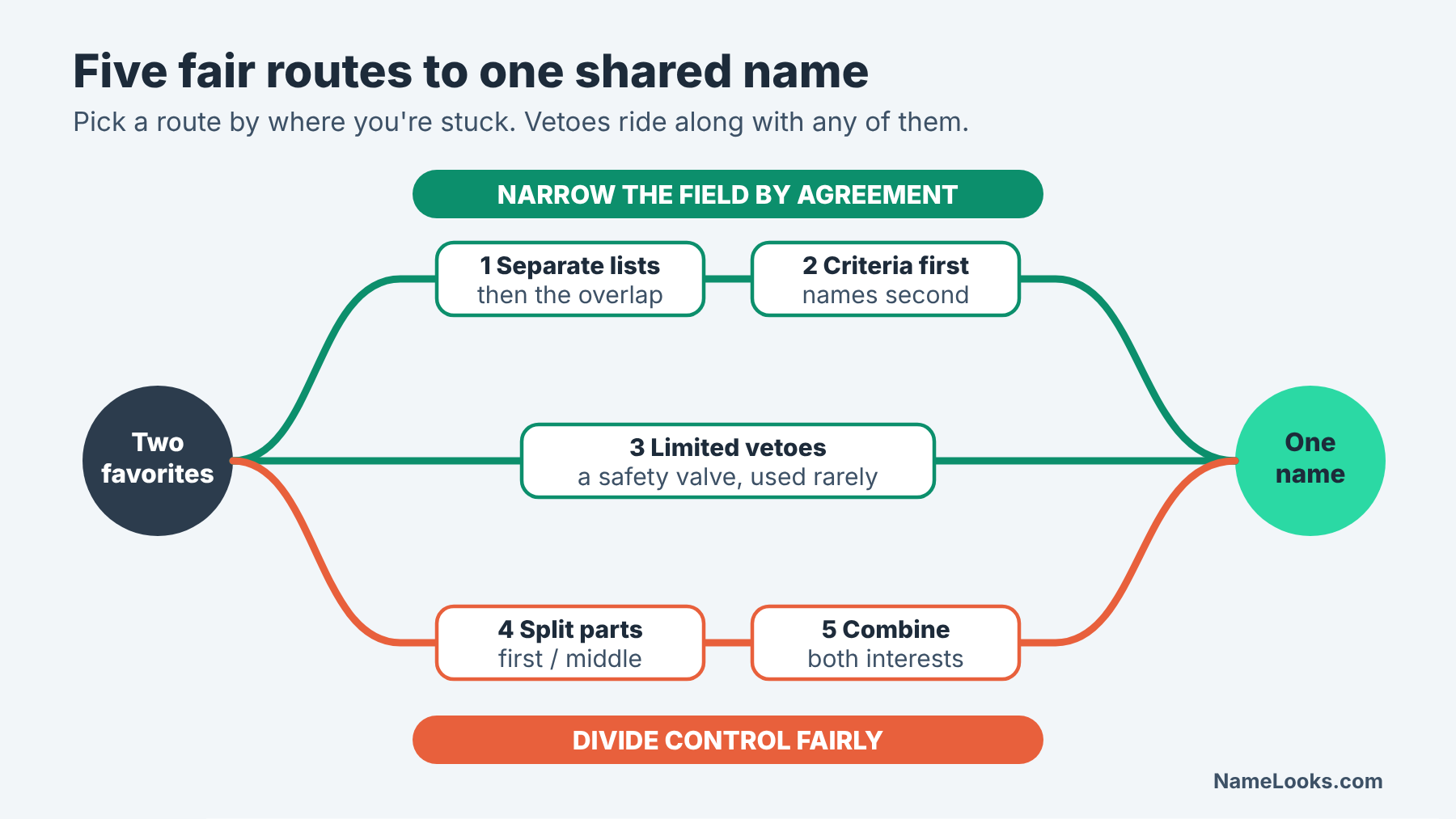
Methods that narrow the field by agreement
These three keep both partners on equal footing throughout. They’re slower than letting one person decide, but they produce a name both people actively endorse rather than accept.
Method 1: Separate lists, then the overlap
Each partner builds a list alone, without sharing, for a fixed period. A week works for many people. Then you compare and look only at names that appear on both lists, or names whose features appear on both: same length, similar sound, the same kind of connection. The overlap becomes the working list.
This method’s strength is that it prevents anchoring. When one partner shares a favorite first, the other tends to react to it instead of generating their own ideas. Its weakness is that the overlap is often empty, especially for couples with different tastes. If that happens, don’t treat it as failure. Look at the features both lists share, and use them as a search brief for a second round. If you need a structured way to cut a large combined list down, our shortlist method for turning 100 favorites into five covers the narrowing step in detail.
Method 2: Criteria first, names second
Instead of trading names, trade requirements. Together, you write a short brief: three to five conditions every candidate must satisfy. For example: “works with our surname,” “easy to say for both grandmothers,” “has at most one common nickname,” “not used by anyone in our close circle.” Only after you both sign off on the brief do names enter the conversation.
The advantage is that it moves disagreement upstream, where it’s less personal. It’s far easier to debate “should the name be short?” than to reject a specific name your partner loves. When a name later fails the brief, it fails the brief you wrote together, not your partner’s taste. The risk is that a brief can become a weapon if one partner keeps adding conditions that happen to exclude the other’s favorites. Cap the list and freeze it once agreed. For a fuller set of criteria worth considering, see our breakdown of baby name criteria such as sound, family fit and spelling.
Method 3: Limited vetoes, used sparingly
Each partner gets a fixed number of vetoes, and a veto is absolute and needs no justification. The point of the limit is to force prioritization. Unlimited vetoes turn into a stalemate where every suggestion dies on arrival; a small number makes each veto cost something.
Veto systems work best when combined with one of the methods above. Use them to remove names from a working list, not to block names before they’ve been discussed. And pick a number before any names are on the table, so neither of you sets the limit with a particular name in mind. Some couples allow vetoes to refresh once the shortlist is cut, which keeps late-stage objections possible without making them free.
The veto trap
A veto protects against a name you can’t live with. It is not a tool for steering the outcome. If one partner is using vetoes on every name the other proposes, the problem isn’t the names. Pause the process and go back to the interests exercise above, because something underneath hasn’t been said yet.
Methods that change who controls which part
Sometimes the most workable answer isn’t to agree on everything, but to divide the decision in a way that both partners see as fair. These methods accept that you may not converge and build fairness into the structure instead.
Method 4: Split the components
A full name usually has several parts: a first name, often a middle name, and a surname. Some couples assign them. One partner leads on the first name and the other on the middle; or one leads on the first child’s name and the other on the second’s. Each partner still has a veto over the other’s choice, but the initiative belongs to one person.
This is the most “transactional” method, and that’s both its appeal and its risk. It’s fast and clear. But first and middle names don’t carry equal weight in daily life, and alternating across children assumes there will be more children, which isn’t something anyone can promise. If you use it, be honest about which part you’re each getting. A middle name is an excellent home for an honor name precisely because it carries less daily load; it’s a poor consolation prize if one partner experiences it as being sidelined.
Method 5: Combine the interests into a new candidate
This is the “invent options for mutual gain” move from negotiation, applied directly. Take the strongest interest from each partner and look for names that meet both. One partner wants a family connection; the other wants something short. Is there a short form, a variant spelling used in the family’s language, or a different relative’s name that also satisfies both? One partner wants a name that works in Spanish and English; the other wants nothing in the national top 50. Is there a name in that intersection?
The combined approach often produces the most satisfying outcomes, because the name ends up “belonging” to both partners. Its cost is effort: it requires actual research rather than reacting to names. When a variant or cultural form is part of the idea, verify it in a reliable reference rather than assuming a relationship between two names. A spelling that looks related may come from a different source entirely.
Best when you’re far apart
Criteria first (Method 2) or Combine interests (Method 5). Both move the argument away from specific names.
Best when you’re short on time
Split the components (Method 4), with a mutual veto. Fast, but be candid about the trade.
Best when one of you dominates
Separate lists (Method 1). It forces both partners to generate ideas before reacting.
Use alongside any method
Limited vetoes (Method 3). A safety valve, not a strategy on its own.
Comparing two finalists side by side
Eventually most couples arrive at two names, each one partner’s favorite. That’s the moment in choosing baby name with partner input where things tend to get stuck. This is where a structured comparison helps more than another round of “but I just love it.” The table below is a worksheet, not a scoring system: you don’t add up points. You fill it in together and see where the actual differences are.
What the matrix is for
Each row is a dimension where two names can genuinely differ, and each column describes what to check without assuming the answer. The “how to check” column matters most. It turns contested claims into tasks either partner can do, and it keeps whichever partner is better at arguing from simply arguing louder.
| Dimension | Finalist A (partner 1’s pick) | Finalist B (partner 2’s pick) | How to check it together | Common trade-off |
|---|---|---|---|---|
| Meaning and origin | Write the sourced meaning, or “unknown” | Same; note if sources disagree | Use a scholarly dictionary or a referenced site; record the source, not a guess | A meaningful origin may matter to one partner and not at all to the other; that’s fine, but it shouldn’t be invented |
| Sound with surname | Say the full name ten times | Same | Both partners say it, in normal speech, including shouted across a room | A name that flows with one surname may clash with a hyphenated or double surname |
| Spelling and pronunciation | How many plausible spellings? | Same | Ask a few people to spell it after hearing it once | Distinctive spellings reduce sharing but increase correcting |
| Usage data | Rank and count, exact spelling | Same | SSA for U.S. births, ONS for England and Wales; name the year and the metric | Spelling variants are counted separately, so the sound may be more common than the rank suggests |
| Family and language fit | Who will say it most? | Same | Ask the relatives who’ll use it, in the languages they’ll use | A name easy in one household language may be awkward in the other |
| Nicknames and initials | Likely short forms; initials | Same | Write all initials with middle and surname; list nicknames you’d dislike | A loved name may come with a disliked nickname you can’t fully control |
| Strength of objection | Partner 2’s honest objection, 0–3 | Partner 1’s honest objection, 0–3 | Each partner rates privately, then reveal together | This row usually decides it; see the decision rule below |
Filling it in without stacking the deck
Fill in the factual rows together, ideally at the same screen. When one partner researches alone, the other is entitled to wonder which facts were selected. If you’re checking usage data, look up both names in the same dataset and the same year, using the same metric. Comparing one name’s U.S. rank with the other’s England and Wales count produces a comparison that means nothing.
The last row is the most important, and it’s the one people skip. A partner who rates their objection to the other’s favorite as a 1 (“I’d be fine with it”) is offering something real. A 3 means “I’d struggle with this every day.” Two people can disagree about every other row and still find the decision obvious once that row is filled in honestly. For how much popularity data should matter to the decision at all, our piece on popular versus uncommon names works through the uniqueness question on its own terms.
3A practical decision rule: lowest objection wins, not loudest enthusiasm
With two decision-makers, there is no majority. Every rule that counts votes ends in a tie, so couples fall back on other tiebreakers: who cares more, who carried the pregnancy, who has the bigger family, who argued longer. Each of those quietly creates a winner and a loser.
We’d suggest a different rule, and we’ll label it clearly as our editorial suggestion rather than a research finding: choose the name with the lowest strongest objection. Not the name with the most combined enthusiasm, and not the favorite of the partner who feels more strongly. The name that neither of you has a serious problem with.

What favors one path over another
The lowest-objection rule is a default for choosing baby name with partner agreement, not a law. There are situations where a different path makes more sense, and it helps to know them in advance so you can name them when they apply.
Why the rule focuses on objections
Enthusiasm and objection aren’t mirror images. A partner who loves a name gains something if it’s chosen. A partner who strongly objects to a name carries a cost every time it’s spoken, written or explained. Since both of you will live with the name for decades, minimizing the worst daily experience tends to matter more than maximizing the best one.
There’s also a practical reason. Enthusiasm is easy to inflate in a negotiation, because saying “I love it” costs nothing. A ranked objection is harder to fake when you know it may be used to decide. Ask each other: if this were the name, how would you feel saying it at a parent-teacher meeting? At a family funeral? On a bad day? The answers are usually more honest than “how much do you love it?”
For couples who want a lightweight structure, here’s how the rule plays out in practice:
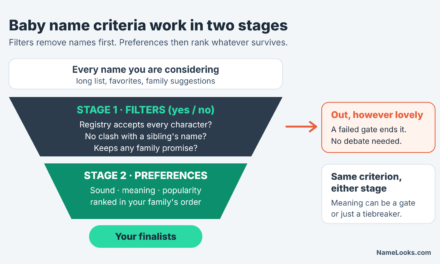
- List the finalists. Two to four names is a workable range. More than that and the ratings get noisy; our guide to how many names belong on a final shortlist explains why the right size depends on your situation rather than a magic number.
- Rate objections privately. Each partner rates every finalist from 0 (no objection) to 3 (would struggle with this). Do this on paper or in separate notes, not out loud.
- Reveal together. For each name, take the higher of the two objection ratings. That’s the name’s “strongest objection.”
- Pick the lowest. The name with the lowest strongest objection is the default choice. If two names tie, the one with more combined enthusiasm breaks the tie.
- Sleep on it. Agree on a waiting period, then confirm. If nothing new has come up, the decision stands.
Situations where a different path makes sense
The rule assumes both partners have roughly equal stakes in every dimension. Sometimes they don’t. Three cases are worth naming.
A specific cultural or religious naming practice. If one partner’s family follows a tradition with particular requirements, such as a naming ceremony, a name tied to a specific relative, or a requirement in a particular language, that interest may deserve more weight than a general preference. That’s not because one family matters more. It’s because one interest is rooted in obligations to a community and the other may be a matter of taste. Have that conversation openly rather than burying it in objection scores. Naming practices vary enormously within any culture, so don’t assume what a tradition requires; ask the people who practice it.
An honor name with real stakes. When a name honors someone who recently died, or someone who’ll be closely involved in the child’s life, the partner with the connection may feel the stakes far more acutely. A middle name is often the right compromise here, though it’s not automatically a lesser placement if both of you see it that way.
A known, specific problem. If one partner’s objection is factual and concrete, like a name that is a slur or insult in a language spoken in the family, or initials that spell something unfortunate, that objection should probably end the discussion regardless of ratings. Our guide to preventing name regret before it starts covers the specific checks for pronunciation, spelling, associations and initials.
What new evidence should change the decision
A decision you’ve reached together, after all the work of choosing baby name with partner input, still needs a way to be revisited, or it will be revisited anyway, just badly. The trick is to agree in advance on what kinds of information would reopen it, and to treat anything else as normal second-guessing.
Evidence that genuinely warrants a rethink
Some new information should reopen the question. A short list:
- A factual problem you didn’t know about. The name turns out to have an unfortunate meaning in a language spoken in the family, or the initials with your agreed middle name spell something you hadn’t noticed.
- A practical barrier. A registration requirement in your jurisdiction affects a spelling, character or surname combination you’d planned. Registries in different places have different rules, and some have restrictions on characters, length or form; check with the registering office rather than relying on general advice.
- A shift in family circumstances. A relative you’d planned to honor is upset by the gesture, or a new family connection appears that one partner wants to recognize.
- A change in a partner’s objection rating. If one partner’s discomfort with the agreed name grows from a 1 to a 3 over weeks, take it seriously. Ignoring a growing objection rarely makes it go away.
A rising popularity rank is a weaker reason than most people think. If the name you’ve chosen climbs in SSA or ONS data, that may matter to one of you. But usage data describes populations, not individual children’s experiences, and the ranking shifts year to year. If you agreed earlier that popularity was a minor factor, a rank change by itself shouldn’t override that agreement.
A pre-agreed reopening clause
Once you choose, write a short note together: “We’ll revisit if any of the following happens,” followed by the list you agreed on. Then agree on what does not reopen the decision. That second list usually includes things like a relative’s general disapproval, an online comment, a passing celebrity association, or one partner’s mild doubts at 3 a.m.
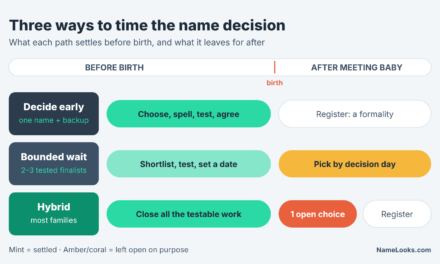
That simple step does two things. It prevents a decision from being relitigated every time someone feels uneasy. And it gives a partner with a genuine new concern a legitimate way to raise it, without having to argue that the whole process was wrong. If you’re unsure whether to lock in a name before the birth at all, our comparison of deciding before birth versus after meeting the baby covers the timing question in detail.
Hypothetical: the rule in action
Imagine a couple with three finalists. Partner 1 rates their objections 0, 2 and 1; partner 2 rates theirs 3, 0 and 1. The first name’s strongest objection is 3, the second’s is 2, and the third’s is 1. Neither partner’s favorite wins. The third name does, because it’s the only one that neither person would struggle with. That outcome often surprises couples, and it’s the point: the name is chosen by the process both agreed on, not by one person.

4How to talk about it: scripts, timing and the stuck points couples hit
Process only helps if the conversations themselves go reasonably well. Tone does as much work as method. Most naming arguments aren’t about the names at all by the time they get heated. They’re about feeling dismissed, rushed or outnumbered. A few habits make those conversations much easier.
Phrasings that keep the conversation open
The words you use when you react to a name matter more than they seem to. A flat “no” closes a door. A specific reason opens one, because it gives your partner something to work with.
Reacting to a name you don’t like
Try naming the feature you’re reacting to, not the name. Instead of “I hate that,” something like: “I think it’s the hard ending that isn’t working for me. Is there a version that’s softer?” Or: “I like where it comes from, but I keep hearing it with our last name and it runs together.” Each of those points toward a fix.
When the reason is personal, it’s fine to say so without detail: “That one has an association for me I’d rather not get into. Can we put it aside?” A respectful partner won’t ask for proof. If the association is something your partner should know about, like a person they’ll meet, say that much at least, so the objection doesn’t look arbitrary.
And when you’re unsure, say that too. “I don’t love it yet, but I’m not ruling it out” is a perfectly good answer. Names often grow on people, and leaving room for that is kinder than a quick verdict you might later want back.
Proposing a name without pressure
How you introduce a name affects how it’s received. “I’ve decided I really want…” sets up a contest. “Here’s one I keep coming back to, and here’s why” invites a conversation. It also helps to propose names in batches of two or three rather than one at a time. A single proposal feels like a bid; three feel like a menu.
If one partner has been doing most of the proposing, switch roles for a round. The partner who usually reacts may have unexplored preferences they’ve never had space to voice, and the partner who usually proposes gets a break from feeling rejected.
Useful sentences to keep handy
- “What’s the one thing about this name you’d fight to keep?”
- “Is this a ‘no’ or a ‘not yet’?”
- “If we can’t use this exact name, what’s the part of it we could keep?”
- “Let’s both say it a few times this week and talk again on Sunday.”
- “I want us both to be happy with this. What would make it a yes for you?”
Timing, pacing and where to have the conversation
Couples often treat choosing baby name with partner input as one long argument rather than a series of short, scheduled conversations. Spacing it out reduces pressure and gives each partner time to sit with new ideas.
Set a cadence, not a marathon
A naming session of twenty to thirty minutes, once or twice a week, is plenty for most couples. Agree in advance when you’ll talk, and agree that naming doesn’t come up outside those times unless both partners want it to. That keeps one partner from feeling ambushed at dinner, in the car or right before sleep.
Build in a decision deadline that is earlier than the real one. In England and Wales, for example, GOV.UK sets 42 days from birth for registration, and U.S. states set their own timelines through their vital records offices. Choosing a working deadline a few weeks before you’d strictly need to leaves room for late doubts without a scramble.
Testing in real life before you commit
A name that wins on paper sometimes falls flat in the mouth. Use it for a few days in private: in sentences like “dinner’s ready,” “time for bed,” or a full-name call across the house. Both partners should do this, not just the one who proposed it. Our guide to testing a full name out loud walks through rhythm, stress, initials and nicknames in more depth.
One small caution. If you test a name with friends or family, they will give you opinions. Decide in advance whether you want them. Many couples find it easier to keep the name private until after it’s registered, specifically so that outside reactions can’t reopen a decision both partners have made. Others want input from a parent or close friend. Either is fine, but agree on it together rather than having one partner share it unilaterally.
Common stuck points and what tends to move them
Some disagreements recur often enough that it’s worth thinking through them ahead of time. The table below pairs common goals with the approach most likely to help, the downside of that approach, and the type of fact that should change the call. The scenarios are hypothetical patterns, not reports of real couples.
A scenario table for the patterns most couples hit
| What the couple wants | Approach likely to help | Why it helps | Downside | Fact that would change the choice |
|---|---|---|---|---|
| Both want to honor different relatives | One honor name as first, one as middle; or one combined honor | Each relative is recognized; neither partner’s family is passed over | First and middle placements may not feel equal to everyone involved | A relative prefers not to be honored, or a family tradition specifies placement |
| One wants distinctive, one wants familiar | Criteria first: agree on an acceptable usage range | Turns “too common” vs “too odd” into a shared, checkable range | Usage data can be misread; variant spellings are counted separately | Checking SSA or ONS data shows the sound is more or less common than either assumed |
| Two household languages | Combine interests: shortlist only names that work in both | Avoids a name that only one side of the family can say comfortably | Narrows the field considerably | A relative fluent in the language flags a pronunciation or meaning issue |
| Disagreement about the surname | Settle the surname first, then first names | Every first-name judgment depends on what follows it | Surname decisions can be more charged than first names | Your registry’s rules on hyphenation, double surnames or order |
| Endless vetoes; nothing survives | Limited vetoes plus the interests exercise | Forces prioritization and surfaces hidden reasons | Feels formal; some couples resist structure | A partner reveals a specific concern (a person, a memory) behind the vetoes |
| One partner cares far more | Split components with mutual veto | Gives the invested partner initiative without removing the other’s voice | Risks feeling like one partner “won” | The less-invested partner discovers a stronger preference once names are concrete |
When the disagreement is really about something else
Occasionally, a naming impasse is a proxy for a bigger question: whose family will be more involved, whose culture will be more visible in the child’s life, how decisions get made in the relationship generally. If you notice that every name gets measured by “whose side” it comes from, the name is probably not the real issue.
That’s not a crisis, and it doesn’t mean the relationship is in trouble. It does mean that a better process for names will only partly help. Talking directly about the underlying question, with each other first and perhaps with a counselor if it’s persistent, usually does more than another round of lists. A name chosen after that conversation tends to stick.

5When two families, languages and surnames meet
Some of the hardest cases of choosing baby name with partner input involve more than two people’s taste. They involve two family histories, sometimes two or more languages, and occasionally two different expectations about how names work at all. Those situations deserve their own attention, because the usual tie-breakers don’t fit them well.
Surnames: deciding what comes last before what comes first
If you haven’t decided the child’s surname, much of the first-name conversation is premature. Rhythm, initials and the overall shape of the name all depend on it.
Options couples commonly consider
The broad choices are familiar: one partner’s surname, the other’s, a hyphenated combination, two surnames without a hyphen, or a new shared surname. Which of these are possible, and how they’re recorded, depends on where the birth is registered. Don’t assume a choice is available, or unavailable, based on what friends in another place were able to do.
Technical systems vary too. As noted above, the Unicode CLDR specification treats a secondary surname as its own field, which reflects how common two-surname naming is in some places. But many forms, databases and booking systems still assume a single surname field, and hyphens or spaces may be handled inconsistently. SSA’s baby name notes, for example, explain that hyphens and spaces are removed from first names in its dataset, so “Julie-Anne,” “Julie Anne” and “Julieanne” are counted as one entry. That’s a statistics convention, not a legal rule, but it’s a reminder that punctuation in names doesn’t always survive contact with databases.
A practical order of operations
Agree on the surname first, even provisionally. Then write each first-name finalist with the full planned surname, including any hyphen or second surname, before you discuss it. If the surname decision is still open, test your top first names against each surname option. A first name that only works with one surname structure is worth knowing about before you get attached.
If the surname question is the real sticking point, the same tools apply. Interests usually include things like family continuity, practical simplicity, fairness between partners, and what siblings will share. Positions (“it has to be mine”) rarely move; interests usually can.
Two languages, two families, one name
When partners come from different language backgrounds, or when grandparents will speak to the child mainly in a language one partner doesn’t speak, the naming conversation gains a dimension that’s easy to underestimate.
What to check, and with whom
Pronunciation can’t be reliably guessed from spelling, especially across languages. The most useful check is the simplest: ask the people who’ll say the name most often, in the language they’ll use, to say it naturally. Listen for whether it’s comfortable, whether it changes shape, and whether it carries any meaning or association you didn’t expect. Fluent speakers will catch things no list or app will.
Meaning claims deserve the same care. If a name’s meaning matters to one partner, look it up in a reliable reference and note the source. Name sites vary widely in quality. Behind the Name, for example, publishes a page listing the references it draws on, which at least lets you see where its information comes from; treat it as a secondary source and cross-check anything high-stakes. Where sources disagree, it’s fine to say so to each other rather than forcing an answer.
Avoiding assumptions about the other family
It’s easy, under stress, to make assumptions about what the other side of the family wants or “requires.” Practices differ enormously within any language, region or faith, and between individual families. The only reliable way to know what your partner’s family expects is to ask, ideally with your partner present, and to accept that the answer may be “nothing in particular.”
Equally, don’t assume a name signals something to others that it may not. Names are personal, and people bear names from every background. Choose based on what the two of you, and the people closest to the child, actually value, rather than guesses about how outsiders will read it.
Bringing it together
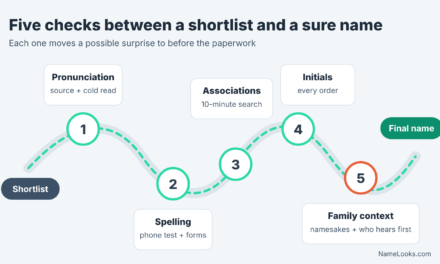
Before you finalize, run through a broader pre-decision check: data, family, culture, documents and everyday use. Our pre-decision naming checklist is built for that last pass, and the overall naming decision framework is useful if you want to step back and look at the whole choice again.
Questions people actually ask
Who gets the final say if we truly can’t agree?
There’s no rule that one partner should, and any default that gives one person the final say creates exactly the winner-loser dynamic this page tries to avoid. If you’re stuck, step back to the interests exercise or agree on a fixed tiebreaker in advance, such as the lowest-objection rule. Deciding the tiebreaker before you know which name it will favor is what makes it fair.
Is it fair for the partner who gave birth to have more say?
Some couples feel it is, and some don’t; there’s no objective answer. What matters is that both of you agree on it openly, rather than one partner assuming it. If you do give one partner more weight, consider making it specific, such as leading on the first name, rather than a general override.
Should we tell family the name before the birth?
That’s a choice for the two of you to make together. Sharing early invites opinions, which some couples welcome and others find destabilizing. If you do share, decide beforehand if you’re asking for feedback or simply announcing, and say which one it is.
What if one partner is far more interested in naming than the other?
A less-engaged partner often becomes more opinionated once real names are on the table, so don’t read early disinterest as permission to decide alone. A practical approach is to have the more interested partner build a shortlist within agreed criteria, and the other partner hold a veto and a final confirmation.
Can we change the name after registration if we regret it?
Sometimes, but the process depends entirely on the jurisdiction, and it’s generally simpler to take more time before registering than to change a name afterward. In England and Wales, GOV.UK directs correction questions to the register office or the General Register Office; in the U.S., each state’s vital records office sets its own rules. Federal records such as Social Security also need updating after a legal change, and SSA explains that a corrected card requires evidence of identity and the name change. Treat all of this as general information rather than legal advice.
Does it help to use a baby-name app that matches our likes?
Matching apps can be a convenient version of the separate-lists method, because they surface overlap without either of you seeing the other’s picks. They’re less useful for the harder part: understanding why you each like what you like. Treat matches as a starting point, then talk about the reasons behind them.
Sources and further reading
- Harvard Program on Negotiation: Principled Negotiation — the interests-versus-positions framing and the four elements from Getting to Yes.
- SSA Popular Baby Names — U.S. birth-name ranks and counts, current through 2025.
- SSA baby name background notes — why spellings are separate, the five-occurrence minimum, and how hyphens are handled.
- ONS Baby names in England and Wales: 2025 — ranks and counts for England and Wales, released July 2026.
- U.S. Census Bureau 2020 names data — population-level first and last name frequencies for names reported 100 or more times.
- Unicode CLDR Person Names — how international software standards model given names, middle names and secondary surnames.
- GOV.UK: Who can register a birth — registration rules for married, civil-partner and unmarried parents in England, Wales and Northern Ireland.
- CDC: Where to Write for Vital Records — directory of U.S. state and territory birth-record offices.
- SSA: changing or correcting a name on a Social Security card — what’s needed after a legal name change.
- Behind the Name: references — a secondary name-meaning source that lists the works it draws on.
NameLooks provides general information about names and naming decisions, not legal, medical or counseling advice. Popularity data describes populations, not individuals, and registration, surname and name-change rules depend on your jurisdiction.