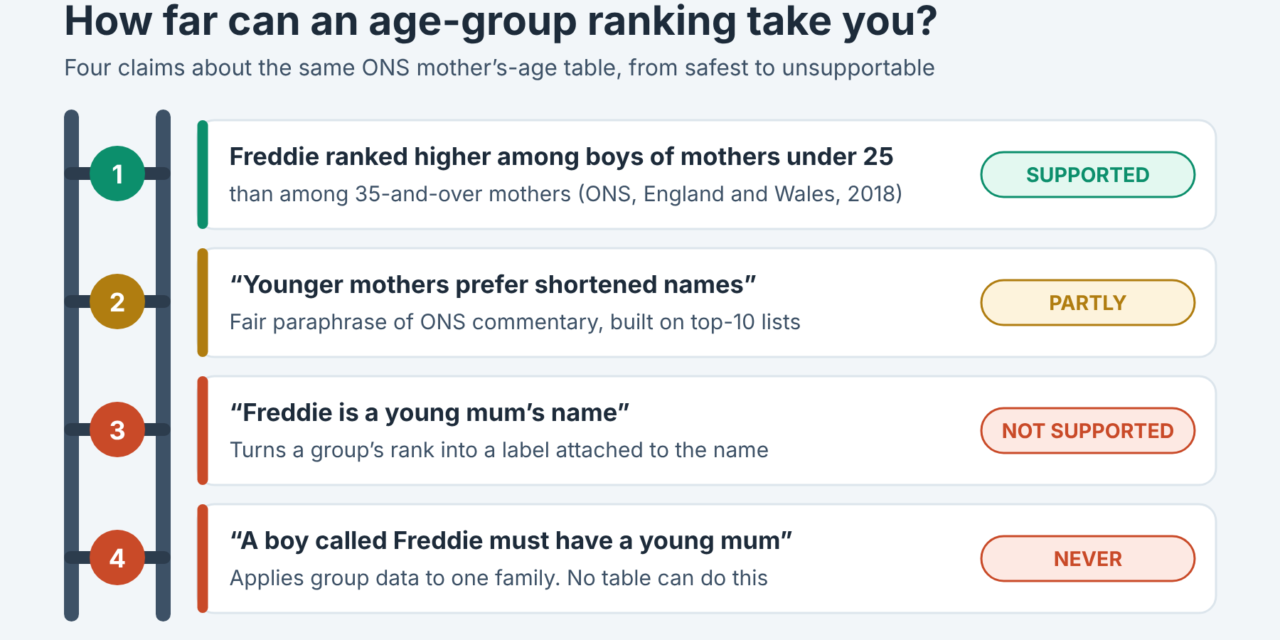
Picture a 37-year-old in Cardiff, eight months pregnant, scrolling past a headline that says older mothers pick “traditional” names while younger mothers go for short, modern ones. She has Freddie on her list. Is that the wrong name for her age? This page takes the official data behind baby names by mothers age, the Office for National Statistics breakdowns for England and Wales, and shows exactly what those tables measure, where the headlines stretch them, and how to read them before they push you toward or away from a name.
The short version
- The ONS data is real and narrow. Each annual girls’ and boys’ workbook for England and Wales includes a mother’s-age breakdown: the top 100 names within each age group, by exact spelling, for live births registered under that year’s rules.
- It describes groups, never people. “This spelling ranked higher among babies of mothers under 25 in 2019” is a supported sentence. “That’s a young mum’s name” is not, and “her mum must be young” is worse.
- The famous pattern rests on ONS’s own wording. “Traditional” and “shortened” are labels from the bulletins, not categories in the data. In 2019 ONS gave one concrete test: whether a name was in the top 100 before the late 1990s.
- Spelling, processing and composition change the picture. Alfie and Alfred are separate entries, hyphenated names were handled differently before 2018, and the overall ranking blends age groups whose sizes keep shifting.
- For your own shortlist, the overall rank usually matters more. Your child’s classmates come from every age group of mothers in that birth year, not only from yours.
1What the mother’s-age rankings actually say
Start with the plain version. Since at least the 2018 release, ONS has split its baby-name counts by the age of the mother at the birth. The age split sits inside the same workbooks as the national top 100, the regional tables and the month-of-birth tables. It is not a separate survey, and nobody asked parents why they picked a name.
So the honest question isn’t “what do older mothers like?” It’s narrower, and it’s the version of baby names by mothers age that the data can actually support: within one year’s registered live births in England and Wales, how does the rank of one exact spelling differ between groups of mothers defined by age? That question has an answer. The broader one mostly doesn’t.
What people often assume when they see baby names by mothers age
The popular reading goes something like this: mothers under 25 choose modern, short or invented names, mothers over 35 choose classic ones, and you can guess which is which from the name alone. Much of the press coverage after each release repeated a version of that, and to be fair, ONS’s own bulletins supplied the framing.
Where the headline comes from: four years of ONS bulletins
The pattern wasn’t invented by tabloids. The ONS bulletin for 2018, published 29 August 2019, had a section titled “Choices of baby names vary by age of mother.” It said “traditional” names such as Alexander, Joshua, William, Thomas, Charlotte, Jessica and Sophie “tend to be more popular among older mothers, especially those aged over 35 years,” while names such as Hunter, Logan, Harper and Nevaeh were among the more popular choices of mothers under 25. Note the quotation marks: ONS put “traditional” and “non-traditional” in scare quotes itself.
The 2019 bulletin repeated the finding and sharpened it. Its main points said shortened versions of traditional boys’ names “featured in half of the top 10 boys’ names chosen by mothers aged under 25 years compared with just one name chosen by mothers aged 35 years and over.” The 2020 and 2021 bulletins carried the same storyline, the 2021 one with a tidy pair: older mothers’ babies more often had names like Thomas, younger mothers’ babies more often had shortened versions such as Tommy.
Four years running, then, the official commentary told the same story. That consistency is worth something. It’s also exactly why the claim drifts, because a sentence repeated each summer starts to sound like a law of nature instead of a description of four top-10 lists.
A worked example: what “driven by younger mothers” can and can’t mean
In the 2020 bulletin, the statistician’s comment said Archie “jumped into the top 10 boys’ names for the first time, driven by younger mothers as well as the obvious Royal link.” Read it slowly. ONS is describing where Archie’s rank was strongest across the age tables in one year. It isn’t saying most Archies had young mothers, and it doesn’t give the share of Archies born to each age group in the text.
Those are different quantities. A name can rank higher among under-25s than among over-35s while most babies with that name still have mothers aged 25 to 34, simply because that middle span is where many births happen. Rank inside a group tells you about the group’s preferences relative to other names. It doesn’t tell you the age mix of everyone who got the name.
Two sentences that look alike and aren’t
Supported: “In ONS data for England and Wales, 2020, Archie ranked higher among boys born to mothers under 25 than among boys born to mothers 35 and over.”
Not supported by the published tables alone: “Most boys named Archie in 2020 had mothers under 25.” The second needs counts by age group for that name, set against the group sizes, and the bulletin text doesn’t print them.
What the tables really show
Once you strip out the commentary, the data object is simple. The girls’ and boys’ datasets on the ONS site describe themselves as giving the rank and count of top names, changes in rank since the previous year, and breakdowns “by country, region, mother’s age and month of birth.” The bulletins point readers to “table 8” for “the full list of the top 100 names per age-group.” Table numbering can change between editions, so check the contents sheet of the workbook you open.
The unit is an exact spelling within an age group
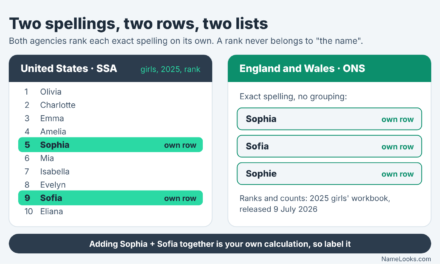
The ONS Baby names quality and methodology information (QMI) is blunt about this: “The statistics are based on the exact spelling of the name given on the birth certificate.” Similar-sounding names aren’t grouped, and ONS says users can group them themselves if they want to. Accents are removed during processing.
That matters more for the age split than for the national list. When the bulletins say younger mothers favor “shortened versions,” they’re comparing separate entries, such as Freddie against Frederick or Alfie against Alfred. The age table never sees “the Frederick family.” It sees two unrelated strings with two separate ranks.
Who is counted, and whose age it is
Everything comes from civil birth registration. The QMI says the figures cover live births that occurred in the calendar year, with stillbirths excluded because there’s no public register of them. Since 2001, births from the reference year registered by 25 February of the following year are included, plus late registrations from the previous year that missed the earlier cut-off.
The age is the mother’s. ONS explained in its 2023 bulletin that it uses mothers’ information because “information relating to mothers should appear on every birth registration.” So a father’s age, a co-parent’s age, or who actually chose the name never enters the table. A name picked by a 41-year-old father and a 23-year-old mother counts in the under-25 group.
Disclosure control trims the bottom. The QMI says ONS doesn’t release names with fewer than three occurrences in England and Wales as a whole. Within an age group, a top-100 cut-off means a name just outside the list is simply absent, not zero.
The evidence matrix below collects the claims we could verify directly from ONS pages during this update, and what each one does and doesn’t license. Where a claim would need figures we couldn’t open, we’ve said so rather than filling the cell.
| Claim | Source | Geography | Year | Metric | Limitation | Editorial takeaway |
|---|---|---|---|---|---|---|
| “Traditional” names more popular among older mothers, especially over 35 | ONS bulletin, section 7 | England and Wales | 2018 | Rank within age group (top 10 charts) | “Traditional” is in ONS’s own quotation marks; no definition given that year | Treat as a description of top-10 lists, not a rule |
| Amelia-Rose 83rd and Ava-Rose 88th among mothers under 25; outside top 200 in all other age groups | ONS bulletin, 2018 | England and Wales | 2018 | Rank within age group | 2018 was also the year ONS changed hyphen processing | Don’t compare hyphenated names with pre-2018 years |
| Seven of the under-25 boys’ top 10 weren’t in the boys’ top 100 before the late 1990s; eight of the 35-and-over top 10 were | ONS bulletin, section 4 | England and Wales | 2019 | Membership of historical top 100 | Counts names, not babies; ten names per group | The clearest operational meaning of “traditional” ONS has given |
| Archie’s entry to the top 10 “driven by younger mothers” | ONS bulletin, statistician’s comment | England and Wales | 2020 | Rank pattern across age groups | No share of Archies by mother’s age in the text | Says where the name ranked strongest, not who most Archie parents were |
| Half the under-25 boys’ top 10 were shortened traditional names; one in the 35-and-over top 10 | ONS bulletin, section 3 | England and Wales | 2021 | Count of names in top 10 by type | “Shortened” is an editorial grouping of separate spellings | Consistent with 2019; still a top-10 comparison |
| No mother’s-age commentary in the bulletin | ONS bulletin (series discontinued) | England and Wales | 2023 | n/a | Age breakdown remained in the datasets | Absence of commentary isn’t absence of a pattern |
| Girls’ and boys’ workbooks include a mother’s-age breakdown | ONS dataset pages, released 9 July 2026 | England and Wales | 2025 | Rank and count by exact spelling | We couldn’t open the workbook itself through our tools | Read the 2025 age table directly before quoting any 2025 age rank |
2Confounders that can make an age gap look bigger or smaller
Most misreadings of baby names by mothers age trace back to the issues in this section. An age difference in the tables can be real and still be partly an artifact. Some of the gap comes from how names are spelled and processed, some from how big each age group is, and some from the simple fact that a top-10 list is a blunt instrument. None of this means the pattern is fake. It means you should know which knobs move it before you lean on it.
Spelling, processing and labels: the year-to-year traps
The three issues in this section are all about what gets counted as “the same name.” They matter for any ONS comparison, but they bite harder on the age split, because the headline finding is literally about forms of names: short versus full, hyphenated versus single.
Exact spelling splits name families in two
The 2018 bulletin noted that shortened boys’ names such as Archie, Alfie and Freddie were all in the top 10 for mothers under 25, “whereas the full spellings, such as Alfred and Frederick were more popular with older mothers.” That’s a striking contrast. It’s also a contrast between separate dataset entries that the reader has mentally joined.
Think about what that does to a sentence like “older mothers prefer traditional names.” If you grouped Alfie with Alfred and Freddie with Frederick, the family as a whole might sit high in several age groups at once. The difference would then be about which form parents put on the certificate, not about whether they chose an old name at all. ONS doesn’t publish grouped families, and we haven’t computed them, so we can’t tell you how large that effect is. We can tell you it’s a real possibility the published sentence glosses over.
Our sibling piece on variant-ranking problems such as Sofia and Sophia walks through how to group spellings yourself without overstating the result.
The 2018 hyphen change and the “hyphenated names” finding
Here’s a detail that’s easy to miss. According to the QMI, before 2018 any text after a space was dropped, so a name entered as “Amelia – Lily” became Amelia. From 2018, ONS removed all spaces from hyphenated names instead, keeping the full form. ONS says the change had a negligible effect on rankings.
Negligible for the national top 100, probably. But the 2018 bulletin is also the one that reported hyphenated girls’ names appearing in the top 100 only for mothers under 25, with Amelia-Rose 83rd and Ava-Rose 88th. If you tried to show that this was a new trend by comparing with 2016 or 2017 workbooks, part of any difference could come from processing rather than parents. We’d treat 2018 as the earliest year where hyphenated forms are comparable, and say so in anything you write. For the practical side of giving a child a hyphenated name, see our guide to hyphenated given names on forms and in databases.
“Over 35” versus “35 and over,” and bands you should read, not assume
The bulletins name two groups again and again: mothers “under 25 years” and mothers “35 years and over.” The 2021 bulletin uses “35 years and over” and “over 35 years” within a few lines of each other. Those aren’t the same set of women if you read them literally. In practice it looks like a wording slip, but it shows why you should take band definitions from the table header, not from commentary.
The bulletins also don’t spell out the middle band or bands. The 2018 text refers to “all other age groups” without listing them. We couldn’t open the 2025 workbook through our research tools, so we won’t print its band edges from memory. When you open it, write down the exact bands and keep them in any sentence you quote.
Composition: who is having babies changes the overall list
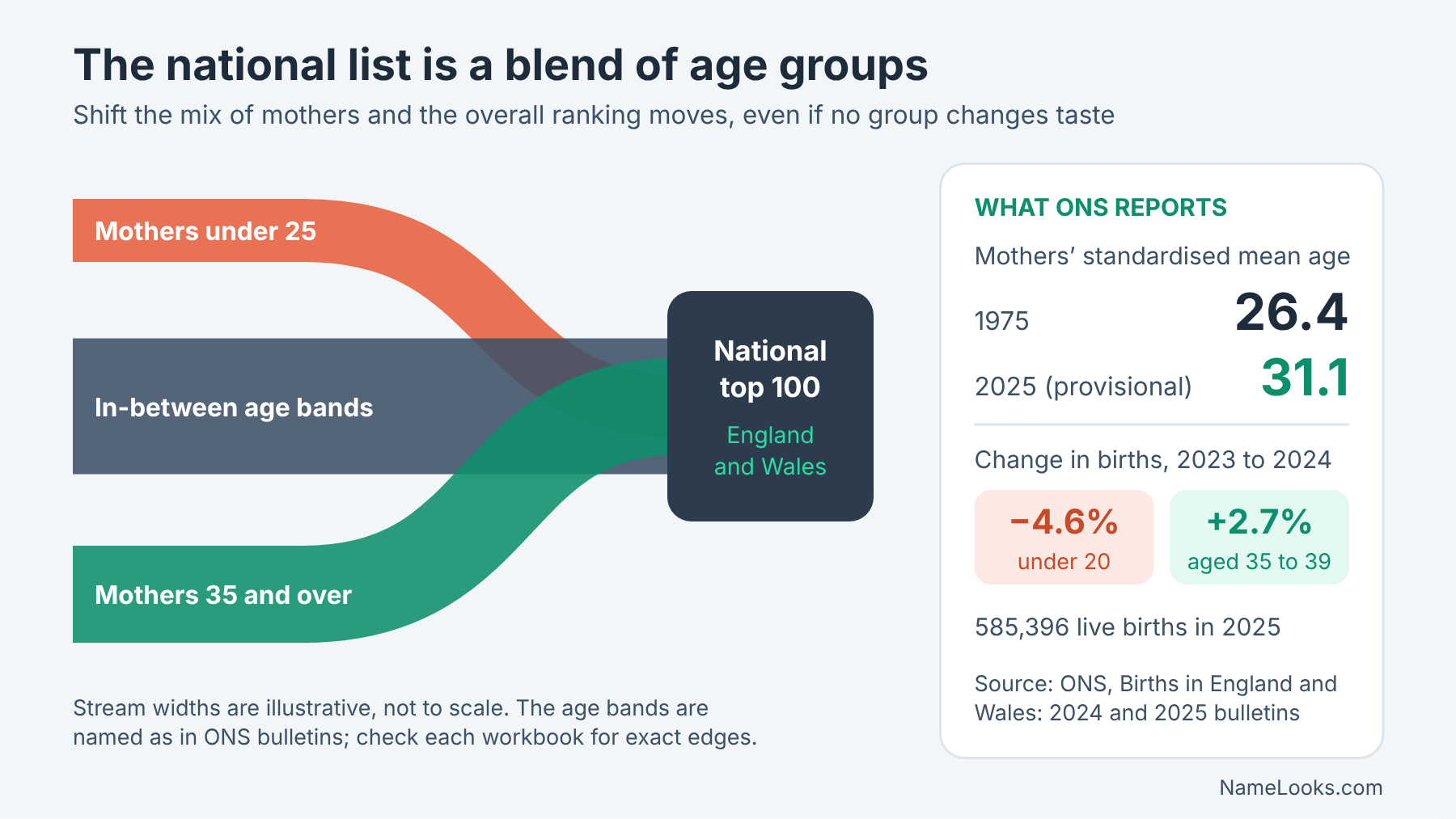
This is the confounder that gets the least attention, and it’s the one that matters most for the national ranking. The overall top 100 for England and Wales isn’t a separate opinion. It’s what you get when you pour every age group’s births into one pot. If the groups change size, the pot changes flavor even when no group changes its taste.
The overall ranking is a weighted blend
ONS’s Births in England and Wales: 2025 bulletin reports 585,396 live births in 2025, a 1.6% fall from 594,677 in 2024. It gives a provisional standardised mean age of mothers of 31.1 years in 2025, against 31.0 in 2024 and 26.4 in 1975. That’s a long, steady shift in who is giving birth.
Now the reasoning, which is ours rather than ONS’s. If names that rank well among older mothers stay stable while the share of births to older mothers grows, those names can climb the overall list without any group liking them more. The reverse applies to names concentrated among younger mothers. So when you see a name “rising” nationally, one candidate explanation is a change in the mix of mothers, not a change in fashion. You can’t tell which from the national table alone.
A quick thought experiment (hypothetical numbers)
Imagine two age groups. In both years, group A gives a name to 1 in 200 babies and group B gives it to 1 in 1,000. In year one, group A has 100,000 births and group B 300,000; the name goes to 500 + 300 = 800 babies. In year two, group A grows to 150,000 and group B shrinks to 250,000; the name now goes to 750 + 250 = 1,000 babies. Neither group’s preference moved. The national count rose by a quarter anyway. These numbers are invented to show the arithmetic, not taken from ONS.
Smaller groups, thinner counts, more jumpy ranks
Group size also affects how stable each age table is. ONS’s Births in England and Wales: 2024 reported that births fell in 2024 for mothers under 20, 20 to 24 and 25 to 29, and rose for 30 to 34, 35 to 39 and 40 and over. The biggest fall was for under-20s (4.6%) and the biggest rise for 35 to 39 (2.7%).
If the youngest groups are shrinking, their top-100 lists rest on fewer births each year. Fewer births means a handful of babies can move a name several places, and ties near the bottom become more common. A ten-place jump in the under-25 table may carry much less information than a ten-place jump in the national list. When you see a dramatic age-group movement, look for the counts behind it before you treat it as news.
Why a single rank or anecdote can mislead
The bulletins compared top-10 lists, because top-10 lists make good charts. That’s a reasonable editorial choice for a news release. As evidence, it’s thin: ten names per group, ranks without shares, and labels applied after the fact.
Rank inside a group is not share of the name
We touched on this with Archie, but it’s the most common error, so here’s the general rule. A rank tells you a name’s position among other names within one group. A count tells you how many babies got it. A share tells you what fraction of the group’s babies got it. And the age mix of a name, how its babies split across groups of mothers, is a fourth quantity that you can only build from counts in every group.
Mixing these up produces confident nonsense. “Harper is a top-10 name for young mothers” can be true while most Harpers have mothers over 25. If you want a longer treatment of why position alone misleads, our U.S.-focused explainer on rank versus number of babies uses SSA data, but the logic carries straight over to ONS tables.
“Traditional” is a label someone applied
Nothing in the dataset marks a name as traditional, modern, shortened or non-traditional. Those words come from the bulletin writers. The 2019 bulletin gave the most useful operational test: of the top 10 boys’ names chosen by mothers under 25, “seven had not featured in the top 100 boys’ names prior to the late 1990s,” against eight of ten for mothers 35 and over that had featured. That’s a checkable definition, and it’s a good one to borrow if you write about this.
The vaguer uses deserve more caution. Is Harper “modern”? That depends entirely on the window you pick and the dataset you check, and two careful people can answer differently. Calling a name traditional or modern is an editorial judgment about history and taste. Our cluster on what “classic” can mean when you measure long-term use takes that question apart properly.
The data can’t speak to class, ethnicity or anyone’s family
Commentary on maternal age and names sometimes slides into assumptions about education, income, religion or background. The ONS age tables contain none of those variables. Any such link would need separate research with its own data, and even then it would describe groups, not a particular child. NameLooks doesn’t infer anyone’s identity, background or family circumstances from a name, and the age tables give no basis for doing so.
It’s also worth remembering that names travel through families in ways the tables can’t see. A short form might honor a grandparent who always went by it. A long form might be a parent’s own name. Region and month of birth are separate splits in the same ONS workbooks, and our sibling articles on regional differences in England and Wales and month-of-birth patterns show how each split comes with its own small-number traps.
3Read the age tables yourself, step by step
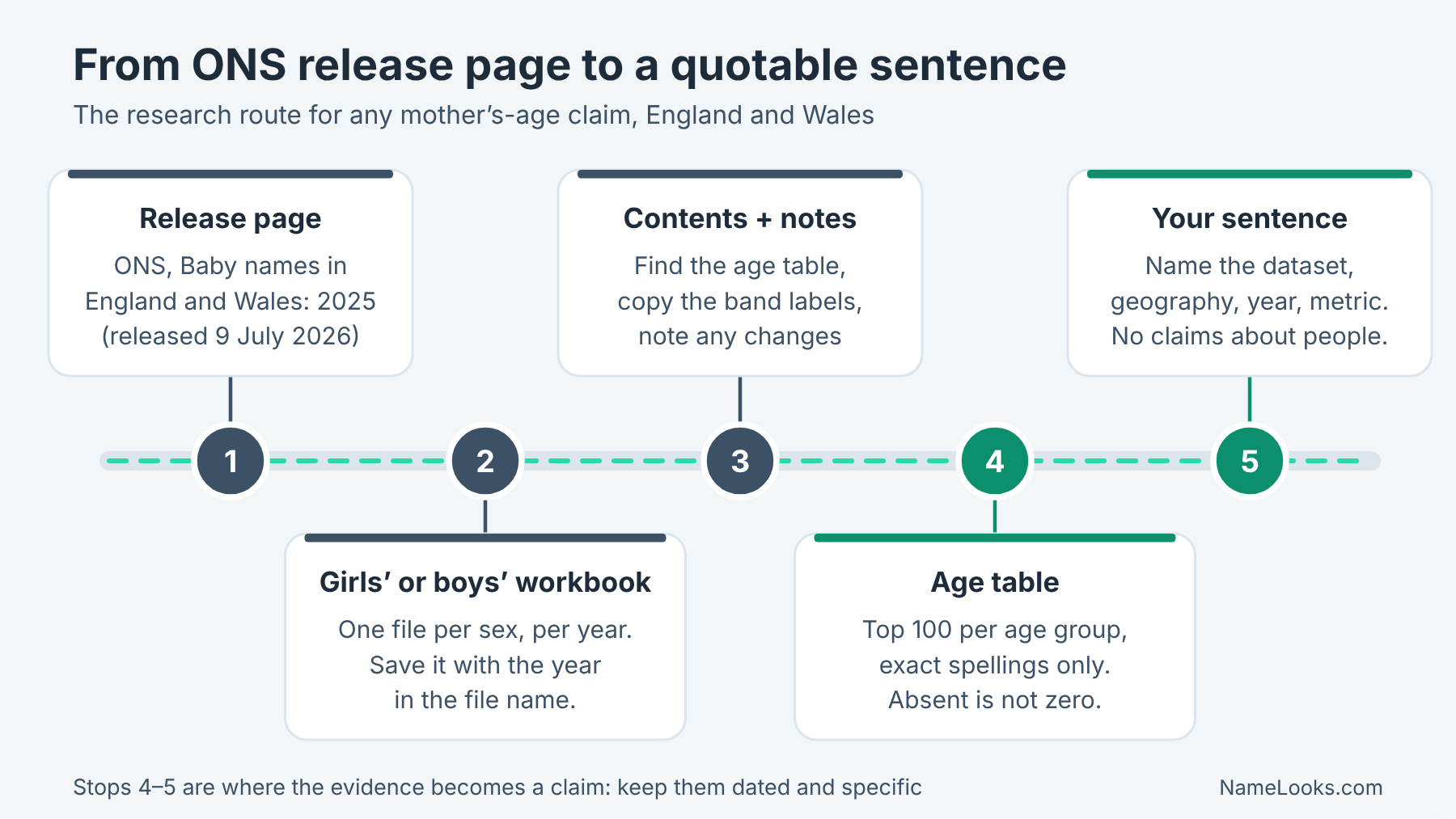
You don’t need a statistics degree for this. You need the right file, twenty minutes, and the discipline to write down what you looked at before you form an opinion. The method below is what we’d follow for any claim about baby names by mothers age, whether it’s a headline you want to check or a name you’re curious about.
Getting to the right table
Most mistakes happen before anyone reads a number. People quote a chart from a bulletin year that doesn’t match the dataset year, or confuse the girls’ and boys’ files, or read the national table while thinking it’s the age table. Five minutes of orientation prevents all three.
From the release page to the workbook
- Start at the release. The ONS release page for Baby names in England and Wales: 2025 lists a release date of 9 July 2026 and links the girls’ and boys’ datasets plus the long-run file from 1996.
- Pick the sex-specific dataset. The girls’ dataset page and the boys’ dataset page each hold one workbook per year. These are the pages that describe a mother’s-age breakdown; the combined 1996-onward file is the place for long-run counts.
- Choose the edition year deliberately. The page lists editions back to 1996. The bulletin commentary on mother’s age that we verified covers 2018 to 2021. For anything after that, the workbook is your only official source.
- Save the file with its year in the name. It sounds fussy. It stops you mixing a 2024 age table with a 2025 national table three weeks later.
Read the contents and notes sheets before any numbers
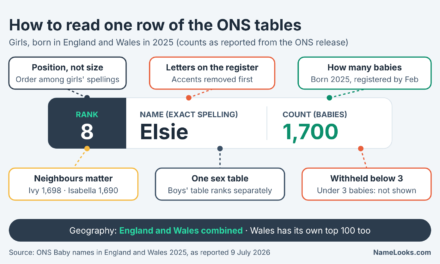
ONS workbooks open with a cover or contents sheet and usually a notes sheet. Read both. They tell you which table holds the age breakdown that year, the exact age bands, how ties are ranked, and any changes from the previous edition. The bulletins have pointed to table 8 for the age-group top 100, but don’t assume the number holds forever.
Also note what isn’t there. The age table is a top 100 per group. A name ranked 140th among over-35s simply won’t appear in that group’s list. That’s an absence from a list, not a zero. Our cornerstone on how to use ONS 2025 data covers the general structure of the workbooks, so we won’t repeat it here.
If your browser can’t open the file
Some networks and tools block direct downloads from ons.gov.uk. If that happens, don’t fall back on a third-party site’s copied list without checking its date and source. Try a different connection, or ask ONS directly. The dataset pages list a contact address, [email protected], for questions about the statistics.
Doing the comparison honestly
With the right table open, the comparison itself is short. The care goes into how you frame it and how you write it down.
Compare one spelling across bands, then look for counts
Take the exact spelling you care about and find its rank in each age group’s list. Write the ranks side by side with the band labels exactly as printed. Then, if the table gives counts, write those too. A rank of 8 resting on a modest count in a small group is a different fact from a rank of 8 in the largest group.
Next, look up the name’s national rank and count for the same year. If the name sits high in every group, the age difference may be real but practically small. If it appears in one group’s top 100 and nowhere else, that’s a sharper signal, as with Amelia-Rose in 2018. Finally, check the obvious relatives: the full form, the short form, alternative spellings. Note each one’s ranks separately rather than adding them up unless you’re explicit that you’ve grouped them.
Write the sentence with all four anchors
Every claim should carry dataset, geography, year and metric. If it can’t, it isn’t ready to share. Here are fill-in templates you can use as they are:
- “In ONS data for England and Wales, [year], [exact spelling] ranked [n] among [girls/boys] born to mothers [band as printed], compared with [n] among mothers [band].”
- “[Exact spelling] appeared in the top 100 for mothers [band] but not in the top 100 for any other age group (ONS, England and Wales, [year]).”
- “ONS’s [year] bulletin described [name] as more popular among [band]; the dataset gives [rank/count] for each group.” Only use the second clause once you’ve read it yourself.
Notice what the templates leave out: any word about what kind of parent chooses the name. That’s deliberate. A cross-country version of the same discipline appears in our guide to building a trend record with rank, count, share, year and source.
The comparison table below lines up the forms and periods where the age split is most often misread. It doesn’t contain any ranks we couldn’t verify; the middle column tells you what form the evidence takes, so you know what to look for.
| Variant or period | How ONS presents it | What changed | Caveat | Naming implication |
|---|---|---|---|---|
| Alfie vs Alfred; Freddie vs Frederick (2018) | Separate exact-spelling entries; bulletin says short forms in under-25 top 10, full forms more popular with older mothers | Editorial grouping into “short” vs “full” added by the bulletin | No published family totals; grouping could shrink or reshape the gap | Choosing the full form for paperwork and using the short one daily is a separate decision from the data |
| Thomas vs Tommy (2021) | Main points pair them: older mothers’ babies more likely Thomas, younger mothers’ more likely Tommy | Repeats the 2018–2019 storyline with a new pair | Two names out of hundreds; no shares by age printed in text | An illustration, not a forecast of how either name will be perceived |
| Hyphenated forms, pre-2018 vs 2018 onward | From 2018, spaces removed and full hyphenated form kept; before, text after a space dropped | Processing rule, not parents | Cross-year comparisons of hyphenated forms are unsafe before 2018 | Check the exact hyphenated string in the year you care about, not a base name |
| Bulletins 2018–2021 | Section and charts on age of mother, top 10 per group, full top 100 in the dataset | Commentary repeated each year | Interactive chart values not reproduced in text | Quote the bulletin’s words as ONS commentary, not as a measured share |
| Bulletin 2023 | No mother’s-age section; datasets still include the breakdown | Bulletin series later discontinued | Silence isn’t evidence the pattern stopped | Go to the workbook for anything after 2021 |
| Datasets 2024–2025 | Girls’ and boys’ workbooks with age, region, country and month breakdowns | Release in July 2026 for 2025 births | No official commentary to lean on | Any “2025 young-mum names” story is someone’s own reading; check it |
4Should mother’s age change the name you pick?
Back to the woman in Cardiff with Freddie on her list. What does the evidence actually say to her? Less than the headline implied, and a little more than nothing. This section separates what you can reasonably take from the ONS figures on baby names by mothers age from the parts that are taste, family and guesswork.
Reasonable takeaways from the age tables
There are two honest uses for the mother’s-age split when you’re choosing a name. One is understanding how common a name is among families who are, demographically, a bit like yours. The other is spotting a name whose use is unusually concentrated in one group. Neither use tells you what to choose, and that’s the most useful thing to know about baby names by mothers age before you open a single table.
For “how common will this be,” the overall rank usually wins
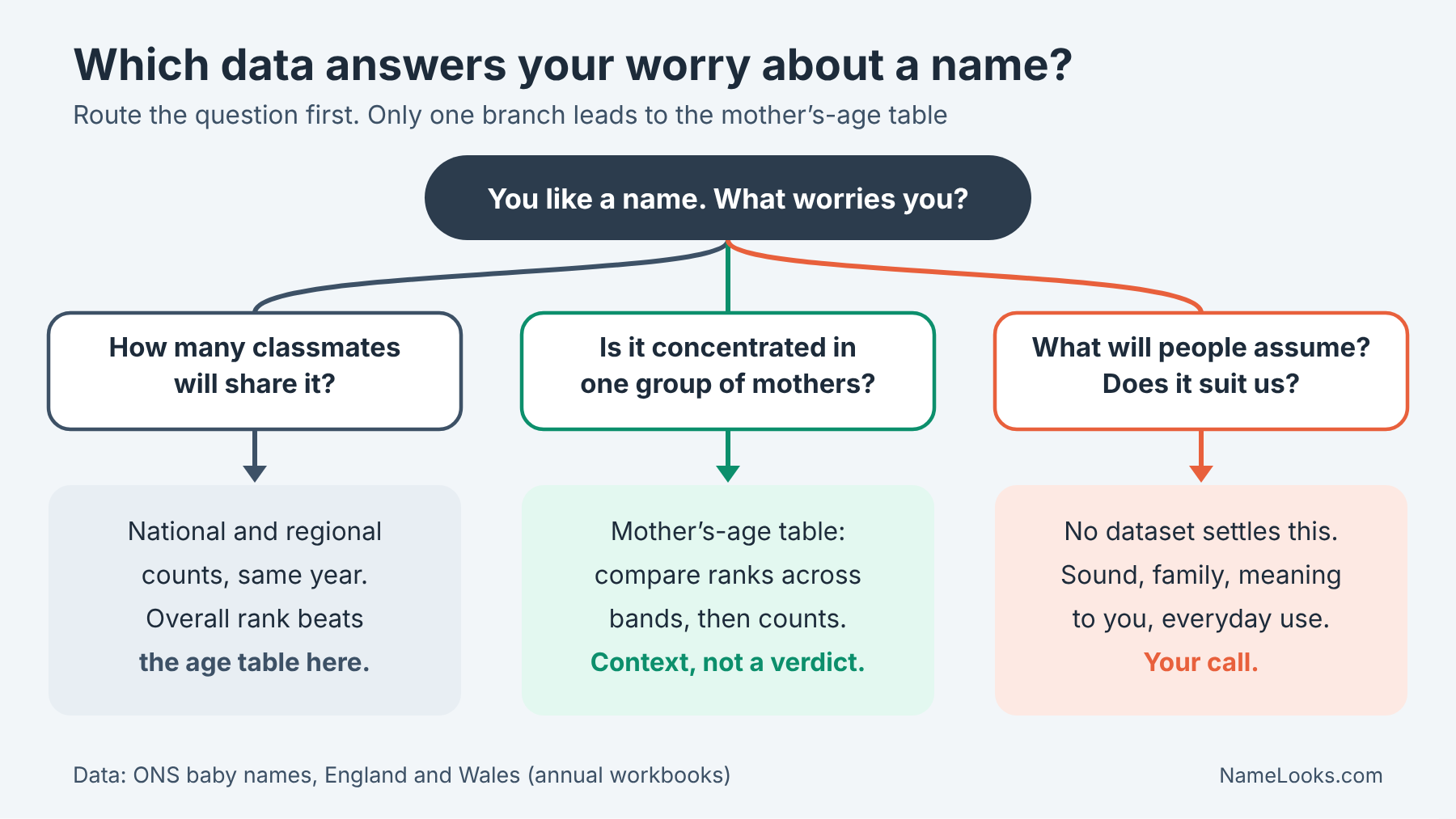
Here’s the point that tends to get lost. Your child won’t only meet babies born to mothers in your age band. Classmates, teammates and colleagues come from the whole birth cohort, which is every age group of mothers in that year. So if your worry is “will there be three of them in the class,” the national count for England and Wales, or the regional count for where you live, answers it better than the age table does.
That’s not just a convenience. The age table answers a narrower question: how a name ranks among one slice of parents. If you’re aged 37 and a name ranks 40th among over-35s but 6th nationally, you’ll meet it often regardless of your own age. How much repetition you’re comfortable with is a separate preference, and our guide to how much uniqueness you actually want is built for exactly that question.
For “will people assume things,” the honest answer is: some might
Associations exist even when they’re unfair. If a short form appeared in the under-25 top 10 several years running, some people will have formed a loose impression about it. The data supports the existence of a group difference in ranks. It doesn’t support anyone acting on that impression about a specific child or parent, and it can’t predict who will.
If someone in your family says “that’s a young mum’s name,” you don’t need to argue statistics at the dinner table. Something like this works: “It ranked higher among younger mothers in a few recent years, sure. It was also in the national top 10 in 2025. We like it.” That’s accurate, it’s short, and it doesn’t concede that the remark was a rule. For Freddie specifically, the 2025 national top 10 for boys in England and Wales, as reported from the ONS release, does include it.
What remains subjective or uncertain
Some questions sound empirical and aren’t. Others are empirical but nobody has published the data to answer them. It helps to know which is which, so you stop searching for a number that doesn’t exist.
Associations move as cohorts grow up
A name that’s concentrated among one group of mothers today won’t necessarily carry that association in thirty years. The babies grow up. The name becomes “a name people my age have,” attached to whoever those people turn out to be. We have no dataset that measures how age-linked associations fade, and we’d distrust anyone who claims to quantify it.
Long-run fashion cycles are better documented, mostly in U.S. data. If you want to see how names move from new to everywhere to dated to revived, the overview on measuring a revival with multi-year data is a good companion. Just remember the U.S. Social Security data has no mother’s-age field to compare with ONS. Its background notes describe names from Social Security card applications by year of birth, sex and state, with names under five occurrences in an area excluded and spellings kept separate.
What we’d suggest, labeled as opinion
Our editorial view, not a finding: treat the age split as context, not as a filter. If you like a name, check its national and regional counts for the latest year, read its rank in your own age band if you’re curious, and then decide based on everything else that matters to you. Sound with your surname, family meaning, how it travels, how it looks on a form.
The decision tree above is one way to make that concrete. It routes the most common worries to the dataset that actually answers them and drops out the ones no dataset can settle. For the broader framework, our decision framework beyond endless lists sets the age question alongside the factors that usually carry more weight.
Data can answer
How a spelling ranked within each age band in a given ONS year, and whether it appeared in one band’s top 100 but not others.
Data can partly answer
How common a name will be in your child’s cohort: use national and regional counts, not the age table, and accept a year’s lag.
Data can’t answer
What strangers will assume about you, what the name will “feel like” in 2050, or whether it suits your family. That’s yours to decide.
5Six checks before you quote or share an age-group ranking
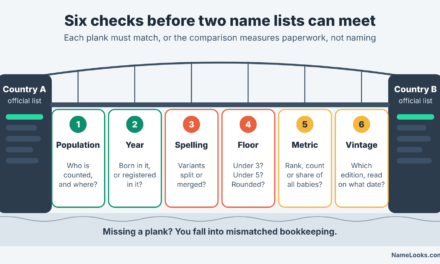
If you write about names, run a parenting account, or just like sending charts of baby names by mothers age to the group chat, this is the section to bookmark. The six checks below catch almost every misreading we’ve described. They’re numbered because the SEO title promises six, and because the order matters: the early ones stop you before you’ve built a story on the wrong table.
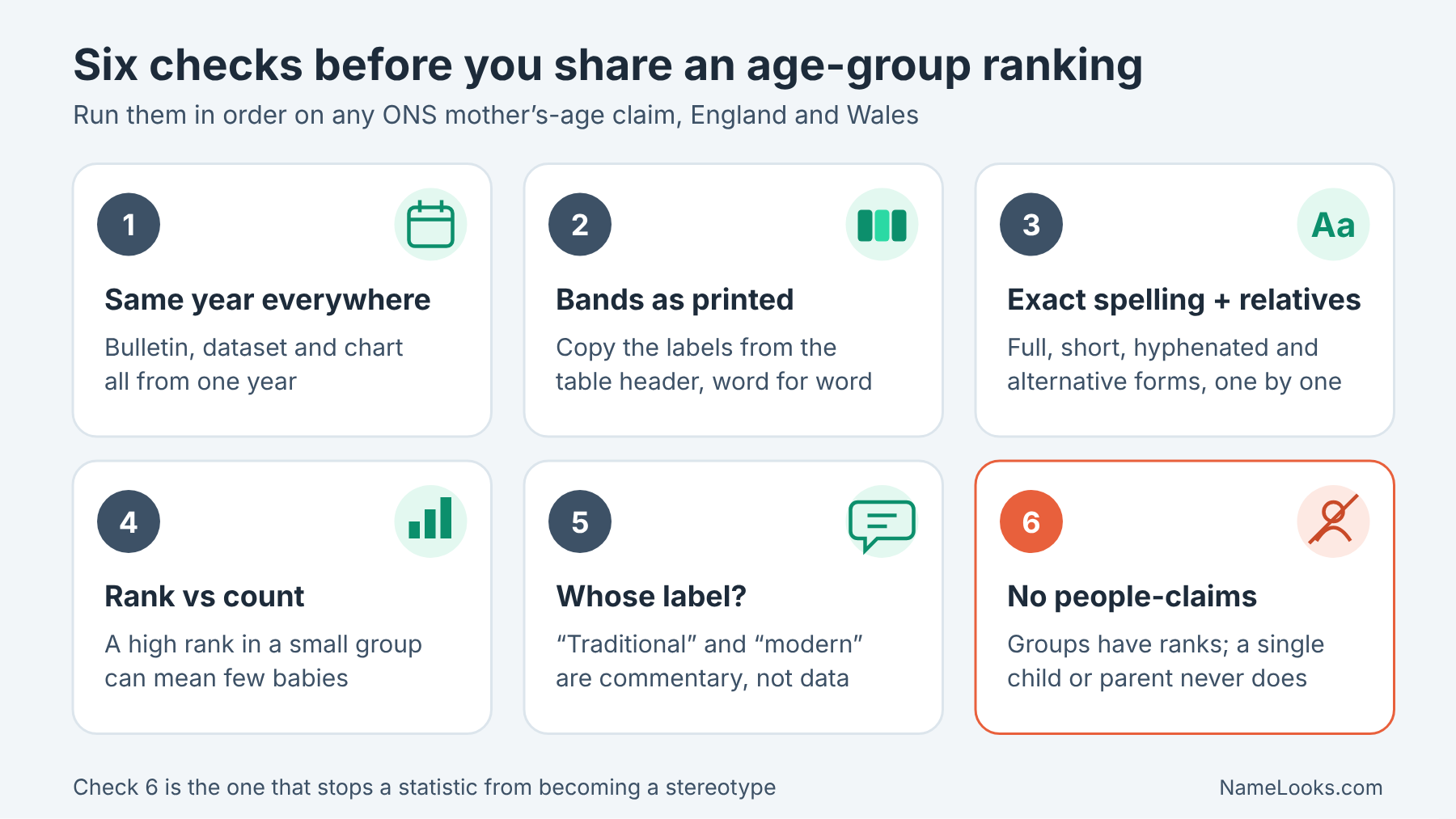
- Check the year on both ends. The bulletin year, the dataset year and the year of the chart you’re looking at should match. A 2019 chart quoted in a 2026 article is history, not news.
- Check the band labels as printed. Copy them from the table header. Don’t turn “35 years and over” into “older mothers” or “over 35” without saying so.
- Check the exact spelling and its relatives. Look up full forms, short forms, hyphenated forms and alternative spellings separately. Say whether you grouped them.
- Check rank against count. A high rank in a small group can rest on far fewer babies than a modest rank nationally. Report the metric you used.
- Check whose words the label is. “Traditional,” “modern” and “shortened” are commentary. Attribute them to ONS’s bulletin, or define them yourself, as ONS did in 2019 with the late-1990s top-100 test.
- Check the sentence for people-claims. If it describes a kind of parent or child rather than a group’s ranks, rewrite it. Group data never licenses a statement about an individual.
Mistakes that show up in coverage
These are the patterns that turn a careful ONS paragraph into a misleading social post. None of them needs bad intent. They happen because a group comparison is hard to say in eight words.
Turning a group rank into a label for individuals
“Older mums choose traditional names” becomes “Charlotte is a posh older-mum name” becomes a joke about a specific family. Each step loses information. The first is a fair paraphrase of ONS commentary. The second adds a class word that isn’t in any ONS table. The third applies group data to a person, which no dataset can support.
If you write the first version, add the year and the bands. If you see the second or third, the honest reply is that ONS publishes ranks by mother’s age, nothing about class, and nothing about any individual family. Our guidance on writing about names without stereotyping people applies the same logic to gender labels.
Assuming other countries publish the same split
The mother’s-age breakdown is a feature of the England and Wales release. U.S. SSA data doesn’t include parent information in its public files, as noted above. The QMI says Scotland and Northern Ireland publish their own figures using similar methods; whether their releases include a mother’s-age split is something to check in their own documentation rather than assume.
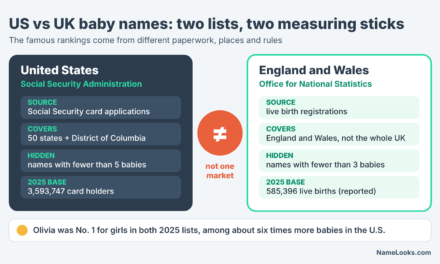
So a claim like “younger mothers everywhere prefer short names” has no shared dataset behind it. Comparing patterns across systems takes care with definitions, and our sibling guides on comparing popularity across different data systems and on why a name ranks differently in England and Wales than in the U.S. cover the traps. The broader point about U.S. versus British naming markets lives in our U.S. vs England and Wales comparison.
Mistakes in your own research
Even careful readers trip on these, usually late at night with three tabs open.
Mixing years, files and bands
The commonest research slip is quoting an age rank from one year next to a national rank from another. Close behind is comparing bands across editions without checking that the bands stayed the same. If you’re tracking a name across several years in the age tables, record the edition, table number and band labels for every year in a simple log. When something doesn’t line up, you’ll see why.
The other trap is the registration rule. The QMI says births are included if registered by the following year’s cut-off. 2020 was handled differently because of pandemic registration delays: the 2020 bulletin says ONS included births registered up to 12 August 2021 for that year. If 2020 looks odd in an age table, that’s a candidate reason before any cultural story.
Treating a missing name as a zero, or a tiny count as a trend
A name missing from an age group’s top 100 is not unused in that group. It’s below the cut-off. And at the national level, names with fewer than three occurrences aren’t released at all. The 2023 bulletin also noted that redacted counts of two or fewer still contribute to totals.
The reverse error is getting excited about small numbers. If a name moves from 95th to 70th in one age band, check how many babies that represents before calling it a surge. Small counts in small groups are noisy. Very rare names raise privacy questions too, which our piece on the privacy problem with rare-name data explains.
Questions people actually ask
Does ONS publish the most popular baby names by mother’s age every year?
The girls’ and boys’ dataset pages for the 2025 release describe a breakdown by mother’s age, and earlier bulletins pointed to a top 100 per age group in table 8. What changed is the commentary: the bulletins for 2018 to 2021 discussed the age split, the 2023 bulletin didn’t, and the bulletin series has since been discontinued. Open the workbook for the year you want and check its contents sheet.
What age groups does ONS use?
The bulletins consistently name “under 25 years” and “35 years and over,” and refer to other age groups without listing them in the text. Take the exact bands from the header of the age table in the workbook you’re using, and keep them in any sentence you quote, since commentary sometimes words them loosely.
Is it the mother’s age at the birth or at registration?
The bulletins describe names by the age of the mother, and the data comes from birth registration. We couldn’t confirm from the pages we opened whether age is measured at birth or at registration, and the difference would matter only for a small number of births near a band edge. If it matters for your purpose, check the workbook notes or ask ONS.
Why doesn’t the data use the father’s age?
ONS’s 2023 bulletin explained that it uses mothers’ information because it should appear on every birth registration. Father’s or second parent’s details aren’t always recorded the same way, so a mother-based split covers more births consistently. It also means the table says nothing about who in the family chose the name.
Can I find out which age group most babies with a name came from?
Only if you have that name’s count in every age group, plus the full group sizes, for the same year. Ranks alone won’t do it. Even with counts, a top-100 cut-off can hide a name in some groups, so the age mix you calculate may be incomplete. Label any such figure as your own calculation from ONS data.
Are there similar figures for Scotland or the U.S.?
Scotland’s names are published by National Records of Scotland, not ONS, and SSA publishes U.S. data without parent information. Don’t stitch these together with England and Wales age tables as if they were one dataset; methods, cut-offs and spelling rules differ.
Sources and further reading
- ONS: Baby names in England and Wales: 2025 (release page) — release date and links to the 2025 girls’, boys’ and 1996-onward datasets.
- ONS: Baby names for girls in England and Wales (dataset) and for boys — annual workbooks with the mother’s-age breakdown.
- ONS: Baby names QMI — exact-spelling rule, hyphen change, registration cut-offs and disclosure threshold.
- ONS bulletin 2018, 2019 and 2021 — the official commentary on names by age of mother, with figure notes.
- ONS: Births in England and Wales: 2025 and 2024 — total births, mothers’ standardised mean age and changes by age group.
- SSA: Background information on the baby names data — what the U.S. files contain, useful as a contrast.
NameLooks provides general information about names and name data. Popularity figures describe populations of registered births, not individual people or families, and official methods and tables can change between releases.