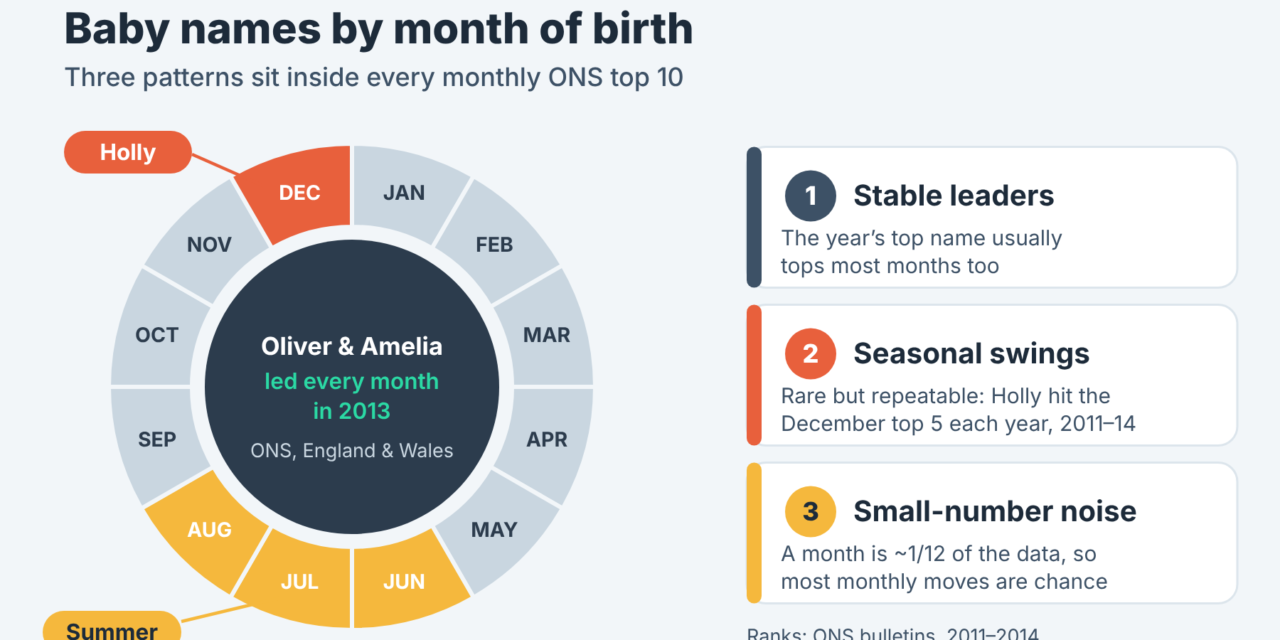
Baby names by month of birth are first-name rankings and counts split by the calendar month in which a baby was born, rather than pooled across the whole year. In England and Wales, the Office for National Statistics publishes that split inside its annual baby names datasets; in the United States, the Social Security Administration does not publish it at all. This page explains what the monthly figures can genuinely show, why a handful of names really do follow the seasons, and why most month-to-month movement is just small numbers wobbling.
What to carry away from this page
- Only one of the two big English-language name datasets has a month field. ONS splits England and Wales names by month of birth; SSA’s public files record birth year, sex and state, and nothing finer.
- The top of the list barely notices the calendar. In ONS bulletins for 2012 to 2014, the annual leaders topped most or all months. Where the lead did change hands, the annual counts were close.
- Real seasonality exists, but it is rare and repeatable. ONS reported Holly climbing into the girls’ monthly top 5 every December from 2011 to 2014, and Summer peaking in summer months and sinking in December.
- A month is roughly one-twelfth of a year’s data. That makes counts small and ranks jumpy, so a single month’s spike is weak evidence on its own.
- The data records outcomes, never motives. ONS doesn’t say why Holly rises in December. Any explanation you give is interpretation and should be labeled that way.
1What month-of-birth name data is, and who actually publishes it
The short answer first. If you want baby names by month of birth from an official source, England and Wales is where you look. ONS has published a month breakdown alongside its annual rankings for years, and its bulletins from the early 2010s summarized what those tables showed. If you are working with U.S. names, there’s no equivalent official table to open, and any “most popular names for March babies” list for the U.S. comes from somewhere other than the government’s name files.
That asymmetry shapes everything else on this page. It means the evidence for seasonal naming is thinner than the volume of “names for your autumn baby” content suggests, and it means the evidence that does exist comes with ONS’s specific counting rules attached. For the broader tour of the annual data, our guide to using the ONS 2025 baby names data is the place to start; here we stay with the monthly slice.
The ONS monthly breakdown: what is in the files
ONS publishes two separate datasets each year, one for girls and one for boys, plus a long-run file covering 1996 onward. The month breakdown lives in the separate girls’ and boys’ editions, not in the long-run file.
What the dataset pages and the QMI say
The dataset page for baby names for girls in England and Wales describes its contents as rank and count of the top names, changes in rank since the previous year, and a breakdown by country, region, mother’s age and month of birth. The matching boys’ page carries the same description. Both list a 2025 edition released on 9 July 2026, as does the ONS release page for baby names in England and Wales: 2025.
The ONS Baby names Quality and Methodology Information (QMI) report, last revised on 5 October 2022, is more specific. It says the release includes the top 10 names by month of birth. So the monthly view is deliberately narrow: a top 10 for each month, by sex, rather than a full name-by-month grid for every name in the country.
One caution about our own reporting. We could open the dataset landing pages and the QMI in this session, but the spreadsheet downloads themselves would not load for us. So this page does not print any 2025 month-level ranks or counts. Where we cite monthly results, they come from ONS bulletins that summarized the monthly tables in plain text, and we name the year each time.
What the U.S. files leave out
The SSA’s background notes for its baby names data say names are drawn from Social Security card applications for U.S. births, and that a record is only used when the year of birth, sex and state of birth are on record. Month is not among the published fields. The national files are organized by year; the state files add a state code. That’s the whole time resolution.
This matters in practice because U.S. readers often meet “month” name lists that look official. Some are themed lists (names that echo a month, a season or a holiday). Some are drawn from private app or registry data with undisclosed methods. Neither is a government ranking, and neither should be described as “the most popular names for babies born in October” without saying exactly whose data it is. If you need a refresher on what the SSA files can and can’t carry, our explainer on how SSA baby name rankings are built covers the mechanics.
A quick test for any “names by month” list
Ask three questions before you trust it. Whose records is it counting? Which year, which geography? And is “month” the baby’s month of birth, or just a theme the writer picked? If the list can’t answer all three, treat it as inspiration, not as data.
Counting rules that carry into every monthly table
A monthly table isn’t a fresh dataset with its own logic. It’s the annual dataset cut into twelve pieces, so every rule that shapes the annual figures shapes the monthly ones too. Some of those rules matter more once the numbers get small.
Exact spellings, no grouping, accents removed
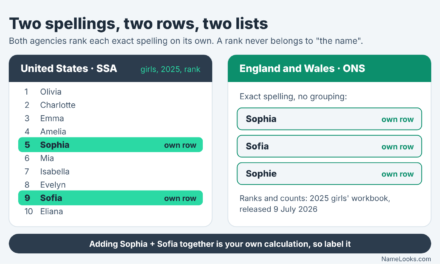
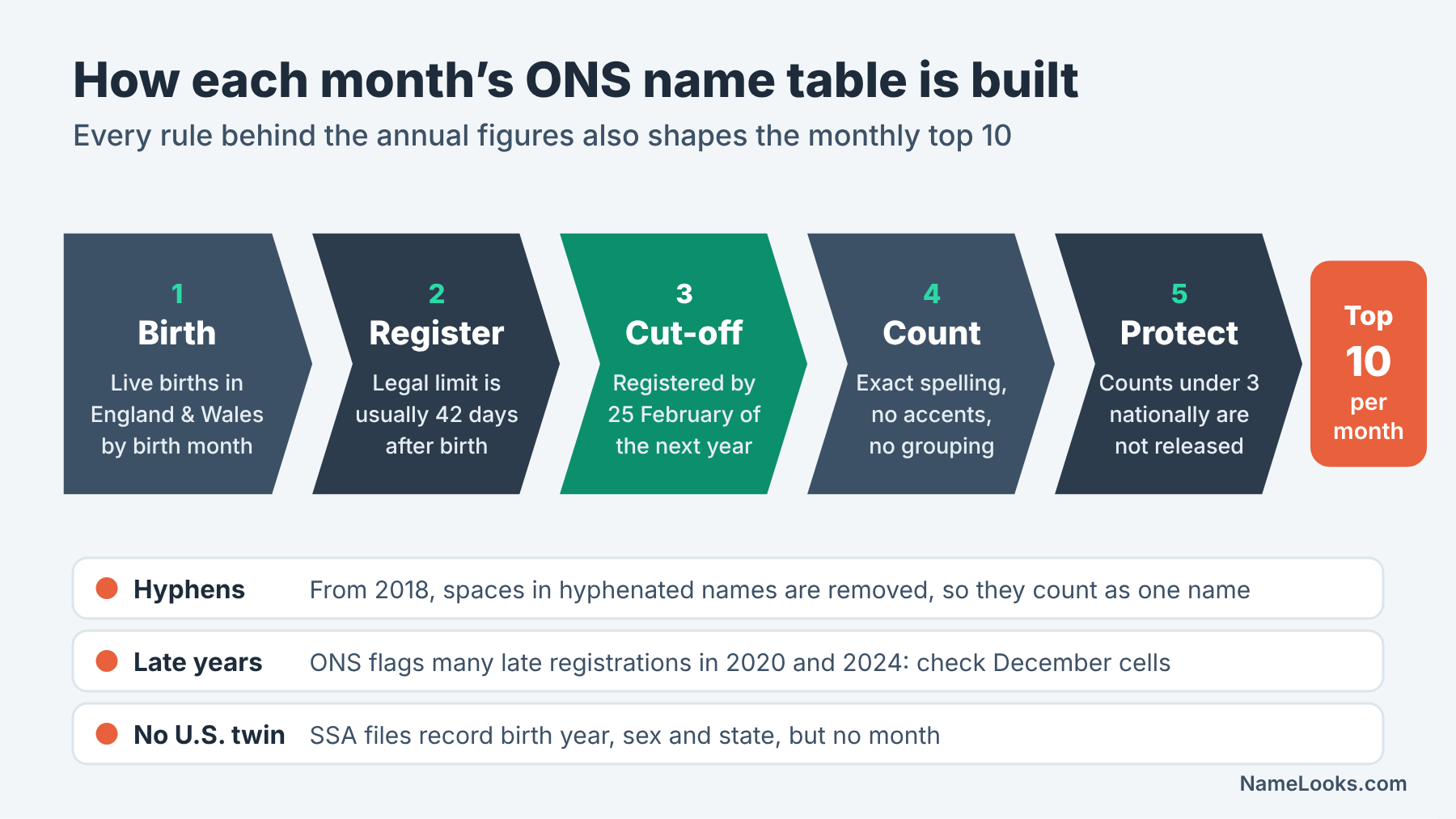
The ONS QMI states that the statistics are based on the exact spelling of the name given on the birth certificate, and that ONS does not group names because some groupings are subjective. If you want to treat two spellings as one name, you do the grouping yourself, and you say so. That split matters even more in a monthly table, where a name divided across two or three spellings can drop out of a top 10 that a combined form would have made.
Two smaller rules are worth knowing. ONS says names are analysed without accents, because the software can’t process them automatically. And for 2018 onward, spaces are removed from hyphenated names so that they count as one name; before 2018, the QMI says, text after a space was dropped. That second rule means a double-barrelled first name is handled differently on each side of 2018, which is worth remembering if you compare monthly tables across that boundary. Our companion piece on spelling variants and ranking problems in the U.S. and UK goes deeper on the grouping question.
The registration clock behind each month
ONS baby names come from birth registrations, not from hospital records. The QMI says the annual figures include births occurring in the reference year that were registered by 25 February of the following year, plus a very small number of late registrations from the year before. The ONS user guide to birth statistics gives 42 days as the usual legal time limit for registering a birth.
Put those two facts together and you get a small point about December. A baby born on 31 December who is registered within the usual 42 days is registered in mid-February, before the 25 February cut-off. So December babies are not routinely missing from their year.
The risk is at the margin: a December birth registered unusually late could miss the cut-off. The user guide notes that late registrations were a much bigger issue in 2020, when pandemic disruption pushed many registrations past 42 days, and that 2024 also saw a large number of late registrations for reasons ONS did not identify. That’s our reading of how the rules interact, not an ONS analysis of monthly bias, but it’s a reason to look twice at the December figures in those particular years.
2What the ONS record shows about seasonality in baby names by month of birth
Between 2012 and 2015, ONS bulletins included a short section called “Seasonal variations” that described the monthly tables in words. Those bulletins are now the clearest public record of how month-by-month naming behaves in England and Wales, because they say what happened without forcing you to reconstruct it from spreadsheets. Four years of them tell a consistent story: the top of the list is stable, a small number of names genuinely swing with the calendar, and the rest is movement you shouldn’t read much into.
The years below are birth years 2011 to 2014. They’re old, and that’s fine for this purpose. We are not using them to tell you what’s fashionable now; the annual 2025 rankings do that job. We are using them to show what monthly patterns look like when an official statistician describes them.
The stable top: leaders barely move from month to month
If you expect each month to have its own favorite names, the ONS record is a little deflating. For most of these years, the name that won the year won nearly every month in it.
Four years of monthly leaders, as ONS described them
For births in 2012, the ONS bulletin for 2012 reported that Amelia was number one for girls in every month. For boys, Harry led in eight months and Oliver took the top spot in August, September, October and November. In the bulletin for 2013, ONS said Oliver and Amelia were the most popular names in every month of the year, with Olivia second for girls in all twelve months. For 2014, the bulletin for 2014 said Oliver and Amelia led in 11 of the 12 months, with Jack top for boys in January and Olivia top for girls in May.
2011 is the interesting exception. The ONS bulletin for 2011 said Amelia, the year’s top girls’ name, was number one in only five months. Olivia took January, April, July and August, and Lily took February, March and May. Harry led the boys in nine months, with Oliver on top in January, April and June.
Why the lead changed hands in 2011 and not in 2013
The annual counts explain most of it. In ONS’s 2011 table, Amelia had 5,054 registrations, Olivia 4,938 and Lily 4,761. Divide by twelve and you get monthly averages of about 421, 412 and 397. That’s our arithmetic, not an ONS figure, and real months aren’t equal in size, but it shows the problem: the three names were separated by roughly a dozen babies a month. At that distance, ordinary month-to-month variation is enough to reshuffle the order.
Compare 2012, when Amelia’s 7,061 was more than 2,400 ahead of Olivia’s 4,585. A gap that size, about 200 a month on average, isn’t going to be overturned by chance, and ONS duly reported Amelia first in every month. The rule we’d take from this is simple. When the annual gap between two names is small, a monthly lead change tells you almost nothing about the calendar. It tells you the race was close.
A pattern worth noticing, with care
In 2012, Oliver led the boys in four consecutive months at the end of the year, and in 2013 the bulletin reported him first in every month. A run of late-year wins followed by an annual win looks more like a name overtaking its rival than like a seasonal effect. That’s our interpretation; ONS didn’t frame it that way. But it’s a useful reminder that a monthly pattern can be a trend showing up early rather than a season. Our guide to how long a name trend lasts covers the rise-and-peak shape in more depth.
The names that do swing: Holly and Summer
Against that stable background, ONS singled out two girls’ names in each of these bulletins. Both swing far more than ordinary noise would allow, and both swing in the same direction every year. That combination, size plus repetition, is what makes them real seasonal signals rather than curiosities.
Holly climbs every December
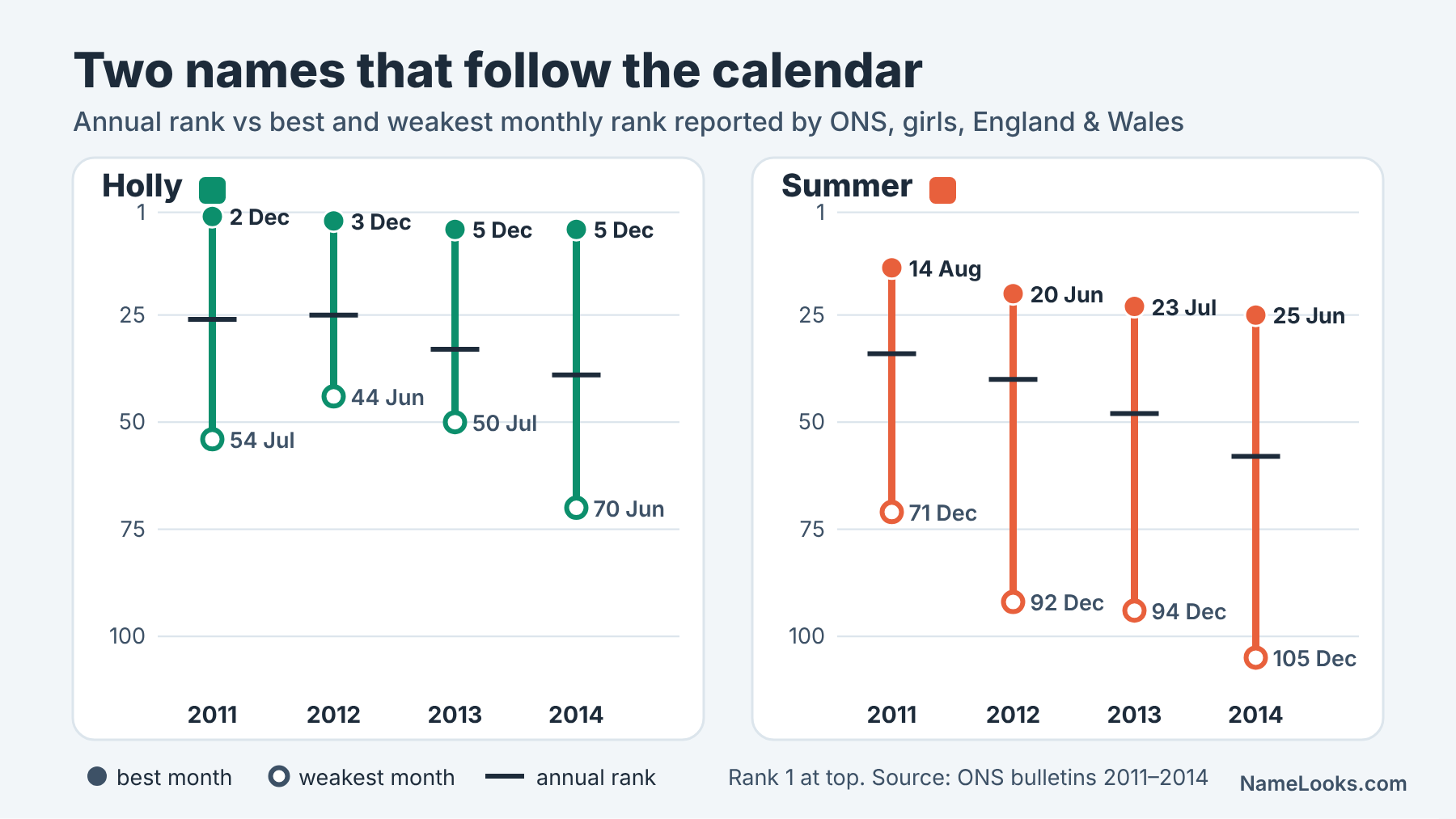
Here is how the four bulletins describe Holly. In 2011, Holly was 26th in the annual girls’ ranking but second in December; she was 21st in January and fell to 54th in July. In 2012, she was 25th for the year and third in December, 16th in January and 44th in June. In 2013, 33rd for the year and fifth in December, falling to 50th by July. In 2014, 39th for the year and fifth in December, and 70th in June.
Four years, four Decembers in the monthly top 5, and a summer trough every time. The annual rank was slipping across those years, from 25th or 26th down to 39th, yet the December peak held. ONS gives no explanation, and we’re not going to supply one as fact. The spelling is shared with a plant, and it’s easy to guess at a winter association. But the dataset records which name was registered, not what the parents had in mind, so that guess stays a guess.
Summer rises mid-year and falls in December
Summer is the mirror image. ONS reported it at 34th for 2011, reaching 14th in August and falling to 71st in December. In 2012 it was 40th for the year, 20th in June and August, and 92nd in December. In 2013, 48th for the year, 23rd in July and 94th in December. In 2014, 58th for the year, 25th in June and 105th in December.
Notice what the December figures imply. A name ranked in the top 60 for a whole year still fell below 100th in a single month. That gap between the annual position and the worst month widened as the name’s annual rank slipped. A swing of that scale, repeated in the same season four years running, isn’t what you would expect from chance alone.
| Name and birth year | Annual rank | Best month reported | Weakest month reported | Caveat | Naming implication |
|---|---|---|---|---|---|
| Holly, 2011 | 26 | 2nd (December) | 54th (July) | Bulletin text only; full monthly ranks not reproduced | December share far above the annual average |
| Holly, 2012 | 25 | 3rd (December) | 44th (June) | January also strong at 16th | Peak sits in midwinter months, not only December |
| Holly, 2013 | 33 | 5th (December) | 50th (July) | Annual rank slipping, peak holding | Seasonal pattern survives a falling overall trend |
| Holly, 2014 | 39 | 5th (December) | 70th (June) | Widest summer trough in the series | A December Holly is less unusual than the annual rank implies |
| Summer, 2011 | 34 | 14th (August) | 71st (December) | Bulletin text only | Mid-year births carry most of the name’s use |
| Summer, 2012 | 40 | 20th (June and August) | 92nd (December) | Two months tied as best | The peak is a season, not a single month |
| Summer, 2013 | 48 | 23rd (July) | 94th (December) | Annual rank slipping | Pattern repeats as the name cools |
| Summer, 2014 | 58 | 25th (June) | 105th (December) | December rank falls outside the top 100 | A December Summer is rarer than the annual rank implies |
Two notes on reading that table. First, “best” and “weakest” mean the months the bulletin happened to mention, which were the extremes ONS chose to highlight; we haven’t seen every month’s rank for these names. Second, these are ranks, not counts. A rank of 5th in December and 5th in March don’t mean the same number of babies, because months differ in size and the names around them differ in strength. If you want the distinction between position and volume spelled out, our explainer on why rank alone can mislead walks through it with U.S. data.
The calendar moves the denominator, too
Monthly name data sits on top of monthly birth data, and births themselves are seasonal. That matters because a rank compares a name with every other name born in the same month, while a count depends partly on how many babies were born that month at all.
When babies are born in England and Wales
The ONS article How popular is your birthday? analysed births in England and Wales from 1995 to 2014. It found that 26 September was the most common birthday over that period, with eight of the ten most common dates falling toward the end of September and the other two in early October. ONS described the September explanation as tentative, suggesting parents might plan around the school year and pointing to a 2011 Institute for Fiscal Studies study.
At the other end, six of the ten least common birth dates fell over Christmas and New Year. ONS attributed that mainly to bank holidays: hospitals generally handle natural births and emergency caesareans on those days, while planned inductions and elective caesareans are scheduled for other dates. The article also noted that 1 April ranks low, possibly because some parents avoid an April Fools’ Day birthday. ONS says that interactive is no longer updated, so treat it as a description of 1995 to 2014, not of 2025.
What that does to a monthly count
If one month has more births than another, every name in it tends to have a slightly higher count, even if parents’ tastes didn’t change at all. So comparing a name’s raw count in September with its count in December mixes two things: the name’s popularity and the size of the month. Rank partly avoids that problem, since it compares names within the same month, but rank brings its own distortions in the crowded middle of the list.
The cleaner measure, if you can build it, is share: a name’s count in a month divided by all births of that sex in that month. That needs a monthly births total from ONS’s birth statistics alongside the name file. It’s more work. It’s also the only way to say “this name was used by a larger fraction of December babies” with a straight face.
3Signal or noise? Small-number caution for monthly name counts
Here’s the uncomfortable part of monthly name data. Splitting a year into twelve pieces to study baby names by month of birth doesn’t add information about any one name; it divides the information you had. Every month holds roughly a twelfth of the year’s registrations, so every count is smaller and every rank is shakier. Most of the “this name surged in March” stories you’ll see are, statistically speaking, a coin landing heads a few more times than usual.
That doesn’t make the monthly tables useless. It means you need a way to tell the Holly-type pattern, which is large and repeatable, from the ordinary wobble that every name shows. This section gives you the arithmetic, then a set of four tests.
Why one month is a thin slice of the year
Imagine a name that parents choose at exactly the same rate all year round. Its monthly count still won’t be flat. Births are scattered events, and the number that happen to carry a given name in a given month varies by chance alone. The question is how much.
The arithmetic of a twelfth
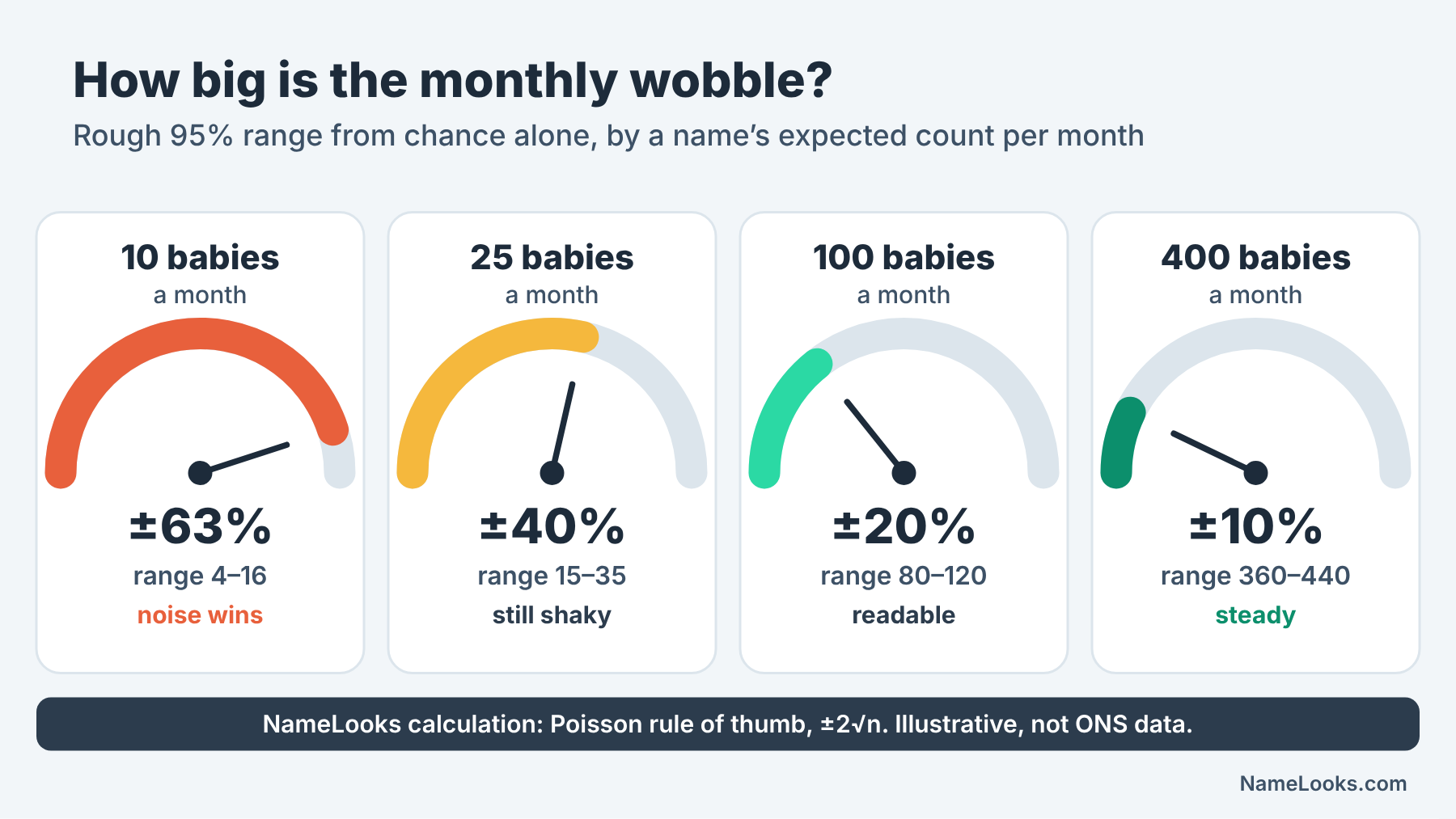
A standard rule of thumb for counts of independent events is that random variation is about the square root of the expected count; a rough 95% range runs about two square roots either side. This is a Poisson approximation, a textbook model rather than anything ONS publishes about names, and real data can be lumpier. Still, it gives a sense of scale. The figures that follow are NameLooks calculations using that rule.
- A name expected to appear 10 times in a month could plausibly land anywhere from about 4 to 16, a swing of roughly 60% either way.
- At 25 a month, the range is about 15 to 35, or 40% either way.
- At 100 a month, about 80 to 120, or 20%.
- At 400 a month, about 360 to 440, or 10%.
Now translate to annual figures. A name with around 1,200 registrations a year averages about 100 a month, so a 20% monthly bump is within normal noise. A name with 120 a year averages 10 a month, and a month that looks like it doubled could be nothing at all. The smaller the name, the bigger the swing you need before it means anything. That’s why the names ONS highlighted, Holly and Summer, were names in the annual top 60 with substantial counts behind them. Their swings were large relative to their size, not just in absolute terms.
Ranks exaggerate small moves in the crowded middle
Rank adds a second layer of distortion. Near the top of a list, names are well spaced: the gap between first and fifth can be hundreds of babies. Further down, dozens of names sit within a few counts of each other, and a change of two or three registrations can move a name many places. A monthly table makes this worse because all the counts are smaller, so the crowded zone starts higher up the list.
So a name moving from 40th to 25th between two months may represent a modest change in count, while a top-3 name holding its position may hide a larger absolute change. When you read monthly ranks, check the counts beside them, and be especially skeptical of large rank jumps outside the top 20. The same logic is behind our piece on rank jumps versus real birth counts in the U.S. annual data; the monthly version is the same problem at a smaller scale.
The headline trap
“Name X is the most popular name for May babies” can be true and still mislead, if name X is also the most popular name for every other month. Before you write or repeat a month-specific claim, check whether the month differs from the year. A month’s leader is only news if it isn’t the year’s leader.
Thresholds, missing names and privacy
Small numbers don’t only make counts noisy. They make some counts disappear. Both ONS and SSA withhold very small counts to protect the children behind them, and month is exactly the kind of detail that makes that protection necessary.
What ONS and SSA hold back
The ONS QMI says it doesn’t release names with counts of fewer than three in England and Wales as a whole, to protect the confidentiality of uncommon names and prevent identification of individuals. The QMI doesn’t spell out how the same principle is applied to each breakdown, and since the monthly output is a top 10, small names wouldn’t appear there anyway. In the U.S., SSA’s background notes say it excludes names that would reveal fewer than five occurrences in any geographic area.
The practical consequence is that a name’s absence from a monthly table tells you almost nothing. A name may be outside the monthly top 10, or below a disclosure threshold, or simply not used that month. None of those is the same as “nobody named their baby this in April,” and none of them supports a claim that a name is “rare” in a particular month. If you want a defined rarity claim, our cluster on rare names explains why you have to define rare before using the word.
Why month makes identification easier
Combine a distinctive name with a birth month and an area, and the number of children who fit can shrink to one. That’s the reason official tables publish month-level views only for names at the top, where hundreds of babies share each cell. It’s also a good reason for anyone building their own month tables from published data, or from a private registry, to be cautious about publishing small cells. Our article on the privacy problem with extremely rare name data covers the principle; month of birth is one of the details that raises the risk.
The same logic applies on the personal side. Picture a parent posting online that their baby is “the only Clementine born in our town in March.” That parent is publishing a date-of-birth clue alongside a name. That’s a choice families are entitled to make, but it’s worth seeing that a birth month is identifying information, not just trivia.
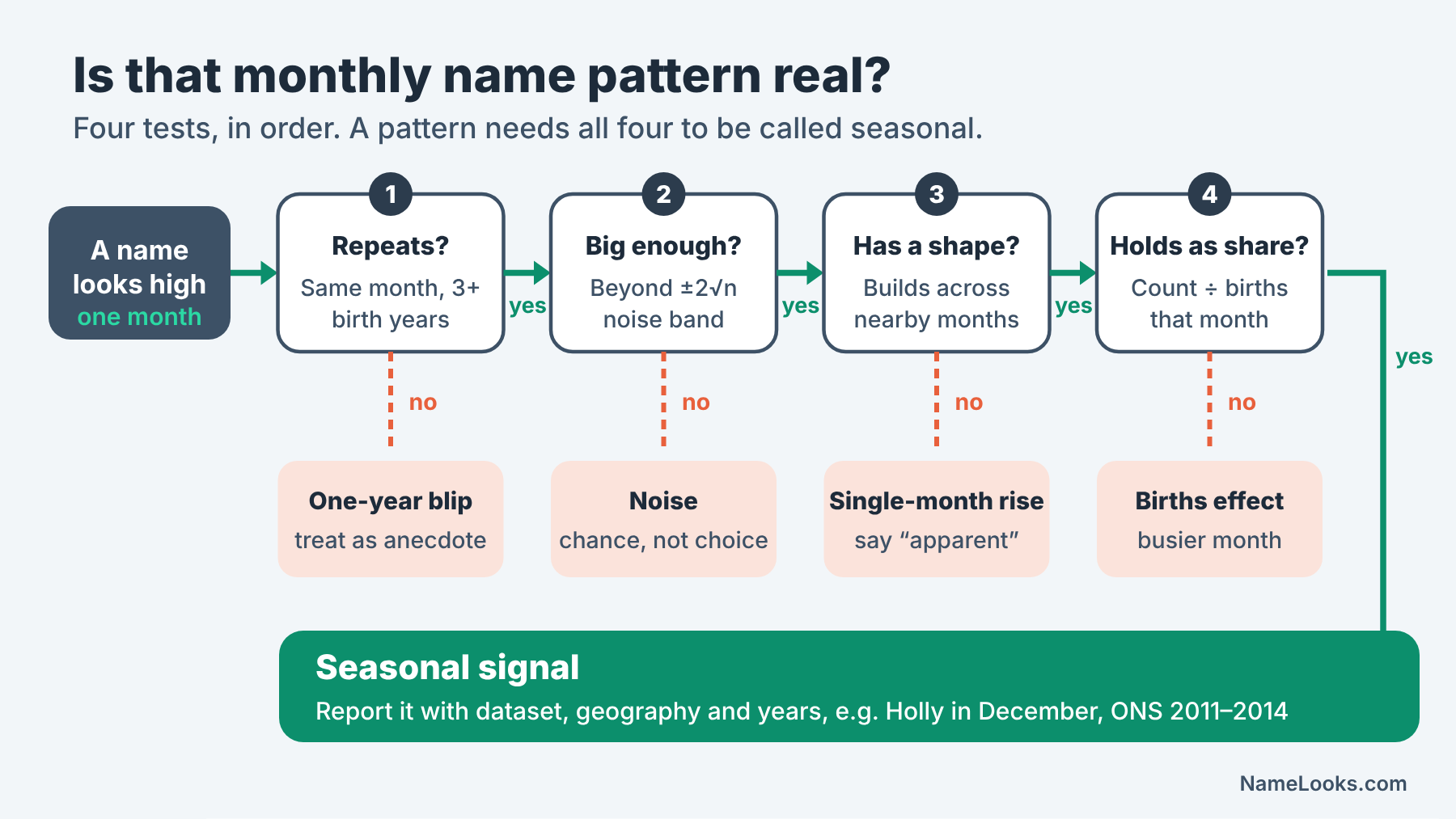
Four tests before you call a name seasonal
Here is the checklist we’d use before calling any monthly pattern seasonal. It’s built from the arithmetic above and from what distinguished the Holly and Summer cases in the ONS bulletins. A name doesn’t have to pass all four for the pattern to be interesting, but it needs all four before you call it established.
Test 1 and test 2: does it repeat, and is it bigger than the wobble?
- Repetition across years. One December spike is an anecdote. The same spike in the same month across three or four separate birth years is a pattern. Holly’s December top-5 finish in each year from 2011 to 2014 is the model; a single year would have proved much less.
- Size against the noise band. Estimate the name’s average monthly count from its annual count, then ask whether the month’s deviation exceeds about two square roots of that average. If the annual counts aren’t available, a move from outside the top 50 into the top 5, as Holly showed, is far beyond what chance could plausibly produce for a name of that size.
Test 3 and test 4: does it have a shape, and does it survive the denominator?
- A seasonal shape, not a lone spike. Real seasonality usually builds and fades across neighbouring months. In the ONS record, Holly was strong in January as well as December in 2011 and 2012, and Summer peaked across June, July and August with a December low. A single high month surrounded by ordinary months is more likely noise or a one-off event.
- Share, not just count. If you are working with counts, divide by the month’s births of that sex before comparing months. A September bump in raw counts may simply reflect more September births. If you’re working with ranks, remember that ranks already compare within a month but get unstable outside the top of the list.
A pattern that passes all four is one you can describe as seasonal, with the dataset, years and geography attached. A pattern that passes one or two is worth mentioning as “an apparent rise in a single month” and nothing stronger.
4Separate what the monthly data proves from what people say about it
Monthly name data attracts stories. A name rises in December and someone says parents are “choosing festive names.” A name peaks in summer and it becomes “the sunshine baby trend.” Those stories may even be right. But they’re claims about motives, and no registration form asks parents why they chose a name. Keeping the evidence and the interpretation in separate boxes is the main skill that baby names by month of birth ask of you.
What the sources establish, and what they can’t
Start with a narrow, defensible list. Everything on it can be traced to a named ONS or SSA publication, a geography and a year.
Established by the official record
ONS establishes that, for England and Wales, it publishes a top 10 of first names by month of birth for each sex, based on exact spellings recorded at birth registration. It also establishes that the annual release including that breakdown for 2025 came out on 9 July 2026.
The 2011 to 2014 bulletins establish the monthly ranks it chose to report, including the Holly and Summer patterns, the identity of the monthly leaders, and the number of names that reached a monthly top 10 at least once: 13 boys’ and 15 girls’ names in 2011, 14 and 15 in 2012, 15 and 17 in 2013, and 14 and 16 in 2014.
That last statistic is worth a moment. Only a dozen or so names per sex ever cracked a monthly top 10 in a year, out of thousands of names registered. The monthly top of the list is a small, stable club. On the U.S. side, SSA establishes only that its public name files carry year of birth, sex and state, so U.S. claims about month-specific naming can’t rest on the SSA files.
Not established anywhere in the official data
No official source here tells you why a name is chosen more often in a particular month. None tells you whether parents of December babies picked the name before or after the birth, whether the baby’s due date or actual birth date drove the choice, or whether the pattern is about the season, a holiday, a family custom, or something else. None of it describes an individual child. A Holly born in July is not an anomaly; she’s one of the many Hollys born outside December, and the data says nothing about her family’s reasons either.
The data also can’t tell you that a name “belongs” to a month in any cultural sense. A seasonal pattern in England and Wales registrations is a pattern in one population, under one registration system, over specific years. It doesn’t transfer automatically to the U.S., to Scotland or Northern Ireland (which register births separately from ONS’s England and Wales figures), or to any other country. Our piece on why a name can rank differently from country to country explains why that transfer fails even for annual figures.
| Claim | Source / dataset | Geography | Year | Metric | Limitation | Editorial takeaway |
|---|---|---|---|---|---|---|
| Official month-of-birth name tables exist | ONS girls’ and boys’ baby names datasets; Baby names QMI | England and Wales | Editions to 2025 (released 9 July 2026) | Top 10 by month, by sex | Top 10 only; we could not open the 2025 spreadsheets | Cite the dataset, not a press summary |
| U.S. official name data has no month field | SSA baby names background notes | United States | Current files through 2025 | Year, sex, state | Private U.S. “month” lists use other data | Say whose data any U.S. month list uses |
| Annual leaders usually lead most months | ONS bulletins for 2012–2014 | England and Wales | 2012–2014 | Monthly rank 1 | 2011 girls an exception, with close annual counts | A month’s leader is news only if it differs from the year’s |
| Holly peaks in December | ONS bulletins for 2011–2014 | England and Wales | 2011–2014 | Monthly rank (girls) | Bulletins discontinued; recent years need the dataset | Repeatable seasonal signal for those years |
| Summer peaks in summer months | ONS bulletins for 2011–2014 | England and Wales | 2011–2014 | Monthly rank (girls) | Ranks, not shares | Repeatable seasonal signal for those years |
| Births peak in late September | ONS, How popular is your birthday? | England and Wales | 1995–2014 | Births by date | Interactive no longer updated | Monthly counts carry a births effect; compare shares |
| Parents choose seasonal names on purpose | None in official data | — | — | — | Motive is not recorded | Label as interpretation, or leave out |
Where interpretation begins, and how to write it honestly
Interpretation isn’t forbidden. It’s the useful part, as long as it’s labeled. The aim is to make it obvious to your reader which sentences are the dataset talking and which are you.
Plausible explanations, labeled as such
Take Holly. A reasonable editor might suggest that some parents of December babies are drawn to a name that shares its spelling with a plant widely seen at that time of year. That’s a hypothesis consistent with the timing.
It isn’t tested by the data, though, and there are other possibilities you can’t rule out from a rank table, such as family names, a name chosen long before the due date, or a popular character at the time. The honest sentence is something like: “ONS data shows Holly ranking far higher among December births; one possible explanation is a seasonal association, though the data doesn’t record parents’ reasons.”
The same structure works for Summer, and for any other pattern you find. State the observation with its dataset, year and geography. Then offer the explanation as an explanation, using words like “possibly,” “one reading,” or “consistent with.” If you can’t think of a way the explanation could be wrong, you probably haven’t thought about it long enough.
Phrases to retire, and what to say instead
- “The top names for October babies are…” Better: “In ONS data for England and Wales, the top 10 girls’ names among October births in [year] were…” and then check whether they differ from the annual top 10 at all.
- “A popular December name.” Better: “A name that ranked higher among December births than in the year overall, in [dataset, years].”
- “Parents love summery names.” Better: say what the data shows and leave motive out, or label it as speculation.
- “Rare for a spring baby.” Better: drop it. Monthly tables don’t publish enough of the list to support a monthly rarity claim.
None of those rewrites is long. They just put the dataset in the sentence. If you write about names regularly, our broader guide to reporting rank, count, share, year and source together sets out the same discipline for cross-country trend work.
Monthly views next to the other ONS breakdowns
Month isn’t the only way ONS slices the annual data. The same girls’ and boys’ datasets break names down by country, region and mother’s age. Each of these is a lens on the same registrations, and each has the same basic weakness: the slices are smaller than the whole.
How month compares with region and mother’s age
A region or an age band can contain a large share of a year’s births, so those breakdowns can sometimes show sharper contrasts than a month can. Month is different in one useful way. Months are interchangeable units of time, and it seems reasonable to assume that each month draws on a broadly similar mix of parents, regions and ages, give or take the birth seasonality described earlier. That is our assumption, not something the names release tests.
If it holds, it makes month a cleaner test of “does timing alone change naming?” than region or age, where who the parents are changes too. Our articles on what ONS regional data can show and on reading the mother’s-age breakdown carefully cover those lenses on their own terms.
Don’t stack the slices without checking cell sizes
It’s tempting to combine lenses: December births in one region, or summer births to younger mothers. ONS doesn’t publish those combinations as far as we could see, and if you build them from any source that allows it, the cells shrink fast. A name with a hundred registrations a year in a region might have eight or nine in a given month there. At that size the noise band covers almost any story you’d want to tell. If a combined slice is essential, report it with the count beside it and say plainly that it’s small.
5Using month-of-birth patterns when you are actually naming a baby
Most people who look up baby names by month of birth aren’t statisticians. They’re expecting a baby in a particular season and wondering whether that should shape the name. The data can help with one narrow question and is silent on the rest, so it’s worth being clear about which question it answers.
If you love a name that seems to suit the season
Seasonal fit is a perfectly good reason to like a name. The data doesn’t tell you whether it’s a good idea; that’s taste, family and sound. What it can tell you is whether a name you think of as seasonal is actually concentrated in that season among real births, which affects how often your child may meet others with the same name who were born around the same time.
What the monthly record can tell you about namesakes
Look again at Holly in the ONS bulletins. Its annual rank was in the 20s and 30s, which by itself might suggest a moderately common name. Among December births it was in the top 5. So a December-born Holly in those years shared her name with a much larger fraction of same-month babies than the annual rank implied, while a June-born Holly shared it with fewer. Summer ran the other way. For a name whose use is genuinely seasonal, the annual rank is an average that fits nobody exactly.
Does that matter? For some families it doesn’t at all. For others, especially those who care about how often a child will hear their own name called by someone else, it’s a real factor. Our decision guide on how much uniqueness you actually want helps you decide how much weight this deserves before you go looking at monthly tables.
It’s also worth keeping in proportion: the monthly effect only changes the picture for the small number of names that pass the four tests above. For most names, the annual figure is the better guide, because it’s built on twelve times as much data.
A hypothetical: two December due dates
Picture two couples in England, both due in December, both drawn to names with a winter feel. The first couple loves a name that sits around the middle of the annual top 100. They check ONS monthly tables for several past years and find the name never appears in any month’s top 10, December included. That tells them its use isn’t concentrated in December, at least not at the top of the list. Their December baby is unlikely to be one of an unusually large cluster.
The second couple likes a name with a pattern like Holly’s: much stronger among December births across several years. They now know that their child may share the name with more same-season babies than the annual rank suggests. Neither couple has learned whether their name is “good.” They’ve learned something narrower and more useful: how the annual number translates to the slice of the calendar their child will actually belong to. That’s the right size of conclusion to draw from this data.
Running your own monthly check in the ONS files
If you want to look at baby names by month of birth for recent years yourself, the girls’ and boys’ datasets are the source. You don’t need special software; a spreadsheet program is enough. The process below keeps you inside what the data can support.
Steps for a careful monthly look
- Download the right edition. From the ONS girls’ or boys’ dataset page, choose the birth year you want. For several years of comparison, download several editions; the monthly tables are per year.
- Read the notes sheet first. Check what the monthly table covers, whether it’s a top 10, and any notes about registration timing for that year, particularly for 2020 and 2024, the two years the ONS user guide flags for unusual late registrations.
- Write down the annual rank and count beside each name you care about. The month only means something against the year.
- Look for the name in every month, across several years. Note where it appears and where it doesn’t. Absence from a top 10 is not evidence of low use.
- Apply the four tests. Repetition across years, size against the noise band, a seasonal shape across neighbouring months, and share rather than raw count where you have counts.
- Record your spellings decision. ONS counts exact spellings separately. If you combine spellings, write down which ones and why.
How to report what you find
If you’re writing about the result, a blog post or a note to family, one sentence structure covers almost every case: In ONS data for England and Wales, [name] ranked [position] among [girls/boys] born in [month] [year], compared with [position] for the year as a whole. Add “a pattern repeated in [years]” only if it was. Leave out the “why” or label it clearly.
And resist ranking months against each other as if they were competitions. “December’s most distinctive name” is a phrase that sounds like data but asks the reader to trust a judgment you haven’t shown. Two numbers side by side, monthly rank and annual rank, will tell the story more honestly than any adjective. For how this fits into a wider decision, our framework on how to choose a name beyond endless lists puts data in its place alongside sound, family and meaning.
When the monthly lens isn’t the right one
Sometimes the most helpful thing this topic can do is send you to a different question. Monthly data answers “is this name concentrated in a season?” It’s a weak tool for most other questions people bring to it.
Questions better answered by annual or multi-year data
“Is this name rising?” belongs to the annual series, ideally over several years, where counts are twelve times larger. “How common will this name be in my child’s year group?” is mostly an annual question, unless the name is one of the rare strongly seasonal ones. “Is this name more popular here than in the U.S.?” is a cross-country question that can’t use months at all, since the U.S. files have no month field.
Our comparison of U.S. and England and Wales rankings handles that one, and the cluster’s main guide to the ONS 2025 release is the better starting point for “what’s popular now.”
Questions no name dataset answers
“Will a seasonal name suit my child?” “Is it a cliché to name a December baby after a winter plant?” “Will people assume something from the name?” Those are questions about taste, family and how names land socially. Data on registrations can’t settle them, and we’d be suspicious of any source that claims it can.
Talk them through with the people who’ll be saying the name every day; that’s where the answer actually lives. If you want the comparison method behind all of this applied across several countries’ systems, our guide to comparing name popularity across data systems picks up where this page stops.
Questions people actually ask
Does the U.S. publish baby names by month of birth?
Not in the Social Security Administration’s public baby names files. Those files are organized by birth year, with sex and, in the state files, state of birth. If you see a U.S. list claiming to rank names by birth month, look for the data source; it will be a private dataset, a themed list, or an estimate, not the official SSA ranking.
Can I find the top names for my own baby’s birth month in England and Wales?
Yes, for any recent birth year. Open the ONS girls’ or boys’ baby names dataset for that year and look for the month-of-birth table, which the ONS QMI describes as a top 10 per month. Remember that the newest edition always describes births a year or more earlier, since data for a given year is released the following summer.
Are names popular in December mostly Christmas-themed?
The ONS record shows one clear December riser in its 2011 to 2014 bulletins, Holly, but it doesn’t say why, and it doesn’t support a general claim that December names are holiday-themed. And since only 15 to 17 girls’ names reached any monthly top 10 in each of those years, the twelve monthly top 10s, December’s included, must have overlapped heavily.
Why do some months seem to have different top names in news coverage?
Usually because the annual leaders are close in count, so the monthly order shuffles by chance. ONS’s 2011 girls’ data is a good example: three names within about 300 registrations of each other for the whole year traded the monthly lead. A different monthly leader is only meaningful if the gap is large or the pattern repeats.
Is a name that appears in a summer month’s top 10 a “summer name”?
Not on one year’s evidence. Check whether it ranks lower in other months, whether that happens in several years, and whether the difference is larger than ordinary noise for a name of its size. Summer, the name, passed those checks in the ONS bulletins for 2011 to 2014; most names that pop into a single month’s top 10 won’t.
Does birth seasonality affect name counts by month?
Yes. ONS’s analysis of 1995 to 2014 births found a late-September peak and lows around Christmas and New Year, so months differ in size. That pushes raw counts up or down for every name. Comparing a name’s share of each month’s births, rather than its raw count, removes most of that effect.
Sources and further reading
- ONS: Baby names in England and Wales: 2025 (release page) — release date and links to the girls’, boys’ and 1996-onward datasets.
- ONS: Baby names for girls in England and Wales (dataset) — annual editions with the month-of-birth breakdown; the boys’ dataset sits alongside it.
- ONS: Baby names QMI — exact-spelling rule, the fewer-than-three disclosure rule, accents, hyphens, and the top 10 by month.
- ONS: User guide to birth statistics — registration timing, the 42-day limit and late registrations.
- ONS bulletins for 2011, 2012, 2013 and 2014 — the “Seasonal variations” sections quoted on this page.
- ONS: How popular is your birthday? — birth seasonality in England and Wales, 1995 to 2014.
- SSA: Background information on the baby names data — the fields the U.S. files carry, and the five-occurrence privacy rule.
NameLooks provides general information about names and name data. Popularity and seasonal figures describe populations of registered births, never individual children or families, and the datasets cited here can be revised; check the publisher’s current release before relying on a figure.