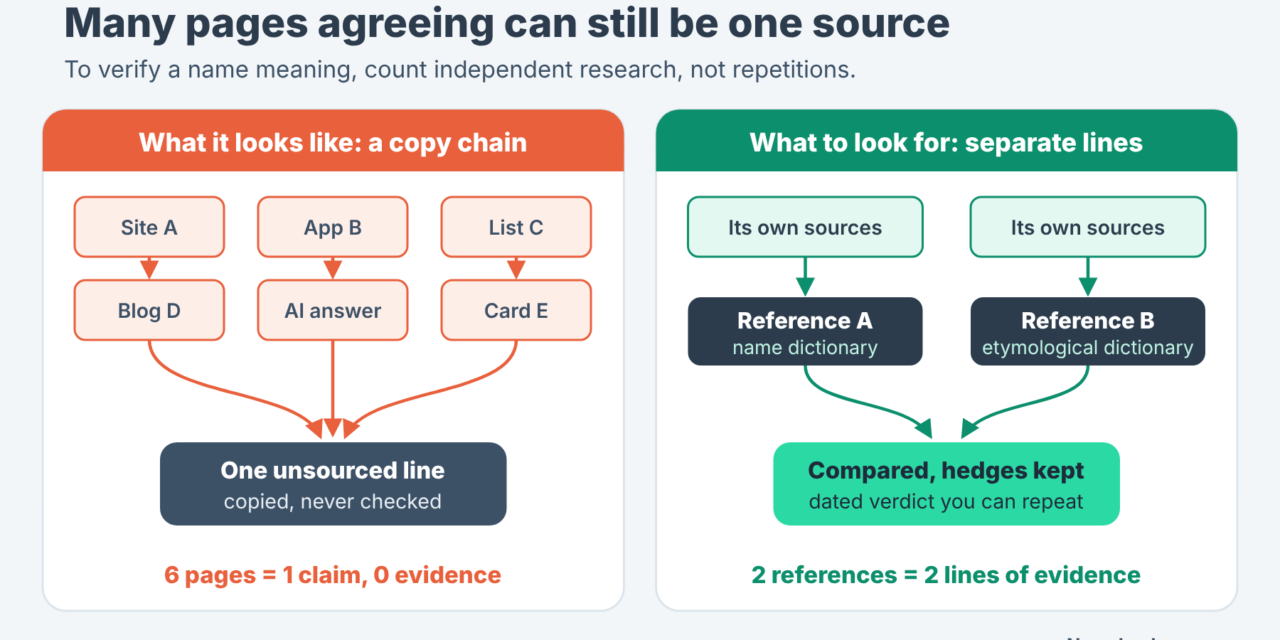
The most common mistake people make when they try to verify name meaning claims is counting websites. Ten baby-name pages that all say the same thing feel like ten votes, but they are often one source copied ten times. This page gives you a six-step method for checking a meaning against references that are genuinely independent, reading what those references actually commit to, and writing down a verdict someone else could repeat.
The short version
- Agreement is not evidence. What matters is how many independent lines of research stand behind a meaning, not how many pages repeat it.
- Name the claim before you check it. “Comes from a Latin family name,” “was coined by a novelist,” and “symbolizes strength” are three different kinds of statement, and each needs a different kind of proof.
- Two references only count as two if they did separate work. A site that quotes a dictionary is a pointer to that dictionary, not a second witness.
- Read the hedges. Words like “possibly,” “apparently,” and “said to mean” are the most important words in an entry. Dropping them is how a guess becomes a “fact.”
- Most date disagreements are edition disagreements. A poem written in one year and printed in another will be dated both ways, and both can be right.
- Write the verdict at the confidence the evidence supports, keep a dated note of what you checked, and say “unknown” when that is the honest answer.
1How to verify name meaning claims in six steps
Here’s the whole method in one paragraph, so you don’t have to dig for it. First, write down the exact claim and what kind of claim it is. Second, trace it upstream to whoever actually did the research. Third, find a second reference that did its own research. Fourth, pin the name to a source language, an earliest form, and a date. Fifth, compare the two accounts line by line and note every gap. Sixth, write a verdict in words that match the strength of the evidence, with the date you checked.
That sounds like a lot of work just to verify name meaning for a baby. In practice it takes twenty minutes for a well-documented name and an afternoon for a hard one, and it’s the only way to tell a sourced meaning from a pleasant sentence someone typed in 2009. The rest of this section walks through the steps with real names. Later sections cover which references count, how to tell evidence from interpretation, and how to record the limits of what you found.
If you want the broader picture first, what etymology is, why name meanings get garbled, and which kinds of origin research exist, our cornerstone guide on researching name meanings and origins without repeating myths covers that ground. This page stays narrow: the checking routine itself.

Steps 1 to 3: pin down the claim and find who really researched it
The first half of the method is about the question rather than the answer. Most bad verdicts come from checking a vague claim against vague sources, so the early steps make both more precise.
Step 1: write the exact claim and label its type
Copy the claim word for word from wherever you found it. “Vanessa means butterfly” is a different claim from “Vanessa was invented by Jonathan Swift,” and you can’t check either one until you’ve written it down without paraphrasing it into something kinder.
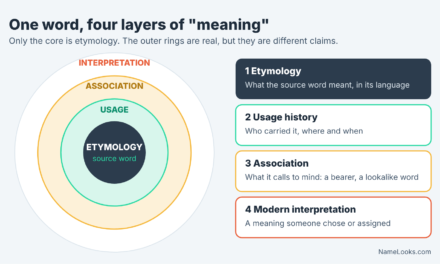
Then label it. We use four labels, borrowed from the distinctions in our explainer on what a name’s “meaning” actually refers to:
- Etymology: the source word or words the name came from, and what they meant in that language.
- Coinage or usage history: who first used the name, where, and when it spread.
- Relationship: the name is a variant, diminutive, cognate or transcription of another name.
- Association: a later link to a person, a story, a thing, or a symbolic idea.
The butterfly claim is an association. Swift is a coinage claim. As you’ll see in the worked case below, the references we opened support the second and actively undercut the idea that the first is an etymology. Labeling first stops you from “verifying” an association by finding sources for a different kind of claim entirely.
Step 2: trace the claim upstream
For each page making the claim, ask one question: where did this page get it? Look for a named reference book, a cited dictionary, or a link. If a page gives no source at all, it’s a lead, not evidence. If it gives a source, the source is the thing you now need to check, and the page drops out of your count.
This step is where the “ten sites agree” illusion collapses. Meaning lists on apps and generator sites tend to share wording because they draw on the same handful of older books or on each other. Identical phrasing across sites, down to the same odd comma, is a strong sign of copying. Our piece on how folk etymology and copy-paste websites create myths goes deeper into how those chains form; for verification, all you need is to follow the chain until it stops at someone who did original work.
Behind the Name is a useful example of a source that shows its work. The site publishes a list of the reference books it draws on, including Elizabeth Gidley Withycombe’s The Oxford Dictionary of English Christian Names (1945) and Patrick Hanks and Flavia Hodges’s A Dictionary of First Names (Oxford, 1990). That transparency is exactly what makes it useful as a secondary reference: you can see what it rests on and go check.
Step 3: find a second reference that did separate work
Now look for a second account that wasn’t built from the first. A general etymological dictionary, a scholarly name dictionary, or an encyclopedia entry on the person or text behind the name are all good candidates. The test of independence is covered in detail in the next section, but the short rule is this: if reference B cites reference A as its only source for the claim, you still have one reference.
For English-language given names, a practical pairing is Behind the Name alongside the Online Etymology Dictionary (Etymonline), which publishes its own list of principal sources, including the Oxford English Dictionary and the Barnhart Dictionary of Etymology. Be aware that the two aren’t perfectly independent: Behind the Name’s own source list includes the Online Etymology Dictionary among its online resources. Where the entries diverge in detail, as they do for the names below, that’s a sign each did some of its own work. For anything important, add a third check against a book-length name dictionary or a primary text.
Steps 4 to 6: anchor the name, compare accounts, and record a verdict
Once you have two accounts in hand, the work shifts from finding to reading. This is where the real disagreements show up, and where most of them turn out to be smaller than they first look.
Step 4: anchor the name to a language, a form, and a date
A meaning is only meaningful relative to a language. “Means beloved” in which language, from which word, attested when? Write down the source language, the earliest form each reference gives, and any date or text they attach to it. For names with deep histories, this step can open into real philological work, which is why we have a separate guide on researching ancient names through script, earliest forms, and source quality.
Take Vanessa. Behind the Name’s entry for Vanessa says Jonathan Swift invented the name for his poem Cadenus and Vanessa, built from the first syllables of the first name and surname of his friend Esther Vanhomrigh. Etymonline agrees on Swift and Vanhomrigh, says he apparently coined it around 1711 as a pseudonym used in private letters, and dates the poem to 1713. So the anchor is clear: an English literary coinage of the early eighteenth century, not a word inherited from an older language.
Step 5: compare the accounts line by line
Put the two accounts side by side and look for three kinds of difference: dates, mechanisms, and hedges. Vanessa shows all three in miniature.
On dates, Behind the Name calls it Swift’s “1726 poem,” while Etymonline dates the poem to 1713. Wikipedia’s article on Cadenus and Vanessa resolves this: the poem was written in 1713 and published as a book in 1726. Both dates are right; they describe different events.
On mechanism, the accounts differ slightly about which letters went where. Behind the Name says first syllables of first name and surname. Wikipedia says the first three letters of her surname plus the first two of her first name. Etymonline reports William Monck Mason’s view that the first syllable of the surname went in front of “Hessy,” a pet form of Esther. None of these changes the core conclusion, but if you were writing about the name, you’d say “Swift built it from parts of Esther Vanhomrigh’s name” rather than pretending to know the exact recipe.
And on the butterfly: Etymonline notes that the butterfly genus Vanessa dates to 1808, that the entomologist Johan Christian Fabricius chose it for unknown reasons, and that it has no clear connection to Swift. That’s why “Vanessa means butterfly” fails as an etymology. It’s a later, separate use of the same word.
Step 6: write the verdict and date it
The last step is writing down what you found in words the evidence can carry. For Vanessa, a fair verdict reads something like: “A name coined by Jonathan Swift from parts of Esther Vanhomrigh’s name, used in his poem Cadenus and Vanessa (written 1713, published 1726). The butterfly genus of the same name, from 1808, has no documented connection to Swift. Checked October 2026 against Behind the Name and Etymonline, with publication dates confirmed on Wikipedia.”
That’s longer than “means butterfly,” and it’s also true. Notice that it records which sources you used and when. That date matters more than it seems, because reference sites revise entries, and a verdict with no date can’t be rechecked against the version you saw.
A twenty-minute version for busy weeks
If you need to verify name meaning claims across a long shortlist, do Steps 1, 3 and 6 for every name and save the full routine for the finalists, for any name whose meaning will be part of the reason you choose it, and for any claim about a culture or religion other than your own. Speed is fine. Pretending a quick check was a thorough one is the problem.
2Decide which sources count before you look at the answer
There’s a reason this section comes before any verdicts. If you choose your sources after you’ve seen what they say, you’ll drift toward the ones that tell you what you hoped. Deciding the rules first, before you verify name meaning for any single candidate, which references count as evidence and what makes two of them independent, keeps the check honest even when you’re invested in the name.
Which references count as evidence
Not every source is weak, and not every book is strong. When you set out to verify name meaning, what you want is a reference that names its own sources, separates what is documented from what is proposed, and was written by someone accountable for errors. Here’s how the usual candidates compare.
Scholarly name dictionaries and the books behind the websites
The strongest everyday references for English-language given names are book-length dictionaries compiled by lexicographers and onomasts, the people who study names professionally. Hanks, Hardcastle and Hodges’s A Dictionary of First Names is a standard example: an Oxford University Press reference whose second edition (2006) covers more than 6,000 names, according to its Wikipedia summary. Withycombe’s 1945 Oxford dictionary is older but still cited, including by Behind the Name for the Pamela entry discussed below.
Two limits apply. These books are written in English, mostly about names used in English-speaking countries, so their coverage of names from other languages is uneven. And they are not free: the online version of the Oxford first-names dictionary sits behind a subscription. A public library card often gets you in. If you can’t reach one, say so in your notes rather than citing a book you haven’t seen.
For names that come from outside English, the equivalent is a scholarly dictionary or onomastic reference in that language, ideally produced by a university, a national language institute, or a recognized specialist. That’s a different search for every language, and it’s worth doing for the one or two names that matter most.
General etymological dictionaries
Etymological dictionaries of ordinary words, such as the Oxford English Dictionary or Etymonline, include some given names, especially names that have also become words or that show up often in literature. They’re strong on word history and dating, and their entries tend to be careful about hedging.
Their limit is coverage. A general dictionary will have an entry for Mary or Vanessa but nothing for many names in active use. When you find a name there, treat it as a serious second reference. When you don’t, don’t read the absence as evidence of anything except a narrow word list.
Secondary indexes, wikis, and encyclopedias
Behind the Name, Wikipedia, and Wiktionary sit in the middle. They can be excellent, but they are syntheses of other sources, and their quality varies entry by entry. Behind the Name is open about this: it lists its references, so you can see which book an entry probably rests on. Wikipedia entries carry footnotes, which make them good maps for finding the books and articles behind a claim.
The working rule we use: these sources are allowed to be one of your two references for a well-documented name, provided the other is independent of them. For anything disputed, culturally sensitive, or central to your decision, use them as pointers and go to what they cite.
Baby-name sites, apps, and AI answers
Most meaning lists on baby-name sites and apps give a one-line meaning and no source. That doesn’t make every line wrong. It makes every line uncheckable on its own terms, which for verification purposes is the same thing.
AI chat answers belong in this bucket too, and for an extra reason: a language model can produce a fluent, specific, entirely invented meaning, complete with a plausible-sounding source language. If an AI tool gives you a meaning, treat it exactly as you’d treat an unsourced app entry. Use it as a search term, then go find a reference that a person stands behind. Our checklist of name meaning red flags is a quick way to triage these before you spend time on them.
What makes two sources independent
The whole method rests on having two independent references, so it’s worth being precise about what independence means and how to group names before you count anything.
The independence test
Two references are independent for a given claim when neither one got the claim from the other, and they didn’t both get it from the same single upstream source. You can rarely prove this perfectly, but you can run a few checks:
- Read the citations. If reference B footnotes reference A for this point, you have one source plus a pointer.
- Compare the wording. Paraphrase is normal. Identical unusual phrasing suggests copying.
- Compare the detail. Independent accounts usually differ in small ways, a date here, a nuance there. Perfect agreement on every detail is, oddly, a reason for mild suspicion.
- Check the source lists. Behind the Name and Etymonline publish theirs. Where both lean on the same older book, find that book or a third reference.
The Wendy case later on this page shows why point 3 matters: the references disagree about whether the name existed before J. M. Barrie, and that disagreement is the most useful thing they tell you.
Grouping rule: spellings, look-alikes, and names that only seem related
Before you count sources, decide which names you’re actually checking. Two names that look alike are not automatically the same name, and a meaning verified for one doesn’t transfer to the other.
Emily and Amelia are the classic trap. Behind the Name’s Emily entry traces it to the Latin Aemilius, a Roman family name, while its Amelia entry describes Amelia as a variant of Amalia built on the element amal and notes it is “sometimes confused with Emilia, which has a different origin.” Etymonline’s Amelia entry says the name is “said to be of Germanic origin” and that it was assimilated with the Roman name Aemilia.
So two references agree that these names have separate roots, and both also record real historical blending. Behind the Name even notes that Princess Amelia Sophia (1711 to 1786) was commonly called Emily in English.
The lesson for verification: check each spelling as its own claim, and note blending where your sources record it. The same applies to the relationships covered in our guide to cognates, variants, diminutives, and transcriptions: “a variant of” is itself a claim that needs sources.
When only one reference makes the claim
Sometimes your two references agree on the basics and only one adds a meaning. That’s common, and it’s not a failure. You just have to report it as one source.
Emily is again a good example. Etymonline’s entry for Emil derives the Latin family name Aemilius from aemulus, “imitating, rivaling.” Behind the Name’s entries for Emily and Aemilius trace the Latin form but don’t make that connection.
So the honest summary is: both references agree Emily comes from the Roman family name; one of them connects that family name to a Latin word meaning “rivaling.” If you print “Emily means rival” with no qualifier, you’ve turned one reference’s derivation into a consensus it doesn’t have. If the meaning matters to you, that’s the moment to find a third reference, such as a Latin dictionary or a scholarly name dictionary, before you lean on it.
3Separate what a source proves from what it suggests
Finding two good references is half the job. The other half is reading them precisely, because a reference can be entirely trustworthy and still say less than people quote it as saying. Most myths don’t start with a bad source. They start with someone summarizing a good source and dropping the qualifier.
What a reference actually establishes
Every entry in a careful name dictionary mixes things it states as documented with things it offers as likely or possible. Your verdict should keep those layers apart.
Read the hedge words first
Before you read what a name means, scan the entry for hedges: “possibly,” “probably,” “apparently,” “perhaps,” “said to mean,” “of uncertain origin,” “has been connected with.” These words are the reference telling you how much weight its own statement can bear. When you verify name meaning entries, the hedges are the part you’re most likely to lose in a summary and the part that matters most.
Mary shows how much can hang on them. Behind the Name’s Mary entry says the meaning of the Hebrew Miryam is not known for certain. It lists several proposed meanings, including “sea of bitterness,” “rebelliousness,” and “wished for child,” and adds that the name may originally have been Egyptian, perhaps connected to words for “beloved” or “love.” Etymonline’s Mary entry traces the name back through Latin, Greek and Aramaic forms to Hebrew Miryam, which it calls “a word of unknown origin, said to mean literally ‘rebellion.'”
Now look at what the two references agree on. Both say the ultimate origin is uncertain. Both record “rebellion” or “rebelliousness” as a traditional or proposed reading. Only one mentions the Egyptian hypothesis. So a baby-name card that says “Mary: means beloved” has picked one hypothesis from one source and removed the uncertainty both sources insist on. A card that says “Mary: means bitter” has done the same with a different hypothesis. The verified statement is less tidy: the origin is uncertain, and several meanings have been proposed.
Separate the settled part from the conjectural part
Pamela is a useful contrast, because its history is well documented and its meaning isn’t. Behind the Name’s Pamela entry says the poet Philip Sidney invented it for his romance Arcadia, and that it came into use as a given name after Samuel Richardson used it for the heroine of Pamela, or Virtue Rewarded. It adds that Sidney “possibly” intended it to mean “all sweetness,” from Greek pan (“all”) and meli (“honey”). Etymonline’s Pamela entry also credits Sidney and Richardson and calls the “all-sweetness” reading conjecture.
So the two references, which agree with each other on both points, divide the claim cleanly into two layers. The coinage by Sidney and the boost from Richardson’s novel are established. The Greek meaning is an educated guess about what Sidney had in mind, and no source we opened says he explained it. A fair one-line version: “Coined by Philip Sidney for Arcadia; often explained as Greek for ‘all honey’ or ‘all sweetness,’ though that reading is conjecture.”

Where interpretation, taste, and inference creep in
Past the edge of what references establish, there’s a wide zone of material that isn’t false, exactly, but isn’t evidence either. It’s useful to recognize it, because baby-name content leans on this zone heavily, and because you can’t verify name meaning claims that were never about evidence in the first place.
A coinage story is not an etymology
Some names do have a documented origin story, and the story gets compressed into a “meaning.” Wendy is the clearest case. Behind the Name’s Wendy entry connects the name to J. M. Barrie’s play Peter Pan (1904) and to a nickname, “fwendy” (meaning “friend”), that a young friend gave the author. That’s where the common line “Wendy means friend” comes from.
But look at what kind of claim that is. It’s an anecdote about why Barrie liked the sound, not a statement that the name descends from a word meaning “friend.” Behind the Name also says the name was rarely used before the play and may have been connected to Welsh Gwendolen. Etymonline’s Wendy entry says the name was “apparently” coined by Barrie for his 1911 book Peter and Wendy and gives no earlier example.
Wikipedia’s article on Wendy as a given name frames Barrie as the reason the name became popular in Britain and points to earlier uses, including a seventeenth-century man recorded as Captain Wendy Oxford and use as a surname; those are leads to follow back to the books it cites, not facts to repeat on their own.
So the verified picture is: Barrie’s work made the name popular; whether he invented it or picked up a rare existing name is something the references don’t agree on; the “friend” story explains his inspiration rather than a word history. That is more interesting than “means friend,” and it has the advantage of being true.
Symbolic, spiritual, and personality meanings
A lot of meaning content describes what a name “represents”: its energy, its numerology, the personality it supposedly brings. Those descriptions are interpretations. They can be meaningful to the person who holds them, and nothing here is meant to mock that. But no etymological reference can confirm them, so they don’t belong in a verified meaning.
The practical move is to label them. If a family tradition says a name stands for something, write “in our family, this name has stood for…” rather than “this name means…”. You keep the significance and drop the false claim to linguistic authority.
Inferences about a person, a family, or a heritage
Some meaning pages slide from what a name means to what it supposedly says about the person who carries it: their background, their religion, their ancestry, their character. That’s a different category of claim, and it’s one no name reference can support. A name’s origin language tells you about the name’s history, not about any individual who bears it. Plenty of names, as our piece on why a name’s origin and its usage can sit in different cultures explains, are used far from where they started.
When you’re checking a name from a tradition that isn’t yours, the right sources are references from within that language and community, and the right humility is to treat a single English-language summary as provisional. Avoid statements like “this is a Muslim name” or “a Celtic name,” unless a reliable reference uses those terms in a specific, defined sense. Even then, say which language or naming practice it means rather than assigning the name to a whole people.
| Claim as commonly repeated | Sources checked | Language / place | Date anchor | What the sources actually say | Limitation | Editorial takeaway |
|---|---|---|---|---|---|---|
| “Vanessa means butterfly” | Behind the Name; Etymonline; Wikipedia (dates) | English literary coinage | Poem written 1713, published 1726; butterfly genus 1808 | Coined by Swift from parts of Esther Vanhomrigh’s name; the genus name is a separate, later use | Sources differ on exactly which letters Swift used | Reject as etymology; keep as an association, labeled |
| “Wendy means friend” | Behind the Name; Etymonline; Wikipedia (pointer) | English; possible Welsh link | Play 1904; book 1911 | Popularized by Barrie; “fwendy” is the story of his inspiration | Sources disagree on use before Barrie | Say “popularized by”; describe the anecdote as an anecdote |
| “Pamela means all sweetness” | Behind the Name; Etymonline | English literary coinage with a possible Greek basis | Arcadia 1590s; Richardson’s novel 1740 | Coinage is settled; the Greek reading is conjecture | No source we opened records Sidney explaining it | Print with “often explained as” |
| “Mary means beloved” (or “bitter”) | Behind the Name; Etymonline | Hebrew Miryam, via Aramaic, Greek, Latin | Biblical; no single coinage date | Origin uncertain; several meanings proposed | Any single meaning overstates the evidence | List the proposals and say the origin is uncertain |
| “Emily and Amelia are the same name” | Behind the Name; Etymonline | Latin (Emily); Germanic (Amelia) | Blending recorded from the 18th century | Separate roots; historically confused and assimilated | Popular sources often merge them | Verify each spelling separately |
| “This name is ranked #N” | SSA background notes | United States | Birth year stated with each figure | Each spelling ranked separately; names under 5 uses withheld | Says nothing about meaning or origin | Keep popularity and meaning claims in separate sentences |
The last row is there for a reason. Popularity claims often travel alongside meanings on the same card, and they need a different kind of source entirely. The SSA’s own background notes say its counts come from Social Security card applications, that different spellings are not combined, and that names with fewer than five occurrences are withheld for privacy. None of that bears on what a name means. If you want the details of how those rankings work, see our explainer on how SSA counts births, spellings, and sex categories.
4Write down the limits so someone else could repeat your check
When you verify name meaning claims, the result is only as good as the record of how you did it. That sounds bureaucratic for a baby name, but it pays off quickly: when a grandparent quotes a different meaning, when you want to put the meaning on a birth announcement, or when a reference revises its entry, you’ll know exactly what you relied on. This section covers the cases where the method runs out, and how to keep your findings current.
Missing data and the cases the method struggles with
The six steps work best for names with a long written history in a language well covered by English-language references. Outside that zone, the method still applies, but the honest result is more often “partly known” or “unknown.”
Names that no reference covers
Many names in use today have no entry in any scholarly dictionary. Some are recent coinages, some are new spellings of established names, and some come from languages that English-language references barely touch. For these, the absence of an entry is not a meaning, and it’s not evidence that a meaning exists somewhere else.
To verify name meaning for a name like this, check the parts. If a name is a new spelling of an established name, verify the established name and say the new spelling is a modern variant, which is itself a claim you should be able to support. If it’s built from recognizable words in some language, a dictionary of that language can confirm what the words mean, but not that the name was formed from them on purpose.
And if the name is genuinely new, the most accurate statement is something like “a modern name; no documented etymology.” Our guide to finding uncommon names without inventing meanings or origins covers how to talk about these names without filling the gap with guesses.
One spelling, several unrelated origins
Some spellings exist independently in two or more languages, each with its own history. Short names are especially prone to this, because a few letters can arise by coincidence in unrelated languages. A page that lists five origins for one short name in a single breath may be right about some of them and wrong about others, and it rarely tells you which.
The method here is to treat each origin as a separate claim and run it through Steps 2 to 5 on its own. Keep the ones you can source to two independent references, mark the ones resting on one, and drop the ones you can’t trace at all. Then write them as parallel histories: “As a name in language A, it comes from…; as a name in language B, it is a separate name from…”. Don’t merge them into one combined meaning, and don’t imply that a person with that name has any particular one of those histories.
Names from other scripts and romanized forms
For a name written originally in another script, the Latin-alphabet spelling you’re checking may be one of several romanizations of the same source form, or a transliteration of a completely different word that happens to look the same in English letters. Before you can verify a meaning, you need to know which source-language form you’re dealing with, ideally in its original script.
This is also where meaning and pronunciation tangle together, because the romanized spelling is a poor guide to either. Our explainers on why one name can have several Latin-alphabet spellings and on researching pronunciation without guessing from English spelling are the right next stops. For meaning specifically, a reference in the source language, or a speaker who can show you the written form, is worth more than any number of English summaries.
Freshness: dates, editions, and when to recheck
Etymologies don’t change often, but entries about them do, and dates in name histories are surprisingly slippery. A good verification record handles both.
Most date conflicts are edition conflicts
When two references give different years for the same event, the first thing to suspect is that they’re describing different events: when a work was written versus when it was published, or a first edition versus a later one, or a play versus the book of the play. The table below lays out the three cases from this page. In each, the apparent conflict turns out to be two correct dates for two stages of the same story.
| Name and stage | Date or form in each source | What changed between them | Caveat | What it means for your verdict |
|---|---|---|---|---|
| Vanessa: written vs printed | Etymonline: coined around 1711, poem 1713. Behind the Name: “1726 poem.” Wikipedia: written 1713, published 1726. | Composition vs book publication | Etymonline’s “around 1711” refers to the pseudonym’s use in private letters, a third stage | Give both dates and say which is which |
| Wendy: stage vs page | Behind the Name: play Peter Pan (1904). Etymonline: book Peter and Wendy (1911). Britannica: play first performed December 27, 1904; novel 1911. | Stage premiere vs novelization | Neither date settles whether the name existed earlier | Date the popularizing work to 1904; treat “invented by Barrie” as disputed |
| Pamela: two editions of Arcadia | Behind the Name: Arcadia published 1593. Etymonline: 1590s. Wikipedia: editions of 1590 and 1593. | Incomplete 1590 edition vs the completed 1593 edition | Sidney wrote earlier drafts around 1580 | “1590s” is safe; “1593” names a specific edition |
| Pamela: Richardson’s novel | Behind the Name: 1740. Etymonline: 1741. Wikipedia: first published November 1740; the Oxford edition’s first printing is dated 1741. | Release date vs date printed on a title page | Both appear in reputable references | Either is defensible if you say what it refers to |
Notice what this does to the “two sources” rule. A date disagreement between your two references isn’t a reason to throw one out. It’s a prompt to find the third reference that explains the gap, which for literary coinages is usually an encyclopedia entry on the work itself, as with the publication history of Sidney’s Arcadia and the first printing of Richardson’s Pamela.

Keep a research note someone else could follow
You don’t need a spreadsheet. A short note per name is enough, as long as it records the same things each time. Ours looks like this:
- The claim, copied exactly, with where you first saw it.
- The type: etymology, coinage or usage, relationship, or association.
- Reference A and reference B, with the entry name, and a third if you needed one to resolve a gap.
- What each one says, including its hedge words, in a sentence apiece.
- The verdict, written at the confidence the evidence supports.
- What you couldn’t check: a book you couldn’t access, a language you can’t read, a claim only one source made.
- The date you checked.
Item 6 is the one people skip and the one that saves the most trouble later. “I couldn’t see the Oxford entry” is useful information. It tells future-you, or your partner, exactly where to look if the meaning becomes important.
When to check again
Recheck a verified meaning when you’re about to put it somewhere permanent: an announcement, a framed print, an engraving, a speech. Recheck it when someone gives you a different meaning with a source attached, because that source might be one you missed. And if your note is more than a year or two old and the meaning matters to the decision, a quick look at whether the online entries have changed is cheap insurance.
You don’t need to recheck because a new list site says something different. A new unsourced page is not new evidence, however many times it’s been shared.
5Say what you found at the strength the evidence supports
The last mile of any attempt to verify name meaning is language. You can do every step well and still undo the work by writing the result as a flat “means X.” This section is about phrasing: how to state a verified meaning, how to handle disagreement out loud, and how to talk about it with the people who care.
Wording a verified meaning at the right confidence
We find it helps to sort every verdict into one of four levels before writing it down. The levels aren’t a scoring system. They’re a way of matching your words to your evidence.
Four levels, four ways of saying it
Documented and agreed
Two independent references agree, without hedging, on the origin. Write it plainly: “Coined by Philip Sidney for Arcadia.” “From the Roman family name Aemilius.”
Agreed, but hedged
References agree on a reading but mark it as uncertain. Keep the hedge: “Often explained as Greek for ‘all sweetness,’ though that is conjecture.”
Disputed or one-source
References disagree, or only one makes the claim. Name the disagreement: “Popularized by J. M. Barrie; sources differ on whether the name existed before him.”
Unsupported or unknown
No reference you can trace supports it, or the references say the origin is unknown. Say that: “Origin uncertain; several meanings have been proposed.”
Most names you’ll check land in the first two levels for their history and the second or third for their “meaning” in the dictionary-card sense. That’s normal. Name histories are often better documented than the literal sense of the source word, especially for very old names.
Writing it up when sources disagree
When your references disagree, resist the urge to pick a winner unless one of them gives you a reason to. Describe the disagreement in a sentence or two, attribute each side, and stop. For Mary, a verified write-up might read: “From Hebrew Miryam, via Aramaic, Greek, and Latin. The Hebrew name’s origin is uncertain; proposed meanings include ‘rebellion’ and ‘sea of bitterness,’ and Behind the Name also notes a possible Egyptian origin connected with ‘beloved’ (Behind the Name; Etymonline).”
That’s three sentences, and it doesn’t pretend. If you need a one-line version for a card or a caption, the honest compression is “Hebrew origin; meaning uncertain,” not whichever proposal sounds nicest. For a fuller account of why old names pick up competing meanings as they move between languages, see our piece on how name meanings shift through borrowing, translation, and reinterpretation.

When the meaning is part of a family conversation
Meanings rarely stay on a research note. They come up at dinner, in a group chat, in the card a relative sends. Verification gives you a calm way to handle those moments without turning them into arguments.
When a relative has heard a different meaning
Picture this hypothetical: you’ve settled on Pamela, and an aunt is delighted because it “means honey.” She’s not wrong to like that, and she’s not exactly wrong about the tradition either. The useful response is to share what you found rather than correct her: “That’s the explanation people usually give. The name was made up by a poet, Philip Sidney, and the ‘all honey’ reading is a guess about what he intended, but it’s the guess most references mention.” That keeps the warmth and adds a better story.
If the meaning a relative cites is one you couldn’t find in any reference, ask where they heard it. Sometimes the answer is a family tradition worth recording as such. Sometimes it’s a book you didn’t check. Either way you’ve learned something, and you haven’t made anyone defend a sentence from an app.
When a meaning carries religious or cultural weight
For some families, a name’s meaning is not a pleasant extra but part of why the name is given. In those cases the people best placed to speak to the meaning are often the tradition’s own scholars, clergy, or language references, not English-language name dictionaries. Treat English summaries as a starting point and defer to sources within the tradition where they exist.
Two cautions apply. First, traditions are not uniform: the same name can be understood differently by different communities, regions, or families within what outsiders lump together as one culture. Second, a meaning that matters within a tradition doesn’t license claims about anyone else who bears the name. Verification is about the name’s history, not about the people who carry it.
How much should a verified meaning count in the decision?
That’s your call, and it’s not one a reference can make. Some parents choose a name for its sound and treat the meaning as trivia. Others won’t use a name unless the meaning fits. Verification doesn’t tell you which kind of chooser to be. It just makes sure that if meaning is part of the decision, it’s a real meaning.
If you’re weighing meaning against sound, family connections, spelling, and everything else, our decision framework for choosing a name shows where meaning fits among the other criteria, and our guide to preventing name regret covers the checks worth doing before you commit. For the wider academic field this method borrows from, our introduction to onomastics, the study of names, explains how name scholars approach these questions. And when you’re ready to go beyond checking individual claims, the name meanings and origins cornerstone covers the research skills behind every step on this page.
Questions people actually ask
How many sources do I need to verify name meaning claims?
Two independent references is the working minimum for a meaning you plan to rely on, and a third when the first two disagree or lean on the same older book. The count that matters is independent research, not pages. If both of your sources cite the same dictionary, find that dictionary or a different one.
Is Behind the Name a reliable source?
It’s a useful secondary reference that lists the books it draws on, which makes its entries checkable. We treat it as one of two references for well-documented names and as a pointer for anything disputed or culturally sensitive. Its entries vary in depth, so read the hedges and follow its references where it matters.
Can I trust a meaning from an AI chatbot?
Treat it as a search term, not a source. Language models can produce specific, confident meanings that no reference supports. To verify name meaning from a chatbot answer, open any source it names and check the entry yourself before using the meaning.
What if a name has no documented meaning at all?
Then that’s the verified result. Many modern names have no etymology in the dictionary sense. You can still describe the name truthfully, for example as a modern coinage or a new spelling of an established name, and you can give it personal significance without attaching a borrowed meaning.
Do different spellings of a name share the same meaning?
Sometimes, when the spelling is a documented variant of the same name. But look-alike names can have separate roots, as Emily and Amelia do. Verify each spelling as its own claim, and keep in mind that popularity datasets such as the SSA’s also treat each spelling separately.
Is it wrong to use a name for a meaning that turns out to be a myth?
No. Plenty of people love a name for an association that isn’t its etymology, like Vanessa and butterflies. The only thing verification changes is how you describe it. “We love that it’s also the name of a butterfly genus” is accurate; “it means butterfly” isn’t.
Sources and further reading
- Behind the Name: Sources Used — the reference books behind the site’s entries; useful for tracing a claim upstream.
- Online Etymology Dictionary: Sources — Etymonline’s principal references, so you can judge overlap with other sources.
- A Dictionary of First Names (overview) — editions and scope of the Oxford first-names dictionary by Hanks, Hardcastle and Hodges.
- Behind the Name entries for Vanessa, Wendy, Pamela, Mary and Emily — the secondary-reference accounts compared on this page.
- Etymonline entries for Vanessa, Wendy, Pamela, Mary and Emil — the second, independently compiled accounts.
- Encyclopaedia Britannica: Peter Pan — the 1904 premiere and 1911 novel dates used to resolve the Wendy discrepancy.
- Wikipedia on Cadenus and Vanessa, Arcadia, Pamela and Wendy (given name) — publication histories and leads to cited sources; used as pointers, not as final authority.
- SSA: Background Information on Popular Baby Names — how U.S. name counts are compiled, and why they say nothing about meaning.
NameLooks provides general information about names and how to research them. Popularity data describes populations, not individuals, and a name’s origin says nothing about the person who carries it; references can be revised, so check entries again before relying on them for anything permanent.