A state baby-name ranking is the order of exact spellings among Social Security card applications for babies of one sex, born in one state, in one birth year. That is all it is, and it is enough to show something the national list hides: in the 2025 data, the country’s No. 1 girls’ name led only a handful of states. This page explains how to read baby names by state popularity without overreading it, using SSA’s official state tables, a six-check method, and plain notes on what the numbers can’t tell you.
The short version
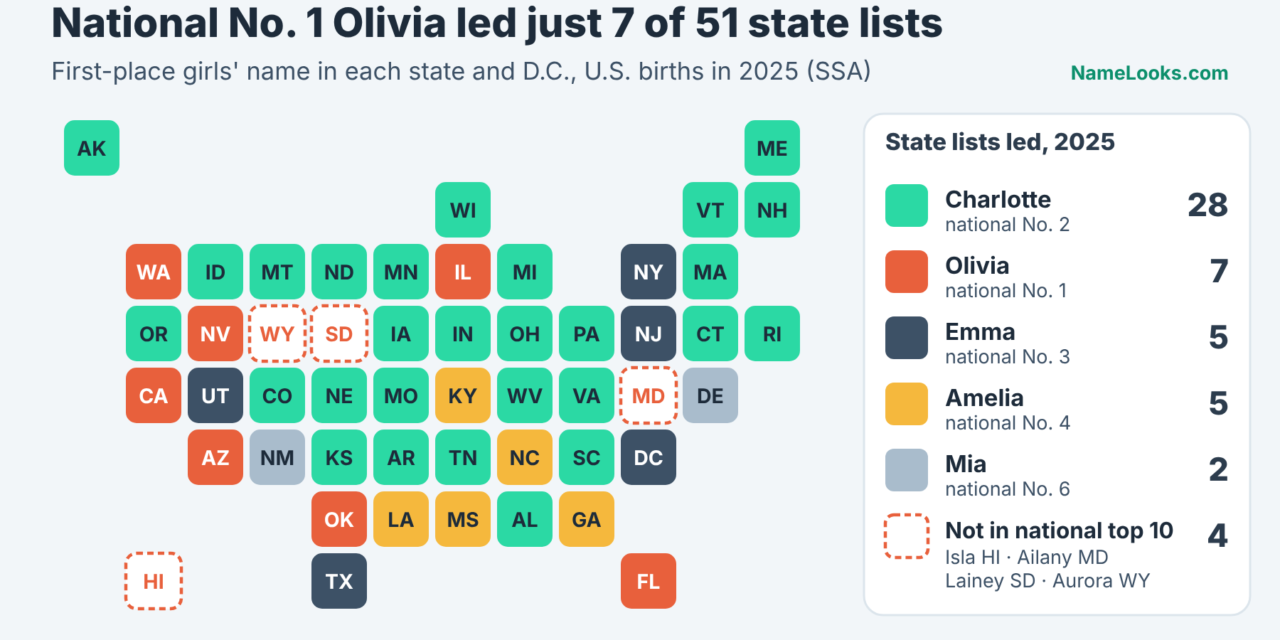
- National No. 1 is not “No. 1 everywhere.” In SSA’s Top 5 by State table for 2025, Olivia, the national No. 1 girls’ name, topped 7 of the 51 lists (50 states plus D.C.). Charlotte, national No. 2, topped 28.
- Big states decide the national order. The national rank comes from total counts, so a name that leads a few large states can outrank a name that leads many smaller ones.
- “State” means state of birth on the Social Security record, not where the family lives now, and births with no state of birth on record are left out of the state files.
- Thin data moves fast. In a small state, a few dozen babies can reorder the top five. Look at counts and at least three years before you read a state list as a trend.
- Each spelling is its own entry. Sophia and Sofia sit side by side in New Mexico’s 2025 top five as two separate names. Sound-alike totals are your calculation, not SSA’s.
- A state list describes births, not people. It can’t tell you anything about a particular family, and it shouldn’t be used to guess where someone is from.
1Does the national No. 1 lead your state too? Usually it doesn’t
The quickest way to see why ranking baby names by state popularity matters is to put the national winner next to the state results for the same year. We did that with SSA’s own published tables rather than with a secondary list, and the answer was clearer than we expected.
For the national picture and how it’s built, the guide to reading the latest SSA rankings is the place to start. This page assumes you’ve seen the national top 10 and want to know whether it describes the place you actually live.
What SSA’s 2025 state tables actually show
SSA publishes a page called Top 5 Baby Names by State for Births in 2025. It lists the five most frequent given names for boys and for girls in each of the 50 states and the District of Columbia, based on Social Security card application data as of March 2026. We tallied the first-place names ourselves from that page. Every figure below is a count of state lists, not a count of babies.
Girls: Olivia leads 7 lists, Charlotte leads 28
Nationally, according to SSA’s May 8, 2026 announcement, Olivia was the most popular girls’ name of 2025 for the seventh year in a row, and Charlotte moved up to second. In the state tables, the order flips. Charlotte is the first-place girls’ name in 28 of the 51 lists. Olivia is first in 7. Emma and Amelia each lead 5, Mia leads 2, and four states have a first-place name that isn’t in the national top 10 at all: Isla in Hawaii, Ailany in Maryland, Lainey in South Dakota and Aurora in Wyoming.
It goes further than first place. Olivia doesn’t appear anywhere in the top five for 14 of the 51 lists, including Indiana, Michigan, Minnesota, Wisconsin and West Virginia. Charlotte, the national runner-up, is absent from the top five in eight, among them California, Texas, Florida and New Jersey.
Boys: a three-way split behind Liam
On the boys’ side, Liam was the national No. 1 for 2025 and Noah No. 2, per the same SSA release. Across the state lists, Liam leads 15, Noah 14, Oliver 12 and Theodore 6. Single states go to James (Mississippi), John (Alabama), Elijah (Hawaii) and Waylon (West Virginia). John and Waylon are the two state leaders outside the national boys’ top 10.
Liam is missing from the top five in 10 lists, including Michigan, Missouri, Vermont and Wyoming. Noah, despite being second nationally, is missing in six: Idaho, Iowa, Montana, New Hampshire, Vermont and Wyoming. Put simply, the national top two are national averages, not a shared experience.
How we counted
We read each state’s rank 1 to 5 from SSA’s 2025 and 2024 Top 5 by State pages and counted lists, treating D.C. as one of 51. SSA’s page says counts appear beside each name; the copies we could open didn’t include them, so this article never prints a state birth count. If you want counts, open the state Top 100 tool on SSA’s Popular Names by State page for the state and year you care about.
Why a national leader can lose most states and still win
This looks like a contradiction until you remember what a national rank is. SSA ranks a name nationally by its total count among U.S. births of that sex. A state “win” carries no weight of its own. A state with very many births contributes far more babies to Olivia’s or Charlotte’s national total than a state with few, whether or not that name is first there.
Big states carry the national total
Look at where Olivia does lead in 2025: California, Florida, Arizona, Illinois, Nevada, Oklahoma and Washington. Several of those are among the most populous states in the country. Charlotte’s 28 first places include many states with far fewer births. And in Texas, where Emma is first, Olivia still sits at No. 2, so Olivia piles up a big count there without winning it.
That is why “most states” and “most babies” are different questions. A name can be broadly liked and still not have the most babies. Another can be concentrated in large states and win the national count. Both are true descriptions of the same year.
A small worked sketch (made-up numbers)
Picture an imaginary country with three regions. Region A is huge, and Name X is first there with a big lead. Regions B and C are small, and Name Y is first in both, narrowly. Add the counts and Name X wins nationally while losing two of three regions. Nothing about that is odd; it’s simply weighting.
The numbers in that sketch are invented on purpose to show the mechanism. For real numbers you’d need each state’s count for each name, which SSA publishes in its state files, plus the number of births in each state, which comes from vital statistics rather than from SSA. The point is general, though: the national No. 1 is the name with the largest pile, not the name with the most first places.

2Define the method before you read any state result
A state ranking looks like a simple list, but it’s the output of a pipeline with several filters. If you know what those filters do, most of the strange-looking results in lists of baby names by state popularity stop being strange. If you don’t, it’s easy to build a whole story on something the method itself produced.
The full mechanics of SSA’s national data, including how card applications become counts, belong to our explainer on how SSA baby name rankings work. Here we only cover the parts that change, or matter more, once you split the country into states.
What goes into a state table
The input is the same as for the national list: Social Security card applications. What changes is that each record now also has to carry a usable state of birth.
Card applications, sorted by state of birth
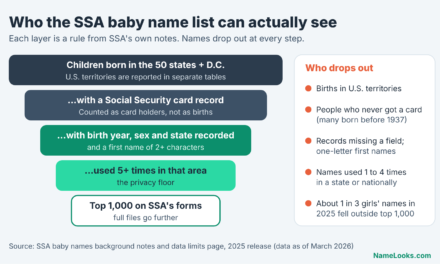
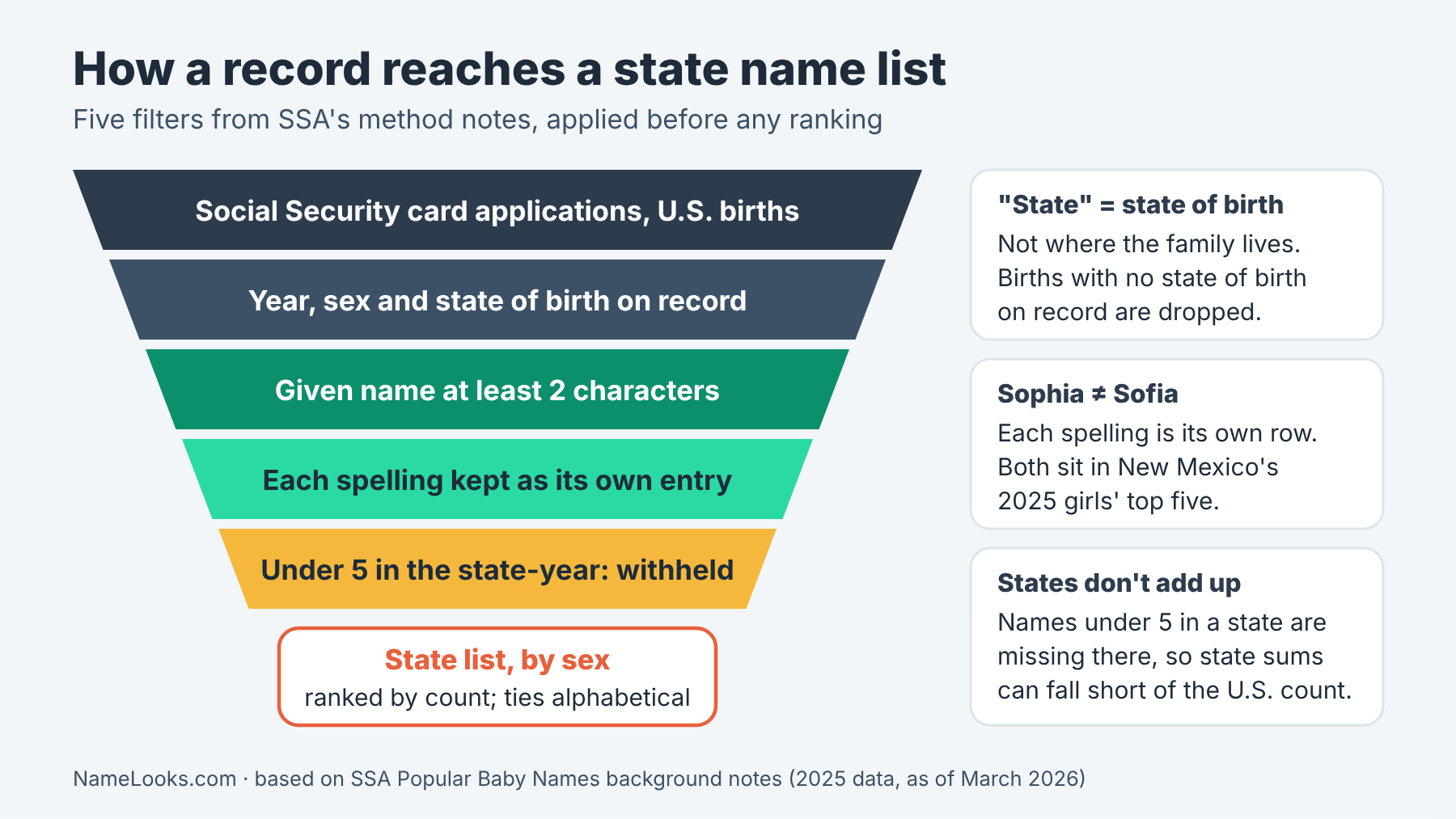
SSA’s background notes say all names come from Social Security card applications for births in the United States, and that the 2025 release uses a 100% sample of those records as of March 2026. The same notes say names are restricted to cases where the year of birth, sex and state of birth are on record, and where the given name is at least two characters long. Records without a place of birth aren’t included.
So the geography in a state list is the state of birth written on the record. It isn’t the state where the parents live, where they filed the paperwork, or where the child grows up. For most babies those are the same place. For some they aren’t, and the method has no way to tell you which ones.
When “born in” and “lives in” come apart
Imagine a family that lives in one state but delivers at a hospital just across the line, a common enough situation in metro areas that straddle a border. Their baby counts toward the neighboring state’s list. Multiply that across a region and a state’s list partly reflects where delivery hospitals are, not only where families live.
We can’t put a number on how often this happens, and SSA doesn’t publish one. It’s best treated as a reason for humility near borders and in small states. If you live in a metro that spans two states, check both lists before deciding what’s “local.”
Thresholds, spelling and grouping rules at state scale
Three rules from SSA’s methodology cause most of the confusion people run into with state data: the privacy threshold, the no-merging rule for spellings, and the separate lists by sex.
The five-occurrence rule, and why states don’t add up
To protect privacy, SSA excludes names that would reveal fewer than five occurrences in any geographic area. Its background notes spell out one consequence directly: if a name has fewer than five occurrences for a year of birth in any state, the sum of the state counts for that year will be less than the national count.
In practice, a name given to, say, three babies in each of several states never appears in those states’ files, yet those babies are in the national total. Add up fifty state files and you’ll come up short of the national number for many less common names. That isn’t an error. It’s the privacy rule working as designed, and it’s covered in more depth in our page on what the SSA dataset cannot tell you.
Every spelling is its own row
SSA says plainly that different spellings of similar names are not combined. At state level this produces some striking side-by-sides. New Mexico’s 2025 girls’ top five includes Sophia at No. 3 and Sofia at No. 4, listed as two names. Maryland’s 2025 first-place girls’ name is spelled Ailany, while SSA’s national release lists a different spelling, Ailanny, among the year’s fastest-rising girls’ names. Those are separate entries, and nothing in the data says they should be read as one.
SSA also removes hyphens and spaces, so Julie-Anne, Julie Anne and Julieanne count as a single entry, per the background notes. That’s the only merging the method does for you. If you want to know how a sound or a name family is doing in your state, you have to add the spellings yourself and say so when you report it. The profile of Sophia and Sofia as separate variants walks through why that choice matters.
Separate lists by sex
Rankings are done separately for boys and girls. A name used for both appears on both lists with different ranks, and a state top five for girls tells you nothing about the same name’s use for boys. SSA’s background page also warns that the data aren’t edited, so a small number of records carry the wrong sex. At state scale, with smaller counts, that kind of noise is proportionally larger.
Rank, count and share mean different things in a state
These three get blurred all the time, and the blurring does more damage at state level than nationally. A rank is a position. A count is a number of babies. A share is that count divided by all babies of that sex born in the same place and year.
A rank tells you order, not size
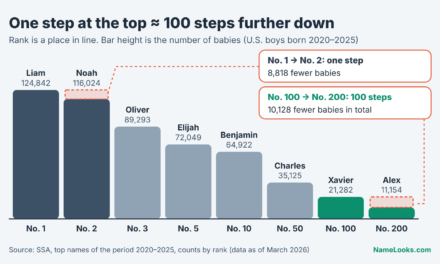
First place in a large state and first place in a small one are both “No. 1,” but they can represent wildly different numbers of babies. A name can also be No. 1 in a state by a margin of a handful of births, and SSA breaks ties alphabetically, according to its background notes. Ranks are good at telling you which names are near the top. They’re poor at telling you how crowded the top is. Our piece on rank versus number of babies shows how far position alone can mislead.
Turning a state count into a share
A share needs a denominator. SSA doesn’t publish total births by state on its names pages; birth totals come from vital statistics, which the CDC’s National Center for Health Statistics compiles. Its births data page points to state-level tools and to final and provisional reports.
Be careful when you combine the two. SSA counts card applications with a state of birth on record; NCHS counts registered births. They are close but not the same population, and they’re published on different schedules. A share you build this way is a good approximation, and you should call it that. If you want precision, use the same denominator for every name and every state you compare, so any bias at least points the same way.
3Six checks before baby names by state popularity change your shortlist
Most people come to state data with a practical question. Will my kid be one of four Charlottes in class? Is the name we love “everywhere” here even though it’s only mid-list nationally? Is the national top 10 even relevant to us? The six checks below are the method we’d use to answer those without fooling ourselves. They’re split into two groups: three about the number itself, and three about what the number means for you.
If you’re still at the stage of working out what you want from a name at all, the broader decision framework for choosing a name comes first. State data is one input to that decision, never the decision.

Checks on the number itself
Before you interpret a state result, make sure you’re looking at a real, comparable figure. These three checks take a few minutes and catch the most common reading errors.
Check 1: Is this the right geography, year and sex list?
Any table of baby names by state popularity is tied to one place, one year and one sex, so write down exactly what you’re looking at: “SSA, Maryland, births in 2025, girls, rank.” It sounds fussy. It stops three common slips: reading a 2024 list as current, reading the national list as if it were your state’s, and reading a girls’ rank for a name you’re considering for a boy.
Also note the as-of date. SSA’s 2025 files are labeled as reflecting card applications as of March 2026. When you compare figures from different releases, record both dates so a later reader knows what you were working from.
Check 2: Find the count behind the rank
The Top 5 by State page is a quick look, but the state Top 100 tool on SSA’s state page is where you can see how many babies each rank represents. A first place backed by a large count in a populous state is a different fact from a first place backed by a modest count in a small one.
When you have the count, look at the gap to the next name, too. If No. 1 and No. 2 are separated by a few births, the “winner” is close to a coin flip, and next year’s order says more about chance than about taste. SSA’s alphabetical tie-break makes this worse at exact ties: the earlier letter takes the higher rank.
Check 3: Gather every spelling you’d treat as the same name
Because SSA keeps spellings apart, a name’s real presence in your state can be larger than its rank suggests. Decide which spellings you, personally, would hear as the same name, look each one up in the same state and year, and add the counts.
Then be honest about what you’ve built. “Sophia plus Sofia in New Mexico, SSA 2025, our sum” is a fair statement. “Sophia is No. 1 in New Mexico” is not, because SSA doesn’t rank sound-alike groups. The same logic applies to newer spellings like Ailany and Ailanny: whether you group them is your editorial call, and it should be visible. For a longer method on tracking families of spellings, see tracking the family, not just one rank.
Checks on what the number means for you
Once the number is solid, the harder question is whether it should change anything. These three checks are about interpretation, and they’re where opinion starts to creep in, so we mark it.
Check 4: Look at three or more years, not one
State lists, especially in smaller states, can reshuffle from one year to the next. Wyoming’s first-place girls’ name was Emma in SSA’s 2024 state table and Aurora in 2025. West Virginia’s first-place boys’ name was Oliver in 2024 and Waylon in 2025. Neither change tells you a trend on its own.
Our suggestion: look at a name’s state rank and count across at least three recent birth years before calling it rising or falling locally. For how to frame multi-year reading at national level, the page on using 2020 to 2025 counts instead of one-year hype applies the same idea.
Check 5: Compare the state with the nation, in counts or shares
The interesting question is usually not “what is first here?” but “is this name more or less common here than nationally?” To answer it, compare the name’s state share with its national share for the same year and sex. A name ranked 30th in a state could be more concentrated there than a name ranked 5th, if the 5th-place name is even more common everywhere else.
If you only have ranks, you can still say something, carefully. A name in a state’s top five that is outside the national top 10, as Lainey is in South Dakota’s 2025 girls’ list, is plainly more prominent there than nationally. How much more prominent needs counts.
Check 6: Ask what your child’s everyday world actually is
This one is judgment, not data. A state list is a large and mixed area. Your child’s daily life is a daycare, a school, a neighborhood, maybe a church or a team. None of those are measured by SSA. A name that’s first in your state could be rare in your town, and the reverse.
So treat baby names by state popularity as rough background context, then talk to people who see your actual setting: teachers, pediatric staff, other parents. If what you most want to know is whether a name will feel shared or distinctive, our page on how much uniqueness you actually want helps turn that preference into something you can test.
A one-line citation for any state claim
“[Name], [rank or count], [state], births in [year], [boys/girls], SSA state data as of [month year].” If you summed spellings, add “spellings combined by us: [list].” Anyone can reproduce that sentence from SSA’s pages, which is the whole point.
Reading baby names by state popularity: four worked scenarios
The scenarios below are hypothetical. They aren’t drawn from readers or interviews; they’re there to show how the six checks play out on typical questions.
The name that’s “everywhere” here but mid-list nationally
Picture parents in South Dakota who love Lainey and keep hearing it at the playground. SSA’s 2025 state table shows Lainey first among South Dakota girls, while it isn’t in the national top 10 for that year. Their sense that it’s common locally is consistent with the data. The checks they’d still run: find the count (Check 2), look at whether it held a top-five place in earlier years (Check 4), and consider whether spellings they’d treat as the same name add more (Check 3).
The data can’t tell them whether that’s a problem. Some parents would welcome a name that feels at home where they live. Others would see it as too shared. That’s preference, and it’s theirs.
The national No. 1 that isn’t No. 1 here
Now picture parents in Michigan worried that Olivia is “too popular” because it’s the national No. 1. In SSA’s 2025 Michigan girls’ top five, Olivia doesn’t appear: the list is Charlotte, Amelia, Sophia, Eleanor and Evelyn. That doesn’t make Olivia uncommon in Michigan; it may sit just below fifth. It does mean the national headline overstates how dominant it is there. Check 2 and Check 5, using the state Top 100 tool, would settle how far down it actually sits.
The cross-border family
Imagine a couple who live in one state and deliver in a neighboring one. They read the delivery state’s list because that’s where the birth certificate comes from. Our suggestion would be to read both states’ lists and weight the one where the child will spend daily life, since SSA’s geography follows state of birth on the record.
The family moving soon after the birth
Picture parents who expect to move from Texas to Vermont within a year. In SSA’s 2025 tables, Texas girls’ first place is Emma and Vermont’s is Charlotte; Texas boys’ top five includes Mateo and Santiago, Vermont’s includes Cooper and Hudson. If local feel matters to them, the destination state is the more relevant list. If it doesn’t, neither list should carry much weight.
4What state data proves, and what we read into it
Lists of baby names by state popularity invite storytelling. One state’s list looks “traditional,” another looks “trendy,” and suddenly there’s a theory about regional character. Some of that has real research behind it at the level of patterns across states. A lot of it is projection. Keeping the two apart is most of the work.
What the state tables establish
The tables establish a narrow set of facts very well. Read inside those limits, they’re some of the most reliable naming data available anywhere.
Order within one state, year and sex, for exact spellings
For each state and D.C., SSA’s state data give the relative order of exact spellings among recorded births of one sex in one year, and the counts behind that order wherever a name clears the privacy threshold. That’s solid. It comes from essentially all card applications with a state of birth on record, not from a sample survey, so there’s no margin of error in the polling sense. The uncertainty lies in what the records leave out and in the random swing of small numbers.
The table below sets out the main claims this article makes, where each comes from, and what each can’t support.
| Claim | Source / dataset | Geography | Year | Metric | Limitation | Editorial takeaway |
|---|---|---|---|---|---|---|
| Olivia was the national No. 1 girls’ name; Liam the boys’ No. 1 | SSA national data, May 8, 2026 announcement | 50 states + D.C. | 2025 births | National rank by count | Excludes U.S. territories; spellings not merged | The national headline is a total, not a typical state |
| Charlotte was first in 28 of 51 state lists; Olivia in 7 | SSA Top 5 Baby Names by State, 2025 (our tally) | Each state + D.C. | 2025 births | Count of lists where a name ranks 1st | Ignores state size; one list = one vote | Breadth and national volume are different questions |
| Sophia and Sofia both appear in New Mexico’s girls’ top five | SSA Top 5 by State, 2025 | New Mexico | 2025 births | State rank (3rd and 4th) | SSA never combines spellings | Sum spellings yourself and label the sum |
| Sum of state counts can be lower than the national count | SSA background notes | All states | Any year | Counts | Names under 5 in a state are withheld there | Never rebuild national totals from state files |
| State means state of birth on record | SSA background notes | All states | Any year | Record filter | No residence data; births with no state of birth on record are dropped | Read border metros with care |
| Groups of states with correlated naming emerged and reorganized late in the 20th century | Barucca et al., PNAS (2015), SSA state data 1910–2012 | U.S. states | 1910–2012 | Correlation of name-frequency profiles | Describes state aggregates, not people; older period | Regional patterns are real, but they’re about populations |
Change between two published years
Because SSA publishes the Top 5 by State page for each year, you can compare years directly. We did that for 2024 and 2025 using the two official pages. The shifts are large enough to be worth a table of their own, and they show why one-year state comparisons need care.
| Name or state | 2024 (state lists led, or 1st place) | 2025 | Change | Caveat | Naming implication |
|---|---|---|---|---|---|
| Olivia (girls) | 18 lists | 7 lists | Down 11 lists | Still national No. 1 both years | Losing first places isn’t the same as losing babies |
| Charlotte (girls) | 19 lists | 28 lists | Up 9 lists | National rank rose from 4th to 2nd | Broad, many-state strength can precede a national rise |
| Liam (boys) | 23 lists | 15 lists | Down 8 lists | Still national No. 1 both years | The national leader can lead a minority of states |
| Noah (boys) | 6 lists | 14 lists | Up 8 lists | National No. 2 both years | First places can swing without a national rank change |
| Theodore (boys) | 1 list | 6 lists | Up 5 lists | National No. 4 both years | Watch the counts, not the tally, before calling it a surge |
| Maryland, girls’ 1st place | Olivia | Ailany | New leader | Ailany is a distinct spelling; we couldn’t verify its count | One state’s leader can be a name barely visible nationally |
| Hawaii, girls’ 1st place | Olivia | Isla | New leader | Small number of births; Isla only in Hawaii’s 2025 top five | Small-state lists are volatile; check three years |
| Mississippi, boys’ 1st place | William | James | New leader | Both names in its top five both years | A swap near the top may be a few births |
Two patterns stand out. First, the tallies moved a lot in one year even though the national top two didn’t change. Second, in the girls’ data, Charlotte led more state lists than Olivia in 2024 too, while sitting fourth nationally. That’s a clean example of breadth and volume pulling apart. We’d be cautious about reading it as a prediction. It’s one pair of years, and the tally treats Wyoming and California as equal votes.
What is interpretation, preference or inference
Everything past the counts is interpretation. Some of it is careful and published. Some of it is a hunch dressed up. Here’s how to tell them apart.
Regional patterns: what research actually found
There is serious work on regional naming in the U.S. A team of physicists, Barucca, Rocchi, Marinari, Parisi and Ricci-Tersenghi, studied state-level SSA data for babies born from 1910 to 2012. In their paper “Cross correlations of the American baby names” (PNAS, 2015) they report that groups of correlated states emerge in different eras, stay stable for decades, and reorganize suddenly in the last part of the twentieth century.
A separate study by Pomorski and colleagues, “Inferring cultural regions from correlation networks of given baby names” (Physica A), used each state’s top 100 names from 1910 to 2010 and found network communities that, until about 1980, roughly matched the Northeast, the South, and a combined Midwest and West. It also reports that, from 1920 to 1980, the distribution of name frequencies was steepest in Southern states, which the authors read as a narrower pool of names there.
Both are about state-level aggregates and mostly about the twentieth century. They support the idea that regional naming patterns are real. They don’t tell you why any single family chose a name, and they don’t describe 2025.
Stories that go beyond the data
Saying “Wyoming parents prefer nature names” because Aurora was first there in 2025 is a leap. It’s one year, one name, and we don’t know the count or how close second place was. Saying “this state’s list looks more traditional” is a fair personal description, but it’s a style judgment, not a measurement.
The line we’d hold: describe what the list shows, in rank or count terms, and label any explanation as a hypothesis. Don’t connect a state’s list to the religion, ethnicity, politics or class of the people who live there. The data contain none of that information, and a name’s popularity in a place says nothing about any one person who carries it. If you want to write about names and gender in a way that avoids the same trap, our editorial guidelines on name gender apply the same principle.

Using state data next to the national story
None of this makes the national list less useful. It answers a different question. Most readers benefit from holding both views at once.
When the national view is the right one
If your question is about the country as a whole, for example how a name moved in the 2025 national rankings, the national file is the right tool. Our summary of what changed in the 2025 U.S. rankings covers that, and the page on seven years of Liam and Olivia at No. 1 takes the long view of the two leaders. State tallies add context; they don’t overturn those stories.
When the state view earns its place
Comparing baby names by state popularity is the better tool when your question is local, when a name is concentrated in a region, or when the national headline looks nothing like what you hear around you. Fast national climbers are a good case: a name can rise sharply nationally because of strong growth in a few states. If a name you like shows up on the list of fastest-rising names of 2025, the state files are where you’d check whether that growth is broad or concentrated.
5Publish your limitations so anyone can reproduce the result
If you write about baby names by state popularity, for a blog, a family group chat or a newsroom, the fastest way to earn trust is to say what’s missing before someone else points it out. This section is the checklist we use ourselves, and it’s written so you can lift it.
Missing data and edge cases
Some gaps are built into the method. Others are edge cases that show up only at state scale. Neither is a reason to distrust the data; both are reasons to describe it precisely.
Territories, D.C. and who is left out
SSA’s national figures cover the 50 states and the District of Columbia. Births in U.S. territories are excluded from the national data and reported separately. The territories page shows top names for Puerto Rico and, as a combined group, for American Samoa, Guam, the Northern Mariana Islands and the U.S. Virgin Islands, with birth years from 1998 through 2025 in its menus.
So “every state” articles that list 50 entries leave out D.C., and “national” articles leave out the territories. Neither is wrong, but say which you mean. D.C. behaves like a city, not a state, which is worth remembering when its list looks unlike its neighbors’. Its 2025 girls’ top five, for instance, includes Lucy and Zoe, which few state lists share.
Also left out of state files: births with no state of birth on record, names shorter than two characters, and any name below five occurrences in that state and year. SSA adds that many people born before 1937 never applied for a card, so older years are less complete. If you’re comparing a state across many decades, that last point matters a lot.
Small states and the problem of tiny counts
The smaller a state’s birth count, the more its top five can move from random variation alone. When a few births can swap first and second place, a change in rank mostly reflects chance. This is general statistical behavior, not something SSA states about any particular list. The official tables show plenty of first-place changes between 2024 and 2025 in smaller states, such as Hawaii, Wyoming and West Virginia. Large states change too: California’s and Texas’s girls’ first places both changed that year, a reminder that a close race at the top isn’t only a small-state issue.
For rare names, the privacy threshold creates a further blind spot: a name can be in national use and still be invisible in every single state file. That raises its own questions about re-identification, which our piece on the privacy problem with extremely rare name data takes on.
Don’t do this
Don’t add up the 51 state files to get a national count, don’t rank names by “number of states won” and call it popularity, and don’t compare a girls’ rank in one state with a boys’ rank in another. Each of those produces numbers that look precise and mean very little.
Freshness and the update rule
Rankings of baby names by state popularity go stale, and readers rarely notice the date on a screenshot. A simple update rule keeps your claims honest.
When new state data arrive
SSA announced the 2025 national names on May 8, 2026, and its background notes date the 2025 files to card applications as of March 2026. The state Top 5 page for 2025 carries the same as-of statement. The state Top 100 tool on SSA’s state page offers birth years from 1960 through 2025, and the all-states Top 5 view goes back to 1980.
Our rule of thumb: a “current” state claim is one that uses the latest birth year SSA has published. Once SSA posts the next year, any article that says “this year” should be updated or reworded to name its year. If you can’t update it, the fix is to make the year explicit in the sentence, so the claim stays true even when it’s no longer new.
A reproducible note to put under any state chart
Under a chart or list of state names, include: the dataset (SSA state data), the birth year, the sex list, the as-of date SSA states, whether you combined spellings and which, whether D.C. and territories are included, and the metric (rank, count or share). If you computed shares, name the birth-total source and its year, for example the CDC’s NCHS natality figures.
That note takes forty words, and it lets anyone check your work against SSA’s own pages. It’s also exactly the information that tends to vanish when a chart gets shared, so put it inside the image if you can.
Comparing states with other countries’ regional data
Readers who follow both U.S. and British name news sometimes expect the two to work the same way. They don’t, and the difference matters when you compare.
England and Wales use a different system
The Office for National Statistics publishes names for England and Wales from birth registrations, with its own regional breakdowns and thresholds. Our guide to regional differences in England and Wales explains what ONS can show at that level. A U.S. state and an English region aren’t equivalent units, so compare patterns, not ranks.
Comparing like with like
If you do compare across countries, use shares within each dataset, name both sources and years, and treat spelling and threshold rules as part of the comparison. The method page on comparing name popularity across different data systems covers the details we’d otherwise repeat here.
Questions people actually ask
Where do I look up the top names for my state?
On SSA’s Popular Names by State page. One tool gives the top 100 names for a chosen state and birth year, from 1960 through 2025. Another shows the top five for every state at once for a chosen year from 1980 through 2025. The Top 100 view is the one that shows counts.
Why is my state’s No. 1 different from the national No. 1?
Because the national rank adds up babies across the country and is dominated by the most populous states. A name can lead your state, or many states, without having the largest national count. In 2025, Charlotte led more state lists than Olivia, yet Olivia had the national top spot.
If a name isn’t in my state’s top 100, does that mean nobody here has it?
No. It means it ranked below 100 in that list, or fell under the five-occurrence privacy threshold for that state and year. The name can still appear in the national data. Absence from a state list is a statement about rank and privacy rules, not about zero babies.
Does the state list reflect where my baby will grow up?
Only loosely. Data on baby names by state popularity follow SSA’s state geography, which is the state of birth on the Social Security record. Families who deliver across a state line, or move soon after birth, are counted in the birth state. For your child’s daily life, local schools and neighborhoods matter more than any state figure.
Can I combine different spellings to see the “real” popularity in my state?
Yes, as long as you say you did it. SSA keeps each spelling separate, so a combined figure is your calculation, not an official rank. List the spellings you included, use the same state, year and sex list for all of them, and report the result as a count or share rather than as a rank.
Are Puerto Rico and Guam in the state rankings?
No. SSA reports Puerto Rico separately, and groups American Samoa, Guam, the Northern Mariana Islands and the U.S. Virgin Islands together, on its territories page. Those births are not included in the national figures or the 50-state-plus-D.C. lists.
Sources and further reading
- SSA, Popular Baby Names — the official home of national and state name data, including the 2025 national top 10.
- SSA, Popular Names by State — the state Top 100 tool (1960–2025) and the all-states Top 5 view (1980–2025).
- SSA, Top 5 Baby Names by State for Births in 2025 — the table behind our 2025 tallies.
- SSA, Top 5 Baby Names by State for Births in 2024 — the comparison year for our second table.
- SSA, Background information — the privacy threshold, state-of-birth rule, spelling and tie-break rules.
- SSA, Top 5 names by year — national top five for each birth year from 1926 to 2025, useful for checking national ranks.
- SSA press release, May 8, 2026 — the official announcement of the 2025 rankings.
- SSA, Popular Names in U.S. Territories — Puerto Rico and the other territories, reported separately.
- CDC NCHS, Births and Natality — where birth totals by state come from if you want to compute shares.
- Barucca et al., “Cross correlations of the American baby names” (PNAS, 2015) — research on groups of states with correlated naming, 1910–2012.
- Pomorski et al., “Inferring cultural regions from correlation networks of given baby names” (Physica A) — regional network communities in U.S. state name data, 1910–2010.
NameLooks provides general information about names and name data. State and national popularity figures describe birth populations, not individuals, and should never be used to infer anything about a particular person or family.