Picture a couple at a baby shower, quietly in love with the name Olivia, when an aunt announces that “every girl in America is called Olivia now. It’s been number one for years.” She’s half right. This page takes apart the Liam Olivia top names trend the way a data editor would: what seven straight years at the top of the Social Security Administration’s rankings actually measures, what kept moving underneath, and how to use that evidence when you’re the one choosing.
The short version
- The “seven years” belongs to the pair. In SSA’s national data, Olivia has been the top girls’ name for births in 2019 through 2025, and Liam has been the top boys’ name since 2017, so his run is already nine years.
- A number-one rank says a name was given more often than any other single spelling in that sex category. It doesn’t say how many babies got it, how far ahead it is, or whether it’s common where you live.
- Long runs at the top are normal in SSA’s history. Michael held the boys’ top spot for 38 straight birth years (1961 to 1998), and Jennifer led girls for 15 (1970 to 1984).
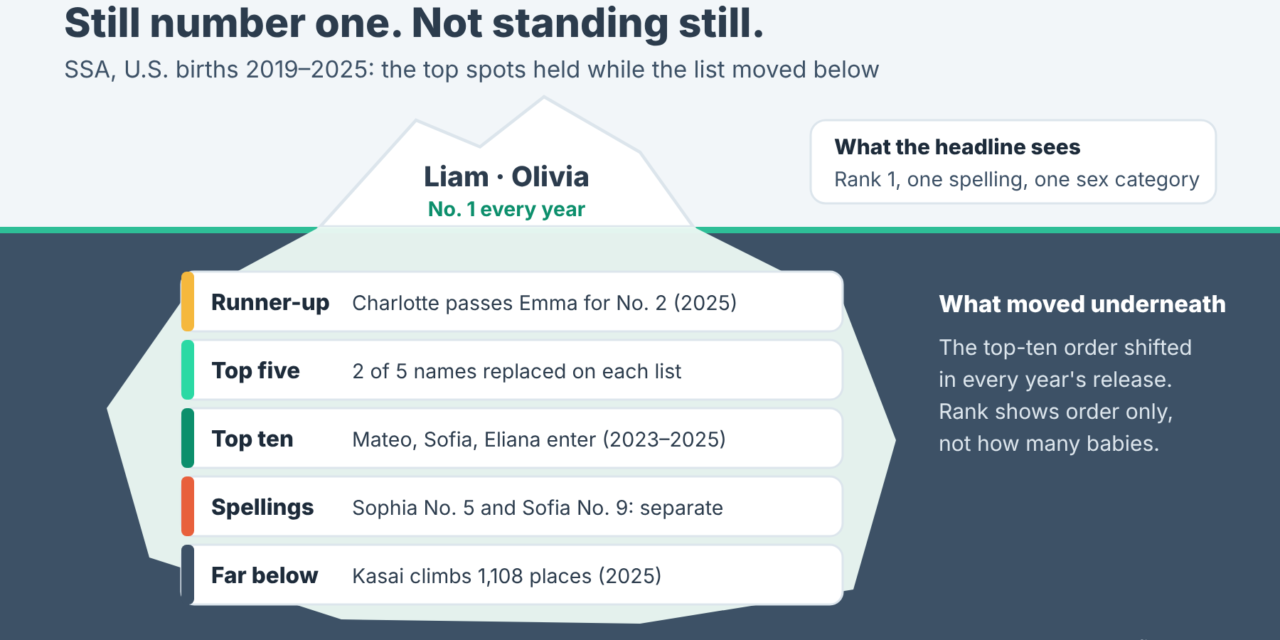
- Below the top, plenty moved between 2019 and 2025: two of the five names in each top-five list were replaced, newcomers such as Mateo, Sofia and Eliana entered the top ten, and Charlotte took the girls’ number-two spot for 2025.
- For your decision, the streak is a prompt to check counts and local context, not a verdict. If sharing a first name with classmates bothers you, find out how likely that really is before ruling the name out.
1What “seven years at number one” actually measures
Start with the claim in its exact form. On May 8, 2026, the Social Security Administration announced that Olivia and Liam topped its list of the most popular baby names for 2025, their seventh straight year as the pair at the top. That sentence is accurate, and it’s the root of what search engines and news feeds now bundle as the Liam Olivia top names trend. It’s also easy to misread in three different directions.
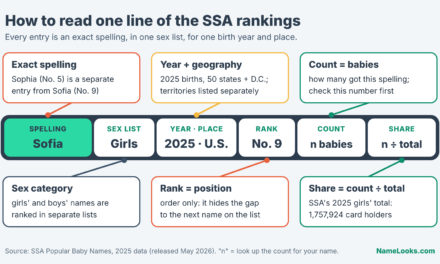
The first misreading is about time. “Seven years” describes the pair, not each name. The second is about size: a rank is a position in a sorted list, not a count of children. The third is about what counts as “the name”. SSA counts each exact spelling as its own entry, so the number-one Olivia is the spelling O-l-i-v-i-a and nothing else.
Once those three things are clear, the headline turns into something much more modest and much more useful. Two specific spellings were each given to more U.S.-born babies of one recorded sex than any other spelling, every year for a while. That is real stability at one position. It isn’t a statement about how naming as a whole has behaved.
What people often assume when they hear about the streak
Streak headlines invite a particular mental picture: a country where a large slice of newborns share two names and nothing much changes from year to year. It’s an understandable picture, because “number one for seven years” sounds like dominance. The data supports a narrower reading, and the gap between the two is where most bad naming advice comes from.
The “every kid is named Olivia” reading
The strongest version of the assumption is that a top-ranked name is so common it’s practically unavoidable. If that were true, the aunt at the shower would have a point: picking Olivia would mean picking a name your daughter shares with several classmates in every grade.
Rank alone can’t tell you that. A name can be number one while being given to a small share of all babies, because the top of a long, flat list is still only one name among thousands. Whether the top name is “everywhere” depends on its count and its share of births, which is exactly the information a rank leaves out. Our guide to why position alone can mislead walks through that distinction with its own examples, so we’ll only keep the part that matters for this streak.
There’s also a time problem in the assumption. The children named Olivia in 2019 are in elementary school now. The ones born in 2025 are toddlers. “Every kid” spreads across very different age groups, and your child will mostly meet the ones born within a year or two of them.
Why the streak is a fact about rank, not about volume
Here’s the question worth asking every time a streak is reported: compared with what? A rank is always relative. Olivia’s rank for 2025 says she was ahead of Charlotte, Emma, Amelia and every other girls’ spelling in SSA’s national file. It doesn’t say by how much, and it doesn’t say whether the number of Olivias went up or down from 2024.
That matters because a name can hold rank one while its count falls, as long as the names chasing it fall too or don’t rise fast enough. It can also hold rank one while the gap to number two shrinks to almost nothing. Both situations would print the same headline. If you want to know which one happened, you need SSA’s counts for each year, which the agency publishes alongside its ranks on its Popular Baby Names site (the landing page notes that rankings can be shown either by number of births or by percent of total births).
Why this page shows ranks, not counts
SSA’s interactive count tables weren’t retrievable from our research environment for this update, so we haven’t printed a single birth count for Liam or Olivia. Every number on this page is either a rank from SSA’s published lists, a date, or a figure from a named source we opened. If you need counts, the method later in this article shows how to pull them yourself in a few minutes.
What SSA’s tables actually show about Liam and Olivia
The cleanest public record of the streak is SSA’s table of the top five names for each birth year, which runs from 1926 through 2025. It doesn’t carry counts, but it does show who held each position and when the order changed. Read it from the bottom up and the two runs look quite different from each other.
Two runs that started in different years
Liam’s run comes first. In the top-five table, he appears at third place for 2013, sits at second for 2014 through 2016 behind Noah, and takes first for 2017. He’s held that position for every birth year since, which makes 2025 his ninth consecutive year at the top of the boys’ list.
Olivia’s path is longer and bumpier. She first shows up in the girls’ top five for 2003, drops out for 2006 and 2007, returns for 2008, and spends 2014 through 2018 at second place behind Emma. She reaches first for 2019 and stays there through 2025. So the seven-year figure is really Olivia’s run. Liam had a two-year head start.
Behind the Name, a secondary reference, records the same U.S. milestones: Liam ranked first starting in 2017, and Olivia reached first place in the United States by 2019. It also notes that Olivia had already reached first place in England and Wales by 2008. That’s a reminder that a “trend” in one country’s file isn’t automatically news in another’s.
How this streak compares with earlier number ones
Long runs at the top are the historical norm in SSA’s data, not the exception. The top-five page itself notes that over the last 100 years, Michael has been the top boys’ name 44 times and Mary the top girls’ name 30 times. Michael’s longest unbroken stretch ran from 1961 through 1998, which is 38 birth years. Jacob followed with 14 straight years (1999 to 2012).
Girls’ names show the same pattern with shorter runs. Mary led every year from 1926 through 1946, Jennifer from 1970 through 1984, and Emily from 1996 through 2007. Measured against those, Olivia’s seven years and Liam’s nine are solid runs but not unusual ones. If anything, the post-2008 girls’ list stands out for how often the top spot changed hands: Emma, Isabella, Sophia, Emma again, then Olivia.
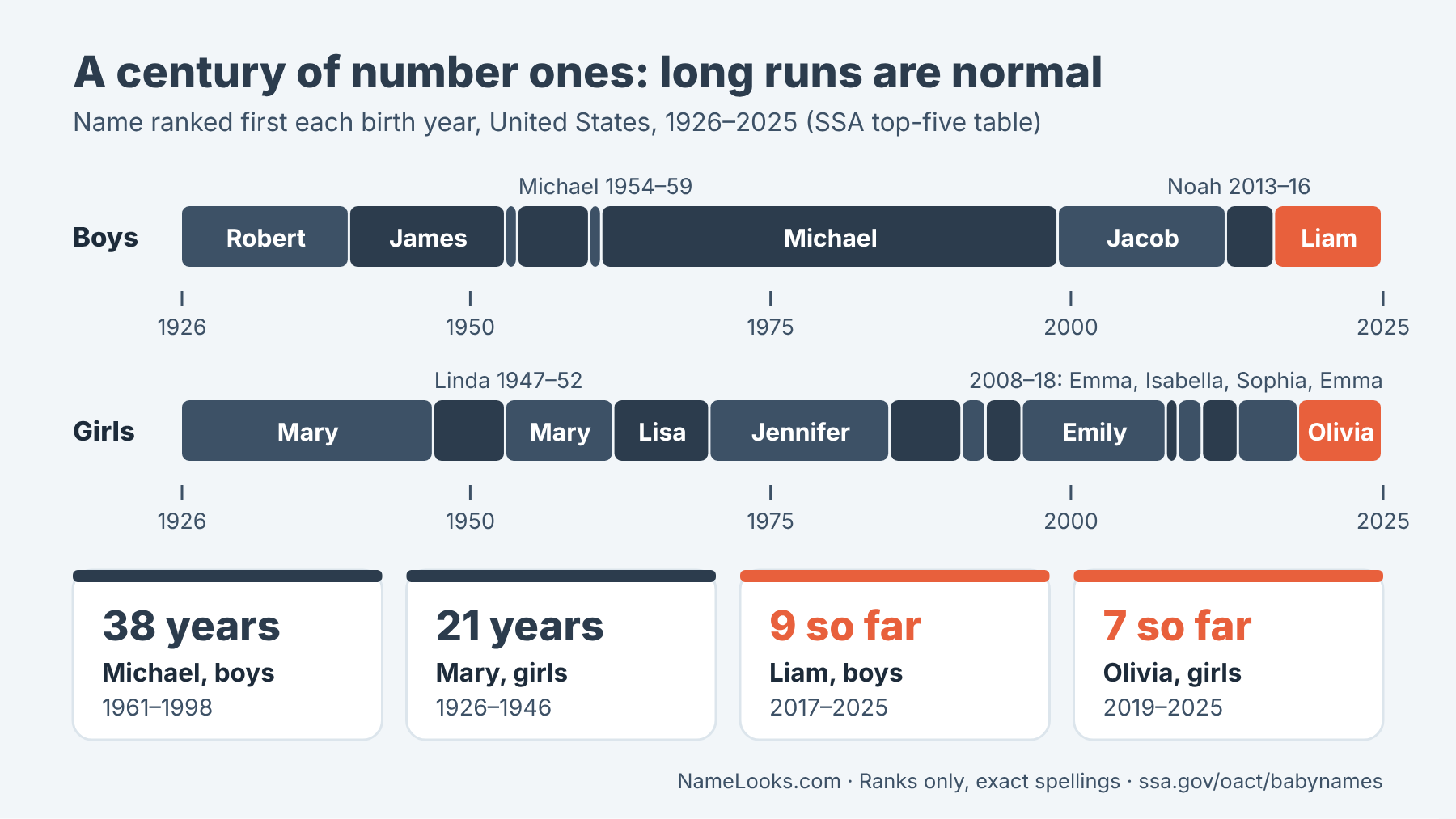
So if a long reign at number one meant “naming has stopped changing”, the United States would have stopped changing for most of the twentieth century. It didn’t, and the reason it didn’t is the subject of the next section: most of the movement in any year’s data happens below the top spot, where a single headline never looks. For the century-scale version of this story, including how names cycle in and out of fashion, see our long-run look at 100 years of U.S. top names.
2Six shifts hidden under the Liam Olivia top names trend
If you only read the first line of each year’s announcement, 2019 through 2025 looks like a rerun. Read the next few lines and the same seven years look busy. Below, we’ve pulled out six shifts that SSA’s own published lists document for this period. Each one uses ranks only, because those are what we could verify, and each one comes with a note on what it does and doesn’t prove.
One caution before the list. The boys’ side really was more settled than the girls’ side. Liam, Noah and Oliver held first, second and third, in that order, for every birth year from 2019 through 2025. That’s a genuine pattern worth stating plainly, not explaining away. The changes on the boys’ list happened from fourth place down.
Movement just beneath the top spot
The positions right under number one are where you’d expect a challenger to appear first, so that’s where to look for change that’s already visible.
Shift 1: the girls’ runner-up spot changed hands
Emma was the second most popular girls’ name for every birth year from 2019 through 2024. For 2025, Charlotte moved up to second, and SSA’s announcement described that as ending Emma’s six-year run in that spot. Charlotte had first entered the girls’ top five in SSA’s table for 2020, at fifth place.
What this proves: the order directly below Olivia isn’t fixed. What it doesn’t prove: that Charlotte is “about to” overtake Olivia. A rank move from third to second says nothing about the size of the gap to first. Only the counts can tell you whether the gap is narrow or wide.
Shift 2: newcomers broke into the top five
Compare the top-five lists for 2019 and 2025 side by side and two of the five names on each list are different. On the girls’ side, Ava and Isabella left the top five while Charlotte and Amelia entered. On the boys’ side, William and Elijah left while Theodore and Henry entered. Theodore first appears in the boys’ top five for 2024; Henry for 2025. Neither name appears in any top-five row from 1990 through 2023.
That’s a 40 percent turnover in the top five on each side over the same seven years that produced the “nothing changes” headline. The top five is a small window, so a few swaps look dramatic in percentage terms. Still, it’s the window most people actually look at.
Shift 3: former favorites slid without disappearing
The names that left the top five didn’t vanish. In SSA’s 2025 top ten, Elijah sits at seventh and William at ninth on the boys’ list, and Isabella is seventh on the girls’ list. William had been third for 2016, 2017 and 2018. Ava, third for 2019, dropped out of the girls’ top ten entirely for 2025, replaced by Eliana at tenth.
This is the quiet half of change. A name losing ten places near the top of the list may still be given to many babies, because the counts near the top are large. A name’s slide in rank tells you its relative position slipped, not that it became unusual. For more on how these patterns play out over a name’s whole life, see our piece on how long a name trend lasts.

Movement further down the list
The deeper you go into SSA’s top 1,000, the more movement you find. That’s partly a statistical fact, since counts are smaller further down and small changes in counts can produce big jumps in rank. It’s also where new names first become visible.
Shift 4: names entered the top ten for the first time
SSA’s announcements for the last three birth years each name at least one newcomer. For 2023, Mateo entered the boys’ top ten for the first time, and SSA called it the only new name in that year’s top ten. For 2024, Sofia entered the girls’ top ten for the first time, at tenth, while Luna dropped out. For 2025, Eliana entered at tenth as Ava left.
None of those entries touched the top spot, which is the whole point. A list can absorb new arrivals every year while its first line stays the same. That’s what “stable at number one” and “changing underneath” look like in the same dataset.
Shift 5: one name, two spellings, two separate entries
SSA’s 2025 girls’ top ten includes both Sophia at fifth and Sofia at ninth. Those are two separate entries because SSA ranks each exact spelling on its own. Its background notes on the data say different spellings aren’t combined and give Caitlin, Caitlyn and Kaitlyn as examples that each get their own rank.
For this streak, the spelling rule cuts both ways. It means Olivia’s number-one rank isn’t inflated by variants. It also means a name with several common spellings can be more widely heard than its rank suggests, because its babies are split across entries. If you’re weighing a name that comes in more than one spelling, our explainer on Sophia and Sofia as separate variants shows how to think about the combined picture without pretending SSA merged them.
Shift 6: big jumps far below the top
Each spring SSA also names its fastest risers, and those come from deep in the list. For 2025, the agency reported that Kasai climbed 1,108 places to enter the top 1,000 for the first time, at 639th, and that Klarity led the girls’ risers. For 2024, it reported that Truce climbed 11,118 places to 991st.
Those jumps are real, and they’re also the reason we don’t treat them as signs of a coming change at the top. A climb of thousands of places near the bottom of the rankings can come from a modest number of births, because the names down there are separated by very small counts. Our sibling article on rank jumps versus real birth counts covers that trap in detail.
| Name and period | Rank as published by SSA | Change | Caveat | What it means for a chooser |
|---|---|---|---|---|
| Liam, births 2013–2016 | 3rd (2013), then 2nd (2014–2016) | Climbing behind Noah | Ranks only; the gap to Noah isn’t shown | The rise was gradual and visible years before the top spot |
| Liam, births 2017–2025 | 1st each year | Nine-year run so far | Exact spelling only; William counted separately | Stable position, not a measure of how many boys share it |
| Olivia, births 2003–2013 | In and out of the top five, between 3rd and 5th | Absent from the top five for 2006 and 2007 | Top-five table shows nothing below 5th | Long climbs can stall; a dip isn’t a decline |
| Olivia, births 2014–2018 | 2nd each year, behind Emma | Five years as runner-up | Rank stability hides any count change | A long time at second doesn’t guarantee first, though here it came |
| Olivia, births 2019–2025 | 1st each year | Seven-year run so far | National data only; territories excluded | Check your own state before assuming it’s everywhere |
| Emma, births 2019–2025 | 2nd (2019–2024), 3rd (2025) | Lost runner-up spot to Charlotte | One-place move; size of change unknown from rank | Neighbors of the top name move even when the top doesn’t |
| Sophia and Sofia, births 2025 | 5th and 9th | Sofia new to the top ten for 2024 | Two spellings, two entries, never merged by SSA | Combined use of a sound can exceed what either rank suggests |
| William, births 2016–2025 | 3rd (2016–2018), 9th (2025) | Gradual slide | Still in the top ten; ranks don’t show count | A falling rank near the top isn’t the same as “uncommon” |
3The context and confounders that change how you read the streak
A streak is a summary of one cell in a large table: one geography, one sex category, one spelling, one year at a time. Change any of those and the picture can shift. This section covers the confounders that matter most when you read the Liam Olivia top names trend specifically, and then the reasons a single rank or a single anecdote is a weak basis for a naming decision.
For the general mechanics of SSA’s file, including how a birth year is assigned and where the data comes from, our explainer on how SSA baby name rankings work is the place to go. Here we stick to the parts that change the meaning of this particular headline.
Geography, year, spelling and sex category
Each of these four is a filter that the headline applies silently. Making them explicit is the quickest way to stop over-reading a national rank.
National rank is not your state, and your state is not your street
SSA’s national ranking pools card applications for births across the United States. Its background notes add one important exclusion: births in the U.S. territories (American Samoa, Guam, the Northern Mariana Islands, Puerto Rico and the U.S. Virgin Islands) are published separately and are not included in the national data.
The national file also can’t tell you how a name is distributed. A name can lead nationally because it’s moderately common in many places, or because it’s very common in some places and rare in others. SSA publishes state-level lists for exactly this reason. If the question in your head is “will my kid be one of three Olivias in class?”, the state list is a better starting point than the national one, and even that is coarse. Our guide to when national rank hides regional differences explains how to read those state files without overclaiming.
Crossing a border changes the dataset entirely. In England and Wales, Olivia was the most popular girls’ name for 2025 for the tenth year running, according to the Office for National Statistics’ 2025 baby names release as reported by The Irish News. That’s a registration-based count with its own methods, so it confirms nothing about the U.S. file. Our piece on why a name can rank differently in England and Wales explains why the two tables shouldn’t be blended.
There’s one more privacy detail with geographic consequences. SSA leaves out any name with fewer than five occurrences in a geographic area, so a state’s counts for a year can add up to less than the national count. That rarely affects names at the very top, but it’s worth knowing if you’re comparing small states.
Spelling and form: Liam and William are separate entries
Spelling separation is the confounder most specific to this pair. Liam is widely treated as a short form of William. Behind the Name lists it as an Irish short form of William, and Wikipedia’s article on the name, citing Hanks, Hardcastle and Hodges’ A Dictionary of First Names and Ó Corráin and Maguire’s Irish Names, describes it as a short form of Uilliam, the Irish form of William. We haven’t checked those print dictionaries ourselves, so treat this as well-sourced but secondhand. Our dedicated Liam name profile handles origin and pronunciation in depth.
For the data, the origin question doesn’t change anything. SSA ranks Liam and William separately, as distinct strings, and it would do the same for any alternative spelling of Liam. So “Liam is number one” and “boys’ names related to William are more common than ever” are different claims. The first is in the file. The second would need someone to decide which forms belong together, add the counts, and say so openly. That’s an editorial choice, not an SSA statistic.
Olivia has the same issue in a milder form. Any respelling would be its own entry with its own rank. We won’t speculate about which variants exist in meaningful numbers, because that’s a count question. Our Olivia name profile covers forms and origins, including the places where references disagree.
Sex categories are ranked separately
SSA ranks names within each recorded sex category. Its background notes give Micah as an example of a name with different ranks for boys and girls. When a name is given in both categories, the headline rank refers to just one of them.
For Liam and Olivia this is a small effect in practice, but it’s a structural point worth keeping: “the top name” always means “the top name in one category”. SSA’s notes also say the data isn’t edited, so the recorded sex can occasionally be wrong and placeholder entries aren’t removed. At the top of the list, a few miscoded records can’t move a rank. Further down, they can. Our article on what the SSA dataset cannot tell you goes through these limits one by one.
The year on the list is a birth year, read from a later snapshot
The 2025 list describes babies born in 2025, released in May 2026. SSA’s background page says the data come from a 100 percent sample of its card-application records as of March 2026. That date matters because the records behind any year’s list are drawn from a snapshot taken after the year ends.
The practical habit this suggests: when you compare years, use the current SSA pages rather than an old screenshot or a news story from a previous spring. If you’re comparing ranks across the whole 2020s, our sibling article on 2020 to 2025 counts instead of one-year hype lays out a sturdier way to do it.
Why a single rank or anecdote can mislead
Even with the filters straight, two shortcuts cause most of the confusion around this streak. One is trusting a rank to describe size. The other is trusting what you’ve personally seen to describe a country.
A rank hides the distance between first and second
Rank tells you order and nothing about spacing. In a race, first place could win by a stride or by a lap, and the results sheet shows “1” either way. Name rankings work the same way. The headline that Olivia led for a seventh year would read identically whether she was far ahead of Charlotte or narrowly ahead.
That’s why “seven years at number one” is weak evidence about the future. A name with a large and stable lead is in a very different position from a name holding on by a thin margin, and the rank can’t separate them. If you’re trying to judge whether the streak is solid or fragile, compare the counts for first and second place over several years. The cluster guide to reading the latest SSA rankings shows where those columns sit on SSA’s pages.
Your playground is a sample of one
Anecdotes about names are vivid and almost always skewed. The people you see regularly share your age range, your neighborhood, often your income bracket and your cultural circles. If three children in a toddler group are called Olivia, that tells you something real about that group. It tells you almost nothing about the country.
Anecdotes also have a timing problem. Names you hear among toddlers right now belong to recent birth cohorts. If you hear “Liam” constantly, it may reflect his long run in exactly the birth years your social circle is producing children. Neither the anecdote nor the national rank tells you how many Liams will be in one particular classroom five years from now.
The share of babies getting a top name fell over the long run
There’s research behind the idea that a number-one name today isn’t what a number-one name was in the 1950s. In a study presented in 2009 and described in a San Diego State University news release, psychologists Jean Twenge and W. Keith Campbell analyzed SSA records for babies born from 1880 to 2007. The release reports that 32 percent of boys born in 1955 received one of the ten most popular names, compared with fewer than one in ten in 2007. For girls, the share went from about 22 percent in 1955 to about one in twelve in 2007.
We couldn’t verify comparable shares for 2019 through 2025, so we won’t extend that line to the present. What it establishes is the background condition: by the late 2000s, the top ten names covered a much smaller slice of U.S. births than they had two generations earlier. A top name in a spread-out market is a different thing from a top name in a concentrated one, and that’s the context any streak should be read in.
Stable at the top is consistent with constant change
It can feel contradictory that a list stays the same at the top while churning underneath. A model published in Psychological Review offers one way to see why it isn’t. According to a Carnegie Mellon University summary from December 2021, Russell Golman and colleagues modeled naming choices as a tension between wanting to fit in and wanting to stand out, and found that adding realistic social networks kept popularity from settling into a fixed equilibrium. They tested the idea against SSA records covering roughly the last century.
The CMU summary uses Emily and Emma as its illustration: when one name peaks, parents may move toward a similar but less saturated one. That’s a model, not proof of why Olivia or Liam specifically have lasted. But it’s a useful frame. On this view, the top position can hold for years while the names around it rearrange, because the forces that move names don’t all point in the same direction at once.

| Claim | Source or dataset | Geography | Years | Metric | Limitation | Editorial takeaway |
|---|---|---|---|---|---|---|
| Olivia and Liam were the top names for a seventh straight year | SSA press release, May 8, 2026 | United States, territories excluded | Births 2019–2025 | Rank | Describes the pair; Liam alone has led since 2017 | Accurate, but say whose streak you mean |
| Liam has led the boys’ list since 2017 | SSA top-five names table | United States | Births 2017–2025 | Rank | Exact spelling only; William and any respelling ranked separately | A position fact, not a statement about how many boys |
| Nothing has changed in naming | Contradicted by SSA top-five table and annual releases | United States | Births 2019–2025 | Rank | Ranks show order changes, not the size of shifts | Two of five names changed on each top-five list |
| A seven-year run is unprecedented | SSA top-five names table | United States | Births 1926–2025 | Rank | Table starts at 1926 | False by that table: Michael led for 38 straight years |
| Top names cover a smaller share of babies than they used to | Twenge and Campbell analysis, via SDSU release | United States | Births 1955 vs 2007 | Share of births in top ten | Ends in 2007; we couldn’t verify current shares | Sound long-run context; don’t extend the figures to 2025 |
| Popularity churns even when the top holds | Golman et al., Psychological Review, via CMU summary | Model tested on U.S. SSA data | About a century | Model of conformity and distinctiveness | A model, not a forecast for specific names | A plausible mechanism, not an explanation of Olivia or Liam |
| Olivia is number one in England and Wales too | ONS 2025 release, as reported by The Irish News | England and Wales | Births 2025 | Rank | Different dataset, registration-based, separate methods | Two countries’ tables, not one global trend |
4Turn the evidence into your own naming decision
So you like Liam, or Olivia, or both, and somebody has told you they’re “too popular”. What should the streak actually change about your decision? Less than the aunt at the shower thinks, and a little more than nothing. The useful move is to replace the vague worry with a specific question you can check. Treat the Liam Olivia top names trend as a starting point for that question, not the answer to it.
If you’re still at the stage of working out how much uniqueness you want at all, our decision guide on popular versus uncommon names is the better starting point. This section assumes a top name is already on your list and you want to know what the evidence means for it.
Reasonable takeaways if Liam or Olivia is on your shortlist
The data supports a few modest conclusions, and it’s worth being as clear about the ones it doesn’t support.
What the streak should change
It should raise your expectation that your child will sometimes share a first name with a peer. That’s the honest meaning of a long run at number one: across several recent birth years, no single spelling was given more often. If sharing a first name in school would genuinely bother you, the streak is a reason to measure that risk rather than ignore it.
It should also nudge you to think about the rest of the full name. When a first name is shared, the middle name, the surname and the nickname do more of the work of telling people apart. Our guide to middle names for a very common first name covers ways to add distinction without overcorrecting, and it’s the most practical next step for anyone who loves a top name and wants to keep it.
What the streak shouldn’t change
It shouldn’t, by itself, knock a name off your list. Rank doesn’t measure how many classmates will share the name, how the name sounds with your surname, what it means to your family, or whether you’ll still like it in ten years. Those are the criteria that usually decide whether a name works for a particular child.
Nor should it be read as a signal that the name is about to become dated. Nobody can tell from a rank streak when a name will start to slide, and a name falling from first to fifth would still be one of the most-used names in the country. The opposite worry, that choosing a top name means you’re “following a trend”, assumes everyone who picks it does so for the same reason. The data can’t see reasons at all.
A worked scenario: two parents, one disagreement
Imagine a hypothetical couple, Dana and Sam. Dana loves Olivia because of a grandmother’s middle name. Sam worries it’s “the name everyone has”. Here’s how the evidence could structure their conversation instead of ending it.
- Name the actual fear. Sam’s concern turns out to be about being one of several Olivias in a class, not about the name itself. That’s a measurable question.
- Use the right geography. They look up their state’s list for recent birth years instead of relying on the national headline.
- Look at counts, not just rank. They check how many babies were given the name in their state, and compare it with a few names they consider “safely uncommon”.
- Test the full name. They try Olivia with each middle-name option and their surname, out loud and on paper, to see how distinct it feels as a whole.
- Decide what result would change their minds. Before seeing the numbers, they agree on what count would feel “too common” to each of them.
Whatever they conclude, they’ve replaced a slogan with evidence and their own stated preferences. That’s the most the data can do for anyone. For the wider version of this process, where popularity is one factor among many, see our decision framework for choosing a name.

What remains subjective or uncertain
Some parts of this question have no data-based answer, and pretending otherwise would be its own kind of misinformation.
Nobody knows when the streak ends
A run at number one ends when another spelling is given more often in a birth year. Whether that happens next year or in ten years depends on choices millions of parents haven’t made yet. The CMU model described above suggests naming systems don’t settle into permanent equilibrium, but it doesn’t predict specific names or dates, and its authors don’t claim it does.
Be wary of anyone who forecasts the “next Olivia” with confidence. Rank histories show that challengers can sit at second for years without taking first. Olivia herself spent five birth years at second before she moved up. Emma sat at second for six birth years and, as of 2025, dropped to third rather than rising.
“Too popular” is a preference, not a measurement
The threshold at which a name feels too common differs between people, and it’s a legitimate preference to have. Some parents are glad to choose a name they hear often because it feels familiar and easy. Others want a name their child will rarely share. Neither preference is more correct, and the data can’t settle it.
What the data can do is make the preference honest. If you’re avoiding a name because of its rank, check whether its count in your area actually crosses the line you care about. If you’re choosing it because it’s familiar, that familiarity is real. Either way, the decision belongs to you, not to the headline.
Check the streak yourself in about fifteen minutes
You don’t need a statistics background to get past the headline. You need three SSA pages and a clear idea of what each one shows.
The steps
- Confirm the positions. Open SSA’s top-five table and find the years each name has held first place. Note who held second.
- Switch from rank to count. On SSA’s Popular Baby Names pages, choose a birth year and display the number of births rather than the percent. Copy the counts for first and second place.
- Repeat for several years. Do the same for at least three birth years. You’re looking for whether the count and the gap are rising, falling or steady.
- Check your state. Use the state-level option for your state and the most recent year, and see where the name ranks and how many births it has there.
- List the spellings you care about. If a variant spelling matters to you, look it up separately. Don’t add counts unless you’re clear that you chose which spellings to combine.
- Write down the metric. Next to every number, note the dataset, geography, year and whether it’s a rank, a count or a share.
How to say it when relatives bring it up
Numbers help less in family conversations than tone does. A sentence like “It’s been the top name nationally, but we looked at our state’s numbers and we’re comfortable with it” acknowledges the point without inviting a debate. If you’re still deciding, “We know it’s ranked first, and we’re checking how common it really is around here” keeps the decision yours.
If the disagreement is between partners rather than relatives, the stakes are higher and the script matters less than the process. Our guide to choosing a name with your partner has approaches for exactly that situation.
5What would count as real change at the top next spring?
SSA releases its annual list around Mother’s Day, and its 2026 announcement notes that the agency has compiled the list since 1997. When the 2026 birth-year data arrives in spring 2027, the coverage will either say “eighth straight year” or announce a new leader. Either way, a few signals will tell you more than the headline.
Signals that matter more than a change in first place
If you follow the Liam Olivia top names trend from year to year, these are the readings that tell you whether something is actually shifting.
The gap between first and second
A streak that ends because the leader’s count fell sharply is a different story from one that ends because a challenger edged past by a handful of births. Track the counts for the top two each year. A narrowing gap over several releases is a stronger signal than any single rank change.
Breadth across states
A national leader that also tops many state lists sits on a broad base. One that leads nationally while ranking lower in many states may be more exposed. You can see this by checking a sample of state lists for the same birth year. It won’t predict the future, but it describes how widespread the name’s lead is.
Signals that are easy to overrate
Some of the most-shared changes each spring carry the least information about the top.
Fast risers and first-time entries
A name jumping a thousand places is genuinely interesting, and it’s how new names first show up in the data. It rarely tells you anything about first place, because those jumps usually happen where counts are small. Our roundup of what changed in the 2025 U.S. rankings covers each year’s movement in its proper context.
A single-place swap just below the top
Charlotte passing Emma for second, or a boys’ name swapping fourth and fifth, is a real change in order. On its own, it says nothing about how close the new second-place name is to first. Treat it as a cue to check the counts, not as a prediction. The guide to reading the latest SSA rankings shows how to put those swaps in context every year.
Questions people actually ask
Have Liam and Olivia both been number one for seven years?
Not individually. In SSA’s national data, Olivia has been the top girls’ name for birth years 2019 through 2025, which is seven years. Liam has been the top boys’ name since birth year 2017, which makes nine. The “seventh year” in the 2026 announcement refers to the two names leading together.
Does number one mean more babies got the name than last year?
No. A rank only says the name was ahead of every other spelling in its sex category that year. The count could have risen, fallen or stayed flat. To find out, compare the number of births across years on SSA’s site, where you can switch the display from rank to number of births.
Would Liam rank higher if SSA combined spellings and related forms?
SSA doesn’t combine them, so there’s no official answer. Any combined figure depends on who decided which spellings and forms belong together, and that’s an editorial choice that should be stated openly. Liam and William, for example, are separate entries in SSA’s file even though references treat Liam as a short form of William.
Is Olivia also the top name outside the United States?
It depends entirely on the country and its statistics agency. For England and Wales, Olivia was the most popular girls’ name for 2025, its tenth year at the top, based on ONS data as reported in July 2026. That’s a separate, registration-based dataset, so it’s a parallel finding rather than part of the same trend. Many countries publish their name data differently or not at all.
Has any name ever held number one longer?
Yes, several, according to SSA’s top-five table. Michael was the top boys’ name for every birth year from 1961 through 1998. On the girls’ side, Mary led from 1926 through 1946, and Jennifer from 1970 through 1984. SSA notes that Michael was number one 44 times and Mary 30 times over the last 100 years.
Why does the boys’ list look more stable than the girls’ list?
For birth years 2019 through 2025, Liam, Noah and Oliver held the top three boys’ positions in the same order every year, while the girls’ second and third places changed in 2025. The data shows that difference but doesn’t explain it. Any explanation you read is an interpretation, and we haven’t seen one we could verify.
Sources and further reading
- SSA press release, May 8, 2026 — the official announcement of the 2025 top ten, the seventh straight year for the pair, and that year’s fastest risers.
- SSA Popular Baby Names — the main data site, with lists by year, state, decade and change, shown by rank, number or percent.
- SSA top five names, 1926–2025 — the source for every multi-year rank run on this page.
- SSA background information — how the data is compiled: card applications, the five-occurrence rule, separate spellings and sex categories, territories.
- SSA press release, May 9, 2025 and May 10, 2024 — the 2024 and 2023 top tens, including Sofia’s and Mateo’s first top-ten entries.
- Carnegie Mellon University summary of Golman et al. — a model of why name popularity keeps moving, tested against SSA data.
- San Diego State University news release, 2009 — Twenge and Campbell’s figures on the shrinking share of babies given top-ten names, 1955 versus 2007.
- Behind the Name: Liam and Olivia — secondary references for usage history; cross-check before relying on origin claims.
- Wikipedia: Liam — a pointer to the print dictionaries cited for the name’s relationship to William.
- ONS: Baby names in England and Wales, 2025 — the official July 2026 release for a separate country’s data.
NameLooks provides general information, not professional advice. Popularity data describes populations, not individuals, and a rank in one dataset says nothing about any particular child or family.