
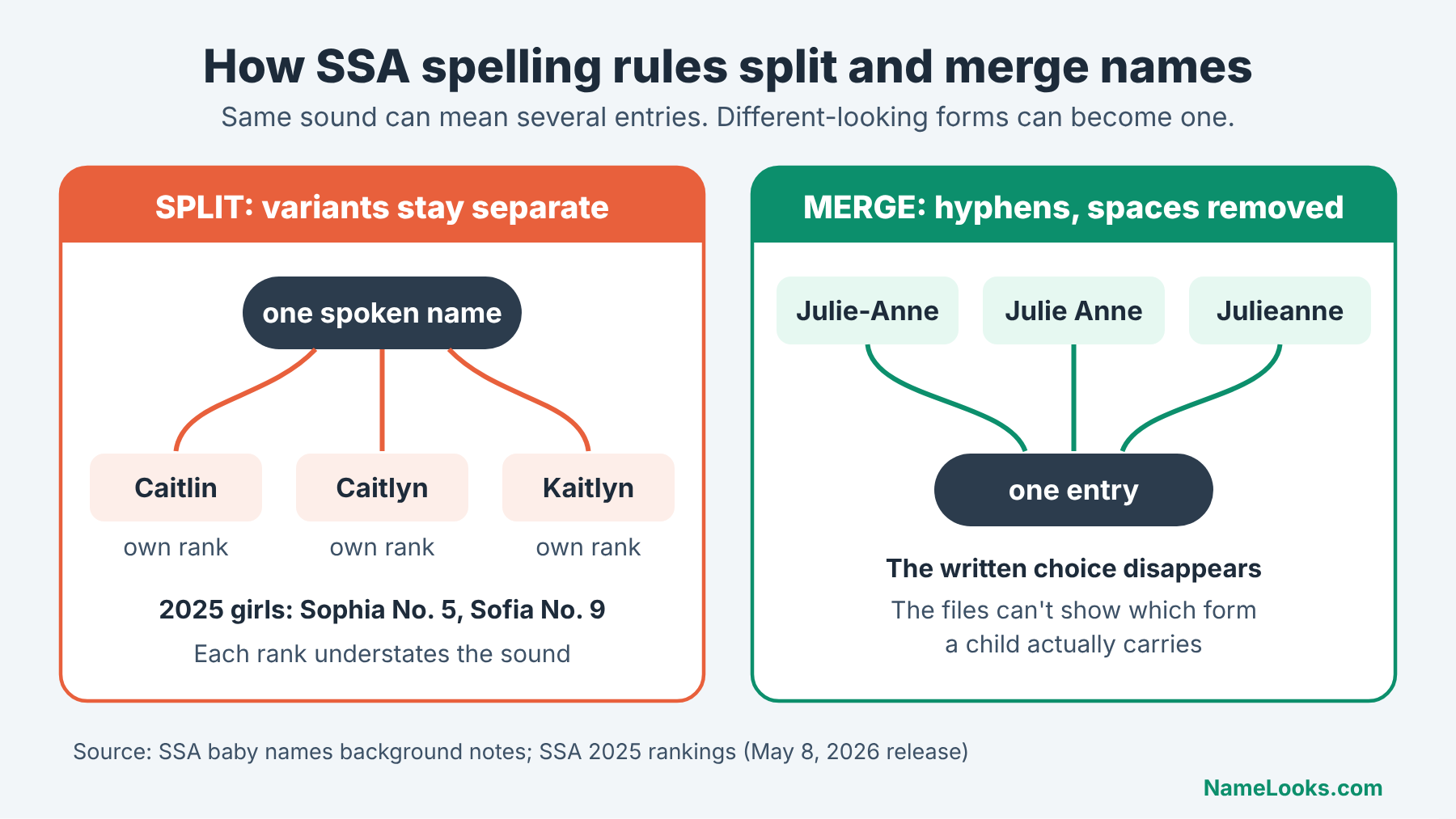
The Social Security Administration counts Julie-Anne, Julie Anne and Julieanne as one name, yet treats Caitlin, Caitlyn and Kaitlyn as three different names with three separate ranks. That one quirk tells you most of what you need to know about SSA baby names limitations: the list is a precise record of what was typed into a form, not a measure of what people hear, mean or intend. This page walks through the five blind spots that matter most when you use the data, and shows how to write claims that stay true.
Before you quote a single rank
- It counts card applications, not births. SSA’s own table is labeled “Social Security card holders born in the U.S.,” and people who never got a card are simply absent.
- Spelling is literal, except when it isn’t. Variant spellings are ranked separately, but hyphens and spaces are stripped, so some different-looking names merge.
- Below five, a name disappears. Any name with fewer than five occurrences in a geographic area is withheld, so a missing name is not proof that nobody has it.
- “Boy” and “girl” are recorded fields, not identities. SSA says the data is unedited and the sex attached to a name can be wrong.
- The numbers are a snapshot. The 2025 release reflects SSA records as of March 2026. Note the release you used and refresh it each May.
1Blind spot 1: the list measures paperwork, not babies
Here is the core answer up front. SSA’s name files are an excellent, complete-looking census of first names on Social Security card records for people born in the 50 states and the District of Columbia. They are not a register of births, they don’t record meaning or origin, and they say nothing about why a family chose a name. Most mistakes people make with the data come from forgetting which of those things it is.
If you want the general walk-through of reading the annual list, our guide to reading the latest SSA rankings covers it, and the mechanics of how ranks are assembled live in how SSA baby name rankings work. This page stays on the other side of the coin: where the dataset stops being reliable, and what to say when you reach that edge.
Where the records come from
Everything in the public files starts with a single administrative act: someone applied for a Social Security card for a person born in the United States. That is a sturdy foundation for counting names. It is also a filter, and every filter has gaps.
What SSA’s background notes actually say
The SSA’s background page for the baby names data spells out the rules. Names come from Social Security card applications for U.S. births after 1879. The current files are described as a 100% sample of SSA records as of March 2026. A record only qualifies if it has a birth year, a sex and a state of birth, and the name must be at least two characters long.
The same page adds a line that is easy to skim past: many people born before 1937 never applied for a Social Security card, so their names are not included. The data is restricted to the 50 states and D.C.; territories are reported separately. Each of those conditions removes someone from the count, usually for good administrative reasons.
Card holders and births are different numbers
SSA publishes a companion table titled Social Security card holders born in the U.S. For birth year 2025, it lists 1,835,823 boys and 1,757,924 girls, or 3,593,747 in total. The title is precise on purpose. These are people with qualifying card records, not live births reported by health agencies, and the two series should not be swapped in a sentence.
For recent cohorts the gap is small, because most cards are now requested at birth. In prepared testimony from July 1999, an SSA official said almost 90 percent of original cards issued in 1998 were processed through its Enumeration at Birth program, in which parents ask for a number on the birth registration form. For older cohorts the gap is real.
A 2021 data report in Frontiers in Big Data by Yuji Ogihara estimated Social Security number holders as a share of births by birth year, finding roughly 20% for the 1909 cohort, about 80% by 1919 and over 99% only by 1952. Those are the author’s own calculations from SSA and CDC counts, not an official SSA series, but they make the direction of the problem clear.
What this means for long-run trends
When you compare a name in 1915 with the same name in 2025, you are comparing two differently filtered populations. The older figures describe people who later got a card, which skews toward those who lived long enough and worked in covered jobs. For century-scale questions, see what long-run rankings reveal about fashion cycles, and read early decades as indicative rather than exact.
Rank, count and share are three different questions
The dataset hands you a rank and a count. A third measure, share, you usually have to calculate. They answer different questions, and most misleading headlines come from using one when the reader needed another.
Rank is position after a tiebreak
A rank tells you where a spelling sits in a sorted list for one sex and one year. SSA ranks boys and girls separately and breaks ties alphabetically, which means two names with identical counts get different rank numbers purely because of their first letters. Far down the list, where many names share the same small count, a rank can move dozens of places on a change of a handful of babies.
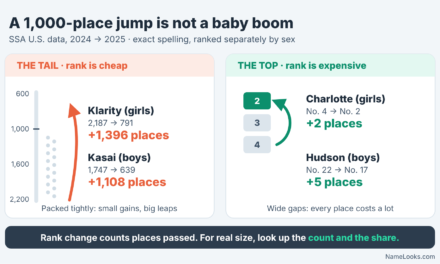
That is why a big rank jump is not the same as a big rise in babies. The SSA’s 2026 announcement said Kasai jumped 1,108 positions to No. 639 among boys born in 2025. That is a striking move in position. The release didn’t state the counts behind it, and position alone can’t tell you whether the change was a few dozen babies or several hundred. Our explainer on why position alone can mislead works through the arithmetic.
Share tells you how crowded a name feels
Share is the count divided by the number of card holders of that sex for the same year. It is the measure that tracks everyday experience: how likely a child is to share a classroom with a namesake. It also lets you compare years, which rank can’t do once the total number of distinct names changes.
SSA gives one share-style figure directly. On its data limits and download page, it reports the percentage of all names represented by the top 1,000. For 2025 that was 75.59% for boys, 67.25% for girls and 71.51% overall, down from 73.25% overall in 2016. Put plainly, about a third of girls with 2025 records got a name outside the girls’ top 1,000. A ranking that stops at 1,000 is silent about all of them.
SSA baby names limitations at a glance
Before the details, a working summary of the SSA baby names limitations that matter most. Think of the files as strong on how often a written form appeared and weak on everything that surrounds the form. The two lists below are the version we’d pin above a desk.
Use it confidently for
- How many qualifying records carry an exact spelling, by sex, year, and state of birth.
- How one spelling’s rank and count moved across recent years.
- Whether a spelling cleared the top 1,000 in a given year, nationally or in the state top 100.
- Comparing two spellings of a name as separate written forms.
Don’t ask it to tell you
- A name’s meaning, language of origin, pronunciation or cultural background. There are no such fields.
- Whether anyone at all has a name that doesn’t appear. The privacy floor hides small counts.
- The gender identity of anyone, or the “true gender” of a name.
- Why a name rose or fell. The data records outcomes, not motives.
- Anything about people born in U.S. territories, unless you use SSA’s separate territory tables.
Every one of those “don’t” items gets asked of the data constantly, usually in headlines. The rest of this article explains each limit, shows you what it looks like in a real query, and gives you wording that respects it.
2Blind spot 2: spelling decides what counts as “the same name”
To SSA, a name is a string of letters. Two spellings that sound identical are two entries, and two entries that look different on a birth form can end up as one. Neither rule is wrong. Both are choices, and once you see them you’ll notice how many popularity claims quietly ignore them.
Two rules pulling in opposite directions
The background notes give two spelling rules that sit side by side. One splits names that people would group. The other merges forms that some families deliberately chose to keep distinct.
Variants stay separate; spaces and hyphens vanish
SSA states that it does not combine spelling variants, and its own example is the Caitlin, Caitlyn and Kaitlyn trio, each with its own rank. The SSA’s 2026 blog post on 2025’s most popular baby names repeats the point for general readers: each spelling is ranked separately, which can change the order.
The second rule runs the other way. Names are taken from the first-name field with hyphens and spaces removed, so Julie-Anne, Julie Anne and Julieanne are counted as a single name. A family that chose a hyphen to signal two names, and a family that chose a closed single word, end up in the same row. The data has no way to tell you which form any child actually carries.
A real case from the 2025 top 10
The clearest current example sits right at the top of the girls’ list. In SSA’s 2025 rankings, published in its May 8, 2026 press release, Sophia is No. 5 and Sofia is No. 9. To many ears that is one name appearing twice. To the dataset it is two names, each ranked only on its own spelling.
What can you conclude? That both written forms are very common in 2025 U.S. card records, and that the spoken name is more common than either rank suggests. What you can’t conclude from the ranks alone is where a combined “Sophia/Sofia” would sit. You’d need the counts, you’d need to decide that the two spellings belong together, and you’d need to say so openly. Our dedicated Sophia and Sofia variant profile treats that pair in depth.
The everyday consequence
A name that sounds familiar on the playground can look modest on the list if its use is split across three or four spellings. The reverse also happens: a spelling ranked in the top 100 may be the minority form of a sound that is far more common. Whenever someone says a name “isn’t that popular,” ask which spelling they checked.
Characters the notes don’t cover
Spaces and hyphens are documented. Several other features of real names are not, and silence in a methodology note is itself information. It means you shouldn’t assume a behavior in either direction.
Accents, apostrophes and very short names
SSA’s background notes do not say how accented letters or apostrophes in a first name are handled in the public files. Compare that with England and Wales: the ONS baby names quality and methodology note says plainly that accents are removed during automated processing, and that before the 2018 data year any text after a space was dropped. The ONS discloses its rules for these characters; SSA’s public notes don’t.
One documented limit is easy to miss: SSA only includes names of at least two characters. A child whose recorded first name is a single letter isn’t in the files at all. That is rare, but it is a clean example of a legitimate name the dataset is designed not to see.
For the human side of these characters, NameLooks has separate guides to accents and special letters in names and to apostrophes and spaces in personal names.
How to handle a candidate with special characters
If the name you’re researching has an accent, an apostrophe or an internal capital, search the plain-letter form and every reasonable variant separately. Then write your finding as being about the form the data shows, not the form the family uses. A sentence such as “the unaccented spelling appears in SSA’s files for that year” is a claim about a string; “the accented name is common in the U.S.” is a different claim that the files can’t settle by themselves.
Don’t read an absence as a ruling, either. If an accented form never appears, the likeliest explanation is processing, not that no family chose it. Without a documented rule, the honest wording is “SSA’s notes don’t describe how accented letters are recorded.”
Grouping spellings without fooling yourself
Sometimes grouping is exactly the right move. If you want to know how often children are called something, the spelling split hides the answer. The ONS refuses to group names because, in its words, some groupings are subjective. That is a fair warning, not a prohibition. You can group; you just have to own the rule.
Pick the rule before you look at the numbers
Decide in advance whether you’re grouping by sound, by written root, or by an external reference that lists variants. Then apply the rule to every name in the comparison. The trap is choosing a generous grouping for the name you like and a strict one for its rival. A sound rule might group Caitlin, Caitlyn and Kaitlyn; a root rule might not group Kaitlyn with the rest; neither is “correct.”
Also decide what to do with forms that sound alike in some accents and not others. If you can’t defend a grouping in one sentence, leave the names separate and list them side by side.
Report both views, always
Publish each spelling’s own rank and count, then your grouped total, labeled as yours. Something like: “SSA ranks these spellings separately; adding their 2025 counts, by our grouping, gives X.” Readers can then rebuild your number or reject your grouping. For tracking a whole family of spellings over time, see tracking revival names with multiple spellings.
Never re-rank a grouped total against ungrouped names. If you combine Sophia and Sofia but leave every other name split, your new “rank” mixes two different units. Either group the whole list by one rule or don’t assign a grouped rank at all.
3Blind spot 3: privacy rules and coverage gaps hide real people
The SSA publishes counts, never individual records, and its blog says it does not share personal information. To keep it that way, it suppresses small numbers. That is the right call for privacy. For research it means the bottom of the distribution, where the most distinctive names live, is partly dark. Of all the SSA baby names limitations, this is the one most often forgotten by people writing about rare names.
The five-occurrence floor
This rule shapes more claims than any other, especially claims about rare and “one-of-a-kind” names. It’s worth reading the exact wording rather than a paraphrase.
What the rule says, and where it bites
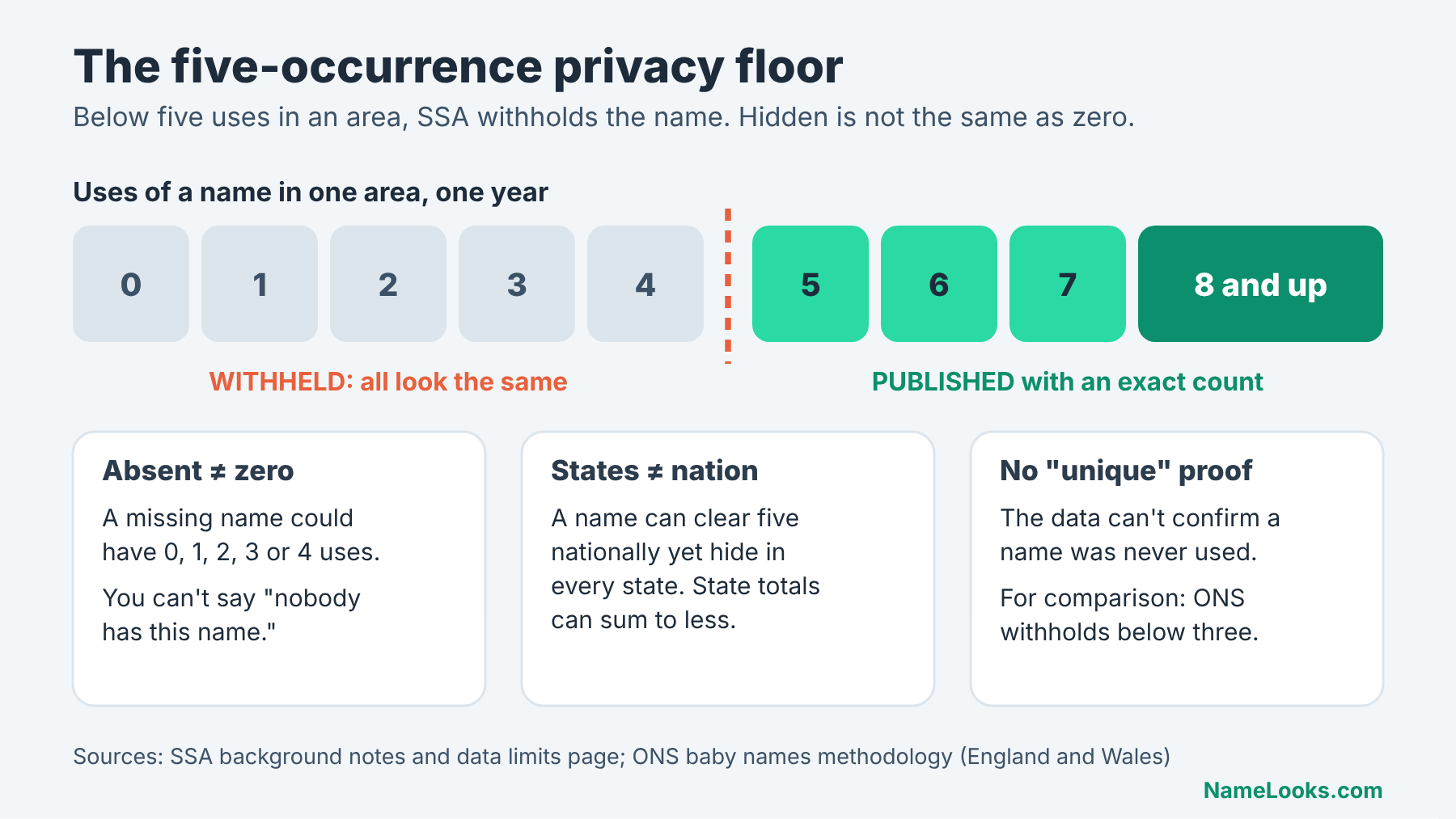
SSA excludes names with fewer than five occurrences in any geographic area. Its data limits page phrases it more carefully: it excludes names that would indicate, or allow someone to infer, names with fewer than five occurrences in any geographic area. That second clause matters because it covers indirect disclosure. If a national total and several state totals were published, simple subtraction could sometimes reveal a hidden small count, so the rule is built to block that too.
The background page draws the practical conclusion itself: state totals for a year may sum to less than the national count. A name can clear the bar nationally while being withheld in every state where it was given fewer than five times. Add up the states and you’ll come up short, by design.
Absent is not the same as zero
The most common misreading follows directly. A name missing from a year’s file was given to somewhere between zero and four children with qualifying records in that area, and the file can’t tell you which. You can’t say “no baby in Vermont was named X in 2025” from the state data. You can only say the name didn’t meet the publication threshold there.
The same logic undermines any claim that a name is “unique” or “never used.” The SSA data can’t prove a negative below five. If that question matters to you, our article on the privacy problem with extremely rare name data explains why the floor exists and why you wouldn’t want a dataset without one.
The top-1,000 window and the full files
Most people meet the data through SSA’s web forms, which top out at 1,000 names per sex for a year. The downloadable files go much further. Mixing up the two produces a different family of mistakes.
Forms show 1,000; downloads show “almost all”
On the limits page, SSA explains that its forms provide only the top 1,000 names to keep the site responsive, and that it provides almost all names for researchers through three zipped collections: national data, state-specific data and territory-specific data, each with a readme describing the format. The word “almost” refers to the privacy floor above.
The state pages have their own window. SSA’s state-level name pages show the top 100 names for a selected state and birth year from 1960 to 2025, and the top five for all states from 1980 to 2025. A name outside a state’s top 100 may still be in the state file. For regional work, start with when national rank hides regional differences.
“Not in the top 1,000” is a wide category
Recall that only 67.25% of girls’ names in SSA’s 2025 records fell inside the girls’ top 1,000. The remaining third is not a tail of oddities. It includes names one spelling away from the top 1,000, names with a few hundred uses, and names given just five times. Treating all of it as “rare” flattens enormously different situations.
For a careful look at the names sitting just below the cutoff, see names just outside the top 1000. The decision-level point here is simpler: rank 1,001 is a boundary set by a web form, not a natural line in how names are used.
People outside the frame
The privacy floor hides small counts inside the covered population. A separate question is who isn’t in the covered population at all. Several groups fall outside the national files by definition.
Territories are counted separately
SSA’s territories page says the national statistics exclude births in U.S. territories, and territory data isn’t included in the other popular-name pages. Puerto Rico has its own tables; American Samoa, Guam, the Northern Mariana Islands and the U.S. Virgin Islands are combined into one. The drop-downs cover birth years 1998 through 2025.
The small numbers there show the privacy floor at work. For 2025, the combined other-territories table lists only seven girls’ names, with no entries for ranks eight to ten, and the page doesn’t explain why. Thin data plus a five-occurrence rule is the likeliest reason, but that is our inference, not SSA’s statement.
Who else isn’t there
Because the base is U.S.-born card applicants, the national files leave out children born abroad, including those who later moved to the U.S., and anyone born in the U.S. who never got a card. For older cohorts that second group is large, as the Ogihara estimates suggest. Records missing a birth year, sex or state of birth are excluded by the qualifying rules too.
None of this is a scandal. It does mean “names Americans have” and “names on U.S.-born card records” are different populations. For the first question, the U.S. Census Bureau’s 2020 names files count first and last names on 2020 Census returns, across all ages, for names that appear 100 or more times. That is a different dataset with its own floor, its own disclosure-avoidance method and a single reference year, so it complements SSA rather than replacing it.
Don’t stitch the two together
A Census 2020 count describes everyone alive and counted in 2020 with that name. An SSA count describes card records for one birth year. Putting them in one sentence as if they measured the same thing (“rose from X in the Census to Y in 2025”) mixes populations, units and thresholds.
4Blind spot 4: sex categories are recorded fields, not gender facts
SSA’s published tables split every year into two columns, boy and girl. That split is useful and also one of the most over-interpreted parts of the dataset. The sex column records what was entered on an application. It doesn’t record identity, and it isn’t a verdict on the name.
How the two columns actually work
Three documented rules govern the split. Each one has consequences that show up the moment you search for a name used for both boys and girls.
Separate rankings, and a default you might not notice
SSA ranks each sex separately. Its own example is Micah, which has one rank among boys and a different one among girls. So there is no single “rank of Micah” for a year, only two ranks for two name-sex combinations. SSA also notes that if you don’t specify a sex in a query, its tools show the more popular of the two combinations. A quick search can therefore return the boys’ figure for a name and leave you thinking it’s the only one.
The practical habit is simple: for any name with meaningful use in both columns, look up both, and report both with their counts. If you only cite one, say which.
The data is not edited
The background notes are frank about this: the data is not edited, so the sex associated with a name may be incorrect, and entries such as “Unknown” and “Baby” remain in the files. That candor is welcome, and it tells you how to read small numbers. A handful of records for a name in the “unexpected” column could reflect real use, data-entry error, or both. The files can’t distinguish.
For large counts this barely matters. For a name with thousands of uses in one column and a few in the other, the small column deserves caution before anyone writes a story about it. Placeholder entries matter too: a scan of the raw files that treats every string as a real name will count “Baby” among them.

What the split can’t tell you
Once you accept that the column is a recorded field, two limits follow. One concerns people, the other concerns names.
Nothing about any person’s gender
A share of boys or girls with a name is a fact about records in aggregate. It says nothing about how any individual identifies, and it should never be used to guess a stranger’s gender from a name. Automated tools that try anyway make measurable errors. A 2018 benchmark in PeerJ Computer Science by Lucía Santamaría and Helena Mihaljević, comparing name-to-gender inference services, found the best-performing service still had a total inaccuracy of about 7.9% on the authors’ test set, with error rates varying notably across the name groups they examined.
That study isn’t about SSA’s files, but it shows what happens when population patterns are applied to individuals. For editorial guidance, see how to write about name gender without stereotyping people.
No fixed “gender of a name”
Two columns also invite a false binary about names themselves: “is this a boy’s name or a girl’s name?” The data can show the split in one dataset, one country and one year. It can’t settle the question in general, because splits change over time, differ between spellings and differ between countries. “Gender-neutral” is a description you build from data with stated thresholds, not a property the files assign.
Our cornerstone on using data without treating a name as a gender test develops that method, and what Census and birth data can and cannot show about unisex names compares the two U.S. sources.
Reading a two-column name, step by step
Here is the routine we’d suggest for any name with real use among both boys and girls. It keeps the evidence in front and the interpretation clearly labeled.
A five-step check
- Query both sexes. Don’t rely on the default view; pull the boys’ and girls’ figures separately for the same year.
- Write down counts, not only ranks. A rank of 400 in one column and 900 in the other says little until you know how many records each represents.
- Compute the split. Divide each count by the combined count for that spelling and year. Label it “share of SSA records for this spelling.”
- Check neighboring spellings. A different spelling may lean the other way, which changes what the spoken name looks like overall.
- Look at several years. A single year can be noise, particularly when one column is small.
A hypothetical worked example
Picture a family weighing a name that, in a given year, shows a few thousand records among boys and a few hundred among girls in SSA’s files. The supportable statement is: “In SSA records for that year, about one in ten uses of this spelling was recorded for a girl.” It is not supportable to say the name “is a boy’s name,” or that girls with it are unusual in any personal sense.
Now suppose the family’s preferred spelling differs by one letter, and that spelling leans the other way. Both statements can be true at once. The spoken name is shared; the written forms have separate histories. How spellings shift gender patterns is covered in how spelling variants change the gender pattern of a name.
5Blind spot 5: a moving snapshot, so make your limits reproducible
The last limit is about time. Every SSA release is an extract of records as they stood on a date, and every claim built on it inherits that date. Writing down which release you used, and what the data couldn’t show, is what turns a popularity claim into something another person can check.
The release you used is part of the fact
“Olivia was No. 1” is incomplete. “Olivia was No. 1 among girls born in 2025, in SSA’s 2026 release” is a fact someone can verify. The difference looks fussy until two sources disagree.
What SSA says about timing
The background notes describe the current files as a 100% sample of SSA records as of March 2026. The 2025 rankings were announced on May 8, 2026, and SSA’s press release says the top 1,000 is released each year in time for Mother’s Day. The release also notes SSA has compiled the list since 1997, with searchable data going back to 1880.
Because the files reflect records on an extract date, a birth year’s figures can, in principle, change in a later release, for example if applications for children born late in a year arrive after the cutoff. SSA’s notes don’t quantify that, so we won’t guess at the size. The safe habit is to treat the release as part of the citation.
An update rule you can actually follow
For anything you publish or keep, a simple rule works: refresh every May when the new release appears, and re-pull the previous year rather than reusing your old numbers. Note the release year next to every figure. If a number changes between releases, keep the newer one and mention the change if it affects a conclusion.
For a quick reference you can always check, SSA’s top five names for each of the last 100 years covers 1926 to 2025 and is easy to open on any device. It won’t give you counts, but it’s a good sanity check for any claim about the very top of the list.

Claims the data can carry, and claims it can’t
The distinction between evidence and interpretation is easier to hold onto with examples. The table below sorts real claims from SSA’s 2025 materials and related sources by what they rest on and how far they can be stretched.
| Claim | Source | Geography and year | Metric | Limitation | Editorial takeaway |
|---|---|---|---|---|---|
| Liam and Olivia were No. 1 for the seventh straight year | SSA press release, May 8, 2026 | 50 states + D.C., births 2025 | Rank, by exact spelling and sex | A rank says nothing about how many babies, or how far ahead of No. 2 | Say “No. 1 in SSA’s 2025 rankings,” not “the most common name in America” |
| Sophia is No. 5 and Sofia No. 9 among girls | SSA 2025 top 10 | 50 states + D.C., 2025 | Rank, separate spellings | Ranks of two spellings can’t be added or merged | Report both; group only with counts and a stated rule |
| The top 1,000 covered 67.25% of girls’ names | SSA data limits page | 50 states + D.C., 2025 | Share of card records | Share of SSA records, not of births reported by health agencies | About a third of girls fall outside any top-1,000 claim |
| 3,593,747 card holders were born in 2025 | SSA card holders table | U.S., 2025 | Count of qualifying card records | Not the same series as official birth statistics | Use it as the denominator for SSA shares, and label it |
| Kasai jumped 1,108 places to No. 639 | SSA press release | Boys, 2024 to 2025 | Change in rank | No count given; rank moves faster far down the list | Get the counts before calling it a surge |
| Kasai means “fire” in Japanese and Swahili | Commentary in the same release | None | Not a data field | Meaning isn’t recorded anywhere in the files | Verify in name references, separately from popularity |
| Names with 100+ occurrences in the 2020 Census | U.S. Census Bureau 2020 names | U.S., all ages, 2020 | Count on Census returns | Different population, threshold and privacy method | Don’t combine with SSA birth-year counts in one figure |
A sentence template that stays true
Nearly every safe popularity claim fits one pattern: [spelling] was [rank / count / share] among [boys / girls] born in [year] in [50 states + D.C. / a named state], according to [SSA, release year]. Fill every slot and the claim is checkable. Leave one out, and the reader has to guess, usually generously.
Notice what the template has no slot for: meaning, origin, pronunciation, reasons. Those may be worth writing about, but they need their own sources. Mixing them into the popularity sentence lends them authority they haven’t earned.
Where commentary slips in
Even SSA’s own release blends the two. The Kasai meaning gloss and the description of Klarity as a contemporary spelling of “clarity” are helpful context, but they’re editorial descriptions in a press release, not values in the dataset. Treat them as you would any secondary claim and check meanings in references that document their sources. NameLooks’ guide to researching name meanings and origins shows how.
The same applies to causes. A rise that coincides with a television show or a celebrity birth is a hypothesis. The files record what parents wrote down, not why. Our look at rank jumps vs real birth counts among 2025’s risers takes that apart name by name.
What a change between years really shows
Year-over-year movement is where the limits pile up: rank instead of count, spelling splits, and the release date all interact. The table below collects verified ranks from SSA’s own pages and shows what each movement can and can’t support.
| Name or form | What SSA shows | Change | Caveat | Implication for a naming decision |
|---|---|---|---|---|
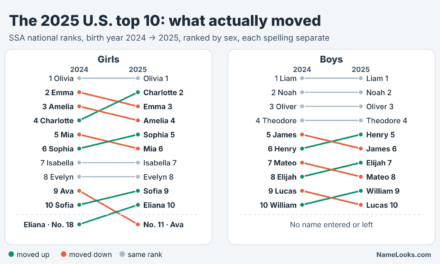
| Charlotte (girls) | No. 4 in 2024, No. 2 in 2025 | Up two places; ended Emma’s six-year run at No. 2 | Ranks only here; the count change isn’t stated | Visible at the top, but a two-place move near No. 1 can be a modest change in babies |
| Emma (girls) | No. 2 in 2024, No. 3 in 2025 | Down one place | Being passed is not the same as falling sharply | Still among the very top names in both years |
| Henry and James (boys) | James No. 5 in 2024; Henry No. 5 and James No. 6 in 2025 | Henry entered the top five | Henry’s 2024 rank isn’t on the top-five page | Two widely used names trading places, not a new trend |
| Ava and Eliana (girls) | Ava left the top 10; Eliana debuted at No. 10 in 2025 | Swap at the edge of the top 10 | The release gives no ranks or counts for Ava in 2025 | The top-10 boundary is a presentation choice, not a cliff |
| Sophia and Sofia (girls) | No. 5 and No. 9 in 2025 | Same sound, two entries | No combined rank exists in the data | The spoken name is more common than either rank suggests |
| Julie-Anne, Julie Anne, Julieanne | One entry, per SSA’s background notes | Three written forms collapsed | The files can’t show which form a child carries | Hyphen and space choices are invisible in the counts |
| Caitlin, Caitlyn, Kaitlyn | Three entries, each ranked separately | One sound, split three ways | Each rank understates how often the sound is used | Check all spellings before judging how common it feels |
Reading the top of the 2025 list
The striking thing about 2025 is how little moved at the very top. SSA’s release noted that Liam, Noah, Oliver and Theodore kept their positions. When rank changes are this small, the interesting story is often in counts and shares, which the press release doesn’t give. For the full year in context, see what changed in the 2025 U.S. rankings, and for the long run at No. 1, why seven years of Liam and Olivia doesn’t mean naming has stopped changing.
Why one year is rarely enough
A single-year rank is one draw from a moving system. If you’re deciding on a name, several years of counts give a far better picture of direction than one release. Our guide to using 2020 to 2025 counts instead of one-year hype shows how to build that view.
A limitations note you can copy
If you write about name data, publish the SSA baby names limitations that apply next to your numbers. It costs a paragraph and saves arguments. Here’s a version to adapt.
The note itself
Sample limitations note
Figures are from the U.S. Social Security Administration’s baby names data, [release year] release, covering births in the 50 states and D.C. They count Social Security card records, not births, and exclude U.S. territories. Each spelling is counted separately; hyphens and spaces are removed. Names with fewer than five occurrences in an area are withheld, so absence doesn’t mean zero. Sex reflects recorded data, which SSA does not edit. Where we group spellings, the grouping is ours and is labeled.
Trim it to fit, but keep the four ideas that change interpretation: card records, spelling rule, privacy floor and recorded sex. Those are the limits readers most often don’t know about.
A pre-publish checklist
- Name the unit. Rank, count or share, and never one standing in for another.
- Name the frame. Sex, birth year, geography and SSA release year.
- Check spellings. List the variants you looked at and say whether you grouped them.
- Respect the floor. Don’t claim zero, “unique” or “never used” from an absence.
- Separate the commentary. Meanings and causes need their own sources.
- Date it. Plan to refresh after next May’s release.
If you’re using the data for a family decision rather than publishing, the same checklist applies in lighter form. Our decision framework for choosing a name shows where popularity fits among the other factors, and the U.S. popularity cornerstone collects every data guide in this series.
Questions people actually ask
Is the SSA list the same as official U.S. birth statistics?
No. It’s built from Social Security card applications, and SSA labels its totals as card holders born in the U.S. Official birth counts come from vital statistics compiled by health agencies. For recent years the two are close because most cards are requested at birth, but they’re separate series and shouldn’t be mixed in one calculation.
Why can’t I find my child’s name in the files?
The most likely reason is the privacy floor: names with fewer than five occurrences in an area are withheld. It could also be a spelling or character difference, a record missing a required field, or a birth in a U.S. territory, which appears only in SSA’s separate territory tables. None of these means the name is invalid.
Does SSA ever combine spellings or show a combined rank?
Not in its rankings. Each spelling has its own rank and count. The one place forms do merge is where hyphens and spaces are removed, which turns several written versions into one entry. Any combined figure you see elsewhere was built by someone else, using a grouping rule they should state.
Can I use SSA data to tell whether a name is “really” a boy’s or girl’s name?
You can describe how records for a spelling split between the two columns in a given year. That’s a population pattern, not a rule about the name or about anyone who has it. The split changes over time and between spellings, so any label needs a dataset, year and threshold attached.
Why do some websites give different numbers for the same name and year?
They may be using an older release, grouping spellings, quoting rank where you expected count, or drawing on a different dataset such as the Census 2020 files. Ask which release, which metric and which spelling rule were used. If a source can’t answer, treat the number as unverified.
Are the SSA files useful for researching names from other countries?
Only in a narrow way, and this is one of the SSA baby names limitations people overlook. They describe how those names are used among U.S.-born children with card records. They tell you nothing about usage in the country of origin, and nothing about meaning or pronunciation. For England and Wales, the ONS publishes its own data with different rules, including a threshold of three rather than five.
Sources and further reading
- SSA Popular Baby Names — the official entry point for rankings by year, name, state, decade and territory.
- SSA background information — the spelling, sex, privacy and coverage rules quoted in this article.
- SSA data limits and downloads — top-1,000 coverage shares and the national, state and territory files.
- SSA card holders born in the U.S. — yearly totals by sex, useful as a share denominator.
- SSA press release, May 8, 2026 — the 2025 top 10 and fastest risers.
- SSA top five names, 1926–2025 — quick check for any claim about the top of the list.
- SSA names in U.S. territories — Puerto Rico and other territories, reported apart from national data.
- SSA blog: 2025’s Most Popular Baby Names — plain-language reminder that each spelling is ranked separately.
- SSA names by state — top 100 per state from 1960 and top five for all states from 1980.
- SSA testimony, July 1999 — background on Enumeration at Birth and how cards are requested at birth.
- U.S. Census Bureau 2020 names files — first and last names across all ages, with a 100-occurrence floor.
- ONS baby names quality and methodology — England and Wales rules, a useful contrast to SSA’s.
- Ogihara (2021), Frontiers in Big Data — estimated Social Security number coverage by birth cohort, 1909–2019.
- Santamaría and Mihaljević (2018), PeerJ Computer Science — benchmark of name-to-gender inference errors.
NameLooks provides general information, not legal or statistical advice. Popularity data describes populations, not individuals, and agency methods and release figures can change; check the source before relying on a number.