
Most parents who want to avoid baby name regret are not worried about choosing a “bad” name. They’re worried about a surprise: a pronunciation nobody gets right, a spelling they’ll correct for decades, initials that spell something, a meme they missed, or a grandparent who feels quietly passed over. This page turns those five surprises into five checks you can run calmly, with real sources where sources exist and honest limits where they don’t.
The short version
- Regret is mostly about surprises. The checks below are designed to move discoveries from after the birth certificate to before it.
- Five checks, in order: pronunciation, spelling, associations, initials and the full written string, then family context.
- Verify, don’t guess. Pronunciation comes from people who use the name and from reliable references, not from how English spelling looks.
- A found problem is not a veto. Most issues have a fix (a middle-name swap, a decided nickname, a family conversation). Only a few are deal-breakers, and you decide which.
- Records have windows. In England and Wales, a first name can usually be changed once within 12 months of registration; in the U.S. the route depends on the state. Know yours before the paperwork.
1How to avoid baby name regret: the short answer first
Here’s the answer before the detail. You can’t guarantee you’ll love a name forever, and nobody can sell you that. What you can do is make sure that nothing about the name catches you off guard after it’s official.
That’s the whole idea of this page. The most reliable way to avoid baby name regret is to remove the surprises, so we treat regret prevention as a short audit of five things other people will notice about the name, run in a sensible order, with a clear rule for what to do when a check turns something up.
Regret usually comes from a surprise, not from a bad name
Think about the complaints parents tend to voice about a name after the fact. They rarely say “it’s ugly.” They say “I didn’t realize everyone would say it that way,” or “I didn’t know my cousin had already picked it,” or “I didn’t notice the initials until the monogrammed towel arrived.”
Every one of those is a fact that existed before the decision and simply wasn’t checked. That’s good news. A fact you can find in advance is a fact you can plan around.
What the research can and can’t tell us about regret
You will find headlines claiming that a specific share of parents regret their child’s name. We looked for the underlying studies and did not find one we could open and verify as a published, peer-reviewed measurement of baby-name regret. Most figures we saw trace back to commercial polls reported in the press, with methods we couldn’t inspect. So we don’t repeat any percentage here, and we’d suggest you treat such numbers loosely too. You don’t need a statistic to avoid baby name regret; you need a method.
There is solid research on a neighboring question. In 2012, Simon Laham, Peter Koval and Adam Alter published “The name-pronunciation effect” in the Journal of Experimental Social Psychology (vol. 48, issue 3). Across five studies, people formed more favorable impressions of names that were easier for them to pronounce, and the effect held after the authors controlled for length, unusualness and foreignness.
Be careful with what that does and doesn’t mean. It’s about how unfamiliar listeners react, in particular study settings. It is not evidence that a name you love is a mistake, and “easy” depends entirely on who’s listening. What it does support is a modest, practical point: knowing how a name will land with strangers is worth a few minutes of your time.
The five surprises this page is built around
Each check below targets one kind of surprise. Keep the list in mind; the rest of the article works through them in this order, because each one can change what you test next.
- Pronunciation. How the name is said by the people it comes from, and how a stranger reads it cold.
- Spelling. How often you’ll spell it aloud, and how forms, systems and keyboards treat it.
- Associations. What the name already calls to mind for other people, from public figures to products to slang.
- Initials and the full written string. What the initials, email-style handles and monograms spell when the whole name is assembled.
- Family context. Namesakes, near-duplicates among cousins, honoring expectations, and who should hear the news first.
What checking can and can’t do to avoid baby name regret
A check is a flashlight, not a verdict. It shows you what’s in the room. It doesn’t tell you whether you like the furniture. That distinction keeps the process supportive instead of anxious, and it’s the reason we keep “what we found” separate from “what we decided.”
Checks reduce surprises; they don’t manage feelings
Some parents feel a wobble after naming even when every check came back clean. Tiredness, hormones, a stray comment from a relative and the sheer strangeness of a name becoming a person can all produce it. A checklist can’t prevent that, and it isn’t supposed to.
What it can do is give you something to lean on when the wobble comes. If you know you verified the pronunciation, talked to the family and looked at the initials, a passing doubt has less to grab onto. You can tell the difference between “I’m tired” and “we missed something.”
When to stop checking
There’s a failure mode on the other side, too. Search any name long enough and you’ll find someone who dislikes it, a fictional villain who had it, or a word in some language that resembles it. If every finding counts as a red flag, no name survives.
Our suggestion is to run each check once, write down what you found in a sentence, and then decide. If you catch yourself searching a fourth time for the same name, that’s usually not research anymore. It’s worry looking for permission. The broader decision framework for choosing a name covers how to weigh findings against what you actually value; this page stays focused on catching the surprises.
A note on tone
None of this is a test you can fail. Families name children in many ways, by many traditions, and plenty of beloved names would trip one of these checks. The goal is informed choice, not a perfect score.
2Gather what you need before running the checks
The checks go faster, and they’re more accurate, when you prepare three things first: the names written exactly as they’d be recorded, a quick map of the family names around you, and a couple of data sources open in a browser tab. It takes perhaps half an hour. It also saves you from the most common mistake, which is checking a first name in isolation when the world will meet the whole thing.
Your shortlist, written the way it will be recorded
Write every candidate as a complete legal string: first name, any middle names, surname, and any second surname or particle. Write it with the exact spelling, capitalization, accents and punctuation you intend. “Something like Anna-Marie” is not checkable. “Anna-Marie Joy Okafor-Lindqvist” is.
If you’re still at a long list, this is the wrong moment for these checks. If you want to avoid baby name regret without exhausting yourselves, narrow first using the shortlist method for cutting 100 favorites to five, then audit the survivors. Running five careful checks on fifty names is how people burn out.
Why the full string matters to systems, not just to ears
Name-handling software doesn’t see “a name.” It sees fields. The Unicode Consortium’s CLDR person-name specification, which many apps draw on to format names, separates a given name, a second given name, a surname and a second surname, and it has explicit rules for turning multiword fields into initials. It also notes that name order and formality depend on locale. In practice, your child’s name will be split, reordered, abbreviated and initialed by software many times.
The U.S. Social Security Administration’s baby-name files show the same thing from a different angle. According to SSA’s background notes on the data, hyphens and spaces are removed when names are tabulated, so Julie-Anne, Julie Anne and Julieanne are counted as a single entry. That’s a statistics decision, not a rule about your child’s records. Still, it’s a vivid reminder that punctuation you care about can disappear when a system processes the name.
A practical next step: make a “how it will be seen” sheet
For each finalist, write four lines: the full legal name, the name on a class list (often first name plus surname), the name as initials, and the name in “Surname, Given” order. That last one is how many forms, rosters and databases sort people, and it’s where awkward combinations sometimes hide.
Picture a hypothetical finalist with a hyphenated double surname. On the sheet, you might notice the “Surname, Given” version is long enough that a form field would cut it off. You aren’t going to change a family surname over a form field. You might, though, decide the first name could be shorter, or simply know in advance that you’ll occasionally write it out by hand.
Family facts and data sources to have open
The second input is context. You want to know which names are already “taken” or emotionally loaded inside the family, and you want a way to see how common each finalist is outside it. Neither should decide anything on its own. Both prevent surprises.
Build a quick family name map
List the first and middle names of siblings, cousins, nieces, nephews, parents, grandparents and anyone recently remembered. Add any names you know a relative is saving for a future child, if they’ve said so openly. Mark names that carry obvious feeling: a grandparent who died recently, an estranged relative, a name someone has publicly “called.”
You’re not building a family tree, and you don’t need to guess about anyone’s background or heritage from their name. You’re just making a list of what’s nearby so that a cousin’s newborn with a near-identical name doesn’t come as a shock at the next holiday.
Which datasets help, and what they can’t say
Three official sources cover most English-speaking readers’ questions about frequency. Each measures something different, so it’s worth knowing which question each one answers.
- SSA Popular Baby Names (United States, birth years through 2025). Built from Social Security card applications. It includes a “Popularity of a Name” lookup that shows a name’s rank over time. SSA’s notes say different spellings are not combined, so Caitlin, Caitlyn and Kaitlyn each have their own rank, and names with fewer than five occurrences are withheld.
- ONS baby names in England and Wales (1996 to 2025, released 9 July 2026). Ranks and counts from birth registrations, published separately for boys and girls.
- U.S. Census Bureau 2020 names files. First and last names that occurred 100 or more times in 2020 Census returns. This describes the whole population, not births, so it’s useful for asking “how many adults share this surname-plus-first-name feel” rather than “is this trending among babies.”
What none of them can tell you: how a name is pronounced, what it means, how it’s perceived, or anything about any individual. They count spellings on records. That’s genuinely useful for the spelling and association checks, and it stops there. If you want the bigger question of how common is too common, the popular-versus-uncommon decision has its own page.
| Naming factor | Evidence or source | Practical implication | Limitation | Question to ask |
|---|---|---|---|---|
| Pronunciation | People who use the name in its source language; dictionaries with IPA; the IPA chart for reading transcriptions | Decide which pronunciation is “yours” and how you’ll teach it | No dataset records pronunciation; English spelling is a poor guide | Who did we hear say it, and do we accept that strangers may say it another way? |
| Spelling | SSA and ONS treat spellings as separate names; SSA strips hyphens and spaces in its tabulation | Each unusual spelling choice adds a little everyday correction | Frequency of a spelling isn’t the same as how “guessable” it is | How many times a week are we willing to spell this aloud? |
| Associations | Ordinary search results, news, product and entertainment references, slang dictionaries | Know what a stranger might think of first | Associations shift over time and differ by community and language | Is this association likely to last, and would it bother the child? |
| Initials and written string | CLDR person-name fields and initial rules; the “how it will be seen” sheet | Catch accidental words, awkward monograms and handle problems | Software and conventions differ by locale and institution | What do the initials spell in every common order? |
| Family context | Your family name map; direct conversations | Avoid near-duplicates and unspoken honoring expectations | No data source can tell you how a relative feels | Who would be hurt or surprised, and should they hear it first? |
3Run the first checks: pronunciation, spelling, associations
These three checks belong together because they’re about how the name travels outside your home: said by strangers, typed by receptionists, and searched by anyone curious. Run them on each finalist before you look at initials and family context, since a name that fails here for you may not be worth the family conversation.
Check 1: Pronunciation from the source, then from strangers
Pronunciation regret has two flavors. One is discovering the name is said differently by the people and language it comes from. The other is discovering that strangers reliably say it in a way you dislike. The first is about accuracy and respect. The second is about everyday friction. You need both answers.
Where reliable pronunciation comes from
Not from guessing. Of all the ways to avoid baby name regret, getting the pronunciation from a real source is the one most people skip. English spelling maps loosely to sound, and a name borrowed from another language may follow that language’s spelling rules, not English ones. Two careful readers can look at the same unfamiliar name and come up with two confident, different answers.
Better sources, roughly in order of reliability: people who carry the name or use it in its home language; recorded speech by native speakers that’s clearly labeled as such; pronouncing dictionaries and language references that give a transcription. If a reference uses the International Phonetic Alphabet, the International Phonetic Association’s official chart is the place to decode it. Be wary of baby-name sites that give a single “how to say it” respelling with no source, especially for names that are used across several languages.
Many names have more than one accepted pronunciation, sometimes in different regions or communities. That’s not a problem to solve. It’s a choice to make on purpose. Pick the one you’ll use, know the others exist, and you won’t be startled when a teacher uses a different one.
The cold-read test
Once you know how you’ll say it, find out how other people will. Write the full name on a card or in a text and ask three or four people who haven’t heard you say it to read it aloud. Don’t coach them. Don’t say “it’s like…” first. Just listen.
Then sort the result. If most people land on your pronunciation, great. If they land on a different, perfectly reasonable one, you’ll be correcting people, and you can decide whether that feels like a small daily kindness or a tax. If they hesitate and stall, that’s the signal worth taking seriously: a name strangers can’t start saying tends to get avoided or shortened by them. The deeper sound work (stress, rhythm, how the first and last names run together) is covered in testing a full name out loud; here, you only need to know whether the pronunciation will cause friction you’d regret.
A script for asking without leading
“Quick favor: can you read this name aloud the way you’d say it if you saw it on a list? No right answer, I’m just curious.” Then thank them and say nothing else. The moment you explain, the test stops being a test.
Check 2: Spelling, and how systems treat it
Spelling regret usually builds slowly. It’s not one dramatic moment. It’s the five hundredth time someone writes it wrong on a coffee cup, a school form or a prescription label. Whether that bothers you is personal. What matters is that you estimate it honestly before you commit.
Estimate the “spell it aloud” cost
Try the phone test. Say the full name to someone as if booking an appointment, then ask them to type it. Do this with two or three people. Count how many letters you had to add, change or clarify.
Some spellings are guessable but varied. If a name has several common spellings, people will often choose the most familiar one, and you’ll correct them. SSA’s data makes this tangible without any opinion from us: because each spelling gets its own rank, you can look up two spellings of the same sound and see which one more babies were given in a recent year. A spelling far less common than its alternatives is likely to be “corrected” to the common one by other people. That’s a fact you can live with; just know it’s coming.
Accents, hyphens and apostrophes on real-world forms
Diacritics, hyphens, apostrophes and spaces inside names are part of many languages and families, and they deserve to be written correctly. They’re also the characters most likely to be dropped, substituted or rejected by older systems. Rules for what a birth registration will accept vary by country and, in the U.S., by state, so check with your registrar rather than assuming.
A sensible approach: decide which form is the true name (with every mark), and decide in advance how you’ll handle systems that can’t display it. Some families keep the full form everywhere it’s accepted and accept a plain-letter fallback elsewhere. Others choose spellings that survive most systems. Neither is wrong. The regret comes from not deciding and being surprised by a passport application or school database years later.

Check 3: Associations, searched on purpose
An association is whatever a name already brings to mind for other people: a famous bearer, a character, a brand, a storm, a song lyric, a joke, a word in another language you’ll be around. You can’t control associations, and they shift with time. But you can know about the obvious ones before you sign anything, which is the whole point.
A short search routine that’s enough
For each finalist, spend ten minutes, not an evening. Search the first name alone, then the first name plus your surname, then the first name in quotation marks with words like “meaning,” “slang” and “meme.” Glance at news results, image results and video results, because associations often show up in pictures before they show up in text. If the name is used in a language your family speaks or lives near, ask a fluent speaker whether it sounds like anything.
Then ask one person from a different generation and one from the same generation as the child’s future classmates’ parents what comes to mind. Older relatives remember associations the internet has forgotten. Younger people know which ones the internet just invented.
Write down what you find in plain words. “Shares a name with a well-known TV character from the 2000s; nobody under 25 seems to know it.” That one sentence is far more useful than a vague unease.
How to weigh what turns up
Not every association matters. A useful test is to ask three questions about each one. Is it likely to last, or is it attached to this year’s news? Is it something a child would be teased about, or only something an adult might mention? And is it tied to the name itself, or only to one spelling or one full-name combination?
A name shared with a mildly famous person is usually a non-issue that fades. A name that is identical to a common slang term, or that forms a well-known phrase with your surname, tends to stick. A full-name combination that matches a public figure exactly is worth noticing too, because search results will follow your child around. That last point is less about teasing and more about what people find when they look a person up later.
Be careful not to overcorrect. Every name is shared with someone you’d rather it weren’t. If you strike names over any negative association at all, you’ll end up with nothing. The question is whether an association is prominent and durable for the people your child will actually meet.
Don’t guess meanings in other languages
If someone says a name “means something bad” in another language, verify it with a fluent speaker or a reliable dictionary before acting on it. Folk claims of this kind circulate widely and are sometimes wrong, sometimes regional, and sometimes about a different spelling entirely.
4Run the later checks: initials, the full written name, and family context
The first three checks were about the first name traveling outward. These two are about the name as a whole, sitting on paper and sitting inside a family. They’re the checks people most often skip, because they feel either trivial (initials) or awkward (relatives). They’re also where a surprising share of real-world “I wish we’d noticed” moments come from.
Check 4: Initials, monograms and the full written string
If you only have time for one quick check to avoid baby name regret, make it this one. Initials are easy to overlook because nobody says them aloud during the naming process. Then they show up on luggage tags, school lockers, email addresses, work signatures and the corner of a baby blanket. A thirty-second check prevents most problems.
Spell out every version, not just one
Write the initials in several orders. First-middle-last is the obvious one. Also try first-last, since many systems skip the middle name; last-first, which is how some forms and institutions abbreviate; and the traditional monogram layout, where the surname initial is often placed in the center and larger. CLDR’s person-name rules explicitly support turning multiword fields into initial sequences, which is a reminder that two-part given names and double surnames can produce four or five letters, not three.
Look for accidental words, common abbreviations, and letters that look odd together. Then look at the “first initial plus surname” form (like a standard work email address) and the “first name plus last initial” form (common on class lists when two children share a first name). Each is a different string your child will see repeatedly.
When initials are a deal-breaker and when they aren’t
We’d treat it as worth changing only when the initials spell a common word that invites teasing, or a well-known abbreviation that’s unpleasant, in the form people will actually see most. Usually that’s first-middle-last or first-last. A word that appears only in an obscure ordering is rarely worth a redesign.
The fix is often small. Swapping the order of two middle names, choosing a different middle name, or dropping a second middle name tends to resolve it without touching the first name you love. If the problem is in first-last initials, and the first name and surname are both fixed, then it’s simply information: you know, so you won’t be blindsided. For the rhythm side of the full name (how first, middle and last sound together, how nicknames form), see the full-name sound test.

Check 5: Family context, namesakes and the conversation
Family context is the check that no database can run for you. It covers three things: duplicates and near-duplicates among relatives, honoring expectations that may or may not have been spoken aloud, and the order in which people hear the news. Handled with care, it’s also the check where many families find their strongest reason for a name rather than a reason to drop one.
Near-duplicates and honoring expectations
Go back to your family name map. Is any finalist the same as, or close in sound to, the name of a cousin or sibling who’ll be in the child’s life regularly? Two cousins with the same name who see each other twice a year is mostly charming. Two who share a grandparent’s house every weekend may end up with a “big” and “little” label they didn’t choose.
Next, think about honoring. In some families and traditions, a child carries a relative’s name as a matter of course. In others, using a living relative’s name is avoided. In still others, it’s a personal choice each set of parents makes. We can’t tell you which applies; families vary widely even within the same culture or community, and it isn’t something to infer from anyone’s surname. What you can do is find out what your own relatives assume, before you announce. A grandparent who has quietly expected a namesake will feel the surprise more than the choice.
Honoring doesn’t have to be all or nothing. A middle name, a shared initial, or a name with a family connection you can explain all carry meaning. If honoring is part of your decision, the related question of family and cultural items on the pre-decision checklist is covered in more depth there.
Who hears first, and how to say it
Much family friction around names isn’t about the name. It’s about who found out last, and how. If a relative’s feelings are likely to be involved (a namesake, a passed-over namesake, a duplicate), consider telling them privately before a wider announcement. That gives them time to react without an audience.
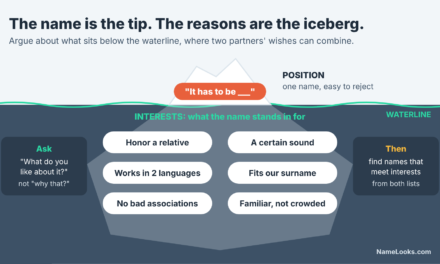
Be clear about which of two things you’re doing: asking for input, or sharing a decision. Those are different conversations, and mixing them is what causes hurt. If you’re sharing, say so: “We’ve decided, and we wanted you to hear it from us first.” If you’re genuinely open to input, say that instead, and mean it. And if the name is honoring someone, tell them why. People rarely object to being thought of.
Two scripts for the harder conversations
To a relative whose name you’re not using: “We thought about your name a lot, and we love it. We went a different way for the first name, and we’d like to use [your name / your initial] as a middle name, if that feels right to you.”
To a sibling or cousin with a near-duplicate: “Before we tell anyone, we wanted to check with you. We’re leaning toward a name that’s close to [their child’s name]. How would you feel about that?” Then actually listen to the answer.
If the two of you as parents don’t agree on how much family context should count, that’s a separate problem with its own approach. Resolving name differences with your partner covers ways to get there without one person “winning.”
5Decide what to do with what you found
After five checks, you’ll have a page of notes per finalist. This is where the effort to avoid baby name regret either pays off or turns into second-guessing. Most will contain at least one finding. That’s normal, and it’s the moment where people tend to either panic and drop a name they love, or shrug and ignore something they shouldn’t. A simple triage keeps you between those two.
Sort each finding: fix it, accept it, or drop the name
For every finding, ask one question: can a small change remove it without losing what we love about the name? If yes, it’s a fix. If no, ask whether you can live with it comfortably for the long haul. If yes, it’s an accept, and you write down why. Only if the answer to both is no does it become a drop.
What usually counts as fixable
Most findings fall here. Awkward initials are usually fixable by reordering or swapping middle names. A pronunciation that strangers split on is often fixable by deciding on the form you’ll use and saying it confidently, or by choosing a spelling that points more clearly to it. A family near-duplicate can sometimes be resolved by a conversation, or by choosing a different nickname. A spelling that systems will mangle can be paired with a planned fallback.
The best fixes are boring. They touch the middle name, the order, or the plan for everyday use, and leave the core of the first name alone.
What usually counts as a real reason to drop
In our view, a few kinds of finding are worth taking seriously enough to drop a name, though you are the judge. The name, or the full name, forms a common insult or crude phrase that children will find. The name is so closely tied to a single prominent, durable, negative public figure or event that most people will think of it first. A close relative will be genuinely hurt in a way that can’t be eased with a conversation, and that relationship matters to you more than this particular name. Or you yourself can’t say it comfortably, and you’d be the person using it most.
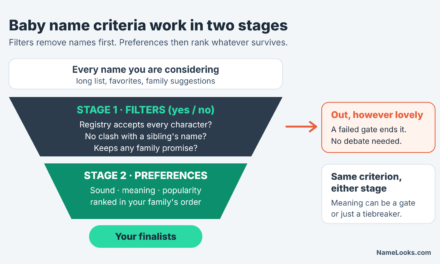
Notice what’s not on this list: “someone online dislikes it,” “it was more common in another decade,” “a fictional character had it once.” Those are information, not reasons. If the ranking or frequency side of that question is what’s nagging you, the full set of baby name criteria will help you see which factor you actually care about.

Worked examples, labeled as hypothetical
The scenarios below are invented to show how the triage works. They don’t describe real families, and the names are used only to illustrate structure (letters, length, order), not meaning or origin. The table after them sums up the pattern.
Three short scenarios
The initials surprise. Imagine parents choosing a first name beginning with A, a middle name beginning with S, and a surname beginning with S. Their sheet shows the initials A.S.S. in first-middle-last order. The first name is the heart of the choice, and the middle name was a placeholder. They swap to a middle name starting with another letter. Fix, five minutes.
The pronunciation split. Imagine a name the parents learned from a grandparent, who says it with the stress on the second syllable. In a cold read, three of four friends put the stress on the first. The parents decide the grandparent’s form is the name, keep the spelling, and plan to introduce it out loud whenever possible. Accept, with a written reason: “We’d rather teach it than lose the family form.”
The cousin collision. Picture a couple whose favorite is one letter different from a cousin’s toddler who lives nearby. They ask the cousin’s parents privately. The answer is a polite but clear “we’d really rather you didn’t.” The couple values that relationship and has a second favorite they also love. Drop, without drama, and they tell the cousin they appreciated the honesty.
The pattern across scenarios
In each case, the decision isn’t made by the finding alone. It’s made by the finding plus what the parents value. Two families with the same finding can reasonably make opposite choices. That’s the reason we suggest writing your reason down. It’s not paperwork. It’s the thing you’ll reread at 3 a.m. if a doubt shows up, and it’s one of the simplest ways to avoid baby name regret later.
| Situation | Naming option | Benefit | Drawback | Verification step |
|---|---|---|---|---|
| Initials spell an unwanted word in first-middle-last order | Swap or reorder middle names | Keeps the first name and surname untouched | May lose a middle name you liked | Rewrite all four orders on the “how it will be seen” sheet |
| Strangers split between two pronunciations | Keep spelling; choose and teach one form | Preserves the form your family uses | Ongoing gentle correction | Repeat the cold read with three new people after deciding |
| Strangers can’t start saying the name at all | Consider a spelling that signals the sound, or a ready nickname | Lowers friction for teachers and new friends | May move away from the source-language form | Ask a fluent speaker whether the new spelling is still acceptable |
| Your spelling is much less common than another spelling of the same sound | Keep it with a plan, or switch to the common form | Distinctive vs. fewer corrections | Frequent “fixing” by others vs. losing the distinction | Compare both spellings in SSA or ONS data for the latest year |
| Name includes a diacritic or hyphen | Keep full form; decide a plain-letter fallback | Respects the true name | Some systems may drop or reject the character | Ask your registrar what the birth record accepts |
| Close relative expected a namesake | Use the name as a middle, or share news privately first | Honors the person without changing your first choice | They may still feel passed over | Have the private conversation before any announcement |
| Full name matches a public figure exactly | Change the middle name or first name; or accept | Clearer search identity for the child later | Possible loss of a favorite combination | Search the exact full name in quotation marks |
6Close the loop before and after the paperwork
Regret prevention doesn’t end at the decision. There are two more moments to get right: confirming that the name you chose is the name that gets recorded, and knowing what options exist if you do change your mind. Neither is complicated. Both are easier to handle calmly before you need them.
What to confirm before you register
The registration form is the moment a name becomes official. It’s also often completed by exhausted people in a hospital room or a register office. A short pre-check, done in calm weeks beforehand, prevents the most avoidable regret there is: a typo. Families who did everything else right to avoid baby name regret still get caught here.
The record-specific facts to know in advance
Find out who registers the birth where you live, which characters the record accepts, how long you have to register, and how corrections and changes work. These rules vary by country and, in the U.S., by state or territory. The CDC’s National Center for Health Statistics keeps a directory, Where to Write for Vital Records, that points to each state and territory office; it notes that the federal government does not distribute vital-record certificates itself. Your state’s vital records page is the authority for your child’s birth certificate.
In the U.S., the Social Security card is a separate record. SSA explains on its page about changing or correcting the name on a Social Security card that a corrected card requires evidence of identity and of the legal name, and that some people can apply online. If the birth certificate is ever amended, the Social Security record won’t follow automatically.
A practical next step: proofread like it’s a contract
Before you sign the registration, read the name aloud from the form letter by letter, with your partner reading along from your written sheet. Check the order of middle names, any hyphen, any accent, and the capitalization of any surname particle. It feels excessive. It takes a minute. A spelling error discovered later usually means a correction process, and some systems keep the original entry visible alongside the fix.
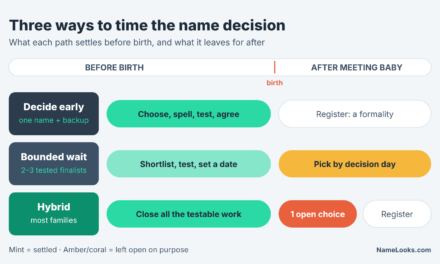
If you haven’t settled on a name by the time you’re at the hospital, that’s a decision in itself, not a failure. Choosing before birth versus after meeting the baby walks through the trade-offs, including registration deadlines.
What to preserve, and what you can still update
The last piece is knowing that a name is not quite as permanent as it feels on day three. That isn’t an invitation to treat it lightly. It’s reassurance. Knowing a door exists makes it easier not to pace in front of it.
Official windows for changing a first name
In England and Wales, local register offices publish a specific route for this. Westmorland and Furness Council, for example, states that you can change your child’s first name within 12 months of the birth being registered, that the change can only be recorded once, and that the new name is added to the register entry, so a new certificate shows both the original and the new first names. It also notes different paperwork depending on whether the child was baptised.
Islington’s register office describes the same 12-month route, gives its own fee, and says the surname cannot be changed this way. Fees and details vary by council, so check yours.
Outside that window, or for surnames, the route in England and Wales is typically a deed poll. GOV.UK’s guidance on changing a child’s name by deed poll says that enrolling one requires the agreement of everyone with parental responsibility, or a court order. In the U.S., amendment rules for birth certificates are set by each state, and they differ. Start with your state’s vital records office. This is general information, not legal advice, and procedures change.
What to keep on file, whatever you decide
Keep the “how it will be seen” sheet and your one-line reasons for each finding. Keep a note of the pronunciation you chose and, if it came from a relative or a native speaker, who. If the name honors someone, write down the story while it’s fresh. Years from now, your child may want to know why, and “we liked it” is a smaller gift than “here’s who it’s for and here’s how Grandma said it.”
That small file is the last step to avoid baby name regret, and it does two jobs. It protects you from the late-night doubt by showing your past self did the work. And it hands your child something real about their own name, which is one of the nicer things a parent can give.

If the doubt arrives anyway
Some parents feel a stretch of “did we get it right?” after naming, and for many it fades as the name attaches to an actual person. If it doesn’t pass, reread your notes, talk it through with your partner, and check your local window. Changing a name thoughtfully is a legitimate choice, not a failure. So is deciding to keep it.
Questions people actually ask
Is there a reliable statistic on how many parents regret their baby’s name?
Not one we could verify. Figures in news stories usually come from commercial polls whose sample and wording aren’t published in full, so we don’t repeat them. The useful takeaway is the reasons people give, which tend to be the same surprises this page checks for.
How many people should we ask for the cold-read pronunciation test?
Three or four is enough to see a pattern without turning it into a referendum. Choose people who haven’t heard you say the name and who roughly resemble the strangers your child will meet: teachers, coworkers, neighbors. If results are mixed, run it once more after you’ve decided how you’ll introduce the name.
Should we tell family the name before the birth?
It depends on whether you want input. Telling early invites opinions, which some families enjoy and others find stressful. A middle path is to tell only the people with a stake (a namesake, a cousin with a similar name) privately, and share with everyone else after the birth.
Does using a rarer spelling cause problems on official documents?
A less common spelling of ordinary letters generally isn’t a records problem; it’s an everyday correction problem. Characters such as diacritics, apostrophes and hyphens are the ones that some systems handle inconsistently. Ask your registrar what the birth record accepts, and plan a fallback for systems that can’t display the full form.
What if we can’t agree on whether a finding is a deal-breaker?
Separate the finding from the feeling. Write down the finding in neutral words, then each of you says how much it matters on your own terms. Often the disagreement is about one specific scenario (teasing, a relative’s reaction), which you can test or ask about directly instead of debating in the abstract.
Can we use these checks for a middle name too?
Yes, but lightly. Middle names matter most for initials and the full written string, and for family honoring. Pronunciation and spelling friction are lower because middle names are spoken and typed less often, though they still appear on many official documents.
Sources and further reading
- Laham, Koval & Alter (2012), “The name-pronunciation effect” — peer-reviewed study on how pronunciation ease affects impressions; useful context, not a verdict on any name.
- SSA: background on the baby-name data — how spellings, hyphens and small counts are handled.
- ONS: Baby names in England and Wales, 2025 — the 9 July 2026 release for England and Wales.
- Unicode CLDR: Person Names — how software splits, orders and initials names across locales.
- International Phonetic Association: full IPA chart — for decoding pronunciation transcriptions.
- Behind the Name: sources used — a secondary index of name references; cross-check anything important.
- CDC NCHS: Where to Write for Vital Records — directory of U.S. state and territory vital-records offices.
- GOV.UK: change a child’s name by deed poll — consent rules in England and Wales.
NameLooks provides general information, not legal advice. Popularity data describes populations, not individuals, and record-change rules depend on your country, state and local office.