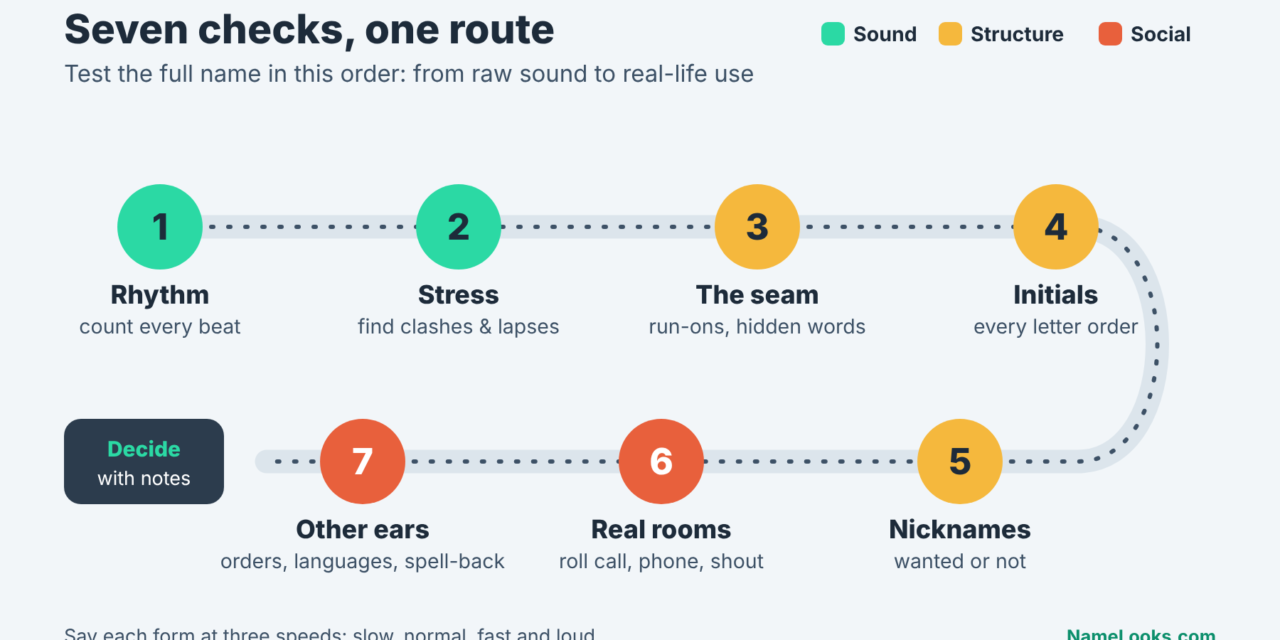
A name that looks perfect on a list can trip over itself the first time someone calls it across a room. The fix is simple and almost nobody does it properly: test full name out loud, in the forms and places it will actually live, with listeners who don’t already love it. This guide gives you seven checks, in order, plus a way to read the results without fooling yourself.
The short version
- Say the whole string, not the first name. Problems live at the joins: where a first name ends and a surname begins, where stresses bump, where initials line up.
- Use other people’s mouths. You’ve already trained your ear to accept your favorite. A friend reading it cold, or a stranger on the phone, hears what the world will hear.
- Test every form, not one. A name lives as a formal full string, an everyday first-and-last, a short form, a set of initials and a nickname you didn’t pick. Each can fail separately.
- Separate “unfamiliar” from “broken.” A new name always sounds odd for a few days. A real problem keeps sounding wrong after a week of use.
- Write down what you learn. A short pronunciation note and a recording save a lot of correcting later, for you and for the person who carries the name.
1What it means to test a full name out loud, and what you’re listening for
Testing a name aloud isn’t a ritual of saying it lovingly into a mirror. It’s a structured listening session with a specific purpose: to catch the problems that only appear when the first name, any middle names and the surname are spoken together, by different people, at different speeds and in different situations.
Most naming decisions are made on paper or on a screen. Lists, apps and shared notes all present names as text, and text hides almost everything that matters here. Your eye doesn’t notice that two names run together, that a stressed syllable slams into another stressed syllable, or that the initials spell something unfortunate when stitched onto a monogrammed bag. Your ear catches those things in about two seconds, if you let it.
If you’re still at the stage of deciding what kind of name you even want, this page is a step ahead of you. The overall sequence, from first ideas to a final decision, is laid out in our decision framework for choosing a name. What follows assumes you already have a few serious candidates and want to know which of them hold up in real speech.
Seven checks to test full name out loud combinations
We’ve broken the process into seven checks. They run roughly from the purely acoustic (how the syllables move) to the purely social (how the name behaves in a classroom, a waiting room or a phone call). You can do all seven in an evening for a short list of three to five full names. And you’ll need nothing more than a pen, a phone that records audio, and a few patient people.
The checks, in the order we’d run them
- Rhythm: count the beats in the whole string and notice whether it moves or plods.
- Stress: find the strong syllables and check for clashes (two strong beats colliding) and long weak stretches.
- The seam: listen to the point where one name ends and the next begins, for run-ons, repeated sounds and accidental words.
- Initials and monograms: write out every combination of letters the name will produce, in every order.
- Nicknames: list the short forms people will reach for, wanted or not, and test each with the surname.
- Real-life rooms: say it the way a teacher, a receptionist, a coach and a stranger on the phone will say it.
- Other ears and orders: test it surname-first, in the other languages your family speaks, and spelled back from hearing alone.
What the test can’t tell you
Saying a name out loud is good at finding sound problems and usage friction. It’s not a way to discover what a name means, where it comes from or how common it is. Those questions need sources, not ears. Meaning and origin need reputable references, and popularity needs official datasets such as the Social Security Administration’s baby name data for U.S. births. We cover how to weigh those factors in our guide to the criteria that matter when weighing a baby name.
The test also can’t tell you whether you’ll love a name in ten years. It can only remove avoidable friction so that your affection isn’t fighting the name’s mechanics. That’s a narrower promise, but it’s an honest one.
Why your ear catches what a list hides
Before you test full name out loud candidates, it helps to know why the ear is the right instrument. There’s a reason people sense that some full names “just sound right” and others feel lumpy. English speakers carry strong, mostly unconscious expectations about how strings of words should move. Linguists have studied those expectations most closely in fixed pairs of words, not in personal names, but the findings are a useful lens.
What research on word pairs suggests
In a classic 1975 paper, “World Order,” William Cooper and John Robert Ross looked at frozen English pairs such as “salt and pepper” and proposed ordering principles. The strongest phonological one, which they credited to Pāṇini, is that the first element tends to have fewer syllables than the second. You can read their original paper on word-order freezes, hosted by the University of Pennsylvania’s Language Log.
A later statistical study by Sarah Bunin Benor and Roger Levy, published in Language in 2006, tested many of these proposed constraints on a large set of English binomials. Their probabilistic analysis of English binomials found that meaning, rhythm and word frequency did most of the work. Short-before-long, avoiding a lapse of weak syllables and avoiding final stress on the second word all mattered. Many of the finer sound-based rules showed no independent effect once those were controlled.
Why that’s an analogy, not a rule for names
Be careful with this. A full name isn’t a binomial. You don’t get to reorder a surname to satisfy a rhythm preference, and nobody has shown that a full name breaking the short-before-long tendency is harder to use. What the research does support is narrower: English speakers have real, measurable rhythm preferences when they string words together, and those preferences are mostly about syllable count and stress.
That’s why the first two checks below are about beats and stress. They’re the dimensions where speakers’ instincts have actually been measured. Everything else (seams, initials, nicknames, rooms) is practical usability, and we’ll label it as such. When we say a pattern “tends to” feel smoother, that’s editorial judgment informed by this research, not a finding about names.
2Prepare the inputs before you say anything
The quality of an out-loud test depends almost entirely on what you feed into it. If you only ever say the one version of the name you already like best, the test will confirm what you already believe. So before you test full name out loud versions with anyone, spend twenty minutes building the raw material: the candidates, every form each candidate will take, and a short list of listeners.
How many names should go into this stage? Fewer than you might think. The out-loud test is detailed, and running it on twenty full names turns into noise. If your list is still long, use a structured way to cut a long list to five first, then bring the survivors here. Our piece on how long a final shortlist should be explains why a small set usually produces better decisions than a sprawling one.
Write out every form the name will take
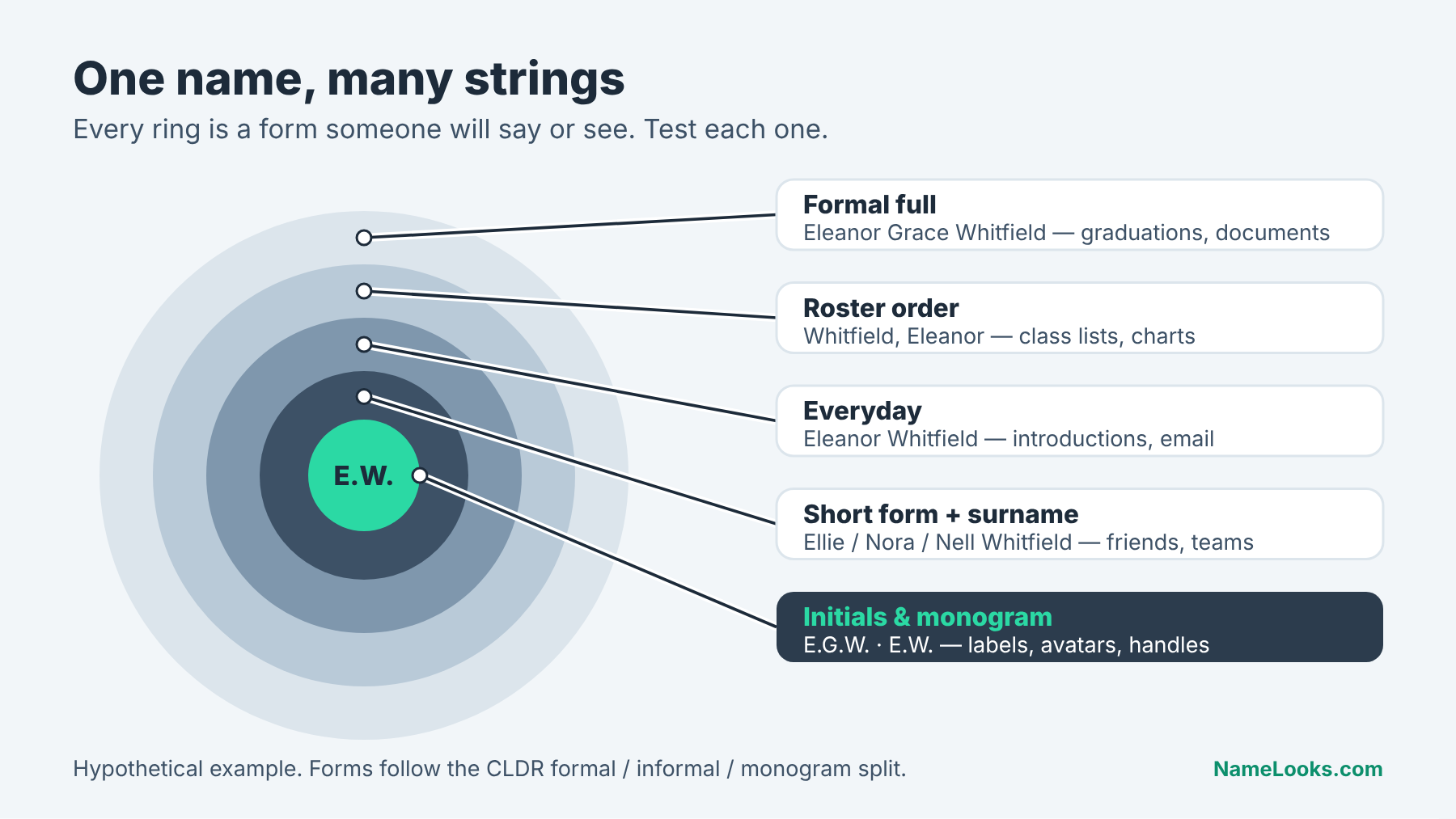
A person doesn’t have one name in daily life. They have a cluster of related forms, and each one is spoken in different situations. The formal full string gets read at graduations. The first-and-last version goes on class lists and email signatures. A short form is what friends use. Initials show up on luggage tags, sign-in sheets and avatars. If you only test full name out loud in its formal version, you’ve tested the form people will use least. Get all of them on paper first.
How software standards break a name into forms
This isn’t just a parenting intuition. The Unicode Consortium’s CLDR specification for person-name formatting, which software uses to display names, distinguishes formal from informal forms and long, medium and short lengths. It also separates “addressing” (speaking to someone, as in “Welcome, Robert”) from “referring” (speaking about them, as in “Robert Smith joined your group”). It even defines a “monogram” usage, a very short form such as “RS” or “RJS” for avatars and similar spots.
That framework maps neatly onto an out-loud test. Each combination of formality, length and usage is a different string that someone will actually say or see. The spec’s own examples show how much changes between them: a long formal version can carry a title, a middle name and credentials, while a short one can shrink to a title plus surname.
A worksheet you can fill in tonight
For each candidate, write these lines. Leave blanks where a form doesn’t apply.
- Formal full: first + middle(s) + surname, exactly as it would appear on a birth certificate.
- Everyday: first + surname.
- Addressing: the first name alone, as a parent would call it, and as a teacher would.
- Short form: every plausible shortening, including ones you dislike.
- Short form + surname: each short form joined to the surname.
- Initials: first-middle-last, first-last, and the traditional monogram order if you’d ever use one.
- Surname-first: “Surname, First” as it appears on rosters and forms.
- Spelled aloud: the letter sequence of the first name and of the surname.
Picture a hypothetical candidate, “Eleanor Grace Whitfield.” The worksheet produces at least a dozen strings: Eleanor Grace Whitfield, Eleanor Whitfield, Eleanor, Ellie Whitfield, Nora Whitfield, Nell Whitfield, E.G.W., E.W., Whitfield comma Eleanor, and so on. Each of those is something someone will actually say. Several of them you probably hadn’t said once.
Include the surname you’ll really use
If there’s any chance of a hyphenated surname, two surnames, or the child carrying one parent’s name while the other parent’s name stays separate, test each version. A double-barreled surname changes the rhythm of the whole string far more than swapping one first name for another.
Choose your listeners and your rooms
The second input is people. You and your partner are the worst possible test audience, and that’s not an insult. After weeks of saying a favorite name, your ear has normalized it. You no longer hear the run-on or the stress clash, because you know what’s coming. Fresh listeners are the only way to recover what a first encounter sounds like, and that’s the whole reason to test full name out loud with other people at all.
Who makes a good test listener
You want a mix. Someone who reads a lot will spot spelling ambiguity. Someone who speaks another language in your family will catch problems in that language. Someone a bit blunt will tell you that a combination sounds like a law firm or a brand of crackers. And at least one person should be a near-stranger, someone who has no reason to be kind.
A reasonable panel is three to five people, chosen on purpose. You don’t need a crowd, and you don’t need a vote. You’re collecting observations, not approval ratings. If you’re making this decision with a co-parent, decide together how you’ll treat feedback before you ask for it. Our guide to choosing a name with your partner without a winner-loser system has a useful approach for exactly that conversation.
How to ask without inviting a referendum
Many families keep names private until birth, and for good reason: asking “what do you think of this name?” invites opinions on taste, which aren’t what you need. A better framing is mechanical. Try something like:
- “Can you read these three names out loud for me? I just want to hear how strangers say them.”
- “I’m going to say a name. Can you write down how you’d spell it?”
- “If you heard this called out in a waiting room, what would you shorten it to?”
These questions get you data, not verdicts. You can also hide the real candidates among decoys if you want privacy. That way nobody knows which one you’re leaning toward, and nobody’s feelings get attached.
Checks the out-loud test depends on but doesn’t replace
Some facts need to be settled before the sound test, because they change what you’re testing. You can’t judge a name’s rhythm if you’re not sure how it’s pronounced. And you can’t predict nickname pressure without some idea of how many classmates might share a name.
Pronunciation and spelling evidence
If a candidate comes from a language you don’t speak, don’t guess its pronunciation from English spelling. Look for a reliable dictionary, a native-language resource or a clearly labeled native-speaker recording, and treat a name website as a starting point rather than the last word. The site Behind the Name, for instance, publishes a list of the references it draws on, which is useful for tracing where a claim came from. If family members say a name differently, that isn’t an error to resolve by majority. Note both pronunciations and test both.
Spelling is the other half. In the SSA’s baby name data, spelling variants are ranked as separate names: its methodology notes say that variants such as Caitlin and Caitlyn are counted separately. So a spelling that looks rare in the rankings may sound identical to a common name once spoken. That matters for the out-loud test, because listeners hear sounds, not spellings.
Frequency data, and what it can and can’t tell you
Two official U.S. datasets help here. The SSA’s popular names data covers first names given at birth, based on Social Security card applications. Its background notes on the baby names data explain that names with fewer than five occurrences are excluded for privacy, and that hyphens and spaces are removed. That means “Julie-Anne,” “Julie Anne” and “Julieanne” are counted as one name. For surnames, the U.S. Census Bureau’s 2020 Census names files tabulate last names that occur 100 or more times in 2020 Census returns, 156,621 surnames in the full file.
Neither dataset tells you how a name sounds, and neither tells you anything about an individual. They’re useful only for a practical question: how often will this child likely meet someone with the same first name, or the same first-and-last combination? That’s relevant to the nickname check later, because a very common first name tends to pull in surname-initials or short forms to tell people apart. For a deeper look at that trade-off, see how much uniqueness you actually want.
3Work through the seven checks in order
Now the actual testing. When you test full name out loud for real, run the checks in this order because each one builds on the one before. Rhythm and stress are about the raw shape of the sound. The seam and initials checks are about how the parts combine. Nicknames, rooms and other ears are about how the name behaves once other people get hold of it.
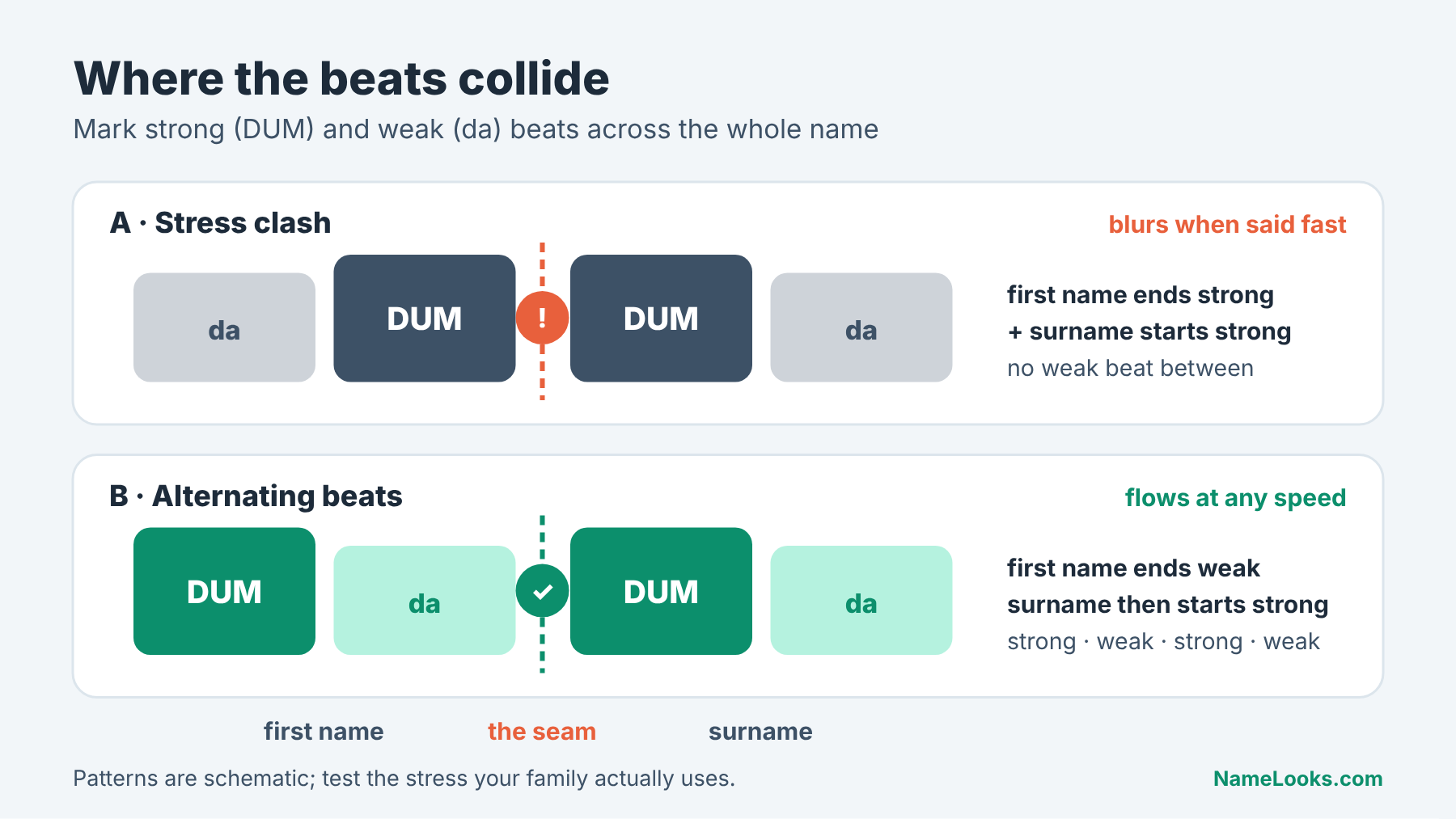
A note on notation before we start. To talk about rhythm without making pronunciation claims about specific names, we’ll mark syllables as DUM (stressed) and da (unstressed). When we use a real name as an example, it’s to illustrate a structural point, and you should check the pronunciation your family actually uses. Plenty of names are stressed differently in different families, regions and languages.
Check 1: Count the beats across the whole string
Say each formal full name slowly and tap the table once per syllable. Then say it at normal speed. You’re listening for two things: the total length, and how the syllables are distributed between first name, middle name and surname.
Patterns that tend to move, and patterns that tend to stall
There’s no correct syllable count. But some distributions are easier to say smoothly than others, and the word-pair research gives a hint about why. English speakers lean toward short-before-long in fixed pairs, and they dislike long runs of unstressed syllables. Translated loosely to names, that suggests a few practical patterns worth noticing:
- Equal and short (one beat + one beat): punchy and clear, but can sound clipped or abrupt, especially when shouted.
- Short then long (one or two beats, then three): often flows, because the string builds toward the end.
- Long then short (three or four beats, then one): perfectly usable, but the surname can feel like it’s been tacked on. Listen for whether it lands or gets swallowed.
- Long and long (three-plus beats each): stately on paper, tiring in a shout. Expect it to get shortened in daily use.
None of those is a verdict. They’re listening prompts. The point of counting is to notice the pattern you’re dealing with, so you know what to listen for in the next check.
A quick tapping drill
Picture a hypothetical surname with two beats, stressed on the first (DUM-da). Now try three first names in front of it: a one-beat name, a two-beat name stressed first, and a three-beat name stressed first. The one-beat version gives DUM DUM-da, which is compact. The two-beat version gives DUM-da DUM-da, a steady march. The three-beat version gives DUM-da-da DUM-da, which has a little lilt.
Say all three. Notice that none of them is wrong, but they have very different characters. The march can feel either confident or sing-song. The lilt can feel either graceful or fussy. Which one suits you is taste. The drill just makes the difference audible so you can choose on purpose.
Check 2: Find the stresses and listen for clashes
Stress is where English rhythm lives. In each full name, mark the strongest syllable of every part. Then look at where they sit relative to each other. Two problems show up again and again: clashes, where two strong syllables collide with nothing weak between them, and lapses, where several weak syllables pile up in a row.
What a clash sounds like in practice
A clash happens when a name ending on a stressed syllable runs straight into a surname starting with one. Imagine a first name that ends DUM, followed by a one-syllable surname: DUM DUM. Spoken quickly, many speakers insert a tiny pause to separate the two beats. That’s an editorial observation, not a measured finding about names, but it fits the word-pair research: the Benor and Levy study found that avoiding a weak-syllable lapse and avoiding final stress on the second element both helped predict word order in binomials.
Clashes aren’t fatal. Some people like the drumbeat quality of two hard stresses. But a clash makes a name harder to say fast, and fast is how names get said in real life: across a playground, during roll call, at the end of a sentence. Say the clashing version five times quickly. If it starts to blur, you’ve learned something.
When a family pronunciation changes the stress
Here’s the exception that matters most. Stress isn’t fixed by spelling. A name can be stressed on the first syllable by one family and on the second by another, and both are legitimate.
The University of Toronto researchers Lisa Sullivan and Yoonjung Kang, in a 2019 paper on the phonology of gender in English and French given names, reported that in English name corpora, names used for girls more often carry stress on a syllable other than the first. In their rating experiment, though, the stress cue alone didn’t shift judgments. That’s a reminder that stress patterns can carry social associations as well as rhythm, and that the evidence on how much they matter is mixed.
So run check 2 with the pronunciation you’ll actually use. If relatives will say it differently, run it twice. A name that’s smooth in one pronunciation and clashing in the other may push people toward one version over time. Decide whether you’re comfortable with that drift.
Say it at three speeds
Slow and careful (a graduation announcer), normal (an introduction), and fast and loud (calling someone in from the yard). Most rhythm problems are invisible at slow speed and obvious at fast speed. Parents almost always test slow.
Check 3: Listen hard at the seam
The seam is the point where one name ends and the next begins. It’s where most avoidable problems hide, because neither part on its own has the issue. Only the combination does. Say the first name and surname together at normal speed and listen to the half-second where they touch.
Three seam problems worth catching
Run-ons. When a name ends in a sound and the next begins with the same or a similar sound, the two can merge. Picture a first name ending in an “s” sound followed by a surname starting with “s.” Said fast, the two sounds fuse and listeners may hear one sound. That’s not wrong, but it means people will mishear and ask again.
Accidental words. Sometimes the end of one name and the start of the next form a recognizable word or phrase. You won’t see it written down because the space between them breaks it up visually. You’ll hear it instantly. This is the single most common surprise that only an out-loud test catches.
Echoes. Rhyming or near-rhyming first and last names, or names sharing a distinctive vowel, produce a sing-song effect. Some families love alliteration and choose it deliberately. It’s worth choosing it deliberately rather than discovering it.
How to hear the seam fresh
Your own ear will smooth over seam problems, because you know where the word boundary is supposed to be. Two tricks help. First, have someone else say the full name without pausing, and listen with your eyes closed. Second, record yourself saying it fast, then play it back a day later. A day’s gap is enough for your brain to hear it more like a stranger would.
If you find an accidental word, don’t panic. Ask how likely it is to be noticed. A faint resemblance that only appears at high speed in one accent is different from a phrase every eight-year-old will spot on day one. The second kind deserves serious weight.
Check 4: Write out every set of initials
Initials aren’t spoken much, but they’re seen constantly: on monograms, luggage, school labels, sign-in sheets, email addresses, and the little circles that represent people in software. The CLDR spec defines a separate “monogram” form for exactly these spots, with examples such as “RS” and “RJS.” So treat initials as a form of the name in their own right, and test them.
Every order, not just the obvious one
Write out first-middle-last, first-last, and last-first. Then write the traditional three-letter monogram, which in some styles puts the surname initial in the middle and larger. Read each string as if it were a word. Some letter combinations spell words, form common abbreviations, or match acronyms people know. A few are funny. A few aren’t.
Also consider how initials will appear in the systems your child will use. Many workplaces generate email addresses from first initial plus surname, or first name plus surname initial. Say those aloud too. An email handle is part of real life, and it’s often the first thing a colleague sees.
When initials stop mattering
Initials matter more in some lives than others. If the family doesn’t monogram, and the middle name will rarely appear, then first-last initials are the main ones in play. Weigh what you find accordingly. A mildly awkward three-letter combination that will appear only on a passport isn’t the same as a two-letter combination that will be on every class roster. Our article on preventing name regret covers initials as one of several regret risks, alongside spelling, pronunciation and family associations.
Check 5: Predict the nicknames, wanted or not
You can choose a first name. You can’t fully choose what people call your child. Classmates, coaches, siblings and eventually the person themselves will reach for short forms. Some will be the ones you hoped for. Some will be ones you’ve never considered. The nickname check is about predicting the realistic set and testing each one with the surname.
Where nicknames come from
Short forms tend to come from a few sources: the first syllable, the stressed syllable, a traditional diminutive, initials, and the surname itself. That last one is easy to miss. In teams and classrooms where several people share a first name, surnames often become the everyday name. So say the surname alone, as a shout, and see how it holds up as a name.
Traditional diminutives are worth checking in a reference rather than guessing, because short forms vary across languages and families. A name may have a well-known English short form and a completely different one in another language your family speaks. If the name crosses languages, ask a speaker of each.
Testing the nickname, not just listing it
For each likely short form, run checks 1 through 4 again in miniature. Nicknames create new seams. A short form that ends on a stressed syllable may clash with a surname that the full first name didn’t clash with. A nickname can also create its own accidental word with the surname that the full name avoided.
Then ask the honest question: if this short form became the name everyone uses, would you be fine with it? If the answer is no, consider how likely that form is. A first name whose only obvious short form is one you dislike carries a real risk that the short form wins. If you want to steer toward a particular nickname, use it from the start, consistently.
Check 6: Put the name in real rooms
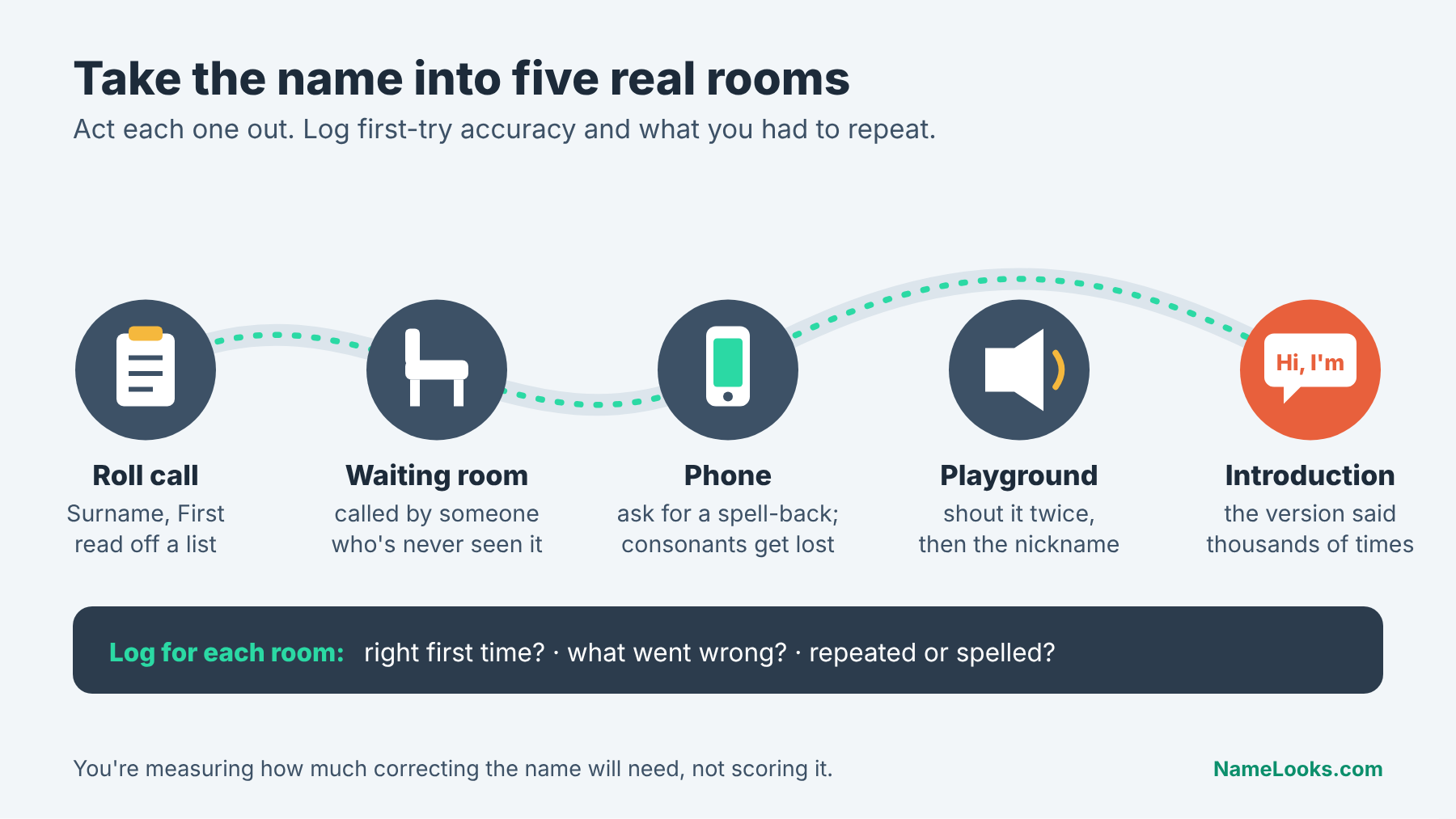
This is the check most people skip when they test full name out loud, and it’s the one that best predicts daily life. A name doesn’t live in a quiet kitchen. It lives in noisy classrooms, on the phone with a pharmacy, read off a clipboard by someone who has never seen it before. Run a short series of role-play scenarios with each candidate.
Five scenarios to act out
- Roll call: read it from a list in the “Surname, First” order a substitute teacher might use, then the first name alone.
- The waiting room: have someone call the full name across a room, as a receptionist would, from written text they haven’t seen before.
- The phone: say the name to someone over a call and ask them to spell it back. Phone audio drops a lot of consonant detail.
- The playground shout: call the first name loudly, twice, as if trying to get attention. Then try the likely nickname.
- The introduction: say “Hi, I’m…” with the everyday version, the way the person will introduce themselves thousands of times.
What to log from each scenario
For each scenario, note three things: whether the listener got it right on the first try, what they got wrong if they didn’t, and whether you had to repeat or spell anything. You’re not scoring. You’re building a picture of how much correcting this name will require. Some names need a one-time explanation and then everybody has it. Others need correcting at every new desk, form and phone call for life.
Neither is automatically bad. A name you love that needs regular spelling out may be worth it to you. But it’s better to know the cost going in, because the person paying it most will be the one who carries the name, not the parents who chose it.
Check 7: Try other orders, languages and ears
The last check widens the test. Names travel across forms, systems and languages. A full name that works perfectly in one order or one accent may stumble in another. Spend a few minutes on each of these.
Surname-first, and on official forms
In many languages and settings, surnames come first. The CLDR spec’s example data, for instance, sets Chinese, Korean, Vietnamese and Cantonese names to display surname-first in an English context, and it describes a sorting format such as “Brown, William.” Even in English, rosters, medical charts and alphabetized lists flip the order. Say “Surname, First Middle” aloud. Some names that flow beautifully given-first feel abrupt when flipped, and that’s how they’ll be read in plenty of official settings.
Other languages, scripts and the spell-back test
If your family uses more than one language, say the name in each, with a native speaker of each if possible. A sound combination that’s neutral in one language can be awkward, hard to pronounce, or a real word in another. If the name may be written in more than one script, remember that transliteration and translation aren’t the same thing. The CLDR transliteration guidelines point out that the same text can be romanized in many different ways, so a name may end up with more than one legitimate Latin spelling.
Finish with the spell-back test. Say the full name to three people who haven’t seen it written, and ask them to write it down. Compare what comes back. If all three spell it the way you intend, the name is “spelling-transparent” for those listeners. If you get three different spellings, you’ve learned how often your child will spell it out. That’s a cost you can now weigh honestly.
4Read the results honestly, then pressure-test them
After the seven checks you’ll have a page of notes per candidate. This is the stage where people most often go wrong, not because the notes are bad, but because they read them through a favorite. A finding that hurts a favorite gets explained away, and the same finding against a name you’re lukewarm about becomes a dealbreaker. A little structure keeps that bias in check.
When families test full name out loud pairings with any rigor, they usually find that no candidate is flawless. Every name has some friction. The real question isn’t “which name has no problems?” but “which problems are we willing to live with, and which are avoidable?”
Sort each finding into one of three bins
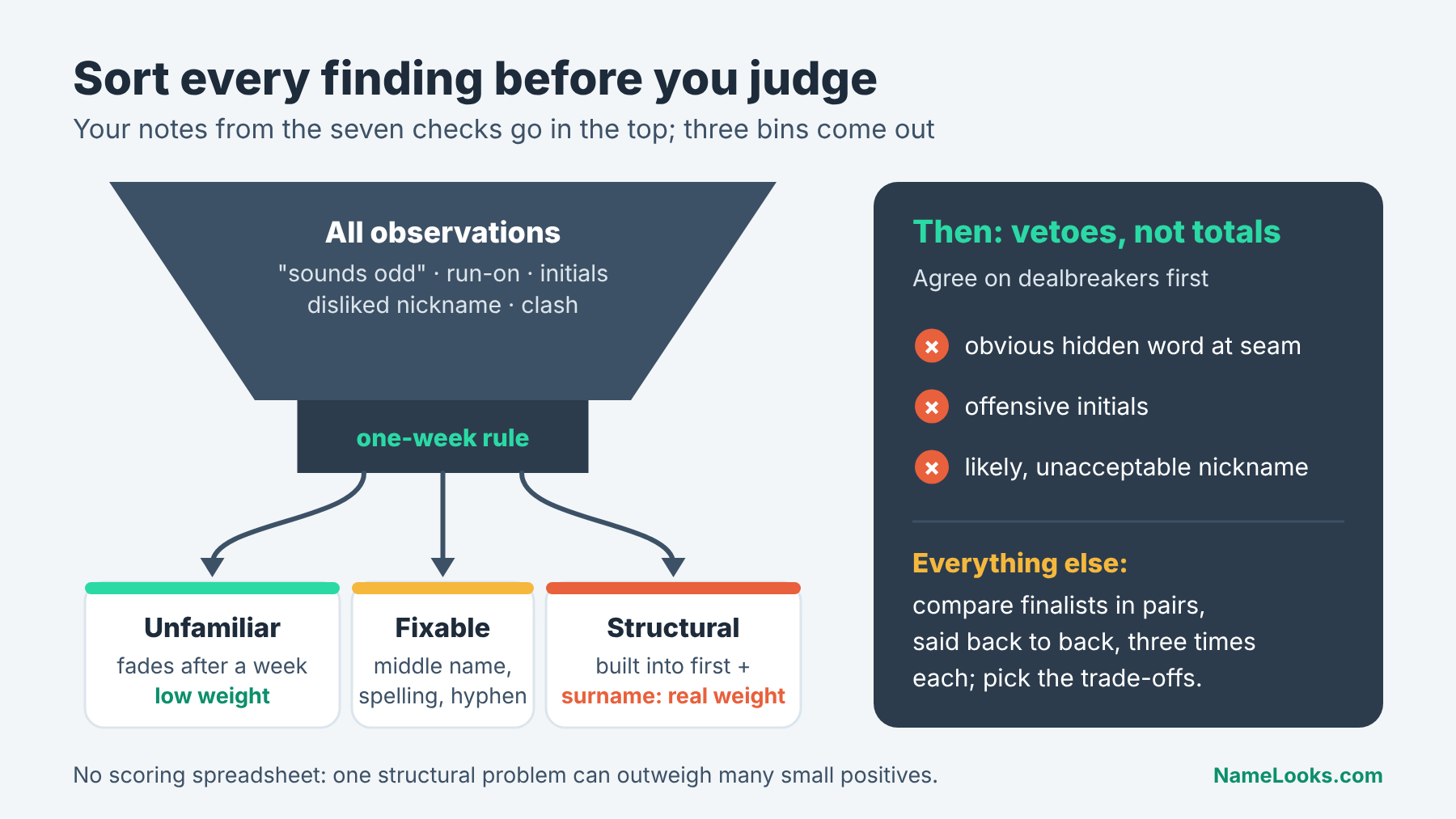
Go through your notes and label every observation as one of three things. This turns a pile of impressions into something you can compare across names.
Unfamiliar, fixable, or structural
Unfamiliar findings are reactions to newness: “it sounds odd,” “I’m not used to it.” These fade. Almost any name sounds strange at first and normal after a week. Don’t weigh them heavily unless they persist.
Fixable findings can be changed by adjusting something other than the first name: a different middle name, a different spelling, a decision about which short form to use from day one, a hyphen or no hyphen. Many initials problems and some seam problems are fixable this way.
Structural findings are built into the first name and surname combination and won’t go away without changing one of them: a strong accidental word at the seam, a clash at fast speed, a nickname you can’t stand that’s nearly certain to stick. These are the ones that deserve real weight.
The one-week rule for “unfamiliar”
To tell unfamiliar from structural, use the name privately for a week. Say it when you’re talking about the future, write it on a sticky note, address the bump or the empty room with it if that’s your style. At the end of the week, rerun the checks that flagged something. If the problem has faded, it was unfamiliarity. If it’s still there, or it’s grown more annoying, it’s probably structural.
A week isn’t magic, and you can test full name out loud again at any point during it. It’s simply long enough to get past first-exposure strangeness and short enough that you’ll actually do it. If you’re running this before a birth, our piece on choosing a name before birth or after meeting the baby discusses how timing affects this kind of trial period.
The table below pulls the seven checks together into a single decision-support view. It’s built from the sources and reasoning above, not from any ranking data, and it’s meant to sit next to your notes while you sort findings.
| Naming factor | Evidence or source | Practical implication | Limitation | Question to ask |
|---|---|---|---|---|
| Rhythm (syllable count) | Word-pair research (Cooper & Ross 1975; Benor & Levy 2006) on short-before-long tendencies | Short-then-long strings often feel like they build; long-long strings tend to get shortened | Studied on word pairs, not personal names; surnames can’t be reordered | Does it still flow when shouted, or does it get cut down? |
| Stress clash or lapse | Benor & Levy 2006 found lapse avoidance and avoiding final stress on the second word predicted order | Collisions blur at speed; long weak stretches mumble | Stress varies by family, region and language | Which pronunciation are we testing, and will relatives use another? |
| Seam (run-ons, accidental words) | Listener observation; no dataset | The most common surprise that only speech reveals | Depends on accent and speed | Would a child spot the accidental word on day one? |
| Initials and monograms | CLDR person-name spec defines monogram forms (e.g. “RS,” “RJS”) | Initials appear on labels, avatars and email formats | Some lives use initials far more than others | Which letter strings will this person actually see daily? |
| Nicknames | Reference works for traditional short forms; listener predictions | The short form people choose may become the real name | No source predicts which form will stick | If the least-liked short form won, would we be okay? |
| Real-room usability | Role-play scenarios; spell-back results | Shows how often the name must be repeated or spelled | A small panel isn’t a representative sample | How much correcting are we signing this person up for? |
| Frequency context | SSA baby names (U.S. births) and Census 2020 surnames; ONS for England & Wales | Common first names push people toward surname or initial nicknames | Population data; says nothing about an individual; spelling variants counted separately in SSA | How often might this person share a first name in a class? |
Weigh findings without a scoring spreadsheet
It’s tempting to give each check a score out of ten and add them up. Resist it. Arbitrary scores create false precision: a 7 for rhythm and an 8 for nicknames don’t mean anything comparable. Worse, a single structural problem can be outweighed on paper by a pile of small positives, when in real life that one problem dominates.
Use a veto list instead of a total
Agree in advance on what counts as a veto. For many families that’s a short list: an accidental word at the seam that’s clearly noticeable, initials that spell something offensive, or a nickname that’s both likely and unacceptable. Anything on the veto list removes a candidate regardless of how well it did elsewhere. Everything else is a trade-off to discuss.
A veto list keeps the conversation honest. It forces you to decide what really matters before you see which names it would knock out. Our pre-decision naming checklist includes a similar step for data, family, culture and documents, and it’s worth running alongside this one.
Compare pairs, not the whole field
Once vetoes are applied, compare candidates two at a time. Say both full names back to back, three times each. Then read both sets of notes side by side. Ask which set of trade-offs you’d rather live with. Pairwise comparisons are easier to make honestly than ranking five names at once, and they tend to reveal a clear favorite or a genuine tie.
If you find a genuine tie, that’s useful information too. It means sound isn’t the deciding factor between those two. The decision will come down to something else: meaning, family connection, how it fits with siblings’ names. That’s exactly where the broader name decision framework takes over.
Common mistakes that skew the test
Even a well-designed test can produce misleading results if it’s run carelessly. These are the errors that come up most, and none of them is exotic.
Testing only the version you like
The single most common error is saying the formal full name lovingly a few times and calling it done. That version is the one that gets used least. The everyday version, the nickname and the roster version will be said thousands of times more often. Test the forms in proportion to how often they’ll be used.
Closely related: testing only at slow speed. A name said slowly and carefully hides clashes and run-ons. Real-life use is fast, often loud, and frequently distracted. If you only do one thing differently after reading this, test at speed.
Letting one voice dominate
A single strong reaction from a relative can swamp everything else. “That sounds like a cartoon character” is memorable, but it’s one person’s association, not a finding. Write it down, ask whether anyone else had the same reaction, and weigh it accordingly. If three unrelated listeners independently hear the same accidental word, that’s a pattern. One person’s association may not be.
The opposite mistake is ignoring a reaction because it’s inconvenient. If a native speaker of a family language tells you a combination sounds awkward in that language, that’s an expert observation. You still get to decide, but decide knowing it.
The way you test full name out loud options shifts depending on your starting point. The checks are easier to apply once you’ve seen them handle a few typical situations, so here are three worked scenarios. They are hypothetical. They’re composites of common naming setups, not stories from real families, and the example names are chosen for their structure, not their meaning. Check any name’s pronunciation and background in a reliable source before you rely on it.
When the surname does most of the work
A surname is the one part of the full name most families don’t choose, so it sets the conditions for everything else. Long or short, stressed first or last, starting with a vowel or a consonant cluster: each of those features changes which first names will flow in front of it.
A one-syllable surname
Picture a family with a single-beat surname. Every first name in front of it ends with that single strong beat, so the last syllable of the first name matters a lot. If the first name also ends on a stressed beat, you get a clash (DUM DUM). If it ends weak, the string bounces into the surname (DUM-da DUM). Many people find that a first name with two or more syllables, ending unstressed, gives a short surname room to land.
The exception: some families deliberately want a crisp, two-beat full name, and a clash gives them that. That’s a valid choice. The test just makes sure it’s a choice rather than an accident. Shout it twice. If it still sounds like a name and not a command, it’s working.
A long or double-barreled surname
Now flip it. With a three- or four-syllable surname, or a hyphenated pair, the full string gets long fast. Here, a shorter first name often keeps the whole thing sayable, consistent with the short-before-long tendency from the word-pair research. A long first name in front of a long surname tends to get trimmed in daily use, and the trimmed form is what the person will mostly hear.
If you’re considering a double surname, test the version people will actually use day to day, too. Some people with two surnames end up using one of them informally. Find out which one the rhythm favors, because that may be the one that sticks.
When the family speaks more than one language
Bilingual and multilingual families have more to test, and also more to gain. A name that works in every family language is a genuine asset. But “works” can mean different things in different languages: easy to pronounce, free of awkward meanings, and recognizable as the same name.
Testing across pronunciations
To test full name out loud across languages, ask a speaker of each language to say the name naturally, without coaching. Record each version. Then run checks 1 through 3 on each recording. You may find the stress moves, a vowel changes, or a consonant isn’t native to one of the languages and gets replaced. None of that is a problem in itself. Lots of people happily answer to two pronunciations of their name. The question is whether the family is comfortable with the variation and whether either version creates a seam problem the other doesn’t.
Testing across scripts
If the name will be written in more than one script, check the romanization you’ll use on documents. Because multiple romanization systems exist, the same name can be spelled differently in Latin letters. A name’s Latin spelling may then invite an English pronunciation the family doesn’t use. That’s worth knowing before the name goes on a birth certificate, because the Latin spelling is what most English-speaking institutions will read aloud.
The matrix below sets those scenarios, and a few more, side by side. It’s an example matrix rather than a recommendation. Each row describes a typical situation, an option families commonly consider, and the specific verification step that would tell you whether it works for your name.
| Situation | Name or naming option | Benefit | Drawback | Verification step |
|---|---|---|---|---|
| One-syllable surname | Multi-syllable first name ending on a weak beat | Avoids a stress clash; gives the surname room to land | May feel less crisp than a short-short pairing | Shout the full name twice; listen for a collision at the seam |
| Long or hyphenated surname | One- or two-syllable first name | Keeps the full string sayable; fits short-before-long tendency | Short first names may share initials or sounds with many classmates | Say it fast at roll-call speed; note whether anyone trims it |
| First name ends with the sound the surname starts with | Keep it, or choose a first name with a different final sound | Keeping it may preserve a family name or a favorite | Run-on; listeners may mishear or ask for a repeat | Phone test: say it on a call and ask for a spell-back |
| Initials spell a word | Change or reorder the middle name | Fixes monogram and three-letter initials without touching the first name | First-last initials stay the same | Write all initial orders, including email-style formats |
| Only obvious nickname is disliked | Use a preferred short form from day one | Consistent early use can steer what others adopt | No guarantee; peers may choose their own | Ask three listeners what they’d shorten it to, unprompted |
| Multilingual family | A name pronounceable in every family language | One name works with all relatives | May require compromise on a favorite | Record a native speaker of each language saying it naturally |
| Very common first name in official data | Pair with a distinctive middle name or surname rhythm | Familiar and easy to spell | Shared first names often push people toward surname nicknames | Shout the surname alone as a name; check SSA or ONS data for the year |
When the name honors someone
Honor names, after a grandparent, a friend or a family tradition, come with a fixed part you may not want to change. That shifts the test. Instead of asking “which first name sounds best?”, you’re asking “what can we adjust around this fixed piece so the whole string works?”
Using the middle slot to fix the rhythm
The middle name is the most adjustable slot. It’s said aloud far less than the first name, but it shapes the formal full name and the initials. If an honor name in the first slot clashes with the surname, sometimes moving it to the middle solves the problem without losing the tribute. If it must stay first, a middle name with a different rhythm can soften the formal version, even though the everyday first-and-last version stays the same.
Test both arrangements. Say the formal version and the everyday version for each. You may find that one arrangement fixes the formal string but leaves the everyday string unchanged, which tells you how much the fix really buys you.
When the honored name is long
A long honor name often comes with a traditional short form. If the family already uses one for the original bearer, that short form may carry over automatically. Test the short form with the surname as seriously as the full name, because it’s likely to be the name in everyday use. If you’d rather the short form didn’t carry over, say so early and choose an alternative to use from the start.
Don’t let the test override what matters more
Sound is one factor. A name that honors someone important may be worth a little rhythm friction, and many families decide that it is. The out-loud test exists to make that trade-off visible, not to veto meaning. If you need help weighing sound against meaning, family fit and practical use, our guide to baby name criteria sets those factors side by side.
5Close the loop: confirm, record and keep testing in real life
Once you’ve chosen, the reason you took time to test full name out loud doesn’t disappear. The test has one more job. It produces information that’s easy to lose: which pronunciation you settled on, which short form you intend to use, which spelling you checked. Writing that down, and confirming it matches the documents, saves a surprising amount of friction later. It also gives the person who carries the name a clear record of what their parents intended.
What to confirm before the name goes on paper
Before registration, compare what you tested aloud with what you’re about to write down. The two drift apart more often than you’d expect: a spelling changes at the last minute, a hyphen appears or disappears, a middle name gets swapped. Each change can undo a finding from the test.
Match the spoken name to the written record
Read the exact form you’re about to submit aloud, letter by letter, and then as a name. Check that it’s the same string you tested: same spelling, same order, same hyphen choices, same spacing. If anything changed, rerun the seam and initials checks on the new version. They take two minutes and catch the problems that a late change most often introduces.
Remember that systems don’t all store names the same way. The SSA’s baby names methodology, for example, removes hyphens and spaces when it tabulates names, so “Julie-Anne” and “Julieanne” end up as the same entry in its counts. That’s a statistics choice, not a rule about what you can name a child. But it’s a reminder that what you write and what a system displays may differ.
Know where corrections are possible, in general terms
If a mistake does get through, most countries have a correction process, but the rules vary and change. In the U.S., the Social Security Administration explains how to get a corrected Social Security card after a name change or correction, which requires evidence of identity and of the new legal name. In England and Wales, GOV.UK describes changing a name by deed poll, including requirements that the new name be pronounceable and not include numbers or most symbols.
This is general information, not legal advice. Birth registration rules, correction windows and allowed characters depend on the jurisdiction, and they’re updated from time to time. Check the current official guidance where you live before relying on any of it.
What to preserve, and what to update as the name gets used
The test doesn’t end at registration. The name now enters real rooms for real, and some findings will only show up there. Keeping a short record of what you intended, and paying attention to what actually happens, closes the loop.
Write a pronunciation note and make a recording
Write a one-line pronunciation guide in plain respelling, using the stress marking from check 2. Add the intended short form and any spelling notes. Then record yourself saying the full name, the everyday version and the short form. Store it somewhere you won’t lose it. When the time comes to tell a daycare, a school or a doctor’s office how to say the name, you’ll have it ready. When the child is older, it’s theirs to share or change.
If the name is from a language not everyone around you speaks, a recording is especially valuable. It avoids having to explain sounds that don’t exist in English. It also respects the person’s right to have their name said the way their family says it.
Notice the drift, and let the person lead
The best time to test full name out loud a second time is after a few months of real use. Pay attention to what people actually call your child in the first year or two. Is the short form you chose sticking, or has another one taken over? Are people consistently mispronouncing the name in the same way? If a pattern appears, you can decide whether to correct it gently, accept it, or adjust how you introduce the name.
And eventually, the person who carries the name gets a say. Many people choose their own nickname, revive a middle name, or adopt a different pronunciation as they grow. That’s not a failure of the test. A name is used by its bearer for a lifetime, and the out-loud test is just the best first draft you can give them.
A 20-minute version, if you’re short on time
Say each finalist at three speeds. Have one person who hasn’t seen it spell it back from hearing. Write out all initials. Ask one listener what they’d shorten it to. Then shout the shortened version with the surname. That catches most of what the full seven checks catch, though not all of it.
Questions people actually ask
How many times should I say a name before I trust my reaction?
There isn’t a magic number, but a single session is rarely enough. Your first reactions mix real problems with simple unfamiliarity. Saying the name in passing over about a week, then rerunning the checks that flagged something, separates the two better than a hundred repetitions in one sitting.
Does the middle name need to be tested as carefully as the first name?
Less carefully, but not skipped. The middle name is said aloud mainly in formal settings, so rhythm matters less there. It matters more for initials and monograms, and for the formal full string at events like graduations. If the middle name might become the everyday name later, test it with the surname as if it were a first name.
Is alliteration a problem?
Not inherently. Matching initial sounds are a stylistic choice many families make on purpose. The out-loud test checks that the alliteration doesn’t produce a run-on at the seam, and that the initials don’t create a combination you dislike. If both are fine, alliteration is simply a matter of taste.
Should I use text-to-speech to test a name?
It can be a useful extra listener, especially for hearing how an automated system might mangle a name. But synthetic voices don’t predict how people will say it, and they often guess pronunciation from spelling. Use it to spot spelling ambiguity, then rely on human listeners for rhythm and nicknames.
What if my partner and I hear the same name completely differently?
That’s common, and it’s useful. It may mean you’re using different pronunciations, different speeds or different reference points. Have each person say the name and record both versions. Then run the checks on each recording. You’ll often find you’re disagreeing about pronunciation, not about the name itself.
Can the out-loud test tell me if a name is too unusual?
Only indirectly. The spell-back and real-room scenarios show how much explaining a name will require, which is one practical effect of unusualness. Whether a name is actually uncommon depends on official data for a specific place and year, such as SSA data for U.S. births or ONS data for England and Wales, not on how it sounds.
Sources and further reading
- Unicode CLDR, Person Names (UTS #35) — how software models formal, informal, addressing, referring and monogram forms of a name, plus name order.
- Unicode CLDR transliteration guidelines — why one name can have several valid romanizations.
- Cooper & Ross (1975), “World Order” — the classic proposal of ordering principles such as short-before-long in English word pairs.
- Benor & Levy (2006), “The Chicken or the Egg?” — a statistical test of which rhythm and meaning constraints actually predict word order.
- Sullivan & Kang (2019), Phonology of Gender in English and French Given Names — corpus and experimental work on syllables and stress in given names.
- SSA Popular Baby Names and its background notes — U.S. first-name data from Social Security card applications, with methodology limits.
- U.S. Census Bureau, 2020 Census names — population-level surname frequency for names occurring 100+ times.
- Behind the Name, references used — a secondary index; useful for tracing short forms and variants back to sources.
- SSA: changing or correcting a name and GOV.UK: change a name by deed poll — official starting points for corrections in the U.S. and the UK.
NameLooks provides general information about names, not legal advice. Popularity data describes populations, not individuals, and registration or name-change rules depend on your jurisdiction and change over time.