The Social Security Administration’s baby name rankings are a count of first names taken from Social Security card applications, tallied by the baby’s year of birth, ranked separately for boys and girls, with every spelling kept as its own entry. That one sentence is most of how SSA baby names data works, and nearly every misleading headline about names comes from forgetting a piece of it. This page takes the method apart rule by rule, so you can read a rank, a count or a percentage and know exactly what it does and doesn’t say.
The short version
- It’s a birth-year tally, not a census. SSA counts names from card applications for babies born in a given year. It isn’t a survey of names people use, and it isn’t a count of everyone alive with a name.
- Spellings never merge. Sophia and Sofia are two separate lines with two separate ranks. The only thing SSA collapses is punctuation: hyphens and spaces are removed, so Julie-Anne and Julieanne become one entry.
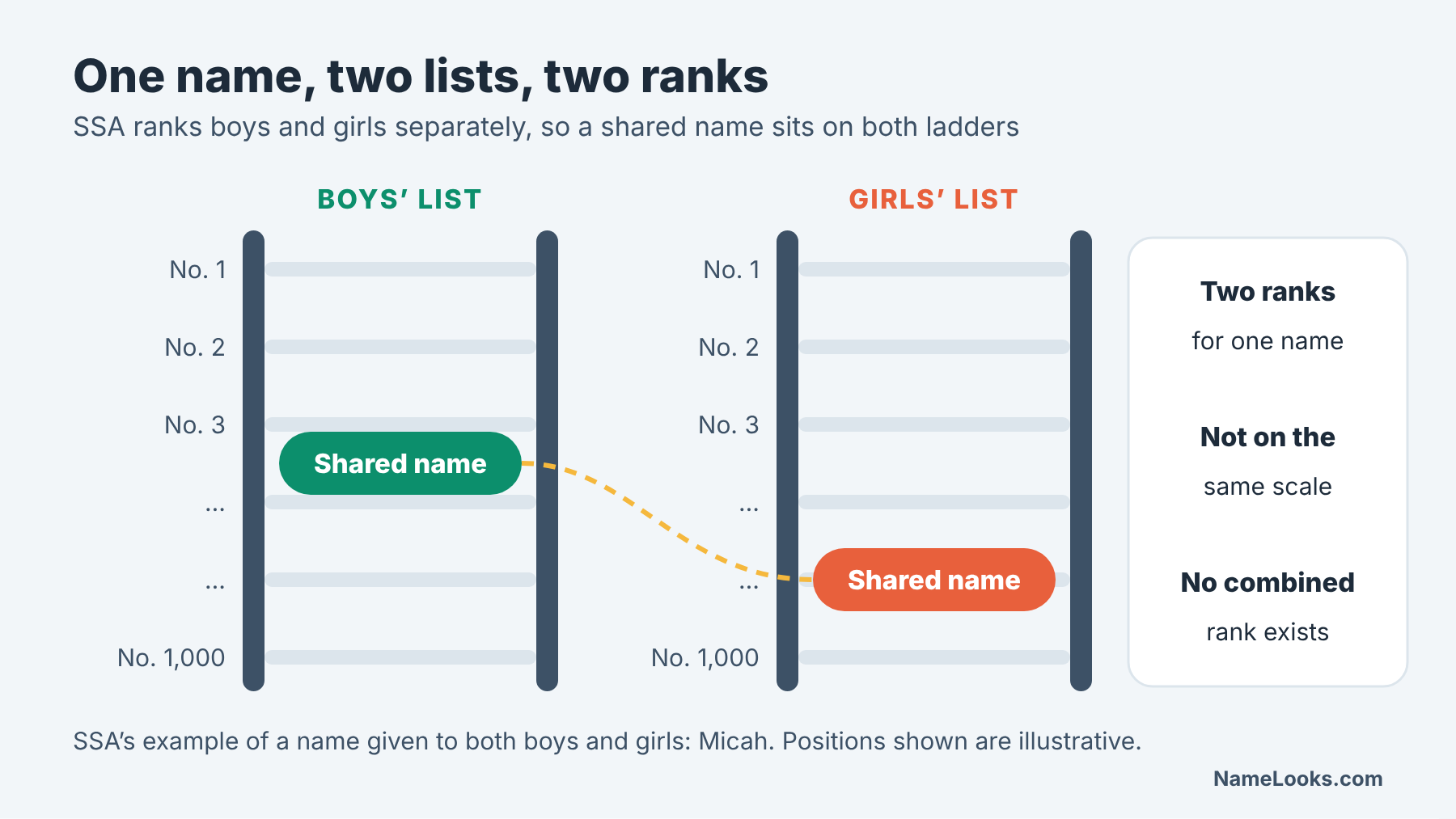
- There are two lists, not one. Rankings are done by sex. A name given to both boys and girls has two ranks, and neither tells you the combined total.
- Small numbers disappear on purpose. Any name with fewer than five occurrences in a geographic area is left out of the published tables, to protect privacy.
- Rank, count and share answer different questions. A rank is a position. A count is babies. A share is babies divided by a total. Say which one you mean, every time.
- Every figure has a release date. The current data reflect SSA records as of March 2026. Cite the release, birth year, geography, sex and exact spelling, and someone else can reproduce your number.
1How SSA baby names data works, in seven rules
If you only read one section, read this one. SSA’s own documentation is short, and it lives on a page called Background information for popular names. Almost everything else you’ll see online, including the annual top-10 stories, is downstream of the rules on that page.
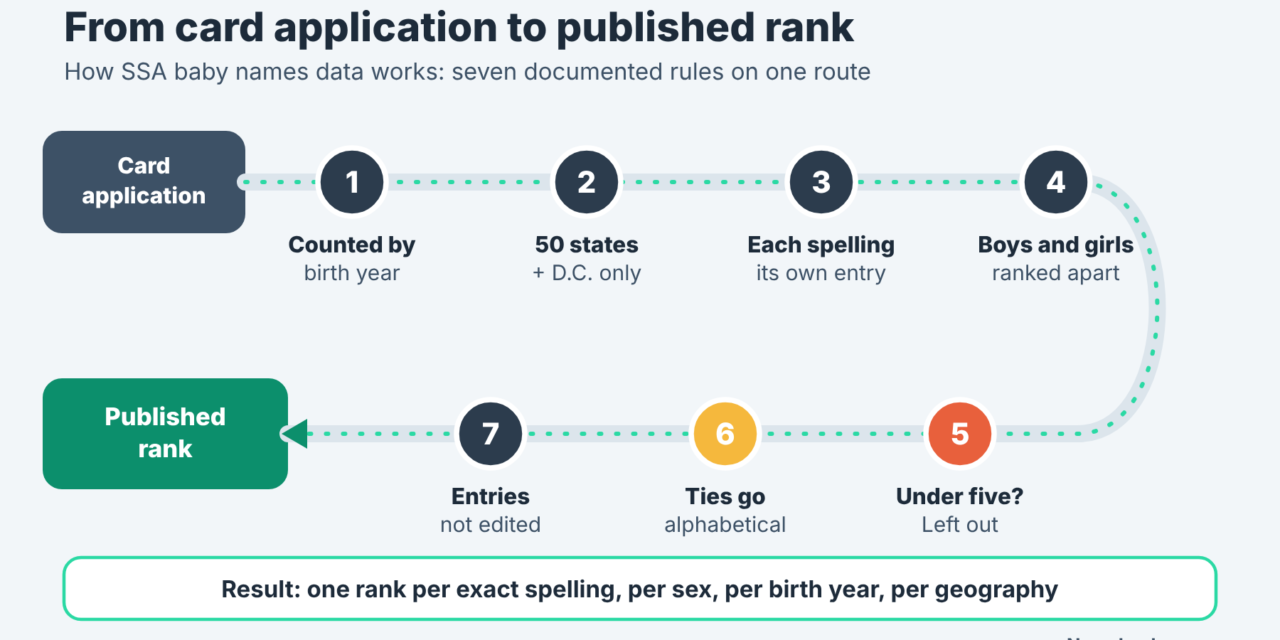
Here they are, in plain language. We’ve numbered them because the numbering helps later: when a claim about a name goes wrong, it nearly always breaks one specific rule.
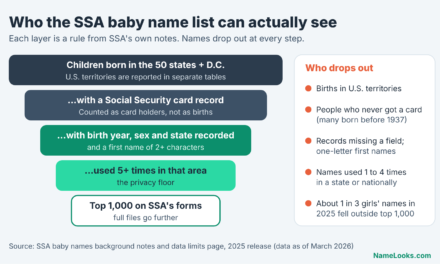
- Rule 1: Names are counted by year of birth, from card applications. The source is SSA’s records of Social Security card applications for births after 1879. A name only counts if the birth year, sex and state of birth are on record and the name is at least two characters long.
- Rule 2: “National” means the 50 states and D.C. Births in U.S. territories are published separately and are not included in the national data.
- Rule 3: Every spelling is its own entry. SSA doesn’t combine different spellings of similar names. It does strip hyphens and spaces before counting.
- Rule 4: Boys and girls are ranked separately. Rankings are done by sex, so a name used for both has two different ranks.
- Rule 5: Fewer than five means left out. To safeguard privacy, names with fewer than five occurrences in any geographic area are excluded from the tabulated lists.
- Rule 6: Ties are broken alphabetically. Two names with identical counts get consecutive ranks in alphabetical order.
- Rule 7: Nothing is edited. SSA doesn’t clean the entries. The sex attached to a name may be wrong, and placeholder entries like “Unknown” and “Baby” stay in.
Seven rules, all documented by the agency itself. The rest of this article is about what each one does to the numbers, where people trip over it, and how to write about names without overstating what the data can carry.
Where the names come from: the dataset behind every rank
The most common misunderstanding about SSA name data is about what it’s made of. It isn’t a poll, a registry of birth certificates, or a list compiled from hospital announcements. It’s an administrative byproduct: when a baby is issued a Social Security number, the first name on that application becomes a data point. If what you want is how many living people share a name, that’s a different dataset: the Census Bureau’s frequently occurring names from the 2020 Census, which covers the whole population and only names that appear 100 or more times.
Card applications, counted by the baby’s year of birth
SSA describes its source as “a 100% sample” of its records on Social Security card applications, and the current release is dated “as of March 2026.” According to SSA’s May 2026 announcement, most parents apply for a child’s number at birth, during the hospital stay. The agency’s explainer on Enumeration at Birth describes how parents can request a number during birth registration, with the state’s vital statistics office sending the information to SSA electronically.
Two consequences follow. First, the unit is the baby, and the year that matters is the year the baby was born, not the year the card was issued. A name in the 2025 tables is a name given to babies born in 2025. Second, the name recorded is the name on the application. If a family later changes a child’s first name, nothing on the published page tells you whether, when or how that’s reflected.
SSA’s documentation also says when the data are thin. Many people born before 1937 never applied for a card, so their names aren’t in the data. If you’re looking at names from the 1910s or 1920s, you’re looking at the people from those years who eventually got a card, not at every baby born then. That matters for anyone doing long-run comparisons, and the article on 100 years of top U.S. names deals with it in depth.
Who’s in and who’s out: states, D.C. and the territories
The national tables cover births in the 50 states and the District of Columbia. SSA publishes separate tables for popular names in U.S. territories: one for Puerto Rico, and one that combines American Samoa, Guam, the Northern Mariana Islands and the U.S. Virgin Islands, which the page describes as less populated with relatively few births.
This is a real difference, not a footnote. In SSA’s 2025 Puerto Rico table, the top boys’ name is Noah, with 268 births, and Liam is second with 249. Nationally, Liam was first for 2025. Those two facts don’t contradict each other, because Puerto Rico’s births aren’t part of the national count at all. If you see a claim like “Liam was the most popular name in America in 2025,” it’s accurate for the national data, and the national data has a defined edge.
State tables exist too, organized by state and year of birth on SSA’s popular names by state page. Because the five-occurrence rule applies to each geographic area separately, SSA notes that the sum of the state counts for a year will be less than the national count. Regional patterns have their own article in this series: how national rank can hide state-level differences.
A quick test for any name claim
Before you repeat a statement about a name, ask four questions: Which birth year? Which geography (national, a state, Puerto Rico)? Which sex category? Which exact spelling? If the claim can’t answer all four, it isn’t an SSA fact yet. It’s a paraphrase of one.
How records become a ranked list: thresholds, spelling and grouping rules
Once the records are in, SSA does a small number of mechanical things to them. None of these steps involve judgment about which names “belong together.” That’s the point. The method is deliberately literal, and literal methods produce numbers you can check.
What the documentation says about spelling, punctuation and length
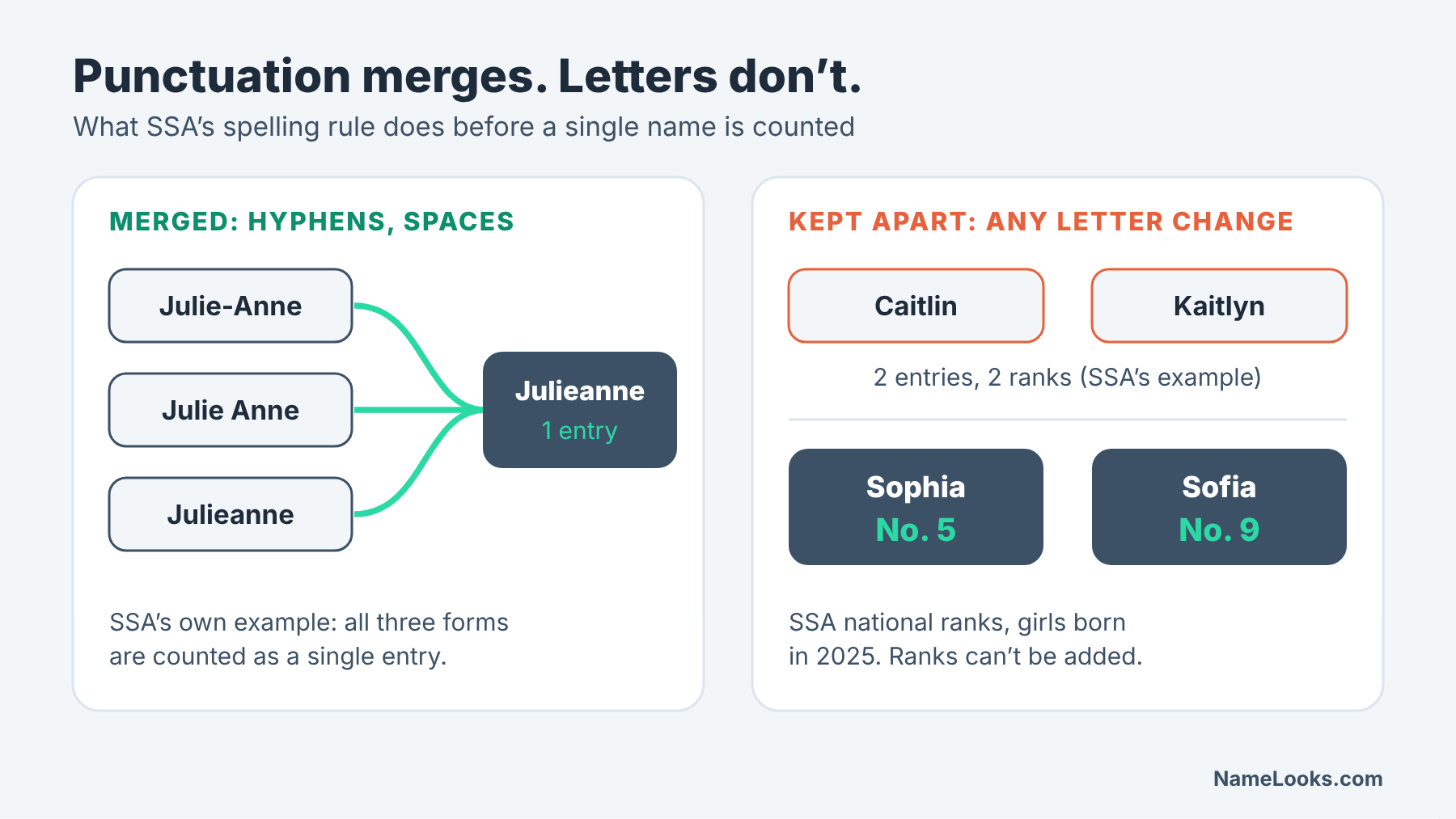
SSA’s background page is blunt about spelling: “Different spellings of similar names are not combined.” Its own example is Caitlin and Kaitlyn, which are counted separately and ranked separately. Nothing in the method decides that two spellings are “really” the same name, because that’s a question about language and family intent, not about records.
The one exception is punctuation inside the name. Hyphens and spaces are removed, and SSA gives the example that Julie-Anne, Julie Anne and Julieanne are counted as a single entry. So the dataset merges forms that differ only by a hyphen or a space, and keeps apart forms that differ by even one letter. If your family writes a double name with a hyphen, the published table can’t show the hyphen at all. Our guide to hyphenated given names covers what that means on forms and in software.
There’s also a minimum length. A given name has to be at least two characters long to be included. The background page doesn’t say anything about accented letters or other diacritics, so we won’t guess how they’re handled. If an accent matters to you, treat the SSA spelling as a plain-letter approximation and check the downloadable files’ readme before drawing conclusions. The wider issue is covered in our piece on diacritics in names.
Sex categories, the five-occurrence floor and alphabetical ties
After spelling, three rules shape the list you actually see. Rankings are done by sex. Names with fewer than five occurrences in any geographic area are excluded. Ties are broken by assigning rank in alphabetical order. Each rule is simple. Together they explain most of the oddities people notice in the tables.
The sex rule means there’s no single national list. There’s a boys’ list and a girls’ list, and SSA’s example of a name used for both is Micah. If you search the “popularity of a name” tool without choosing a sex, SSA says it shows rankings for the more popular name-sex combination. That default is convenient, and it’s also a quiet way to lose half the picture.
The five-occurrence floor is a privacy protection, and SSA says so directly. It also means the full downloadable files are close to complete but not complete. The agency’s own wording is that it provides “almost all names for researchers interested in naming trends.” The ones it leaves out are exactly the rarest ones, which is why the article on the privacy problem with extremely rare name data exists.
Alphabetical tie-breaking sounds trivial until you look at a short list. A name can sit one rank above another purely because of its first letter. When counts are large, ties are uncommon and the effect is negligible. When counts are small, as in state or territory tables, alphabetical order can decide several positions in a row.
Rank, count and share are three different numbers
This is the rule that isn’t on SSA’s background page but governs everything downstream of it. The tables offer you a rank, and the tools let you switch to a number of births or a percentage. Those are three different measurements. Treating one as another is the single most common error in name writing, and it’s the clearest sign that a writer hasn’t checked how SSA baby names data works before quoting it.
What each metric actually answers
A rank is a position in one sex-specific list for one birth year and one geography. It answers “how many names in this list had more babies than this one?” It doesn’t tell you how many babies that is, and it doesn’t stay comparable from year to year if the distribution of names spreads out or bunches up.
A count is a number of babies with that exact spelling, in that sex category, born in that year, in that geography. It’s the most concrete of the three. It also depends on how many babies were born that year at all, so a falling count can reflect fewer births overall rather than a name losing appeal.
A share divides a count by a total, such as all babies in one sex category for that year. On any results page, check which total is being used. Shares are the fairest way to compare across years with different birth totals. They’re also the easiest to misreport, because “1 percent of babies” and “1 percent of girls” are different statements. The deeper comparison of these three, with worked contrasts, lives in our explainer on rank vs number of babies.
Where SSA shows each metric
The SSA popular baby names landing page offers a “popular names by birth year” tool that returns the top 20 up to the top 1,000 names, and it lets you show either the number of births or the percent of births. The territory tables print rank, name and number of births side by side. The top five names for each of the last 100 years shows ranks only, with no counts.
That last point catches people out. The top-five page is a list of positions for birth years 1926 through 2025. It’s perfect for “which names were first?” and silent on “by how much?” When an article says a name “dominated” a decade, check whether the writer saw counts or only ranks.
One sentence, three metrics
“Olivia was No. 1 for girls born in the U.S. in 2025” is a rank claim, and SSA’s top-five page supports it. “More babies were named Olivia than any other girls’ name in 2025” is a count claim about the same list and is equivalent here. “Olivia was the most common name for 2025 babies” is a different claim, because it merges the two sex lists. Only the first two are direct readings of the table.
2Spelling variants and sex categories: where most misreadings start
Rules 3 and 4 are the ones that produce the most confident wrong statements. They don’t make the data less accurate. They make it more literal than the way people talk about names, and the gap between the two is where errors creep in.
Why Sophia and Sofia are two separate lines
In SSA’s 2025 national girls’ list, Sophia is ranked fifth and Sofia is ranked ninth. Both appear on the agency’s landing page for 2025 births. Two spellings, two entries, two ranks. That’s the rule working as designed.
What SSA’s spelling rule establishes, and what it doesn’t
The rule establishes something narrow and useful: each line in the table is one exact string of letters, for one sex, for one birth year. If you want to know how many baby girls born in 2025 were registered as “Sofia” with an f, the SSA data answer that question and no other.
What it doesn’t establish is that the two spellings are the same name, or different names. That’s a separate question involving language history, family tradition and how people pronounce the name, and our profile of Sophia and Sofia as separate variants takes it up properly. The SSA blog post announcing the 2025 list made the practical point itself: it noted that each spelling is ranked separately, which can change the order.
The ranks also don’t tell you what a combined total would look like. You can’t add rank 5 and rank 9 to get anything. If you wanted a combined figure, you’d need the counts for both spellings from the same release, and you’d need to say you added them.
Grouping spellings yourself: allowed, as long as you say so
Nothing stops you from grouping spellings. Researchers do it, and for some questions it’s the right move. Picture a hypothetical family worried that a name “will be everywhere” at school. What they care about is how often children will hear the sound, so a sound-based group of spellings is more relevant to them than any single line.
The honest way to do that is to state your grouping rule before you look at the totals, list which spellings you included, and label the result as your calculation, not SSA’s ranking. A grouped total can’t be given an SSA rank, because SSA never ranked it. The method for following a whole family of spellings over time is laid out in tracking the family of spellings, not just one rank, and spelling differences between countries are in our U.S. and UK spelling preferences piece.
- Write the rule first. “Spellings a typical listener would hear as the same name” is a rule. “Whatever makes the total look big” is not.
- Keep the list of spellings visible. A reader should be able to see every string you added together.
- Keep the sex lists apart unless you say otherwise. Grouping spellings and merging sex categories are two separate decisions.
- Never print a grouped rank. Report the grouped count or share, and keep the official ranks for the individual spellings.
One name, two lists: how the sex categories work
Rule 4 creates a structure that’s easy to forget: every name has a boys’ history and a girls’ history, kept in separate columns. Most names have nearly all their weight in one of them. Some don’t, and those are the names most likely to be misdescribed.
How ranking by sex plays out in the tables
Because SSA ranks by sex, the 2025 boys’ list and the 2025 girls’ list each have their own No. 1, their own No. 1,000, and their own ties. A name used for both, such as SSA’s example Micah, appears in both lists with a rank in each. Those two ranks aren’t on the same scale. Rank 200 among girls and rank 200 among boys can correspond to quite different numbers of babies.
The default in SSA’s popularity-over-time tool matters here. If you don’t pick a sex, the tool shows the more popular name-sex combination. For a name split fairly evenly, that default can flip between years, and a casual reader can mistake a switch in which list is shown for a change in the name itself. Pick the sex explicitly, every time, and look at both if the name is used for both.
What the sex field is, and what it isn’t
The sex category in SSA’s data is the sex recorded on the card application. SSA’s background page notes that the data aren’t edited and that the sex associated with a name may be incorrect. It’s an administrative field with known errors, and the agency tells you so.
It isn’t a measure of anyone’s gender identity, and it isn’t evidence about how a name “should” be used. A name that shows up in both lists is a name parents have registered for babies recorded in both categories. That’s the whole of what the table says. Questions about whether a name is “unisex” or “gender-neutral” need a stated dataset and threshold, and they get careful treatment in what Census and birth data can and can’t show about unisex names.
One practical habit helps a lot. When you write about a name used for both sexes, report both ranks with their years and say which is which. “Ranked X among boys and Y among girls born in the U.S. in 2025, SSA” is longer than “a popular unisex name,” and it’s the version that’s true.
3What the data proves, and what you’re adding on top
The SSA tables are reliable within their rules. Most of the trouble starts when someone takes a reliable number and wraps it in a word the number can’t support. Once you know how SSA baby names data works, the next skill is noticing when a sentence leaves the data behind. This section separates the two layers: the claims the source establishes, and the interpretation people bring to it.
What the source establishes
Think of an SSA figure as a sentence with seven slots: dataset, release, birth year, geography, sex category, exact spelling, and metric. When all seven are filled, the sentence is a fact you can check. When a slot is empty, the sentence is drifting toward opinion.
Claims the SSA files can support
The table below lists the main kinds of claims you can make from SSA’s published pages, with the limit that comes attached to each. It’s an evidence map, not a ranking. Every row comes from SSA’s own documentation or published tables.
| Claim type | Source page | Geography | Years | Metric | Built-in limit | Editorial takeaway |
|---|---|---|---|---|---|---|
| A spelling’s position in a year’s list | Popular names by birth year (landing page tool) | 50 states + D.C. | Birth years back to 1880 | Rank, by sex | Top 1,000 only in the tool; ties ordered alphabetically | Always name the sex list and exact spelling |
| How many babies got a spelling | Same tool, “number of births” option; downloadable files | 50 states + D.C. | Birth years back to 1880 | Count | Names under 5 occurrences excluded | Counts depend on total births that year |
| A spelling’s slice of all babies of that sex | Same tool, “percent of births” option | 50 states + D.C. | Birth years back to 1880 | Share | Read the denominator on the results page before comparing | Best for comparing years |
| The first-place names over a century | Top 5 names in each of the last 100 years | National | 1926–2025 | Rank only | No counts on the page | Supports “who was first,” not “by how much” |
| Movement between two years | Change in popularity tables | National | 2024 vs 2025 | Rank difference | Only names in the top 1,000 in at least one year | Big jumps are easier from low ranks |
| Names in a state | Popular names by state | One state | By birth year | Rank, count | 5-occurrence floor applies per state | State sums fall short of the national total |
| Names in the territories | Popular names in U.S. territories | Puerto Rico; other territories combined | 1998–2025 | Rank, count | Not part of national data | Report territories as their own geography |
| How much of all naming the top list covers | Beyond the top 1000 names page | National | 2016–2025 shown | Percentage | Separate figures for boys and girls | The top 1,000 leaves out a large minority of babies |
Read across any row and you’ll see the same pattern. Each claim is precise and has a boundary. “Back to 1880” is what SSA’s search tools allow, while its 2026 press release adds that the agency began compiling the annual list in 1997. The data reach back further than the tradition of announcing them does.
A worked example: reading a small table line by line
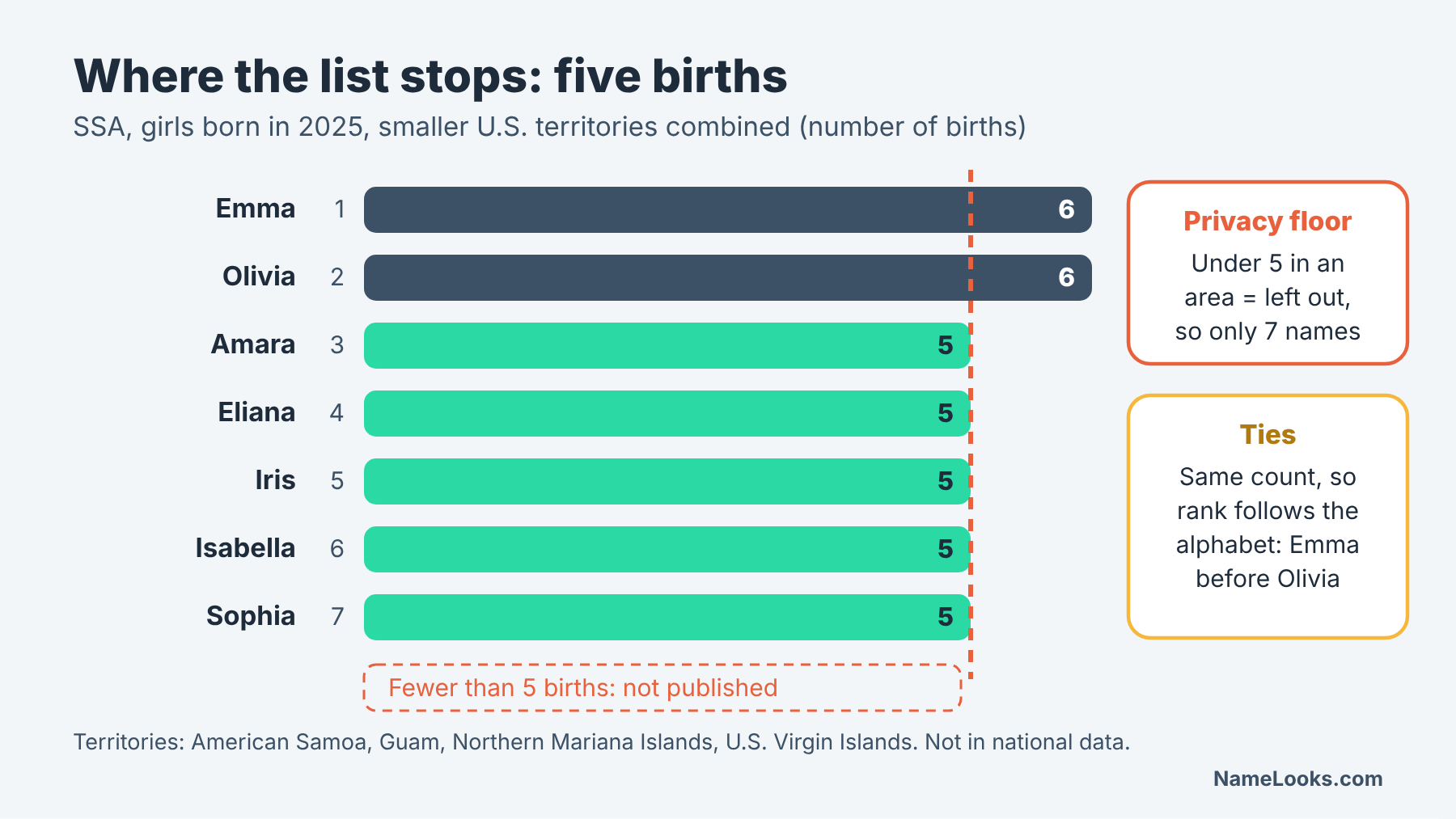
The best way to see the rules in action is a table small enough to read in one go. SSA’s 2025 table for “all other territories” (American Samoa, Guam, the Northern Mariana Islands and the U.S. Virgin Islands combined) is exactly that. The girls’ column lists seven names: Emma and Olivia with 6 births each, then Amara, Eliana, Iris, Isabella and Sophia with 5 each.
Three rules are visible at once. The list stops at seven names, not ten, and the last count shown is 5, which is where the privacy floor sits. Emma ranks above Olivia with the same count, and the five names tied at 5 are in strict alphabetical order. That’s rule 6, doing exactly what the documentation says. Nothing about the order of those five names reflects anything about the names themselves.
The Puerto Rico table shows the same thing at a larger size. Among 2025 boys, Dylan and Lucas both have 112 births and sit at seventh and eighth, alphabetically. Among girls, Catalina and Isabella both have 90 and sit at fifth and sixth. Two ranks, one count. If a story reported Isabella as “behind” Catalina in Puerto Rico in 2025, it would be reporting the alphabet.
Where interpretation, taste and inference take over
Data answer “how many” and “what position.” People want to know “is this name too common,” “is it on the way up,” “will it feel dated.” Those are fair questions. They just aren’t questions the table answers by itself, and the honest move is to show where the data stop and the judgment starts.
Words that smuggle in a judgment
A handful of words do most of the damage. “Popular,” “rare,” “rising,” “trendy,” “unisex” and “classic” all sound like data labels, and none of them is a category in SSA’s files. Each one needs a definition you choose: a rank cutoff, a count, a share, a span of years. Without that definition, the word is taste dressed up as measurement.
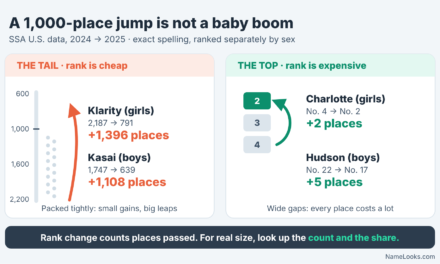
Take “rising.” SSA’s change-in-popularity tables measure rank differences between 2024 and 2025, and only for names in the top 1,000 in at least one of those years. The agency itself notes that the more popular a name is, generally the smaller its change. So a large rank jump is partly a sign of where the name started. SSA’s 2026 announcement said Kasai rose 1,108 positions to 639 among boys, entering the top 1,000 for the first time. That’s a verified rank claim. Whether it signals a lasting trend is interpretation, and the fastest-rising names article explains why rank jumps and birth counts can tell different stories.
“Popular” has the same problem from the other side. A name can be ranked 40th and still be given to a small share of babies. Whether that’s “popular” for your purposes is a decision, and it’s yours. The broader trade-off is in how much uniqueness you actually want.
Rewriting a claim so it holds up
Most weak claims can be fixed with a few extra words. The fix is almost always to fill in the empty slots from the seven-slot sentence above and to separate what the table says from what you think about it.
Weak: “Theodore is one of America’s top names.”
Stronger: “Theodore ranked fourth among boys born in the 50 states and D.C. in 2025, according to SSA.” The original isn’t wrong, but it hides the year, the sex list and the geography.
Weak: “Sofia is more popular than ever.”
Stronger: “Sofia, spelled with an f, ranked ninth among U.S. girls born in 2025 (SSA). Sophia ranked fifth.” The comparison to “ever” needs a time series you’d have to show.
Weak: “Noah is the top name in Puerto Rico and America.”
Stronger: “Noah was the top boys’ name in SSA’s 2025 Puerto Rico table. Nationally, Liam ranked first and Noah second.” Two geographies, two answers.
Weak: “This name is rare, so your child will be the only one.”
Stronger: “This spelling isn’t in SSA’s 2025 top 1,000 for girls.” That’s a fact about one list. It says nothing about other spellings, other years or a particular school.
Notice that none of the stronger versions tell the reader what to think. They hand over the facts and leave the judgment visible as a separate step. That’s also how NameLooks approaches the wider decision, which our framework for choosing a name treats as weighing data alongside family, sound and culture rather than letting a rank decide.
4Publish your limits so someone else can reproduce the number
Knowing how SSA baby names data works is half the job. The other half is being open about where it stops. Good name writing doesn’t hide the edges of the data. It names them, so a reader can check the figure, spot what’s missing and decide how much weight it deserves. The full catalogue of SSA’s limitations has its own home in our guide to what the SSA dataset can’t tell you. Here we focus on the ones that change how you cite and compare.
Missing data and edge cases to know about
Some gaps are documented by SSA. Others aren’t addressed at all, which is its own kind of information. It’s worth keeping the two apart, because “SSA says X” and “SSA doesn’t say” lead to different sentences.
Gaps the documentation names
SSA’s background page lists the main exclusions in a few lines. Taken together, they define who can and can’t appear in the published tables:
- Older births are thin. Before 1937, plenty of people never got a card at all, and anyone who didn’t is missing.
- Incomplete records drop out. A name is only included when year of birth, sex and state of birth are on record.
- Very short names are excluded. The given name must be at least two characters long.
- The rarest names are suppressed. Fewer than five occurrences in any geographic area means the name doesn’t appear.
- Territories are elsewhere. Births in U.S. territories aren’t in the national data.
- Placeholders stay in. Entries such as “Unknown” and “Baby” aren’t removed, and the recorded sex may be wrong.
Every one of these pushes the numbers in a predictable direction. Suppression and incomplete records mean counts are slightly low, never high. The territory rule means “national” is narrower than “every baby born anywhere in the United States that year.” The unedited entries mean you shouldn’t be surprised by an odd string in the full files.
Edge cases the documentation doesn’t settle
Some questions come up often and get no direct answer on SSA’s background page. We’d rather say that plainly than fill the gap with a guess. Accented letters are one: the page explains hyphens and spaces but doesn’t mention diacritics. Apostrophes are another. Names changed after the original application are a third, since the page describes the records as of March 2026 without explaining how later changes to a person’s name are reflected.
For each of these, the responsible move is the same. Say the documentation doesn’t address it, check the readme inside SSA’s downloadable files if your question depends on it, and avoid building a claim on the gap. If an article tells you confidently how SSA treats accents, ask where it got that, because it isn’t on the agency’s methodology page. Software and forms that strip characters are a wider problem, covered in our piece on apostrophes and spaces in names.
One more edge case sits in plain sight. Because the privacy floor applies per geographic area, a name can appear in the national file and be absent from every state file. Picture a spelling given to a handful of babies in each of several states. Each state’s count is under five, so no state lists it, yet the national total clears the bar. That isn’t a contradiction. It’s rule 5 applied at two sizes.
Freshness: which release are you quoting?
Every SSA figure belongs to a release. That sounds pedantic until two articles quote different numbers for the same name and year and both are right, because they pulled from different snapshots. Pinning the release is what makes a number reproducible.
The release calendar and the March snapshot
The current national release covers birth years through 2025. SSA announced it on May 8, 2026, in a press release on the 2025 baby names, which said Olivia and Liam had topped the list for the seventh straight year. The methodology page dates the underlying records “as of March 2026.” Those two dates are worth keeping apart: one is when the tabulation was drawn, the other is when it was published.
The snapshot date tells you something the documentation doesn’t spell out. If applications for babies born in a given year continue to arrive after the snapshot, a later release could include them. SSA’s background page doesn’t describe a revision policy, so we won’t claim one. The practical takeaway is modest: when you write down a figure, write down the release with it. The year-on-year story is covered in what changed in the 2025 rankings, and the longer view of the same pair sits in why seven years at No. 1 doesn’t mean nothing changed.
A citation line anyone can reproduce
Here’s the format we use. It’s longer than a link, and it’s the reason a reader can check the number in two minutes instead of guessing which table you meant.
- Dataset: SSA Popular Baby Names (national, state or territory).
- Release: records as of March 2026, published May 2026.
- Birth year: the year the babies were born, not the year you looked.
- Geography: 50 states and D.C., a named state, Puerto Rico, or the other territories combined.
- Sex category: boys’ list or girls’ list, as recorded on applications.
- Exact spelling: the string as SSA prints it, without hyphens or spaces.
- Metric: rank, number of births, or percent of births, plus the date you retrieved it.
Filled in, it reads like this: “SSA Popular Baby Names, national (50 states and D.C.), release of May 2026; girls born in 2025; spelling Sofia; rank 9; retrieved October 2026.” It isn’t elegant. It’s checkable, which is better.
Coverage: how much of the picture the top 1,000 shows
The SSA lookup tools stop at 1,000 names per sex. That cutoff feels generous, and it hides more than most people assume. SSA publishes a small table that measures exactly how much, on its page about names beyond the top 1,000.
What the coverage figures show
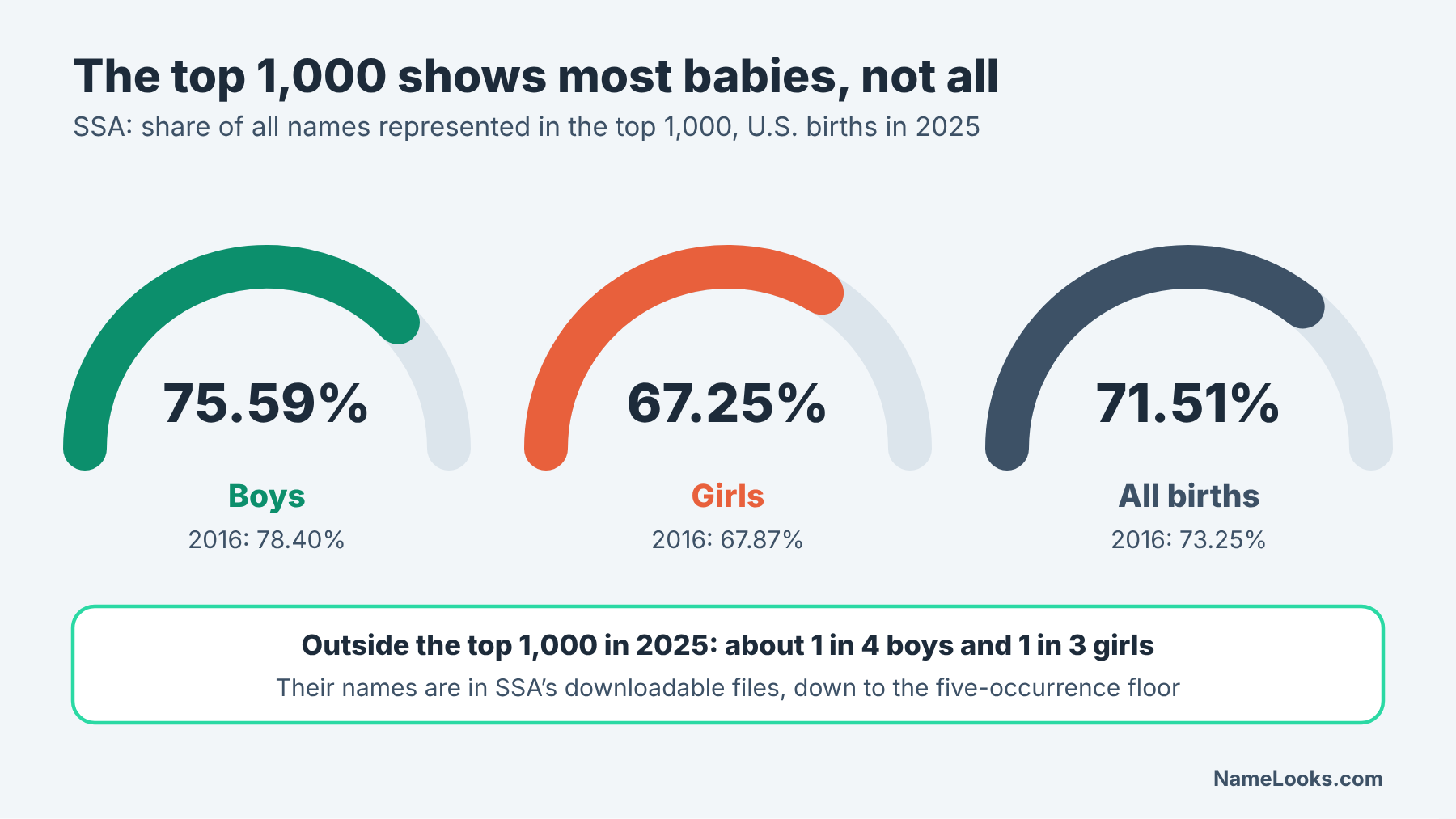
For U.S. births in 2025, SSA says the top 1,000 names represent about 72 percent of all names, with 75.59 percent for boys and 67.25 percent for girls. Since there are far more than 1,000 distinct spellings in each list, those percentages can only be shares of babies, not shares of distinct names. In other words, roughly a quarter of 2025 boys and about a third of 2025 girls had names that the standard top-1,000 tool doesn’t show.
| Birth year | Boys (%) | Girls (%) | All (%) | Girls minus boys (points)* | Caveat | What it means for a name search |
|---|---|---|---|---|---|---|
| 2016 | 78.40 | 67.87 | 73.25 | −10.53 | Every row comes from the same March 2026 snapshot | Even then, a top-1,000 search missed about a quarter of babies |
| 2019 | 76.98 | 67.56 | 72.37 | −9.42 | Separate sex lists, so “all” is a blend | Girls’ names were already more spread out than boys’ |
| 2022 | 75.64 | 66.85 | 71.34 | −8.79 | Shares, not counts; birth totals aren’t shown here | Boys’ coverage kept slipping |
| 2025 | 75.59 | 67.25 | 71.51 | −8.34 | Records as of March 2026 | About 1 in 3 girls had a name outside the top 1,000 |
| Change 2016 → 2025 | −2.81 | −0.62 | −1.74 | +2.19 | Differences calculated by NameLooks from SSA’s table | The gap narrowed mostly because boys’ names spread out |
*NameLooks calculation from the percentages SSA publishes. Source: SSA, “Beyond the Top 1000 Names,” table of percentages for birth years 2016–2025.
The trend in that table is gentle but consistent for boys, and nearly flat for girls. Over ten birth years the boys’ figure fell by almost three points, while the girls’ figure moved by well under one. We’d read that as boys’ naming slowly spreading out across more names, though the table alone can’t tell you why.
What to do with names below the cutoff
If a name isn’t in the top 1,000, that’s a statement about one list. It isn’t proof that the name is “rare,” and it’s certainly not proof that it’s absent. SSA’s downloadable files contain almost all names, down to the five-occurrence floor, and they’re the right place to look. The practical guide to that territory is what SSA data reveal about names just outside the top 1,000.
There’s also a reason not to over-read the cutoff from the other side. Rank 1,000 is a position, and the number of babies behind it changes from year to year and between the boys’ and girls’ lists. Treat “made the top 1,000” as a convenient line, not a natural boundary between common and uncommon names.
5Putting the rules to work: two hypothetical lookups
Rules are easier to remember once you’ve used them, and this is where the seven rules stop being abstract. The two scenarios below are hypothetical, built to show the method, not drawn from any real family. In both, the SSA facts we quote are real and sourced. The people and their questions are invented.
Checking a claim that a name is “everywhere”
Imagine a grandparent who says a shortlisted name is “everywhere now, it’s the number one name.” The parents want to know whether that’s true before they let it sway them.
Fill in the empty slots
Start by turning the remark into a claim the data can test. Number one in which list, for which birth year, in which geography, for which spelling? Suppose the name is Charlotte. SSA’s 2025 national girls’ list puts Charlotte second, behind Olivia, and the agency’s announcement noted that Charlotte rose to second and ended Emma’s run in that position. So “number one” is wrong for the national 2025 list, while “near the top” is right.
Then check the geography the family actually lives in. A state table might tell a different story, because the national ranking is a blend of very different places. If the family is in Puerto Rico, the national list doesn’t apply at all, and SSA’s separate 2025 Puerto Rico girls’ table doesn’t include Charlotte in its top 10. Each answer is true for its own geography.
Separate the data from the worry
Once the facts are in place, the real question comes back into view: is a name ranked second nationally “too common” for this family? That’s not an SSA question. A rank can’t tell you how many children with the name a given classroom will hold, and even a count only describes babies across a whole geography. The family’s answer depends on how much they mind sharing a name, which is a matter of taste, not of statistics.
For a wider read of what the latest national list does and doesn’t mean, our guide to reading the latest SSA rankings is the place to start. For a multi-year view that smooths out a single year’s noise, see the 2020s so far, using 2020–2025 data.
Comparing two spellings on a shortlist
Now picture parents choosing between two spellings of a name they love. One of them has read that “the f spelling is more popular,” and the other is sure the opposite is true.
Look up each spelling as its own entry
With Sophia and Sofia, the answer for the 2025 national girls’ list is a matter of two lookups. Sophia ranked fifth and Sofia ranked ninth. So for that list and year, the ph spelling ranked higher. For girls in the 2025 Puerto Rico table, neither spelling appears in the top 10, which is a useful reminder that a national answer doesn’t travel.
If the parents want a time series, they’d look up each spelling over several years in SSA’s popularity-over-time tool, with the sex set to female, and keep the two lines separate. If they care about how often the sound appears, they could add the counts for both spellings, label the result as their own total, and leave the official ranks alone.
Decide what the data can settle
The data can settle which spelling ranked higher in a given list and year. They can’t settle which spelling is “right,” which one family members will get wrong on a birthday card, or which feels closer to the family’s language. Those are judgments. Writing them down as judgments, next to the sourced ranks, keeps the decision honest and makes it easier to talk about.
That separation is the whole method in miniature. Look up the exact string, name the list, keep spellings and sexes apart, cite the release, and then make the human decision openly. If you want help with that last part, the cornerstone on U.S. name popularity links out to the rest of the series, including trends, state differences and the risers.
Questions people actually ask
Does SSA count names from birth certificates?
Not directly. SSA’s tables come from its records of Social Security card applications. Many of those applications start during birth registration through the Enumeration at Birth process, where the state vital statistics office sends the information to SSA electronically. The data are still SSA’s records, not a tabulation of birth certificates.
Why can’t I find a name that I know a few babies have?
If fewer than five babies of one sex received that exact spelling in a geographic area and year, SSA leaves it out of the published tables to protect privacy. Try the national file instead of a state, check other spellings, and remember that hyphens and spaces are removed before counting.
Is “top 1,000” the same as all the data?
No. The lookup tools stop at 1,000 names per sex, and SSA reports that the top 1,000 covered about 72 percent of all names for 2025 births. The downloadable national, state and territory files go much further, down to the five-occurrence floor.
Can I combine the boys’ and girls’ numbers for a name?
You can add the counts yourself, as long as you say you did it and keep the spelling exact. You can’t produce a combined rank, because SSA doesn’t rank a merged list. Report each sex list’s rank separately and present any combined total as your own calculation.
Will the 2025 numbers change?
SSA’s methodology page dates the current release to records as of March 2026 but doesn’t describe a revision policy. The safe habit is to cite the release alongside any figure, so that if a later release differs, readers can see which snapshot you used.
What’s the quickest way to explain how SSA baby names data works to someone else?
Try this: “It’s a count of first names from Social Security card applications, by the baby’s year of birth, with boys and girls ranked separately and every spelling counted on its own.” Then add the two caveats people most often miss: names under five occurrences are left out, and territories aren’t in the national list. If someone wants to check how SSA baby names data works for themselves, send them to the agency’s background page.
Are U.S. territories in the “national” ranking?
No. SSA publishes Puerto Rico and the other territories in separate tables, available for birth years 1998 through 2025, and states that territory births aren’t included in its national data. Treat them as their own geography.
Sources and further reading
- SSA: Background information for popular names — the methodology: source records, the five-occurrence rule, spelling and sex rules, ties.
- SSA: Popular Baby Names — the lookup tools for rank, number of births and percent of births, plus the 2025 top 10.
- SSA: Top 5 names in each of the last 100 years — ranks only, birth years 1926–2025.
- SSA: Beyond the top 1000 names — downloadable files and the coverage percentages used in our second table.
- SSA: Popular names in U.S. territories — Puerto Rico and the other territories, with counts, 1998–2025.
- SSA: Popular names by state — top names by state and year of birth.
- SSA: Change in popularity — 2024 vs 2025 rank changes and the top-1,000 restriction on comparisons.
- SSA press release, May 8, 2026 — the official 2025 announcement, top 10s and fastest risers.
- SSA blog: 2025’s Most Popular Baby Names — plain-language notes, including that each spelling is ranked separately.
- SSA FAQ: Enumeration at Birth — how a newborn’s number is requested during birth registration.
- U.S. Census Bureau: Frequently occurring names in the 2020 Census — a different dataset: names of the whole population, for names appearing 100 or more times.
NameLooks provides general information about names and name data. Popularity figures describe groups of babies in a stated year and place, not any individual person, and SSA may revise or reorganize its pages, so check the agency’s site for the current release.