By the time you need a name decision checklist, the hard creative work is mostly done. You have two or three finalists you’d be happy with, and what’s left is the unglamorous part: checking the data properly, hearing out family, respecting the cultures the name will live in, making sure the paperwork can hold it, and testing whether it survives a Tuesday morning at a pharmacy counter. This page is that last pass, built so you can run it in an evening and actually finish.
The short version
- Run the checklist on two or three finalists, not on a long list. It’s a verification tool, not a brainstorming tool.
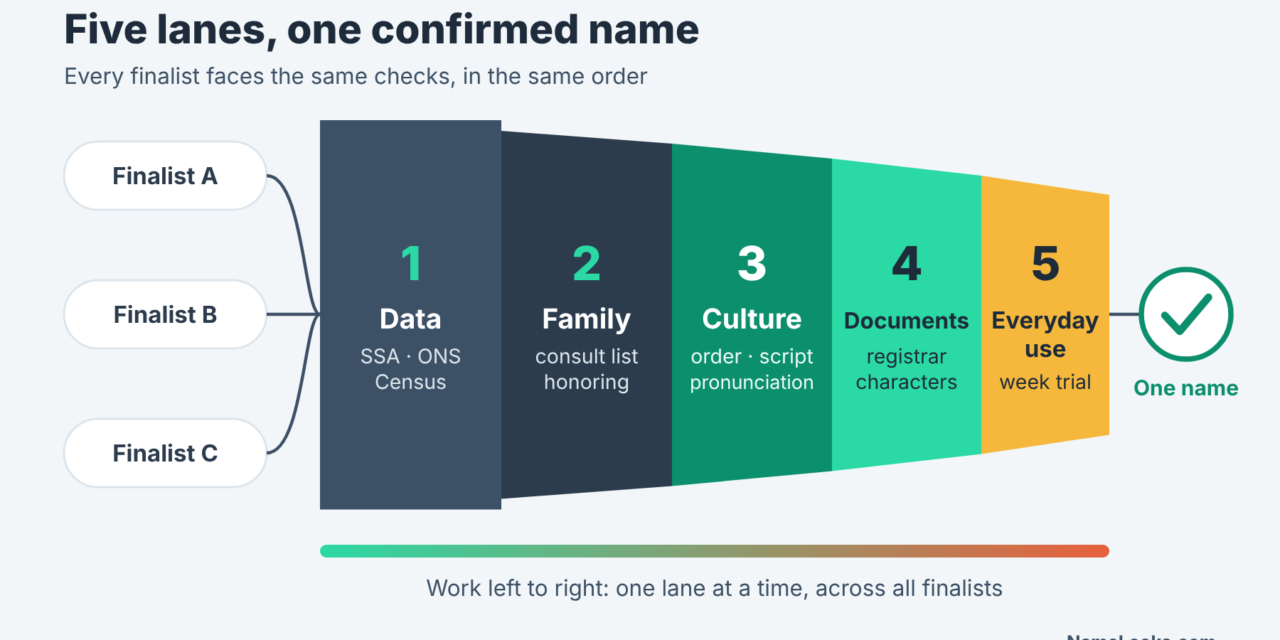
- Check five lanes in a fixed order: data, family, culture, documents, everyday use. Each lane can raise a flag; only you decide whether a flag is a dealbreaker.
- Popularity figures only mean something with a dataset, a place, a year and a metric attached. SSA and ONS both count exact spellings separately, so a “spelling variant” can hide a lot of shared use.
- Paperwork rules differ by country and change over time. Check the actual registration deadline and correction process where the child will be registered before you announce.
- Write the decision down: the spelling, the pronunciation, who you consulted, and which sources you checked. Future you will be glad of the file.
1What a name decision checklist is for, and when to use it
Most naming advice is about generating options. That’s the fun half, and there’s no shortage of it. The other half, the part where you confirm that a name you love will also work, gets squeezed into a rushed conversation in a hospital corridor or a late-night text thread. A name decision checklist exists to move that work earlier and make it boring in the best sense: predictable, complete, and done once.
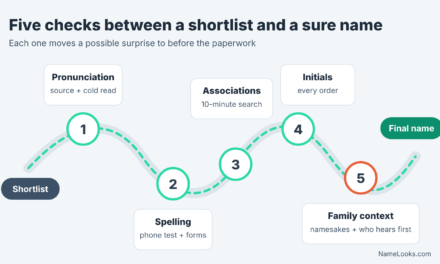
Here’s the core answer up front. Before you commit, confirm five things about each finalist. What the official data actually says about how it’s used. How the people who matter to you will receive it. How it behaves across the languages and naming systems it will meet. Whether the documents you need can record it exactly as you intend. And whether it holds up in ordinary daily use. If a finalist passes all five, you can stop second-guessing. If it fails one, you now know exactly what the problem is, which is far more useful than a vague bad feeling.
If you’re earlier in the process and still building a list, this page will feel premature. Start with our overall framework for choosing a name, which covers the bigger decisions about what you’re even optimizing for, and come back when the list is short.
What the checklist does, and what it can’t do
A name decision checklist is a memory aid for things you already agree matter. It doesn’t tell you which name is best. It tells you whether a name has a problem you haven’t noticed yet. That distinction keeps it honest. When a finalist fails a check, the checklist has done its job even if you go ahead with the name anyway, because now you’re choosing with your eyes open.
Why it beats another round of “but do we love it?”
Taste questions loop. You can ask “do we still love it?” every night for a month and get a different answer depending on how tired you are. Verification questions close. Either the SSA data shows a spelling has been in steady use or it doesn’t. Either your grandmother can say the name comfortably or she can’t. Either the form accepts the hyphen or it rejects it.
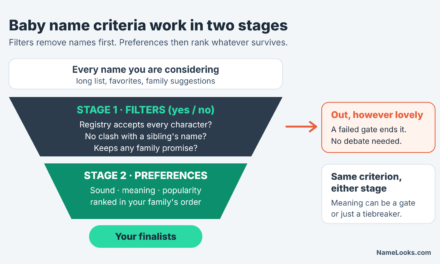
Splitting the two kinds of question is the single most useful thing a name decision checklist does. You keep the love question for yourselves, and you stop asking it of the data. If you want the thinking behind the criteria themselves, our piece on baby name criteria lays out each one and how they trade off. This page assumes you’ve already decided which criteria matter and now need to check them.
The five lanes: data, family, culture, documents, everyday use
We group the checks into five lanes because each one draws on a different kind of evidence. Data checks rely on official datasets. Family checks rely on conversations. Culture checks rely on linguistic and community knowledge. Document checks rely on government rules. Everyday-use checks rely on you, trying the name in real situations.
Mixing them up causes trouble. A relative’s opinion isn’t data. A popularity rank isn’t a cultural judgment. A passport rule isn’t a matter of taste. Keeping the lanes separate lets each kind of evidence speak for itself, and it stops one loud input from drowning out the rest.
When to run it, and on how many names
Timing matters more than people expect. Run a name decision checklist too early and you’re doing paperwork research on forty names you’ll never use. Run it too late and you’re discovering a document problem after the announcement has gone out.
Run it on two or three finalists, not forty
The checks take real effort, especially the family and culture lanes, which involve actual conversations. Doing that for every name on a long list is exhausting and, frankly, a little rude to the relatives you keep consulting. Cut the list first. Our shortlist method walks through getting from a sprawling list to a final five, and the companion piece on how many names belong on a final shortlist argues for stopping when the remaining names are genuinely different from each other.
Two or three finalists is the sweet spot for this checklist. Enough that a failed check doesn’t send you back to the beginning, few enough that you can run every lane properly. If you’re naming with a partner, agree on the finalists before you start. A name decision checklist is a poor tool for settling a disagreement about taste, and our guide to choosing a name with your partner handles that problem directly.
Know the deadline you’re working against
Some deadlines are legal, not emotional. In England, Wales and Northern Ireland, GOV.UK states that all births must be registered within 42 days of the child being born. Scotland runs its own system. In the United States, birth registration is handled by each state, and the hospital paperwork is usually where the name first gets written down officially, so the practical deadline is often the hospital stay itself.
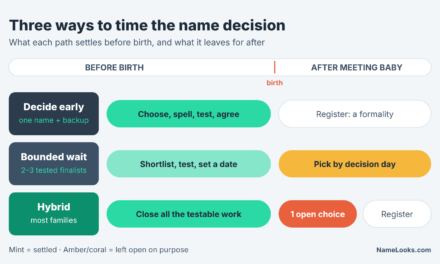
That’s why we suggest finishing the document lane before the due date if you can. Whether you decide on the name before birth or after meeting the baby is a separate question, and a real one; our piece on choosing before birth versus after covers it. Either way, you can do the document research in advance, because the rules don’t depend on which finalist wins.
A quick note on jurisdictions
We cite U.S. and U.K. rules on this page because those are the official sources we could verify this month. They are examples, not a universal standard. Naming and registration rules vary by country, by state, and sometimes by county, and they change. Treat everything in the document lane as “check where you live,” and treat this page as general information, not legal advice.
2Prepare the inputs before you make the call
The name decision checklist runs faster when the raw materials are already on the table. That means writing each finalist exactly as you intend it, pulling the official data once and saving it, and making a short list of the people and documents involved. None of this requires a decision. It just means you won’t be hunting for a link while your mother-in-law waits on the phone.
Gather the shortlist, the family context, and the data
Start a single page or note for each finalist. On it, write the full name in the exact spelling, with any accents, hyphens or apostrophes, plus the middle name and the surname as it will appear on the birth record. Then add a plain-English pronunciation note in your own words, the nicknames you expect, and the initials. That page becomes the file the rest of the checklist fills in.
What the official datasets actually measure
Popularity data is the easiest input to get wrong, because the numbers look precise and the methods behind them are easy to skip. Three sources cover most needs for English-speaking readers, and each measures something different.
The U.S. Social Security Administration publishes popular baby names going back to births in 1880. Its background notes say all names come from Social Security card applications for U.S. births, that names with fewer than five occurrences in a geographic area are left out to protect privacy, that different spellings of similar names are not combined, and that the name data are not edited. That last point is why oddities like “Baby” or “Unknown” can appear in the files. The current release covers births through 2025.
For England and Wales, the Office for National Statistics publishes ranks and counts of baby names from 1996 to 2025, released on 9 July 2026. Its quality and methodology notes say the figures come from first names recorded at live-birth registration, that they are based on the exact spelling on the birth certificate, and that names with counts below three across England and Wales are not released. ONS adds that grouping similar-sounding names would change the rankings, and that users can create their own groupings if they want to.
The U.S. Census Bureau’s 2020 Census names files answer a different question: how common a first or last name is across the whole population, not among babies. The tables include names that occurred 100 or more times in 2020 Census returns, which comes to 53,615 first names and 156,621 last names in the complete files. That’s useful for checking how a surname or first name sits in the wider U.S. population, though it says nothing about who carries a name or where their family comes from.
Pulling the numbers without fooling yourself
When you look a finalist up, write down four things together: the dataset, the geography, the year, and the metric. “SSA, United States, 2025, rank,” followed by the number you found, is a usable note. “Pretty popular” is not. Rank tells you position on a list; count tells you how many babies got that exact spelling; share tells you what fraction of births that count represents. They move differently. A name can climb in rank while its count barely changes, simply because the names above it lost ground.
Then look up every spelling you’d realistically consider, separately. Because SSA and ONS both treat each spelling as its own entry, a name spread across four spellings can look modest in every row while being quite common as a sound. If what you care about is how often your child will meet someone with the same name on the playground, the combined sound matters more than any single row. Add the spellings yourself and label the result clearly as your own combination, not an official figure.
For the deeper question of how much commonness you actually want, our piece on popular versus uncommon names works through it. The checklist’s job is narrower: make sure whatever you believe about a finalist’s popularity is backed by a correctly read number.
A data hygiene habit worth keeping
Save a screenshot or the downloaded file the day you check. Datasets get revised and websites move. If you later want to explain to someone why you thought a name was uncommon in 2025, a dated record beats memory every time.
Checks that still need doing before anyone votes
With the data in hand, there’s a second set of inputs that people tend to forget until they become problems. These aren’t about whether you like the name. They’re about who and what the name has to work with.
Who needs to be consulted, and who just needs to be told
Write two short lists. The first is the people whose input could genuinely change your decision: perhaps a partner, perhaps a co-parent, perhaps a grandparent whose name you’re considering honoring. The second is everyone else, who will hear the name once it’s settled. Being clear about the difference before you start saves hurt feelings. Asking someone’s opinion and then ignoring it lands worse than not asking.
If you’re thinking of honoring a relative, add one more line: has that person, or their closest family, been asked? Some people are delighted. Some find it uncomfortable, or have strong feelings about a particular spelling or a nickname they never liked. That’s information you want before the decision, not after.
Which documents and systems the name will touch first
Make a quick list of the first records that will carry the name. For most families in the United States that’s the state birth certificate, the Social Security number application that many hospitals offer at the same time, health insurance, and possibly a passport later. In England and Wales, it starts with birth registration at the local register office. If your family spans more than one country, list both, because a name that registers easily in one system may need extra thought in another.
You don’t need to research every rule yet. The point of this list is to know which offices and forms you’ll check in the document lane, so the research is targeted rather than a general anxious search.
Here is the decision-support table behind our whole name decision checklist. Each row is a lane factor, what evidence actually supports a judgment on it, what it means in practice, where the evidence runs out, and the single question worth asking.
| Naming factor | Evidence or source | Practical implication | Limitation | Question to ask |
|---|---|---|---|---|
| U.S. birth-name popularity | SSA baby names, births through 2025, from Social Security card applications | Shows how often an exact spelling was given to U.S. babies in a year | Spellings aren’t combined; names under 5 in an area are excluded; data aren’t edited | Have we checked every spelling we’d use, for the right year? |
| England and Wales popularity | ONS baby names, 1996 to 2025, from live-birth registrations | Shows ranks and counts for exact spellings registered in England and Wales | Names with fewer than 3 are not released; Scotland and Northern Ireland are separate | Are we reading rank, count, or share, and do we know which? |
| Population frequency | U.S. Census 2020 first and last names, 100+ occurrences | Shows how common a name is across all ages, not just babies | Aggregate only; says nothing about any individual’s background | Are we using this to check commonness, not to guess identity? |
| Family reception | Direct conversation with the people on your “consult” list | Surfaces honoring wishes, painful associations, pronunciation trouble | One person’s reaction isn’t a forecast for everyone | Did we ask the people whose view could change our mind? |
| Cross-language fit | Native speakers, reputable dictionaries, Unicode CLDR guidance on name order and scripts | Shows how the name is said, written and ordered in other languages your family uses | No single source covers every language or community | Who can tell us how this lands in each language we live in? |
| Document capacity | Official agency rules where the birth is registered (state, GOV.UK, SSA, State Dept) | Confirms characters, length, order and correction routes | Rules differ by jurisdiction and change over time | Have we read the current rule for our specific registrar? |
| Everyday use | Your own tests: saying, spelling aloud, typing, signing | Reveals friction you’d otherwise meet daily | Your tests reflect your circle, not every context | Did we try it in situations that actually happen to us? |
3Work through the five lanes in order
Order matters because some checks are cheap and some are expensive. Data checks take minutes and involve nobody else. Family checks take conversations. Culture checks may take outreach to people you don’t talk to every week. Starting with the cheap lanes means a finalist that fails early never costs you a difficult phone call.
Work one lane at a time across all finalists, rather than one finalist at a time across all lanes. It’s easier to compare like with like, and it keeps a favorite from getting a gentler test than the others.
Early step: read the data lane properly
The data lane answers one narrow question per finalist: how is this exact name, in this exact spelling, used in the population we care about? It doesn’t tell you whether the name is good. It tells you whether your assumptions about it are right.
What a trend line can and can’t tell you
A single year is a snapshot. If you look at several years in the SSA or ONS files, you’ll see whether a name is rising, falling, or steady, and that’s often more informative than its current rank. A name sitting at a middling rank but climbing steeply may be far more common among your child’s classmates in five years than its rank today suggests. One that has been flat for a decade is likely to stay roughly where it is.
What a trend line can’t tell you is why. A rise could reflect a famous person, a fictional character, a broad shift in sound preferences, or simply a few regional clusters adding up. The datasets record counts, not motives. If you find yourself writing “it’s rising because…” in your notes, flag that sentence as a guess unless you have a source.
It also can’t tell you about the place you live. SSA publishes state-specific files alongside its national data, but no official dataset describes your street, your school district, or your family’s social circle. Treat national figures as background, not as a forecast of your child’s classroom.
A worked example with a real, checkable number
The SSA’s top-five history page lists Olivia and Liam as the most popular girls’ and boys’ names for U.S. births in 2025, as they were in 2024. That’s a rank claim, for one dataset, one country, one year. It does not mean “most babies are named Olivia,” and it says nothing about Olivia’s count or share without opening the full files.
Now picture a family whose finalist is a name ranked well outside the top 100 in the same SSA data. They might conclude it’s uncommon. But if two other spellings of the same sound also sit outside the top 100, the combined total could be much larger than any one row. The fix is quick: pull each spelling’s 2025 count from the SSA national file, add them, and write “our combined estimate, three spellings” beside the result. That’s honest arithmetic with a clear label, and it often changes how a family feels about “uncommon.”

Things the data lane should never be used for
Name frequency data describes populations. It can’t tell you anything about an individual’s ethnicity, religion, nationality, class, personality or family history, and the Census Bureau notes its names data do not identify any specific person. If a finalist check ever turns into “people with this name are usually…”, stop. That’s a stereotype, not a finding.
Early step: the family conversation, handled well
The family lane is where most naming stress lives, and it’s usually because the conversation happens at the wrong moment, with the wrong framing. Done deliberately, it’s one of the most useful checks on the list, because family members often know things you don’t: a relative with the same name, a nickname that went badly, a pronunciation the older generation finds hard.
What you’re actually asking relatives for
Be specific about the request. You’re not asking “do you like it?” That question invites a verdict and makes a “no” feel like a veto. You’re asking for information you can’t get elsewhere. Does this name connect to anyone in the family you’d want to know about? Is there a nickname or association we might be missing? Can you say it comfortably? If we honor someone, would they want that?
Framed this way, relatives become sources rather than judges. Their input goes into the file next to the data, with the same status: evidence to weigh, not an instruction. Our piece on preventing name regret covers the specific family associations that most often cause second thoughts later, so we won’t repeat that list here.
Scripts that keep the conversation useful
Some phrasings that tend to keep things calm, which you can adapt to your own voice:
- Opening: “We’ve got it down to a couple of names, and before we decide, we want to check whether there’s anything we should know. We’re not taking a vote, we just don’t want to miss something.”
- Honoring: “We’re thinking of using Grandpa’s middle name. Would he have liked that, and is there a spelling the family used?”
- When someone dislikes it: “That’s helpful to hear. Is it the name itself, or something it reminds you of? If it’s an association, tell us more so we can weigh it.”
- Closing: “Thanks. We’ll make the final call ourselves, and we’ll tell everyone at the same time.”
That last line does a lot of work. Promising to tell everyone together removes the incentive for relatives to lobby early, and it spares you from managing who heard first. Picture a hypothetical couple who skip it: the first grandparent to hear starts sharing the name, and suddenly the couple’s still-open decision is being discussed at a cousin’s birthday party. A single sentence prevents that.
Middle step: culture and language
Many names travel. They’ll be said by grandparents in one language and teachers in another, written in one script on a birth certificate and another on a family document, ordered one way in a passport and another way in daily address. The culture lane checks how a finalist behaves in each of the settings it will actually live in. It’s not about deciding whether a name “belongs” to anyone; it’s about making sure it works where your family is.
Name order, multiple surnames and scripts
Naming systems differ in structure, not only in taste. The W3C’s internationalization guidance on personal names around the world points out that Spanish-speaking people commonly have two family names, that Brazilian names can carry three or four, that Icelanders traditionally use patronymic names rather than family names, and that many people have only a given name. It advises systems not to assume the order is given name then family name.
The Unicode CLDR person names specification formalizes this for software. It distinguishes fields such as given name, a second given name, surname and a second surname, and it notes that name order varies by locale: its examples treat Japanese, Hungarian, Korean, Vietnamese and Chinese names as surname-first in certain display contexts, while English defaults to given-first. These are formatting conventions for display, not rules about how any particular family names its children.
For the checklist, the practical question is simple. In each language and system your family uses, which part of the name is the “first” name, which is the family name, and which will be used in direct address? If the answers differ, decide now which form goes on which document, and write it down.
Transliteration and pronunciation across languages
If a name will be written in more than one script, you’ll need a Latin-alphabet spelling for most English-language documents. Unicode’s transliteration guidelines are blunt about why this needs care: there are many transliteration systems between languages, the same text can be transliterated in many ways, and even within one language different authorities may use variant systems. Some transforms are reversible; lossy ones are often called transcriptions.
That means two relatives may spell the “same” name differently in Latin letters, and both can be right under different systems. Pick one spelling deliberately, note which system or convention it follows if you know, and use it consistently on every document. Inconsistency between records causes more practical trouble than any single spelling choice.
Pronunciation needs the same care. Don’t infer how a name is said from its English spelling. Ask a fluent speaker of the relevant language, or use a reputable dictionary with phonetic transcription. Then write your intended pronunciation in your file in plain terms, so you can say it the same way every time someone asks. Our guide to testing a full name out loud covers rhythm, stress and how a name sounds with the surname; the culture lane is about whether it sounds right to the people who share each language.
Later step: check the paperwork before it checks you
The last two lanes are the most practical. One asks whether official records can hold the name exactly as you intend. The other asks whether daily life can. Both are easy to skip because the name already feels decided by this point. That’s exactly why they belong on a name decision checklist.
Everything in this section is general information drawn from official U.S. and U.K. government sources we read in October 2026. Rules differ by country, state and sometimes county, and agencies revise them. Before you rely on any of it, read the current page for the office that will actually register the birth or issue the document. This is not legal advice.
What official sources say about first records and corrections
United States, Social Security. The SSA’s guide to Social Security numbers for children calls applying at the hospital, at the same time as the birth certificate application, the easiest route; you’ll be asked for both parents’ Social Security numbers, though you can still apply without them. The guide notes that applying later at an office may take longer while the birth certificate is verified. That’s a reason to have the spelling settled before the hospital paperwork, because the same spelling will flow into both records.
If a name later needs correcting on a Social Security record, the SSA’s name-change and correction FAQ says you’ll need to provide evidence of identity and may need to prove citizenship or lawful status. Some requests can be made online in some states; otherwise you’ll need an appointment or a paper Form SS-5. In other words, correction is possible, but it’s a process, not a quick edit.
United States, passports. The State Department’s Form DS-3053 states that both legal parents or guardians must appear in person when applying for a passport for a child under 16, or a parent who can’t attend must submit a signed statement of consent.
For adults, Form DS-5504 covers a name change by marriage or court order within a year of a passport being issued, or a data printing error, generally without a fee unless expedited service is requested; it requires certified documents such as a marriage certificate, court order or birth certificate. The practical lesson for parents: the passport will copy the birth certificate, so the birth certificate is the record to get right.
England and Wales, registration and later changes. GOV.UK states that births in England, Wales and Northern Ireland must be registered within 42 days.
If a name is changed later, GOV.UK’s guidance on changing a child’s name says that for a child under 18 you can use an unenrolled deed poll or enroll one with the High Court, that enrolling needs the agreement of everyone with parental responsibility or a court order, and that a family court application for a specific issue order costs £263.
GOV.UK’s general deed poll page also notes that a new name must be pronounceable and must not include numbers or most symbols, with hyphens and established forms like apostrophes as exceptions. Scotland has different rules.
Practical next steps for the document lane
Turn the reading into a short, concrete list for your finalists:
- Find your registrar’s page. In the U.S., that’s your state’s vital records office; in England and Wales, the local register office. Note the deadline and what they’ll ask for.
- Check characters. If a finalist uses an accent, a hyphen, an apostrophe, or a non-Latin script, confirm what the birth record accepts. Don’t assume; systems vary and we couldn’t verify a universal rule.
- Check structure. If you plan two surnames, a hyphenated surname, or a surname that differs from a parent’s, confirm how the form handles it.
- Check consistency. List every record that will copy the birth certificate (SSN, insurance, passport) and plan to use one exact spelling across all of them.
- Know the correction route. Write down where you’d go if something prints wrong. You’ll likely never need it, and that’s fine.
Picture a hypothetical family whose finalist carries an accented letter that their grandparents’ language uses. The document check might show their state’s birth record will print the accent, or it might not, and other systems further down the line may handle it differently again. Neither outcome forces a change. But knowing in advance lets them decide whether the accented form is the “real” spelling with an unaccented version for systems, or whether they’ll use one form everywhere. That’s a family decision, made calmly, rather than a surprise at a counter.
Don’t read more into a rule than it says
The GOV.UK pronounceability and symbol rules above are stated for deed poll name changes. We did not find an official statement in this session that the same wording governs first-time birth registration, so check with your register office rather than assuming. The same goes for any U.S. state: ask the office, don’t rely on a forum post.
Later step: the everyday-use test
Documents record a name once. Daily life repeats it thousands of times. The everyday-use lane checks the small frictions that are invisible on paper and constant in practice: spelling it aloud on the phone, typing it into a form, fitting it in a field, hearing it shouted across a park, signing it at age thirty.
Forms, fields and systems that will meet the name
Software makes assumptions about names, and those assumptions show up in everyday life. The W3C guidance cited earlier advises developers not to require a family name, not to limit name field lengths, and to use Unicode so that non-Latin scripts work. Its advice exists precisely because many real systems do the opposite. A long name, a two-part surname, or an accented character may be truncated, merged, or rejected by a particular booking site or school database.
That isn’t a reason to avoid such a name. It’s a reason to know what you’ll encounter and decide how you’ll handle it. Some families keep a “systems spelling” for forms that can’t cope and use the full form everywhere else. Others insist on the full form and correct systems as they go. Either works if you choose it on purpose. Write your choice in the file.
A one-week trial with real situations
For each finalist, spend a few days living with it in private. Say it to the cat. Write it on a grocery list. Imagine introducing the child at a doctor’s office and spelling it for the receptionist. Picture a teacher reading it off a register on the first day. Try the full name, the short form, and the initials. Notice which situations make you wince and which make you smile.
Keep this separate from the sound tests in our guide to saying the full name aloud, which focus on rhythm, stress and initials. The everyday trial is about logistics: how often you’ll need to spell it, how often you’ll need to correct it, and whether you’re fine with that rate. A name you need to spell every time can still be the right name. You just want to know that before you start.

The matrix below shows how the name decision checklist plays out in a few common hypothetical situations. These are illustrations of the decision logic, not reports of real families, and the “verification step” column is the part to copy into your own file.
| Situation | Naming option | Benefit | Drawback | Verification step |
|---|---|---|---|---|
| Family uses two languages with different scripts | One Latin spelling on all English-language records, native script kept for family documents | Consistency across official records | Relatives may prefer a different romanization | Confirm one spelling with a fluent speaker; check what the birth record accepts |
| Parents want both surnames | Two surnames, with or without a hyphen | Recognizes both family lines | Some systems truncate or merge long surnames | Check the registrar’s form; decide which surname is used for short-form filing |
| Honoring a living grandparent | Grandparent’s name as the middle name | Connection without daily pressure on the first name | Grandparent may have feelings about the spelling or nickname | Ask the grandparent or their closest family before deciding |
| Finalist appears “uncommon” in one spelling | Preferred spelling of a sound shared by several spellings | Distinctive written form | The sound may be much more common than one row suggests | Add up SSA or ONS counts for each spelling; label it as your own estimate |
| Name contains an accent or apostrophe | Keep the mark on documents that allow it | Preserves the intended spelling | Some forms and travel documents drop the mark | Check the birth record rules; decide on a fallback form in advance |
| Family may move countries | Name chosen to work in both places | Fewer corrections later | Rules in the second country may differ | Read the official guidance in both jurisdictions; note it changes |
4Close the loop: confirm, record, and keep the decision steady
When every lane has been run, you’ll have a file for each finalist with notes, flags and a few saved screenshots. The final step is to turn that into a decision you can stand behind, and a record you can come back to. People skip this because the name already feels chosen. But the closing step is what stops a settled decision from reopening every time someone raises an eyebrow.
What to confirm before you announce
Confirming isn’t re-running the name decision checklist. It’s reading the file one last time and asking whether anything flagged is still unresolved. Most families find one or two loose ends at this stage, usually a spelling they haven’t fully committed to or a relative they meant to ask and didn’t.
The final confirmation pass, step by step
- Spelling, exactly. Write the full name once, by hand and typed, with every mark. This is the master copy.
- Pronunciation, in your own words. One line you’ll use every time someone asks.
- Data, labeled. Dataset, geography, year and metric for each figure you’re relying on, plus any combined-spelling estimate clearly marked as yours.
- Family, closed. Everyone on the “consult” list has been asked. Honoring permissions, if any, are confirmed.
- Culture, checked. Each language in your family’s life has a confirmed spelling, order and pronunciation, from a fluent speaker or reputable reference.
- Documents, ready. Registrar, deadline, accepted characters and correction route noted for the place the birth will be registered.
- Everyday use, accepted. You know how often you’ll need to spell or correct it, and you’re fine with that.
If all seven are settled, you have a name. If one isn’t, deal with that single item rather than reopening the whole choice. A loose end in the document lane is a phone call to a registry office, not a reason to start over.

When a check fails late
Sometimes a problem appears at the very end: a relative mentions an association nobody had heard, or a form turns out to reject a character. The temptation is to treat any late flag as a crisis. Instead, sort it into one of three buckets. A fixable flag can be solved without changing the name, like choosing a fallback spelling for systems. A weighable flag is a real cost you might accept, like a spelling you’ll need to repeat. A dealbreaker is a flag you genuinely can’t live with.
Only the third bucket justifies switching finalists, and that’s exactly why you kept two or three. The second finalist has already passed the same checks, so switching to it is a decision, not a panic. For the longer view on which late flags tend to matter and which fade, our guide to checking for future regret covers the usual suspects, and the main name decision framework explains how to weigh one criterion against another when they pull in different directions.

What to preserve, and what to update later
A naming decision has an afterlife. Records get copied, relatives misremember spellings, and children eventually ask why they’re called what they’re called. Keeping a small, tidy record now makes all of that easier.
Build a one-page naming record
Keep one page, digital or paper, that holds the essentials: the master spelling, the pronunciation note, the meaning or origin only if you verified it from a reputable source (with the source named), the people you consulted, any honoring story, and the datasets you checked with their dates. Add the registrar and the date the birth was registered once it happens.
This isn’t sentimental padding. It’s a reference. If a record is ever misprinted, you’ll have the intended spelling in writing. If a teacher, doctor or official asks how to say the name, you’ll have the line ready. And if your child later wants to know the story, you’ll be able to tell it accurately rather than from a fuzzy memory of a busy month.
One caution on meanings: popular name websites often attach confident meanings to names, and some are disputed or simply unsourced. If a meaning matters to you, find it in a reputable reference and note the source. If sources disagree, write that down too. Behind the Name publishes its list of references, which is a reasonable place to start looking for scholarly sources, though it’s a secondary index and high-stakes claims are worth cross-checking.
Updates: corrections, later changes, and new datasets
Three kinds of update are worth expecting. First, corrections: if a document prints wrong, use the correction route you noted in the document lane, and fix it early, because errors copy themselves from record to record. Second, later changes: some families revisit a name, or a child chooses a different name as they grow. In the United States, the SSA and State Department pages cited above describe how name changes are recorded once a legal change exists; in England and Wales, the deed poll guidance applies, with Scotland handled separately. Rules change, so check the current pages when the time comes.
Third, new data. SSA and ONS each publish a new year of baby-name data annually. If you’re curious how your child’s name moves, you can check each release and add a line to the record. Just remember what the numbers measure: how many babies got that exact spelling in that place and year. They don’t measure your child.
Keep
Master spelling, pronunciation note, sourced meaning if any, honoring story, people consulted, datasets with dates.
Check once
Registrar rules and deadline, accepted characters, correction route, consistency across copies of the birth record.
Revisit if needed
Corrections, later legal changes, new annual data releases from SSA or ONS.
5Edge cases the standard name decision checklist misses
The five lanes fit most newborn naming decisions. A few situations bend them, and it’s worth knowing how before you’re in one. The structure stays the same; the weight on each lane shifts.
When the person being named has a say
Not every naming decision is made for a newborn. Older children joining a family, teenagers choosing a different name, and adults changing their own names all use the same name decision checklist, with one big difference: the person carrying the name is now a participant, not a subject.
Older children and teenagers
When a child is old enough to have opinions, their view belongs on the “consult” list, usually at the top. The family lane changes shape: instead of asking relatives what they think of a name for a baby, you’re asking how the household will support a name the young person has some ownership of. The document lane changes too.
In England and Wales, GOV.UK’s guidance on changing a child’s name notes that 16- and 17-year-olds can make their own unenrolled deed poll in many circumstances, while younger children’s changes go through an agency, a solicitor or the High Court, with parental-responsibility consent or a court order for enrollment. U.S. rules for minors are set by states and courts, so check locally.
The everyday lane matters more for an older child than a baby, because the old name is already in school systems, medical records and friends’ phones. Updating those takes time. Plan the order of updates with the young person so they know what will change and when.
Adults renaming themselves
For an adult choosing a new legal name, the data lane often matters least and the document lane most. The SSA FAQ and State Department forms cited earlier describe what’s needed to update records after a legal change, in the U.S. For England and Wales, the deed poll page covers who can make one and when enrolling with the High Court is required; GOV.UK notes some organizations may only accept an enrolled deed poll. Getting the master spelling right before the first record is updated saves a second round of corrections across every account.
When the name has to work in more than one country
Families living across borders run every lane twice. That’s more work, but the five-lane structure helps keep it organized rather than overwhelming.
Two sets of rules, one name
Read the official guidance in each jurisdiction that will record the name, and note the date you read it. Where the rules differ, for instance on accepted characters, surname structure or who must consent to a document, decide which record is primary and make the others follow it as closely as their rules allow. Consistency, again, is the goal. A name spelled one way on a birth certificate and another way on a foreign registration is a problem you’ll be explaining for years.
Two data sources, two different stories
A finalist can look common in one country’s data and rare in another’s. That’s not a contradiction; SSA and ONS measure different populations with different methods and different minimum thresholds (five occurrences in an area for SSA, three across England and Wales for ONS). Neither covers Scotland, Northern Ireland or anywhere else. If both countries matter to you, record both figures separately, with their labels, and don’t average them into a meaningless third number.
Questions people actually ask
Do we need to run every lane for every finalist?
For two or three finalists, yes, and it’s quicker than it sounds because most of the research is shared. The document rules, for example, are the same for every finalist; you only need to check whether any one of them has an unusual character or structure. The family conversation can cover all finalists at once, which also stops relatives from guessing which one you prefer.
What if the data says our favorite is far more common than we thought?
That’s useful information, not a verdict. Ask whether commonness actually bothers you, or whether you’d assumed it would. Many people find they mind less once they see the real numbers and understand that a national count spreads across a whole country’s births. If it does bother you, a different spelling won’t change the sound, so the real choice is between the name and another finalist.
Can a relative stop us from using a name?
Socially, they can make it uncomfortable. Nothing in the U.S. or U.K. official sources we read gives grandparents or other relatives a role in registering a birth name, though you should check local rules if your situation is unusual. In practice the more useful question is why they object. If it’s an association you hadn’t heard, that’s worth weighing. If it’s taste, you can thank them and keep your decision.
Should we tell people the name before the birth?
That’s a preference, not a checklist item, and both choices are common. If you do share early, share after the checklist is done so you’re not fielding opinions on an unsettled decision. If you don’t, you can still run every lane privately and simply announce once.
Is there an official list of names we’re not allowed to use?
We didn’t find a single official list for the U.S. or England and Wales in this session, and rules vary by state and country. GOV.UK sets out content limits for deed poll name changes, such as no numbers and most symbols, and individual registrars may have their own rules for birth registration. If a finalist is unusual in form, ask the registrar directly before you rely on it.
How long should the whole name decision checklist take?
For most families, a few evenings spread over a week or two. The data lane takes an hour; the document lane maybe another hour of reading; the family and culture lanes depend on how many people you need to reach. The everyday-use trial benefits from a few days of living with each finalist, so start that early and let it run in the background.
Sources and further reading
- SSA Popular Baby Names — U.S. birth-name ranks and counts from Social Security card applications, births through 2025; spellings counted separately.
- SSA top five names by year — quick check of the most popular U.S. names for any year.
- ONS baby names in England and Wales, 1996 to 2025 — ranks and counts from birth registrations, released 9 July 2026.
- ONS baby names quality and methodology — explains exact-spelling counts and the under-three suppression rule.
- U.S. Census Bureau 2020 names files — population-wide first and last name frequency, names with 100+ occurrences.
- Unicode CLDR person names — how name order and name fields vary across locales.
- Unicode CLDR transliteration guidelines — why one name can have several valid Latin spellings.
- W3C: Personal names around the world — practical notes on name structures and how forms mishandle them.
- SSA: Social Security numbers for children — applying for a newborn’s number at the hospital.
- SSA: changing or correcting a name — what evidence a corrected Social Security card requires.
- State Department Form DS-3053 and Form DS-5504 — two-parent consent for minors’ passports; name changes and printing-error corrections.
- GOV.UK: register a birth, deed poll and changing a child’s name — registration deadline and later name changes in England and Wales.
- Behind the Name references — a secondary index pointing to scholarly sources on name origins.
NameLooks provides general information, not legal advice. Popularity data describes populations, not individuals, and registration, document and name-change rules depend on the jurisdiction and change over time, so check the current official source where you live.