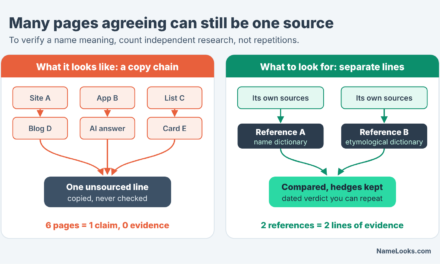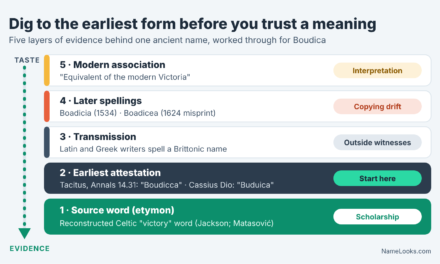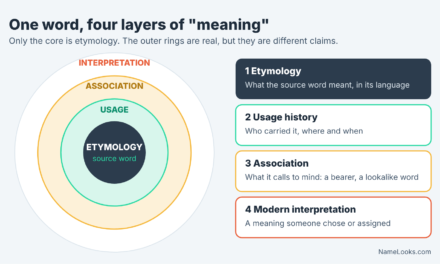
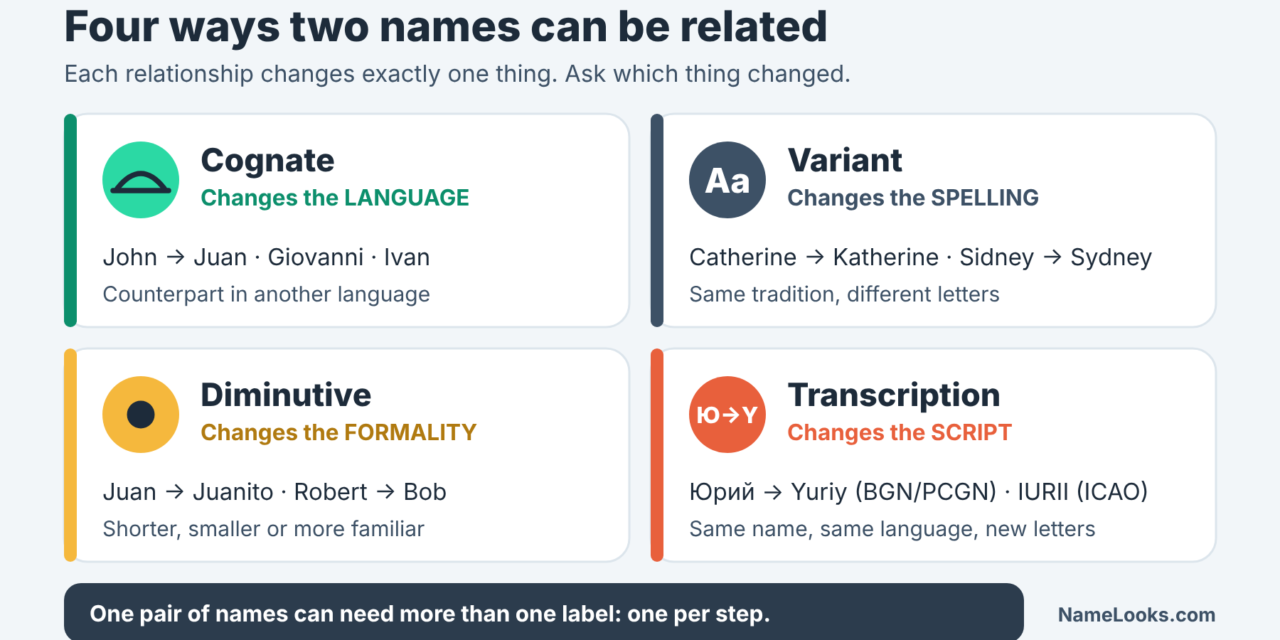
A cognate is one name carried into another language, a variant is the same name spelled or shaped differently inside one tradition, a diminutive is a shorter or more affectionate form, and a transcription is the name moved into another writing system. That is the cognate vs variant vs diminutive name distinction in one sentence, with transcription added because it gets confused with the other three most often. This page shows how to tell the four apart with sources you can check, using a handful of well-documented names rather than a long list.
The short version
- Each label answers a different question. Cognate asks “which language?”, variant asks “which spelling?”, diminutive asks “how formal?”, and transcription asks “which script?” One pair of names can need more than one answer.
- Name references use “cognate” loosely. Linguists reserve the word for forms that share an ancestor by inheritance. Name dictionaries often use it for any equivalent in another language, including names that traveled by borrowing.
- A relationship label is a claim, so it needs evidence. Jack is a good warning. Two reputable references describe its origin differently, and the honest write-up says so.
- Data systems don’t care about any of this. SSA counts every spelling as its own name, so Sophia and Sofia, or John and Jack, never get merged unless you merge them yourself and say so.
- Transliteration is where documents split. The same Cyrillic name comes out differently under the passport standard and under the geographic-names standard, and both outputs are correct for their system.
1Cognate vs variant vs diminutive name: the four relationships, defined
Here is the core answer before any detail. When two names look related, there are four common ways they can be related, and each describes a different kind of change. The change might be a move into a new language, a change of spelling, a change of size or warmth, or a change of script. Getting the label right matters because each one carries different evidence and different consequences.
The broader question of how to research where a name comes from belongs to our guide on researching name meanings and origins without repeating myths. This article stays on one narrow job: sorting the relationship between two forms you already have in front of you.
Cognate: the same name, living in another language
In everyday name books, a cognate is a name’s counterpart in another language. Spanish Juan, Italian Giovanni and Russian Ivan are the standard examples for English John. The Online Etymology Dictionary entry for John lists those three, along with French Jean, Portuguese João, German Johann and Welsh Ieuan, as cognates.
Behind the Name, a widely used secondary reference, defines the term simply. In its glossary entry for cognate, a cognate is “a word in another language which is derived from the same root.” That definition is broad on purpose. It says nothing about how the name got from one language to the other.
What the strict linguistic sense leaves out
Linguists usually mean something narrower. Merriam-Webster’s first linguistic sense of cognate is “related by descent from the same ancestral language,” and its next sense widens that to “derivation, borrowing, or descent.” Both are on the Merriam-Webster entry for cognate, and the gap between them is the whole issue.
Research in historical linguistics tends to keep borrowing out. A 2019 paper in the journal Computational Linguistics by Alina Maria Ciobanu and Liviu P. Dinu defines cognates as “words in different languages having the same meaning and a common ancestor,” and treats borrowing as a separate process. You can read the paper in the ACL Anthology.
By that stricter standard, many famous “name cognates” are not cognates at all. They are parallel adaptations of a name that was borrowed, often through religious texts, into language after language.
Why name dictionaries keep the loose sense anyway
The loose sense survives because it answers the question readers actually ask: “What is this name in Spanish?” Nobody looking up Giovanni wants a lecture on inheritance versus borrowing. They want to know it is the Italian counterpart of John.
That’s fine, as long as you know the loose sense is in use. The practical rule we’d suggest: when you write “cognate” on a name page, either mean the strict sense and check it, or use a plainer word such as “counterpart” or “form in another language.” Behind the Name itself uses the plainer framing in its name entries, grouping these forms under “other languages & cultures.”
Variant: the same name, spelled or shaped differently
A variant stays inside one naming tradition but takes a different spelling or a slightly different shape. Behind the Name’s glossary entry for variant puts it in one line: “A variant name is altered in spelling from another.” Its example is Sydney and Sidney, and it adds that either could be called a variant of the other.
That last point is easy to skip and worth keeping. “Variant” doesn’t automatically mean “copy of the original.” It describes a relationship between two forms, and which one counts as the main form is often a matter of convention or frequency in a given place and time.
The direction problem
Many websites present the more familiar spelling as the “real” name and the other as a deviation. That’s an editorial choice, not a linguistic fact. If both spellings have long histories, calling one the variant of the other says more about the writer’s location than about the names.
A safer phrasing is “Sydney and Sidney are spelling variants of one name.” It records the relationship without ranking the two. If you do want to name a main form, say why: older attestation, the spelling a reference uses as its headword, or the form most common in a stated dataset.
Where a variant stops being “the same name”
Some variants drift far enough that families and registries treat them as separate names. Kathleen is a useful edge case, and we come back to it below, because two respected references classify it in different ways. When a form has its own pronunciation, its own history of use and its own entry in reference works, “variant” may undersell it.
Data systems settle this question bluntly. As we’ll see, the U.S. Social Security Administration treats every distinct spelling as a separate name. That is a counting rule, not a judgment about identity, but it shapes almost every popularity claim you’ll read.
Diminutive: the shorter, warmer, or smaller form
A diminutive is a form that signals smallness, affection or familiarity. Merriam-Webster’s grammatical definition of diminutive is “a word, affix, or name usually indicating small size,” and its examples include the English ending in Bobby. Behind the Name describes a diminutive, or pet name, as “a short and/or affectionate form,” often used only by friends and relatives.
Notice that the Behind the Name definition folds two ideas together: short and affectionate. In practice those are different mechanisms, and separating them makes names easier to analyze.
Suffix diminutives and short forms are not the same mechanism
A suffix diminutive adds something. Spanish Juanito is the clearest kind of case: Behind the Name lists it as a diminutive of Juan, and the Real Academia Española’s dictionary entry for the Spanish suffix -ito says it carries “valor diminutivo o afectivo,” a diminutive or affectionate value. The ending does the work, the same way it does in ordinary Spanish nouns.
A short form removes something. Kate from Katherine or Rob from Robert cuts the name down. Many references call both types “diminutives,” which is acceptable shorthand. But if you’re explaining a name, it helps to say which mechanism you mean, because a short form can be perfectly formal in some families while a suffixed form almost always reads as affectionate.
Pet forms that don’t resemble their source
Some diminutives change sounds in ways that look arbitrary. Peggy from Margaret and Bob from Robert are the famous English cases. Both are well documented as pet forms, yet neither reference we checked can fully explain the consonant change. We look at the details in the next section, because these names are a good test of how much a source actually knows.
For software, the Unicode CLDR person-name specification treats this whole category under one practical label. Its person names part (CLDR version 49) defines an “informal” modifier that “requests an informal version of the name if available,” with Thomas and Tom as its example and Bob and Robert mentioned in the introduction. Software doesn’t care whether Tom is a short form or a pet form. It only needs to know which is formal.
Transcription and transliteration: the same name, in another script
The fourth relationship isn’t about language history at all. It’s about writing. When a name written in Cyrillic, Greek, Arabic or another script appears in Latin letters, somebody had to convert it, and the conversion rules decide the spelling you see.
The Unicode CLDR transliteration guidelines draw the useful line. They use “transliteration” broadly for both reversible and non-reversible conversions, and add that “a non-reversible transliteration is often called a transcription.” They also say plainly that “transliteration is not translation.”
Reversible versus lossy conversion
A reversible system lets you recover the original letters from the Latin spelling. A lossy one, a transcription in CLDR’s terms, aims at something pronounceable and gives up exact recovery. CLDR adds a caution that’s easy to forget: transcriptions “are only roughly phonetic, and only so when the specific pronunciation rules are understood.”
So a transcribed spelling is not a pronunciation guide by default. It’s a spelling produced by a rule set, and you need to know the rule set to read it. Behind the Name’s glossary, by contrast, defines transcription as “writing the sounds of one language in the script of another language,” which is closer to the everyday sense.
Why this is a different kind of relationship
Juan is a different name from John in the sense that matters to Spanish speakers. A transliterated name is the same name, in the same language, wearing different letters. Treating a romanized spelling as a “variant” or a “cognate” confuses a writing decision with a language change.
Our pronunciation cluster covers the mechanics in more depth, especially in why a name can have several Latin-alphabet spellings. Here the point is classification: if the only thing that changed is the script, the relationship is transcription or transliteration, whatever the spelling looks like.
| Term | What changes | Sourced example | Where it applies | Common mistake |
|---|---|---|---|---|
| Cognate (loose sense: counterpart) | The language community using the name | John and Spanish Juan, Italian Giovanni, Russian Ivan (Etymonline; Behind the Name) | Name dictionaries, translation of names in older texts, honor names across languages | Assuming every counterpart shares inherited ancestry, when many arrived by borrowing |
| Cognate (strict linguistic sense) | Nothing was borrowed: both forms descend from a common ancestor | Ordinary words such as English eat and German essen (an example Merriam-Webster uses) | Historical linguistics | Using the strict word for a borrowed biblical or classical name without checking the route |
| Variant | Spelling or shape, within one tradition | Sidney and Sydney (Behind the Name glossary) | Birth registration, popularity data, family records | Calling the more familiar spelling the “real” one |
| Diminutive (suffix) | An ending adds smallness or affection | Juan to Juanito (Behind the Name; RAE on -ito) | Spoken address, family use, sometimes official names | Assuming a diminutive has its own separate meaning |
| Short form or pet form | Part of the name is cut, sometimes altered | Robert to Bob; Margaret to Peggy (Behind the Name; Etymonline) | Everyday use, nicknames, software “informal” name fields | Inventing a story for the sound change when sources say it’s unexplained |
| Transliteration or transcription | Script only | Russian Юрий as Yuriy (BGN/PCGN) or IURII (ICAO Doc 9303) | Passports, catalogs, maps, search systems | Treating one romanized spelling as the only correct one |
2Six well-documented cases, sorted one at a time
Definitions are tidy. Real names are not, and the cognate vs variant vs diminutive name question gets harder the closer you look. The cases below were chosen because each one is documented in at least two independent references we opened for this article, and because each one breaks a different assumption. Where the references disagree, we show the disagreement rather than picking a winner.
One rule applies throughout. A relationship label describes how two forms are connected. It does not tell you what either name “means,” and it doesn’t transfer a meaning from one form to another unless the etymology really is shared. Our piece on what a name’s “meaning” actually refers to covers that difference in detail.
John and its counterparts: a family built by borrowing
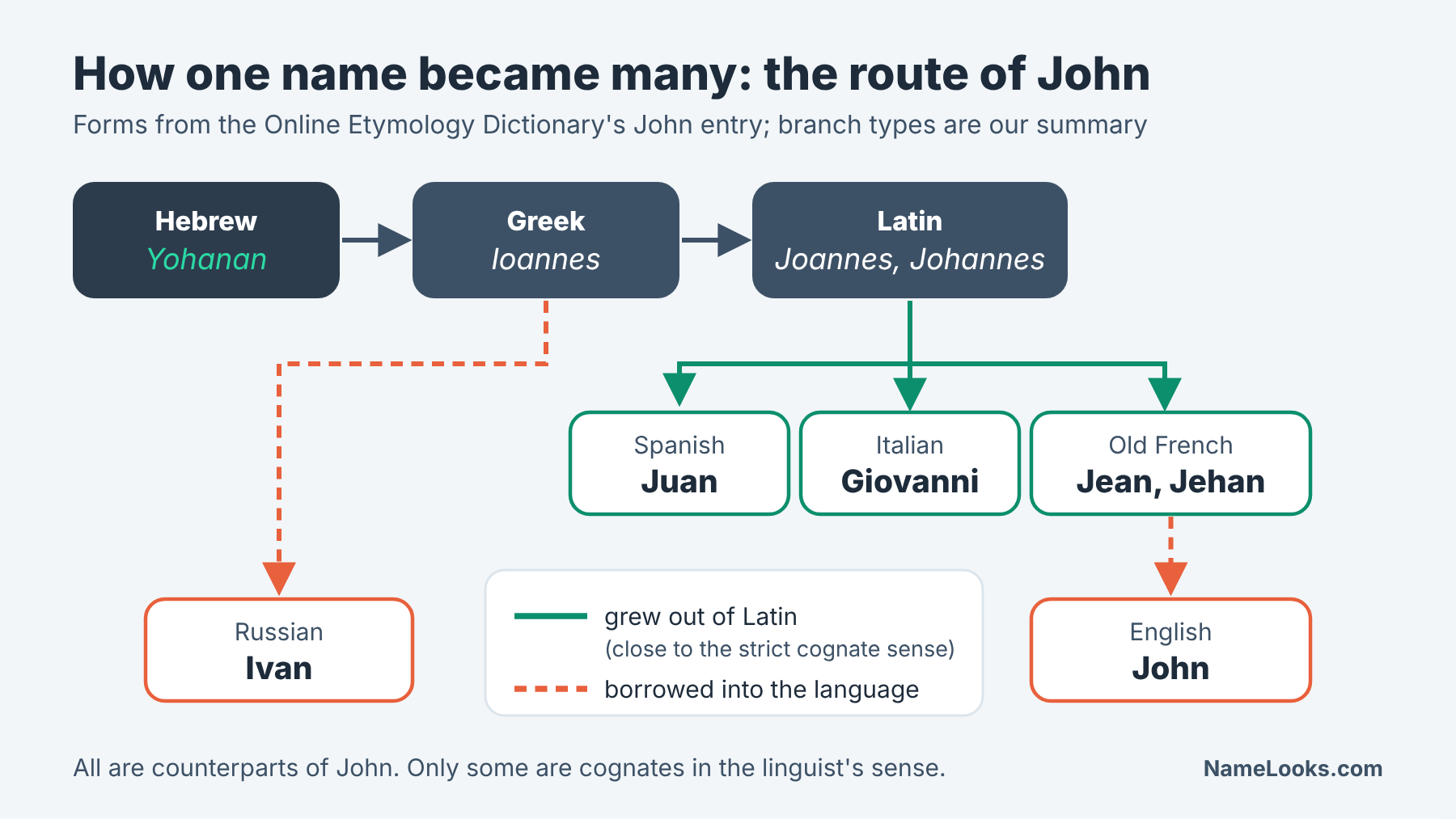
John is the textbook case for a reason. Its route is long, well recorded, and passes through several languages and scripts. It also shows why the strict and loose senses of “cognate” give different answers for the same set of names.
What two references agree on
The Online Etymology Dictionary traces English John to Hebrew Yohanan, which it says is “said to mean literally” that God “has favored” or “is gracious.” From there it runs through Greek Ioannes, Late Latin Joannes and Medieval Latin Johannes, then Old French Jan, Jean and Jehan, before reaching Middle English Jon.
Behind the Name’s John entry agrees on the outline. It calls John the English form of Iohannes, from Greek and Hebrew, and glosses the Hebrew as “Yahweh is gracious.” The two references word the gloss differently, and Etymonline adds the hedge “said to mean,” which is worth keeping when you quote it.
Now apply the strict sense. Spanish Juan and Italian Giovanni developed from the Latin name inside languages that themselves grew out of Latin, so they sit close to the linguist’s idea of inherited cognates. Russian Ivan came, as Etymonline puts it, “from Greek Ioannes,” through Christian use. English John came through French. Those links run through borrowing, so in the strict sense they are counterparts, not cognates.
Where a “family list” mixes relationship types
Behind the Name’s John page groups more than a hundred related forms under “other languages & cultures.” Read that list closely and you’ll find several relationship types sharing one heading. Russian Vanya, Spanish Juanito and Italian Gianni appear right alongside Ivan, Juan and Giovanni.
Behind the Name’s own entries show those are not the same kind of form. Its Vanya entry calls Vanya a diminutive of Ivan in Russian (and of Ivana in Bulgarian). Its Juanito entry calls Juanito a diminutive of Juan. So the family list is a list of relatives, not a list of cognates. That’s useful for browsing and misleading if you copy it as “the cognates of John.”
The references also group by language differently. Etymonline lists Hans as Dutch, next to Jan. Behind the Name lists Hans under German. Neither is wrong; a name can be used in several languages. It’s a reminder that “the German form” or “the Dutch form” is a statement about usage, which our article on origin versus usage treats as its own question.
A quick way to read a family list
Before copying any “this name in other languages” list, open the entries for two or three of the forms. If an entry says “diminutive of” or “short form of,” that form is a relative of a counterpart, not a counterpart itself. Label it that way, or leave it out.
Jack: a diminutive whose origin is still argued
Jack shows what a disputed relationship looks like on the page. Many people “know” that Jack is a nickname for John. Some have heard instead that it comes from French Jacques. The two references we checked frame the question differently, and neither treats it as closed.
The two references, side by side
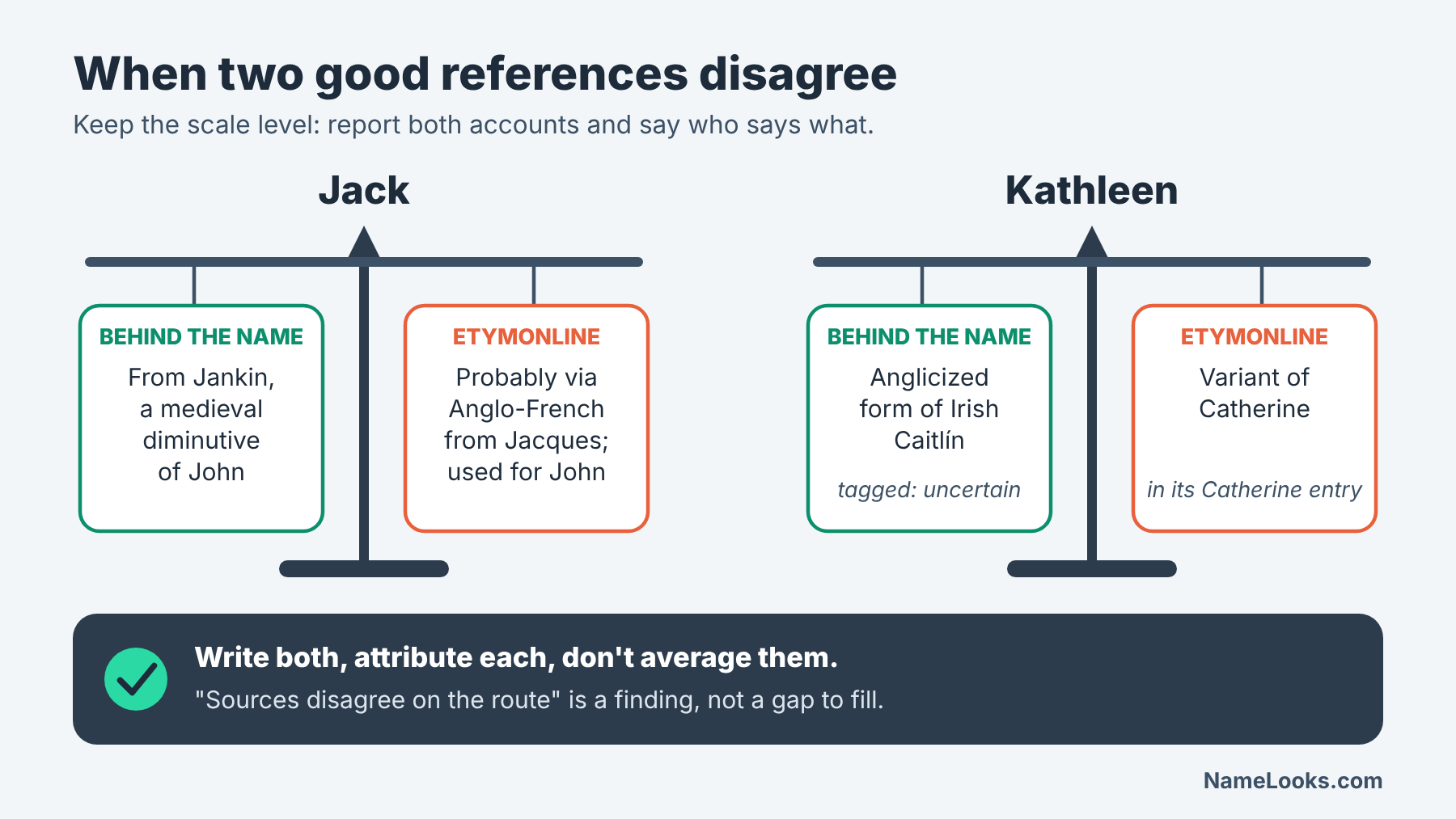
Behind the Name’s Jack entry says the name is “derived from Jackin (earlier Jankin), a medieval diminutive of John.” It adds that there “could be some early influence from the unrelated French name Jacques,” and that Jack “is often regarded as an independent name.”
The Online Etymology Dictionary’s Jack entry leans the other way on the route. It says the name came “probably via Anglo-French Jake, Jaikes,” from Old French Jacques, which traces back to Latin Jacobus. Yet it also says English Jack “always has been regarded as a familiar form of John,” and notes that some have argued it’s a native English formation. It records the name as attested by 1218.
So both sources connect Jack to John in practice. They differ on the linguistic route, and Etymonline presents three explanations without settling on one. That’s not a weakness in either source. It’s what an honest entry looks like when the evidence is thin.
How to write about Jack without overclaiming
A defensible sentence is something like: “Jack has long been used as a familiar form of John in English; references disagree on whether it developed from the medieval diminutive Jankin, from a French form of Jacques, or from both.” That sentence is longer than “Jack means John.” It’s also true.
The wording to avoid is any version that turns one hypothesis into fact, or that attaches the Hebrew meaning of John to Jack as settled. If Jack’s route really ran through Jacques, the source name would be Jacob, not John. This is exactly the pattern our guide to how copy-paste websites create false meanings warns about: the confident version spreads because it’s shorter.
Peggy and Bob: pet forms that don’t look like their parents
Peggy and Bob test a different skill. Nobody seriously disputes that Peggy goes with Margaret or that Bob goes with Robert. What’s uncertain is how the sounds changed. These cases show the difference between a documented relationship and a documented mechanism.
What the sources document, and what they don’t
Behind the Name’s Peggy entry calls Peggy a “medieval variant of Meggy, a diminutive of Margaret,” and states that “the reason for the change in the initial consonant is unknown.” The Etymonline entry for Peggy calls it “an alteration of Maggie,” pointing back to Margaret. The two disagree on the intermediate form, Meggy or Maggie, while agreeing on the source name.
Bob follows a similar pattern. Behind the Name says Bob is a “short form of Robert” that “arose later than Dob, Hob and Nob, which were medieval rhyming nicknames of Robert.” Etymonline calls Bob “a familiar shortening and alteration” of Robert and doesn’t mention rhyming. Both agree on the relationship. Only one offers a mechanism.
What this means if you’re choosing a name for its nickname
If you love the nickname Peggy or Bob and want a formal name behind it, the documented pairings are clear enough to rely on. What you shouldn’t do is repeat a neat explanation for the consonant swap unless you can cite one. “Nobody knows exactly why” is a perfectly good answer to a curious relative.
There’s also a practical point. A pet form that doesn’t resemble its source won’t be guessed by strangers. People meeting a Margaret are unlikely to call her Peggy unprompted, which some families see as a feature. If the nickname is the reason for the choice, our full-name guide on testing nicknames and rhythm out loud is the next step.
Catherine, Katherine and Kathleen: spelling, folk etymology and an Irish route
The Catherine group is where variant spelling and folk etymology meet. It’s also where two careful references give two different classifications for one familiar name. If you only read one case on this page closely, make it this one.
The h that a reinterpretation added
Behind the Name’s Katherine entry traces the name to Greek Aikaterine and calls its etymology “debated,” listing several proposals, among them the goddess Hecate and a Greek word for torture. It says that in early Christian times the name became linked with Greek katharos, “pure,” and that the Latin spelling changed from Katerina to Katharina to reflect this.
The Etymonline entry for Catherine also links the spelling to katharos. It says the -h- was added in the 16th century, probably through folk etymology. The two statements may describe different stages, one Latin and one later, but neither source lays out the full sequence. So we wouldn’t compress them into a single date.
The lesson for relationship labels is sharp. Catherine, Katherine, Kathryn and Catharine are spelling variants. But the h in some of them records a reinterpretation, not the original etymology. A page that says “Katherine means pure” has taken a later association and presented it as the source meaning.
Kathleen: variant of Catherine, or anglicized Caitlín?
Here the references classify differently. Etymonline’s Catherine entry calls Kathleen a variant of Catherine. Behind the Name’s Kathleen entry calls it an “anglicized form of Caitlín,” the Irish form, and tags it with uncertain etymology.
Both can be true at different levels. If Kathleen is an English respelling of an Irish counterpart of Catherine, it is related to Catherine, but by a longer road: into Irish as a counterpart, then back into English spelling. Calling it a simple variant hides the Irish step. Calling it only Irish hides the shared root.
A careful name page might say: “Kathleen is related to Catherine; Behind the Name describes it as an anglicized form of Irish Caitlín, while Etymonline lists it as a variant of Catherine.” Two sentences, two sources, no false certainty.
Sofia and Sophia: the same letters, two relationships
Sofia is a quiet but useful case, because the right label depends on who is using the name. Behind the Name’s Sofia entry calls it a “form of Sophia used in various languages,” and its usage list includes Italian, Greek, Portuguese, Swedish and English, among others.
Same spelling, different status
For an Italian family, Sofia is simply the Italian form of the name. Calling it a “variant spelling” of Sophia from an Italian point of view would be odd; it’s the normal spelling. For an English-speaking family choosing between the two, though, Sofia and Sophia function as spelling variants of one name. The string is identical. The relationship is not.
The etymology underneath is shared either way. The Etymonline entry for Sophia derives it from Greek sophia, glossed as skill, knowledge and practical wisdom, among other senses, from sophos, “wise.” Behind the Name also lists sophia as the root. So the meaning question is settled at the root, while the relationship question depends on the language community.
Why the data treats them as strangers
Official counts ignore all of this. Sophia appears among the top five girls’ names in the U.S. for 2025 in the Social Security Administration’s top-five names table, alongside Olivia, Charlotte, Emma and Amelia. That ranking is for the exact spelling Sophia. Sofia has its own separate rank, and the two are never combined by SSA.
We don’t print Sofia’s 2025 rank here because we didn’t verify it this session. The broader comparison belongs to our profile of Sophia and Sofia as separate variants, which works through the U.S. and UK data properly.
Yuriy, IURII and Giánnis: one name, several Latin spellings
The last case sits outside the cognate vs variant vs diminutive name triangle entirely and shows transliteration doing its quiet work. A single name written in Cyrillic or Greek can come out in Latin letters in several ways, and each spelling is “correct” under the system that produced it. None of these spellings is a variant in the language-history sense.
Three systems, three outputs for one Russian name
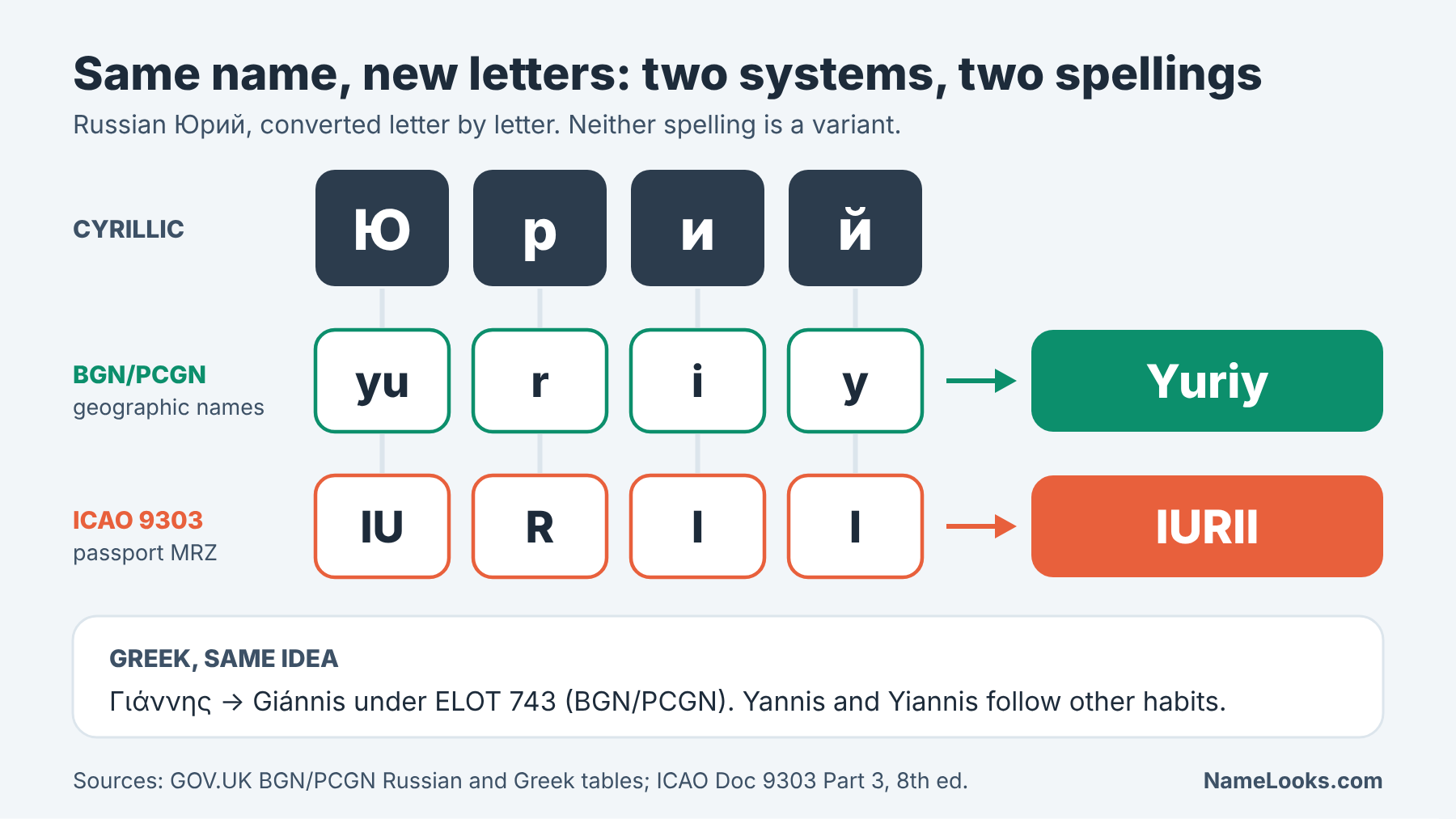
Take the Russian name Юрий. Under the BGN/PCGN system, which the U.S. Board on Geographic Names and the UK’s Permanent Committee on Geographical Names agreed jointly, Ю becomes yu, и becomes i, and й becomes y. That gives Yuriy. The system is published on GOV.UK’s romanization systems page; the Russian table dates from 1944 (BGN) and 1947 (PCGN) and was checked in November 2022.
Passports follow a different standard. The International Civil Aviation Organization’s Doc 9303, Part 3 (8th edition, 2021), sets the rules for the machine-readable zone of travel documents. It transliterates Ю as IU and Й as I, so the same name comes out as IURII. The Library of Congress Russian romanization table, used for library catalogs, writes й with a breve, as ĭ, so catalog spellings end differently again.
Greek: letter-by-letter rules versus familiar spellings
Greek gives a parallel case. The BGN/PCGN Greek table, which follows the ELOT 743 standard of the Hellenic Organization for Standardization, romanizes gamma as g before vowels. Under that table, Γιάννης becomes Giánnis. Behind the Name’s John entry lists Giannis, Yannis and Yiannis as Greek forms.
The Y spellings don’t follow the ELOT letter-by-letter table, so they look like the product of a different, more sound-oriented habit. We haven’t verified which spelling any particular community prefers, and the right one for a person is the one that person uses. The mechanics of choosing among systems are covered in our article on why Yuri, Yuriy and Iurii can all represent one source form.
Yahya and Yuhanna: when “equivalent” is the honest label
Some pairs are linked by the person they name rather than by a fully traced sound history. Arabic gives a well-known example. Behind the Name lists both Yahya and Yuhanna among the Arabic counterparts of John, and the two entries describe them differently.
What the sources say, and how far it goes
Behind the Name calls Yahya the “Arabic form of Yoḥanan (see John) appearing in the Quran,” noting that it honors John the Baptist, a prophet in Islam. It calls Yuhanna the “Arabic form of Greek Ioannes.” Britannica’s biography of John the Baptist lists Yaḥyā as another name for the same figure.
That confirms the two names are used for the same person. It doesn’t, on its own, document the sound-by-sound route from Hebrew to Arabic for Yahya. Behind the Name states the derivation without citing a source on the page, and we did not find a second scholarly reference on the linguistic route during this research.
The label we’d use
For Yuhanna, which Behind the Name ties directly to Greek Ioannes, “Arabic form of John” is a reasonable description. For Yahya, the most defensible label from what we could verify is “the name by which John the Baptist is known in the Quran and in Arabic.” That records the equivalence without asserting a linguistic route we couldn’t confirm.
This is the kind of case where a reader planning to honor a relative across languages needs care, and where a religious and cultural tradition deserves its own context rather than a one-line merge into an English name family. Our article on researching an ancient name through its earliest forms explains how to look for those earlier attestations.
3What the label changes: meaning, data and documents
It’s fair to ask why the cognate vs variant vs diminutive name distinction matters outside a linguistics seminar. The answer is that each relationship carries a different set of consequences. The label decides whether a meaning transfers, whether a count can be combined, and whether two records refer to the same spelling. Get it wrong and the error travels.
What transfers from one form to another, and what doesn’t
Meaning is the place where the labels do the most damage when confused. Name websites routinely copy a meaning from one form to every relative in a list. Sometimes that’s right. Often it isn’t, and the relationship type tells you which.
Counterparts share an etymology only if they share a source
Juan and Giovanni share John’s etymology because they share its source name. That much is a matter of tracing, and both Etymonline and Behind the Name trace it. The transfer is valid because the route is documented.
The transfer fails when the “relative” came from somewhere else. Jack is the warning case from above: if the Jacques route is right, the source is Jacob. Kathleen’s Irish step doesn’t change its root, but it does mean the history of the name includes Irish usage that a simple “variant of Catherine” label erases. Our sibling article on how meanings change through borrowing and reinterpretation goes further into what happens along the way.
Diminutives rarely carry a meaning of their own
A diminutive almost always inherits the etymology of its source name and adds only a sense of smallness or affection. Juanito means what Juan means, with the warmth that -ito adds. Bob carries Robert’s history, not a separate one.
That’s why a name site that lists a unique meaning for a pet form should make you suspicious. If a diminutive appears with a meaning unrelated to its source, either the site has confused it with an unrelated name or it’s inventing. The checklist in our piece on red flags in name-meaning claims treats this as one of the easier mistakes to spot.
The reverse mistake
Sometimes a short form is also an independent word or a separate name from another language. Jack is “often regarded as an independent name,” as Behind the Name puts it. When a pet form has become a given name on its own, describe both facts, and don’t assume a given bearer named Jack was named after a John.
Data: every spelling is its own name
Popularity data is where every cognate vs variant vs diminutive name label collapses into one rule. Official counts don’t know about cognates, variants, diminutives or transliteration. They count strings.
What the SSA background notes actually say
The SSA background notes for the baby names data are explicit. “Different spellings of similar names are not combined,” the page says, and spelling variants such as Caitlin and Katelyn are “considered separate names and each has its own rank.” Hyphens and spaces are removed, so Julie-Anne, Julie Anne and Julieanne count as one entry.
The same page notes that all names come from Social Security card applications for U.S. births after 1879, that names need at least two characters, and that names with fewer than five occurrences in a geographic area are excluded to protect privacy. Each of those rules shapes what a “rank” can tell you, and our article on how SSA birth-year counts and spelling variants work covers them in full.
Combining a family is your decision, so label it
Nothing stops you from adding Sophia and Sofia together, or John, Jon and Jack, to talk about a “name family.” But that’s an analysis you’ve built, not an SSA statistic. The relationship label you chose decides what goes in the bucket, and readers deserve to know which label you used.
A clean way to write it: “Combining the spellings Sophia and Sofia (our calculation from SSA counts, 2025).” Never present a combined total as SSA’s own rank. Our guide to tracking a name family across spelling variants explains how to do the arithmetic without misleading anyone, and why mixing cognates such as Juan into an English “John family” is usually a step too far.
Documents and records: transliteration is where identities split
The fourth relationship has the most practical bite. A person whose name is written in a non-Latin script may carry different Latin spellings in a passport, a library record, a bank file and a social media profile. None of those spellings is a nickname or a variant in the usual sense. They’re outputs of different systems.
The passport rule
ICAO Doc 9303 states that national characters “shall not” appear in the machine-readable zone, and that the issuing state “shall transliterate national characters using only the allowed OCR-B characters.” Its tables cover common Latin, Cyrillic and Arabic language families. That’s why a name with diacritics or a non-Latin script can look different in the strip of characters at the bottom of a passport than it does in the visual zone above.
How the name appears elsewhere on a document follows the issuing country’s own practice, which can change. If you’re dealing with a specific passport or record, check the issuing agency’s current guidance. This is general information, not legal advice.
Keep the source form next to every Latin spelling
The most useful habit for anyone researching or recording a name is to keep the original-script form alongside each romanized version, with a note on which system produced it. “Юрий; Yuriy (BGN/PCGN); IURII (passport MRZ)” is far easier to match across records than a bare Latin spelling.
Software standards point the same way. The CLDR person-names specification lets name data carry its own locale, separate from the locale used for display, and notes that a name from a different locale “may need to be handled differently.” Script and order can both depend on that difference. Our article on diacritics in names and how systems handle them covers the form-filling side.
| Source form | Displayed form | What changed (script, order or relationship) | Verification source |
|---|---|---|---|
| Юрий (Russian, Cyrillic) | Yuriy | Script only; BGN/PCGN table (Ю yu, и i, й y) | GOV.UK romanization systems, Russian table |
| Юрий (Russian, Cyrillic) | IURII | Script only; passport machine-readable zone rules (Ю IU, Й I) | ICAO Doc 9303 Part 3, 8th edition |
| Юрий (Russian, Cyrillic) | Catalog form ending in ĭ | Script only; library cataloging table marks й with a breve | Library of Congress Russian romanization table (2012) |
| Γιάννης (Greek) | Giánnis | Script only; ELOT 743-based letter mapping, stress mark kept | GOV.UK romanization systems, Greek table |
| Γιάννης (Greek) | Yannis or Yiannis | Script only, but not by the ELOT table; follows a different spelling habit | Ask the bearer; Behind the Name lists these as Greek forms |
| Juan (Spanish) | John (in an English text) | Language: the name is replaced by its counterpart, not converted | Etymonline and Behind the Name entries for John |
| Juanito (Spanish) | Juanito | Formality: diminutive of Juan, same language | Behind the Name (Juanito); RAE on the suffix -ito |
| Sophia (English) | Sofia | Spelling variant in English; normal form in Italian and other languages | Behind the Name (Sofia); SSA counts each spelling separately |
| van der Poel (Dutch surname) | Poel (sorted), van der (prefix) | Order and structure: surname prefix handled separately | Unicode CLDR person names, “prefix” and “core” modifiers |
The last row is a reminder that relationship isn’t the only thing that changes when a name moves between systems. CLDR’s specification uses the Dutch surname van der Poel to show how a surname prefix, the “van der,” can be handled separately from the core of the name. That’s a structure problem, not a relationship problem, but it causes the same kind of mismatched records. Our pronunciation and formatting cluster covers name order in its article on surname-first versus given-first order.
4Sort any pair of names with four questions
You don’t need a linguistics degree to settle a cognate vs variant vs diminutive name question for a pair of names. You need the oldest documented form, two references, and a fixed order of questions. The order matters, because the first question that gets a “yes” tells you which kind of change happened most recently, and stacked changes are common.
This method is meant for the moment you’ve got two forms side by side and need a label. For the wider job of checking a meaning across sources, use our step-by-step guide to verifying a name meaning across multiple sources.
Before the questions: find the oldest documented form
Start from the form a reference lists as the source, not the one you met first. Most confusion comes from comparing two modern forms directly. Compare each to the documented source instead, and the relationship usually becomes clear.
Look up both names, not just one
Open entries for both forms in at least two independent references. Etymonline and Behind the Name are a reasonable start for English-language readers. A scholarly name dictionary, a source-language dictionary or a library catalog’s authority record is better for anything disputed. Behind the Name publishes its own list of references, which is useful for finding print sources.
Write down the source form each reference names. If both point to the same source, you have a relationship worth classifying. If they point to different sources, you have a disagreement to report, and you can skip the labeling until you’ve resolved it.
Note the language and script of every step
For each step on the route, record two things: the language community and the writing system. John’s route through Hebrew, Greek, Latin and French is a chain of language changes. Юрий to Yuriy is a script change with no language change at all. Keeping the two columns separate is the trick that makes the four questions work.
If a reference doesn’t give the route, note that too. “Route not documented in the sources checked” is a legitimate finding. It’s better than filling the gap with a guess.
The four questions, in order
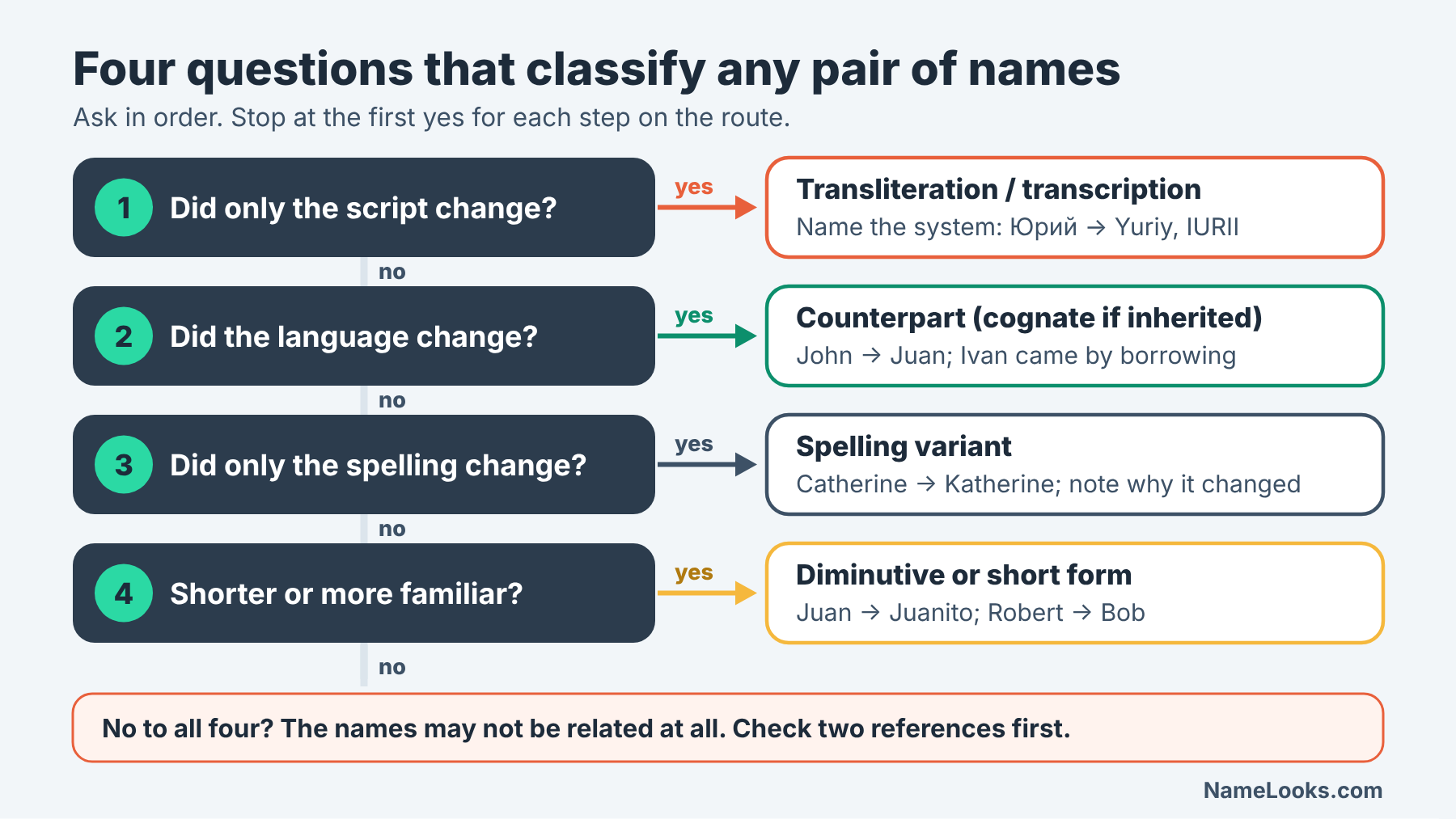
Ask these in sequence about the step between the two forms you’re comparing. Stop at the first “yes” for that step, then move to the next step on the route if there is one.
Question 1: Did only the script change?
If the language is the same and only the writing system changed, the relationship is transliteration or transcription. Find out which system produced the spelling: BGN/PCGN, ICAO, a library standard, an older habit, or the person’s own choice. Don’t call it a variant, and don’t call one spelling wrong because another system exists.
Question 2: Did the language community change?
If the name moved into a different language, the result is a counterpart. Then decide whether “cognate” in the strict sense applies. That requires both forms to descend from a common ancestor by inheritance, as Juan and Giovanni arguably do from Latin. If the name arrived by borrowing, as Ivan did from Greek, say “counterpart” or “form in another language.”
Question 3: Did only the spelling change, within one tradition?
If the language, script and formality stayed the same and only the letters differ, you have a spelling variant: Sidney and Sydney, Catherine and Katherine. Check whether the spelling change carries a history of its own. Katherine’s h, as both references note, reflects a reinterpretation, and that’s worth a sentence.
Question 4: Did it get shorter, smaller or more familiar?
If the form is shorter, carries an affectionate ending, or swaps sounds in a pet-name pattern, it’s a diminutive, short form or pet form. Say which mechanism if you can: suffix (Juanito), clipping (Kate), or altered pet form (Peggy, Bob). If the references don’t explain the mechanism, don’t invent one.
- Script only? Transliteration or transcription. Name the system.
- Language changed? Counterpart. Use “cognate” only if inherited, not borrowed.
- Spelling only? Variant. Note any history behind the new spelling.
- Shorter or warmer? Diminutive or short form. Name the mechanism if documented.
When the honest answer is “more than one”
Plenty of real pairs need two or three labels, one for each step, so a single cognate vs variant vs diminutive name verdict can be the wrong goal. That’s not a failure of the method. It’s the method working. The mistake is forcing a multi-step relationship into a single word.
Stacked relationships
Consider the English spelling Vanya next to English John. Working back: Vanya is a Latin-alphabet spelling of a Russian form (script step), Russian Vanya is a diminutive of Ivan (formality step, per Behind the Name), and Ivan is the Russian counterpart of John, from Greek Ioannes (language step, per Etymonline). So Vanya is not “the Russian cognate of John.” It’s a romanized Russian diminutive of John’s Russian counterpart.
That sounds fussy. It’s also the only description that won’t mislead someone who later meets a man named Ivan and wonders why his friends call him Vanya. It also signals register, which matters: Wikipedia’s overview of Eastern Slavic naming customs, useful as a pointer rather than an authority, describes some colloquial forms as potentially rude outside friendly contexts.
When the references disagree
Sometimes the four questions give different answers depending on which reference you follow. Jack is a diminutive of John under Behind the Name’s account; under Etymonline’s favored route, it began as a French form linked to Jacques. Kathleen is a variant under one reference and an anglicized Irish form under the other.
In those cases, report both, attribute each, and resist averaging them into a vague compromise. “Sources disagree” is information. Our cluster guide to tracing a name’s origin step by step covers how to weigh sources when you need to go further than two.
Wording that keeps a name page accurate
Most relationship errors on the web aren’t research failures. They’re phrasing failures: a careful finding gets compressed into a sentence that claims more than the evidence. Small wording choices prevent that.
Phrases that hold up
- “X is the Spanish form of Y” for a counterpart, without implying the strict sense of cognate.
- “X and Y are spelling variants of one name” when neither is clearly primary.
- “X is a diminutive of Y (Source A); the reason for the sound change is not documented (Source B).”
- “X is a romanization of [original script form] under [system].”
- “Sources disagree: A describes X as…, while B describes it as…”
Each of these keeps the relationship type visible and leaves room for the evidence. They’re slightly longer than the one-word labels on most name sites. That’s the cost of being right.
Phrases that quietly overclaim
“X means the same as Y” is the most common. It’s true for counterparts and diminutives that share a source, and false for names that only look similar. “The original spelling” is the next: unless a reference identifies one spelling as older, it’s an opinion. “The correct English spelling” of a transliterated name is a third. There may be a conventional spelling, but correctness depends on the system and on the person.
A fourth is less obvious: “X is the nickname for Y.” Many pet forms attach to more than one formal name, and some are independent names now. Vanya, by Behind the Name’s account, is a diminutive of Ivan in Russian and of Ivana in Bulgarian. “A common pet form of” is safer than “the nickname for.”
5Where the distinction changes a real decision
Most people meet these labels while doing something practical: honoring a relative, searching old records, picking a name for the nickname they love, or writing about a name for others. The scenarios below are hypothetical, built to show how the labels change the decision. They aren’t reports about real families.
Honoring someone across languages
A counterpart is the most common way to honor a relative whose name belongs to another language. It’s also where the cognate vs variant vs diminutive name confusion has the most emotional weight, because people want the honor to “count.”
A hypothetical: Giovanni to John
Picture a family in an English-speaking country who want to honor a grandfather named Giovanni. They’re considering John, Jack and Gianni. The relationship labels sort the options quickly. John is the English counterpart of Giovanni, with a shared source in Latin Iohannes, per both Etymonline and Behind the Name. Gianni is an Italian form that Behind the Name lists in John’s family, so it keeps the Italian sound.
Jack is the interesting one. In English use, it has long been treated as a familiar form of John. But as we saw, one reputable reference thinks its route ran through French Jacques. If the family’s goal is a documented connection to Giovanni, John is the safer choice, and Jack is a defensible nickname for it. If the goal is a feeling of connection, Jack may be enough. Either way, they now know which claim they’re making.
What a counterpart carries, and what it doesn’t
A counterpart carries the shared source and, usually, the religious or historical associations of a famous bearer. It doesn’t carry the sound, and it may not carry the cultural texture of the original. Some families choose the original form for that reason; others choose the counterpart so the name works smoothly in the language their child will grow up in.
Neither choice is more authentic. The useful step is to say out loud which one you’re making. Our framework for making a naming decision without endless lists treats honor names as one factor among several, and it’s worth reading before you settle the question.
Searching family records
Genealogy is where transliteration and variant spelling cause the most lost hours. A relative may appear under several spellings across documents, and each one can be “right” for the record that holds it. The labels tell you which spellings to search for.
Search by relationship type, not by one spelling
For a relative whose name was originally written in another script, build a search list in three layers. First, the original-script form, if you know it. Second, the romanizations that different systems would produce: a geographic-names table, the passport standard, and a library catalog table. Third, spelling variants and counterparts in the language of the country where the records were made.
Keep these in separate columns rather than one long list. If a record turns up under a counterpart, such as an English form used in place of the original, that tells you something different from finding a transliteration. The first suggests someone used a translated name; the second only shows a different spelling system.
Don’t treat a spelling change as a story
It’s tempting to read a lot into a spelling change between two documents. Sometimes there’s a story. Often there’s just a clerk using a different system, or a person choosing a spelling that was easier to use in daily life. Don’t infer anything about a person’s background, beliefs or intentions from the spelling alone.
What you can do is record the spelling, the document, the date and the system if it’s identifiable. That’s evidence. A guess about why the spelling changed isn’t, unless a document says so.
Choosing a formal name for a nickname you love
Plenty of parents start with the nickname. They love Kate, Bob or Juanito, and need a formal name to sit behind it. Here the diminutive label does the work, but only if the pairing is documented.
Work back from the pet form to documented sources
Look up the pet form first and note which full names the references connect it to. Kate connects to Katherine and its variants, which Behind the Name lists among Katherine’s diminutives along with Kit, Kitty and Kay. Bob connects to Robert. If a reference lists more than one source name, you have a choice; if it lists none, the pet form may be used as a standalone name.
Then check whether the pairing is obvious to strangers. Kate from Katherine is widely recognized. Peggy from Margaret is documented but less transparent, so people may not make the link. Decide whether you want the nickname to follow the name naturally or to be something only family uses.
Pet forms don’t always travel
A diminutive that sounds affectionate in one language can carry a different register in another. Wikipedia’s overview of Eastern Slavic naming customs, for instance, distinguishes short forms used in ordinary informal speech from colloquial forms that can sound rude outside a friendly setting. If a family speaks more than one language, check the pet form’s register in each, ideally with a fluent speaker.
There’s also the software problem. CLDR’s informal-name modifier returns the normal name when no informal version is stored. In practice, that means most systems will print the formal name unless someone has entered the nickname deliberately. If the pet form is what a child will be called, it helps to know that forms and databases won’t guess it.
Writing about a name for other people
If you’re writing a name profile, a family history or a classroom handout, getting each cognate vs variant vs diminutive name label right is your main defense against repeating a myth. A reader can’t check your sources if you don’t name them, and they can’t judge your claim if you hide which relationship you mean.
A short template for a relationship paragraph
- State the source form and its language, with one or two named references.
- State the relationship for each step between the source and the form you’re describing.
- Give the meaning only at the level where it’s documented, usually the source name.
- Add any disagreement between references, with attribution.
- If spellings come from a script conversion, name the system.
Five sentences built this way will be more useful than a page of names copied from a list. They also make your work checkable, which is the real test of a name page. The research approach in our overview of onomastics as a field explains why names scholars treat relationships as claims needing evidence.
A quick self-check before you publish
Read your paragraph once and ask three questions. Does every relationship word (counterpart, variant, diminutive, romanization) match one step on the route? Does every meaning attach to a form whose etymology is documented? Does every disputed point say who disputes it? If the answer to all three is yes, the paragraph is ready. If not, it’s cheaper to fix now than after it’s copied.
If you only have five minutes
Open two references for both names, find the shared source form, and ask the four questions in order. Write one sentence per step.
If the references disagree
Quote both briefly, attribute each, and don’t merge them into a single claim. Add a third source only if you can find one that cites evidence.
If scripts are involved
Keep the original-script form, name the romanization system for each Latin spelling, and ask the person which spelling they use.
Questions people actually ask
Is a nickname the same thing as a diminutive?
Not always. A diminutive is a form derived from the name itself, such as Juanito from Juan or Bob from Robert. A nickname can be anything people call you, including words unrelated to your name. Every pet form of a name can serve as a nickname, but plenty of nicknames aren’t diminutives.
Can a diminutive become a full legal name?
In many places, yes. Jack is a widely used given name in its own right, and Behind the Name notes it “is often regarded as an independent name.” Whether a particular form can be registered depends on the rules of the place of registration, which vary and change, so check with the registering authority.
Do cognates always sound alike?
No. Ivan and John share a source but sound quite different, because the name passed through Greek and Slavic sound patterns on one side and French and English on the other. Sound similarity is a weak clue; a documented route is the real evidence.
Are two names related just because they look similar?
No, and this is one of the most common traps. Look-alike names can come from unrelated sources. Behind the Name, for example, describes Jacques as unrelated to John even though it may have influenced Jack. Check the source form in two references before you assume any relationship.
Which romanized spelling of a name is the correct one?
For a person, the one they use. For a document, the one the issuing system produces. For a library catalog or map, the one its standard prescribes. A single Cyrillic name can be correct as Yuriy under BGN/PCGN and IURII under the passport standard at the same time.
Does a feminine form count as a variant?
It’s a separate relationship. A feminine form adapts a name for a different gender, often with a new ending, as Behind the Name’s John entry lists Johnna and Johna. It is neither a spelling variant nor a diminutive, though references sometimes group it with both. Label it as a feminine form and cite the source.
Sources and further reading
- Online Etymology Dictionary (entries for John, Jack, Peggy, Catherine, Sophia, Ivan): dated, hedged etymologies with named sources; good for routes through English.
- Behind the Name (entries for John, Jack, Peggy, Bob, Katherine, Kathleen, Sofia, Vanya, Juanito, Yahya, Yuhanna): a secondary index with relationship labels; cross-check disputed claims.
- Behind the Name glossary: its working definitions of cognate, variant, diminutive and transcription.
- Merriam-Webster (cognate, diminutive): shows the strict and broad senses of “cognate” side by side.
- Ciobanu and Dinu, Computational Linguistics, 2019: a peer-reviewed definition separating cognates from borrowings.
- Real Academia Española, Diccionario de la lengua española: the diminutive and affectionate value of -ito.
- Unicode CLDR transliteration guidelines: reversible transliteration versus lossy transcription.
- Unicode CLDR person names (version 49): informal name fields, surname prefixes and name locale.
- GOV.UK romanization systems (BGN/PCGN): current Russian and Greek tables for geographic names.
- ICAO Doc 9303 Part 3: transliteration rules for passport machine-readable zones.
- Library of Congress Russian romanization table: the catalog standard for Cyrillic.
- SSA baby names background and SSA top-five names: how U.S. counts treat spellings, and the 2025 top five.
NameLooks provides general information about names, not legal or genealogical advice. Popularity data describes populations, not individuals, and rules for registering names, transliterating them on documents, or changing them depend on the jurisdiction and change over time.