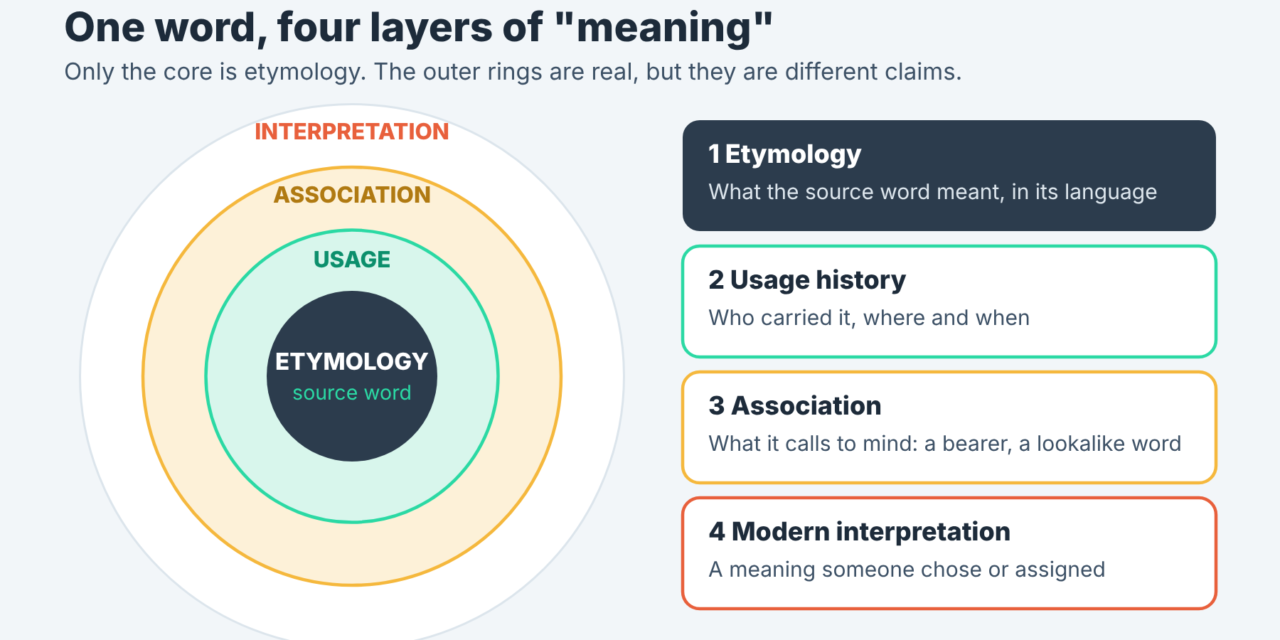
In the strict sense, a name’s meaning is its etymology: the literal sense of the word or word-parts the name was built from, in the language where it was formed. Everything else people call “meaning” is something different, namely who carried the name, what it reminds people of, or what someone has decided it stands for. So when you ask what does name meaning mean, the useful answer is a map of those four layers, with the evidence each one needs. This page draws that map using a handful of names whose histories are actually documented, and shows where even good references disagree.
The short version
- “Meaning” is four claims in a trench coat. Etymology, usage history, association and modern interpretation are different statements, and each is checked against a different kind of source.
- Some names have no source-word meaning at all. Vanessa was built by a writer from pieces of a real woman’s name. Asking what it “means” in the dictionary sense gets you a story, not a gloss.
- A lookalike word is not an origin. Linda resembles the Spanish and Portuguese word for “beautiful,” but the references we checked treat that as a coincidence of form.
- “Unknown” is a legitimate answer. The earliest layer of Mary is unresolved in both references we opened, and a site that gives you one tidy gloss is hiding a debate.
- Interpretation is allowed. Just label it. Choosing a name because of what it means to your family is fine. Presenting that personal reading as etymology is where the trouble starts.
1What does name meaning mean? Four different claims behind one word
Here is the whole answer up front. When a website, a relative or a baby-name book says a name “means” something, the claim usually belongs to one of four layers. They stack on top of each other, and they get looser the further you move from the core.
- Etymology. What the source word or word-parts meant in the language where the name was formed. This is the only layer a historical linguist would call the name’s meaning in the narrow sense.
- Usage history. Who has carried the name, where and when. Saints, rulers, fictional characters and official popularity data live here.
- Association. What the name calls to mind now: a famous bearer, a song, a flower, or a word in another language that happens to look similar.
- Modern interpretation. A meaning someone chose or assigned, such as a family’s reason for the name or a symbolic gloss printed on a nursery poster.
None of these is fake by default. The problem is labeling. A sentence like “Linda means beautiful” mixes the association layer into the etymology slot, and once that sentence gets copied a few hundred times, nobody can see the seam. Most of the work of reading name meanings well is putting each claim back on its own layer.
For the broader research process, including how to work through older sources and which references to trust, our guide to researching name meanings and origins is the place to start. This page stays narrower. It’s about the word “meaning” itself, and what it can and can’t promise.
The strict sense: etymology describes the word, not the person
Etymology answers a historical question about language. Where did this form come from, and what did its parts mean to the people who first put them together? It says nothing about the child who receives the name today, and it isn’t a forecast of anyone’s character.
What onomastics and the philosophy of language actually say
Onomastics is the academic study of names. The American Name Society, founded in 1951 and publisher of the journal NAMES, defines the field as “the study of the origin, history, and use of proper names.” Notice the three nouns. Origin, history and use are separate items in that definition, and they line up neatly with the first two layers above. If you want the longer tour of the discipline, our explainer on onomastics as a field covers it.
Philosophers have argued for a long time about whether proper names have meaning at all, in the way ordinary words do. The Stanford Encyclopedia of Philosophy entry on names uses a neat example. A child can be named Merlot, and the name applies to that child without any link to the grape. The entry traces this line of thinking back to John Stuart Mill, writing in 1843, and notes that many philosophers find it intuitively compelling that names refer without carrying meaning in the usual sense.
That sounds abstract, but it has a practical edge. A name works as a label for a person whether or not anyone knows its etymology. The source-word meaning is real history. It just isn’t doing the job of identifying the person, and it doesn’t constrain who the name can belong to.
Where the strict sense runs out
Etymology assumes there’s a source word to trace. Some names don’t have one. A name coined by an author, built from pieces of another name, or spelled backwards from an English word has a history of creation rather than a lexical meaning. You can explain how it was made. You can’t honestly say it “means” a dictionary word unless that’s how it was built.
Other names do have a source word, but nobody knows for certain what it was. In those cases, the honest etymology is “uncertain,” followed by the competing proposals. That answer frustrates people who wanted one word for a gift card. It’s still the correct one, and the examples in the next section show what it looks like in practice.
A quick test for any meaning claim
If someone asks you what does name meaning mean for a particular name, answer with a question of your own: “Meant what, to whom, when?” If the claim can’t answer all three (a language, a community or period, and a source), it’s probably an association or interpretation that has been promoted to etymology. That doesn’t make it worthless. It makes it mislabeled.
The three looser senses: usage, association and interpretation
Most of what people care about when they talk about a name’s meaning sits outside etymology. That’s fine. Parents rarely choose a name for its Proto-Germanic root. They choose it for a grandmother, a book, a sound, a feeling. The point isn’t to dismiss those reasons. It’s to call them what they are.
Usage history: who carried it, where and when
Usage history is documented fact about people rather than words. It includes the saints, rulers and writers who bore a name, the fictional characters who made it famous, and the population data that shows how often it was given. For U.S. births, the official record is the Social Security Administration’s baby-name data. Its table of the top five names for each year from 1926 to 2025 shows, for example, that Linda was the most frequent girls’ name among U.S. births every year from 1947 through 1952, with Mary at number one on either side of that run.
That fact tells you something true about the name’s history in one country. It tells you nothing about what the name meant to its original speakers. Usage and origin are different questions, and they can point to entirely different languages. Our piece on why a name can come from one language but be used in another culture works through that gap in detail.
Association and interpretation: what it calls to mind vs what someone decides it signifies
Association is what the name triggers for a listener today. It might be a celebrity, a fictional character, a flower, or a word in another language that looks the same. Associations are real and often matter more in daily life than etymology. They also shift with each generation and differ between communities, so they can’t be stated as universal facts.
Interpretation is the layer where a person or publisher assigns a meaning. Sometimes that’s a family’s own reason: “we chose it because it sounds like light to us.” Sometimes it’s a symbolic gloss that a website repeats as if it were history. The first is honest and personal. The second is the most common source of the myths our guide to folk etymology and copy-paste name meanings takes apart.
The table below lines up the vocabulary you’ll meet when reading name references, with one verified example for each and the mistake that most often attaches to it.
| Term | What it means | Checked example | Context | Common mistake |
|---|---|---|---|---|
| Etymology | The documented history of a form back to its source word or parts | Margaret traces to Greek margaritēs, “pearl” (Behind the Name; Etymonline) | Language of formation, not language of current use | Treating it as a statement about the bearer’s personality |
| Source-word meaning | The literal gloss of the underlying word | Daisy, from Old English dægesege, “day’s eye” (Etymonline; Behind the Name) | Old English flower word, later a given name | Forgetting the name may have taken a different route than the word |
| Coinage | A name invented by a known person rather than inherited from vocabulary | Vanessa, built by Jonathan Swift from parts of Esther Vanhomrigh’s name (Behind the Name; Etymonline) | English literature, 18th century | Inventing a dictionary meaning for a name that never had one |
| Pet form / diminutive | An affectionate or shortened form of another name | Daisy recorded as a pet form of Margaret (Etymonline; Oxford Dictionary of First Names, as cited by Wikipedia) | English, via French marguerite for the daisy | Assuming every reference will list the same nicknames |
| Cross-language form | The same name reshaped by another language or script | Hebrew Miryam, Greek Mariam/Maria, Latin Maria, English Mary (Behind the Name; Etymonline) | Biblical transmission through several languages | Treating the English form’s associations as the original sense |
| Usage history | Documented use by people, places and periods | Linda: #1 U.S. girls’ name 1947–1952 (SSA top-5 table) | U.S. births, Social Security card data | Reading popularity as evidence of origin |
| Association | What the name evokes for a given audience | Vanessa is also a butterfly genus, named in 1808 for unknown reasons (Etymonline) | Varies by generation and community | Writing an association as if it were the source |
| Lookalike word | A word in another language that happens to share the spelling | Spanish/Portuguese linda, “beautiful,” vs the Germanic-derived name Linda (Behind the Name; Wikipedia) | Coincidence of form across languages | The single most common way a false meaning is born |
| Modern interpretation | A meaning assigned by a person, family or publisher | Nevaeh, built as “heaven” spelled backward (Behind the Name; Wikipedia) | U.S., popularized from 2000 | Printing a symbolic gloss for an old name as though it were history |
If the rows on pet forms and cross-language forms feel like they deserve more room, they do. The differences between a cognate, a variant, a diminutive and a transcription are subtle enough to have their own page: see how names relate to each other across languages and nicknames.
2Five documented names, taken apart layer by layer
Definitions only go so far, and the question of what does name meaning mean is easier to answer with real cases than in the abstract. The quickest way to see the four layers is to watch them pull apart in real names. We picked five whose histories are covered by more than one reputable reference, and we opened at least two for every claim below. Where the references disagree, we say so rather than picking the tidier story.
The two references we lean on most are Behind the Name, a long-running site that lists the dictionaries it draws from (Hanks and Hodges, Withycombe, Beekes and others), and the Online Etymology Dictionary, usually called Etymonline. Both are secondary sources. They’re good at summarizing scholarship and honest about uncertainty, but neither replaces a scholarly dictionary when a claim really matters. Where we use Wikipedia, it’s as a pointer to the printed references it cites.
Vanessa: a name with an author instead of an etymology
Vanessa is the cleanest case of a name whose “meaning” is a creation story. There’s no older word underneath it. There’s a writer, a friend, and a bit of syllable-shuffling.
What the two references agree on
Behind the Name’s Vanessa entry says Jonathan Swift invented the name for his poem Cadenus and Vanessa, assembling it from the first syllables of the given name and surname of his close friend Esther Vanhomrigh. Etymonline’s entry agrees on the essentials and adds a detail: the name was formed by putting the first syllable of Vanhomrigh in front of Hessy, a pet form of Esther. It cites a nineteenth-century church history by William Monck Mason for that reading.
So the defensible statement is not “Vanessa means butterfly” or “Vanessa means star.” It’s this: Vanessa is a literary coinage by Jonathan Swift, made from parts of Esther Vanhomrigh’s name. That sentence is longer than a one-word gloss, and it’s also true.
The references don’t agree on everything. Behind the Name dates the poem to 1726. Etymonline says Swift was using the name in private letters by about 1711 and gives 1713 for the poem. That gap may reflect when the poem was written versus when it was printed, but neither entry spells that out for us, so if a date matters to your project, check a literary reference on Swift before you print one.
Where the butterfly comes in, and why it isn’t the origin
Vanessa is also the name of a butterfly genus. Etymonline says the Danish entomologist Johan Christian Fabricius named it in 1808, that the genus includes the red admiral and the painted lady, and that his reasons are unknown. It mentions a proposed link to a Greek word and calls that idea unconvincing. Behind the Name also notes the butterfly genus as a later development.
That’s a textbook association. A parent who loves butterflies can reasonably feel the name has a butterfly connection, and that’s a legitimate personal reading. What doesn’t hold up is the claim that the name comes from the butterfly. On the references we checked, the name came first, the genus came eight or nine decades later, and nobody knows whether Fabricius was thinking of Swift at all.
Behind the Name adds a usage note: the name was rare until the middle of the twentieth century, when it became fairly popular. Etymonline says it was rarely used in the U.S. before 1950. Those are usage-history claims, separate from the coinage story, and you’d check them against SSA’s data for U.S. births if you needed specifics.
Linda: when a lookalike word takes over the meaning
Linda is the case most people get wrong, and it shows how an association can quietly replace an etymology. Ask around and plenty of people will tell you Linda means “pretty” or “beautiful.” The references we opened treat that as a coincidence of spelling.
The Germanic element, and two readings of it
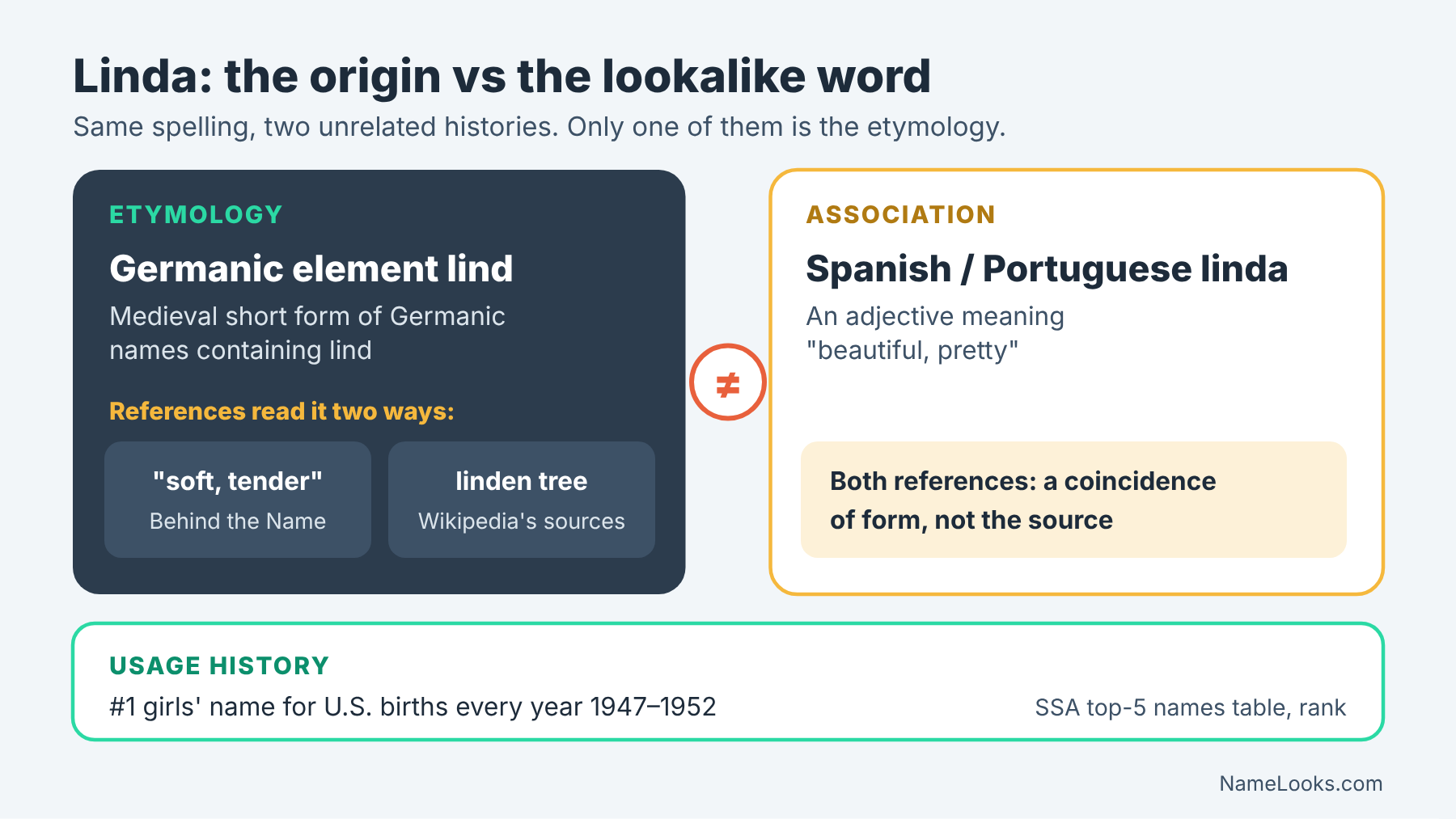
Behind the Name describes Linda as originally a medieval short form of Germanic names containing the element lind, which it glosses as “soft, flexible, tender,” and traces back to Proto-Germanic. The Wikipedia article on Linda as a given name, which cites Withycombe’s dictionary of English Christian names and the Duden lexicon of first names among others, frames it a little differently. It connects the element to the linden tree, possibly by way of a shield made from linden wood, and says the name may have become associated with the sense “soft” or “tender.”
Both readings agree on the big picture: a Germanic name element, a medieval short form, an origin that has nothing to do with Spanish. They differ on what the element pictured. Was it the quality (soft, pliant) or the tree and its wood? Wikipedia’s hedged phrasing (“possibly,” “may have”) is a signal that the printed sources behind it aren’t settled either.
The honest summary is something like: “Linda comes from a Germanic name element, lind; references differ on whether its core sense was ‘soft, tender’ or connected to the linden tree.” That’s two lines, it’s checkable, and it doesn’t invent certainty.
Spanish linda and the mid-century peak
In Spanish and Portuguese, linda is the feminine form of an adjective meaning “beautiful” or “pretty.” Behind the Name points out the resemblance and treats it as a coincidence in form. Wikipedia calls the Spanish word unrelated to the Germanic name and suggests the resemblance may have added to the name’s appeal. Both references, in other words, put “beautiful” on the association layer.
The usage layer is easy to check. The SSA top-five table shows Linda as the most frequent girls’ name for U.S. births every year from 1947 through 1952. Wikipedia credits part of that rise to a 1946 song titled “Linda” by Jack Lawrence. We didn’t find a second reference for the song’s effect in this session, so treat it as a lead worth checking rather than a fact.
Notice how the three layers stack. A Germanic element at the core. A huge American usage spike in the late 1940s. An association with a Spanish adjective that many speakers now treat as the meaning. If you only saw the top layer, you’d come away with exactly the wrong origin.
Daisy: a flower word that also worked as a nickname
Daisy looks like the simplest kind of name there is: a flower. It turns out to have two separate routes into use as a given name, and one of our references mentions only one of them.
The word’s own history: “day’s eye”
Etymonline’s entry for daisy traces the flower word to Old English dægesege, from dæges eage, “day’s eye,” because the petals open at dawn and close at dusk. Behind the Name’s Daisy entry gives the same Old English source and the same gloss, and adds that it came into use as a given name in the 1800s, when many plant and flower names were adopted.
That’s an unusually well-supported source-word meaning. Two references agree, the gloss is concrete, and the reason for it (the flower’s daily habit) is stated. If you’re writing “Daisy comes from an Old English word meaning ‘day’s eye’,” you’re on solid ground.
The Margaret connection, and why one reference leaves it out
Here’s where it gets interesting. Etymonline says Daisy as a woman’s name is said to have originally been a pet form of Margaret. The Wikipedia article on Daisy as a given name gives the mechanism: Marguerite, the French form of Margaret, is also a French name for the oxeye daisy. It cites the Oxford Dictionary of First Names (Hanks, Hardcastle and Hodges, 2006) and The Baby Name Bible for that link.
Behind the Name’s Daisy page, when we checked it, didn’t mention Margaret at all. Its Margaret page lists Maggie, Peggy, Meg and Madge among the diminutives, but not Daisy. That’s not a contradiction exactly. It’s an omission, and omissions are a normal part of reading references. Different works choose what to include.
So Daisy has a source-word meaning (“day’s eye”) and a separate relationship (pet form of Margaret, via the French flower name). Margaret itself has its own etymology: Greek margaritēs, “pearl,” which both Etymonline and Behind the Name say was probably borrowed into Greek from an Iranian or Indo-Iranian language. A family naming a Daisy after a grandmother Margaret is drawing on a real, documented connection. A website that says “Daisy means pearl” has collapsed two names into one.
Mary and Wendy: when the honest answer is “uncertain”
The last two names show the two most common kinds of uncertainty. With Mary, the path through languages is clear but the starting point isn’t. With Wendy, everyone agrees on what made the name famous, but the accounts of where it came from don’t line up.
Mary: a well-traced path with an unresolved starting point
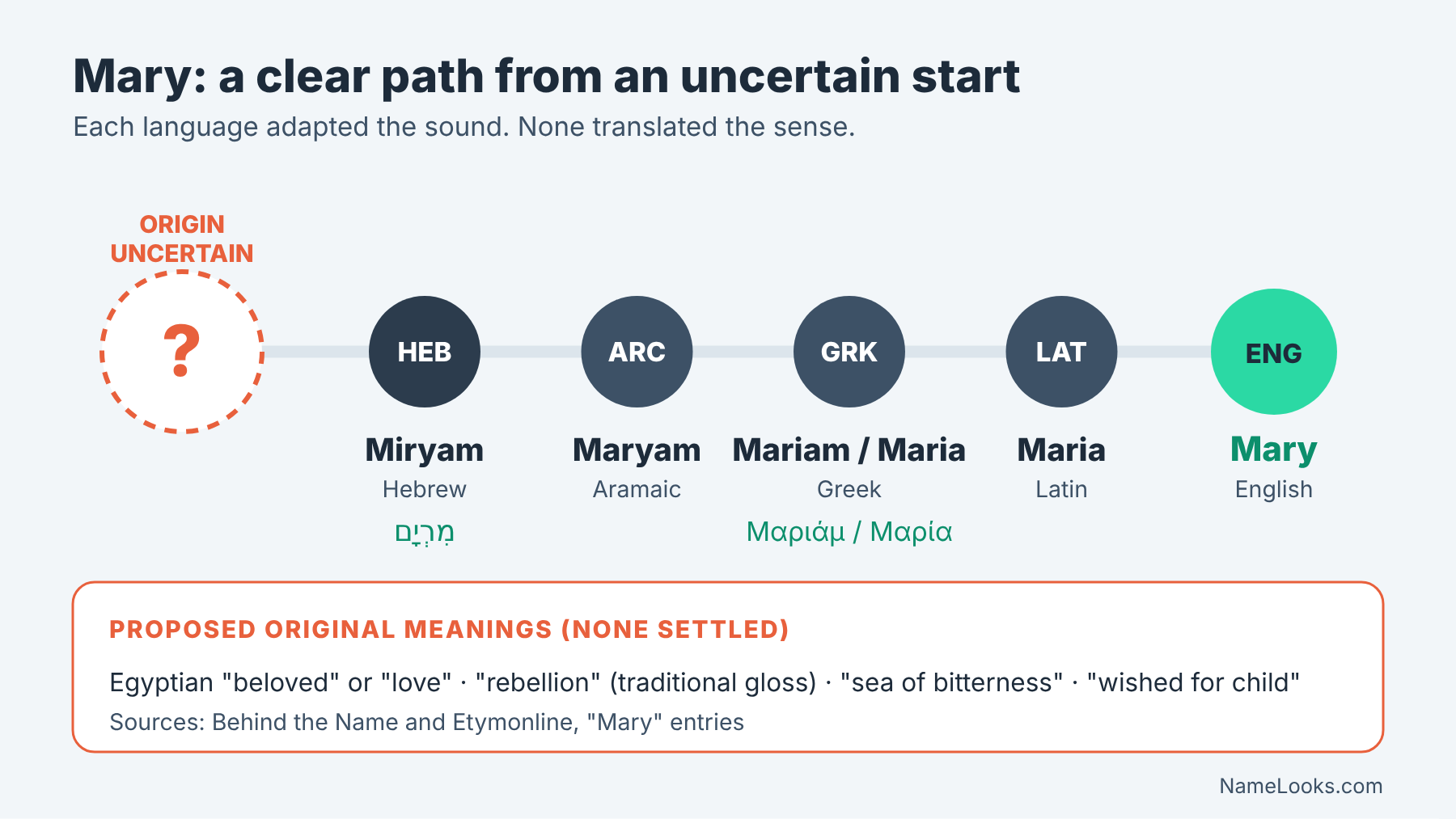
Etymonline traces Mary from Hebrew Miryam, the name of Moses’ sister in Exodus, through Aramaic Maryam, Greek Mariam or Maria, and Latin Maria, into Old English. Behind the Name gives the same Hebrew, Greek and Latin stages and notes that the Greek forms Mariam and Maria were interchangeable.
The meaning of Miryam is another matter. Etymonline calls it a word of unknown origin and mentions that it is traditionally glossed “rebellion.” Behind the Name says the meaning is not known for certain, lists several proposals (“sea of bitterness,” “rebelliousness,” “wished for child”), and suggests the name was most likely Egyptian in origin, perhaps from a word for “beloved” or “love.”
If a baby-name site tells you Mary simply means “beloved” or “bitter,” it has picked one proposal out of a debate. The defensible version: “Mary comes, via Latin and Greek, from Hebrew Miryam, whose original meaning is uncertain; proposals include an Egyptian word for ‘beloved’ and traditional glosses such as ‘rebellion’.” Longer, yes. Also the only version that won’t embarrass you in front of someone who has read the references.
Wendy: coined, popularized, or older? Three accounts
Etymonline’s Wendy entry says the name was apparently coined by J. M. Barrie, author of Peter Pan, and points to his 1911 book Peter and Wendy. Behind the Name says that for the character in Barrie’s play, first performed in 1904, the name came from “fwendy,” a child’s pronunciation of “friend” used by a young friend of Barrie’s. It adds that the name had been used rarely before the play, possibly from Welsh names beginning with the element gwen, and that it only became common after the play ran.
The Wikipedia article on Wendy names the young friend as Margaret Henley, daughter of the poet W. E. Henley, but its sources for that story are a company history page and a popular trivia book. It also cites seventeenth-century records of Wendy as a man’s given name and as a surname in England.
So we have three positions. Coined by Barrie. Popularized by Barrie but recorded earlier, perhaps linked to Gwen- names. Recorded earlier as a male name and surname. What all three agree on is the usage layer: Barrie’s work made the name common. What they don’t settle is the etymology. A careful writer says exactly that, rather than “Wendy means friend,” which turns an anecdote about a child’s pronunciation into a dictionary gloss.
Why these five and not fifty
Each name here earns its place by showing a different way the layers separate: a coinage (Vanessa), a lookalike word (Linda), two routes into use (Daisy), an unknown starting point (Mary) and competing origin stories (Wendy). Adding more names would add length, not insight. When you want the full single-name treatment, with usage data over time, our profile of the name Olivia shows what that looks like.
3Why the label on a meaning changes what you can claim
So what does name meaning mean once you start doing actual research? This can look like pedantry. It isn’t. The layer a claim sits on decides what kind of evidence can support it, what kind can refute it, and how confident you’re allowed to sound. Mislabel the layer and you end up using the wrong source, or defending a claim nobody can prove.
For research: each layer answers to a different kind of source
Picture a researcher with three tabs open: an etymological dictionary, the SSA data, and a fan wiki about a television show. Each one is the right tool for one layer and the wrong tool for the others. The mistake isn’t using any of them. It’s using one to answer another’s question.
Which reference answers which layer
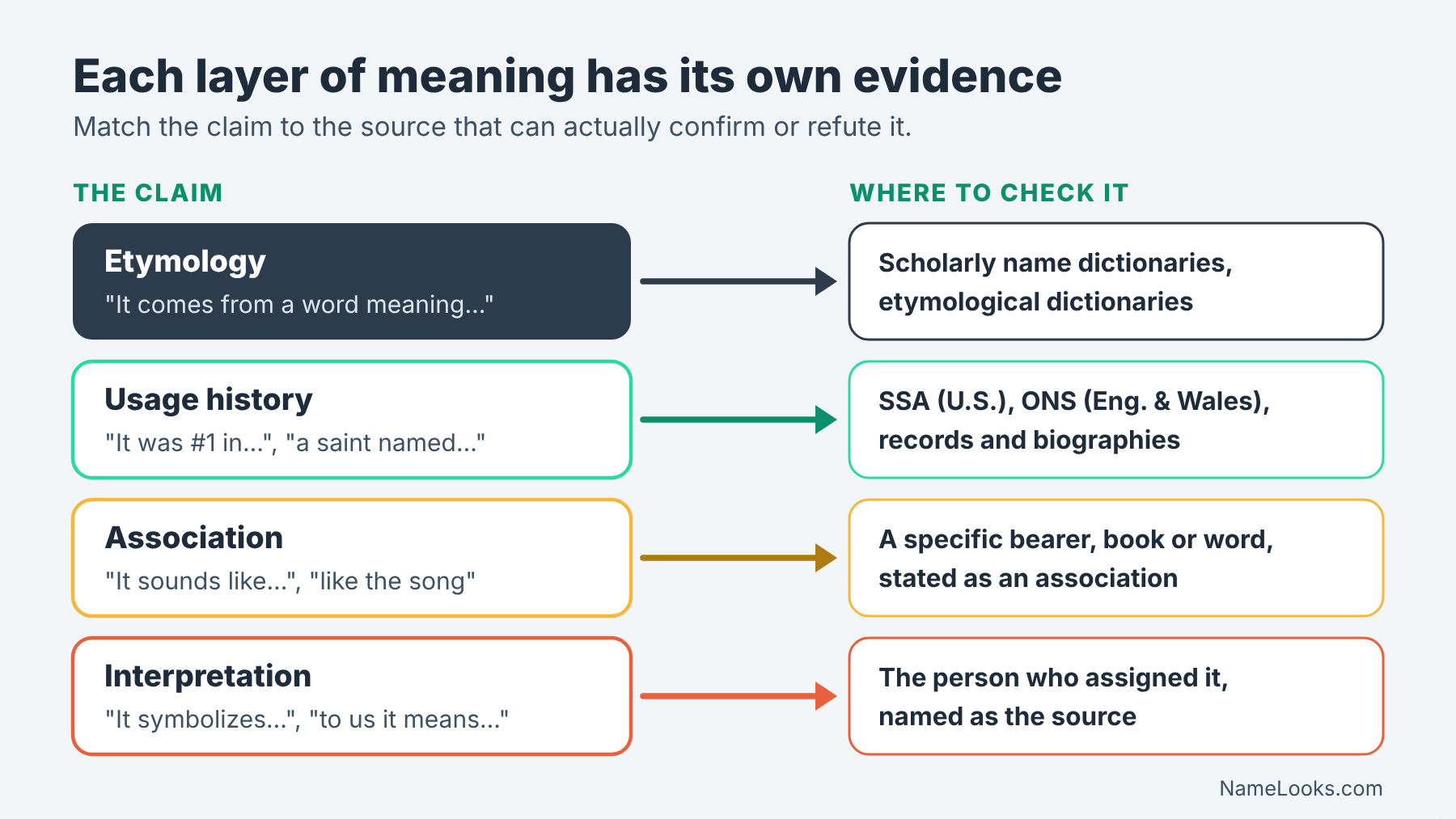
Etymology needs historical-linguistic evidence: scholarly dictionaries of names, etymological dictionaries of the source language, and early written attestations. Secondary references like Behind the Name and Etymonline are useful for locating that scholarship, because both tell you what they draw on. A baby-name site that cites nothing is not evidence for this layer, however confident it sounds.
Usage history needs records of real use. For U.S. births, that’s SSA’s data. Its background page explains that the names come from Social Security card applications for U.S. births after 1879, that different spellings such as Caitlin and Kaitlyn are not combined, and that names with fewer than five occurrences are left out for privacy. For England and Wales, the equivalent is the ONS; for historical bearers, biographies and primary records.
Association and interpretation need something else entirely: evidence about how people perceive a name now, or a clear statement of who assigned a meaning and why. That evidence is usually thin, which is exactly why claims on these layers should be phrased as observations or choices rather than facts.
- Etymology: scholarly name dictionaries, etymological dictionaries, early attestations.
- Usage history: SSA (U.S. births), ONS (England and Wales births), Census 2020 (U.S. population names), biographies.
- Association: cultural context you can point to, such as a specific book, song or bearer, stated as an association.
- Interpretation: the person who chose the meaning, named as such.
If you’re building a research habit around this, the step-by-step version, including how to cross-check two references and what to do when they disagree, lives in our guide to checking a name meaning across multiple sources. For names whose earliest forms are in ancient languages or scripts, the source-quality problem gets harder, and researching an ancient name’s earliest forms covers that.
Writing a meaning statement that survives a fact-check
Here’s a template that helps. It forces each claim onto its layer and makes the evidence visible. It’s longer than a one-word gloss, but you can trim it once you know which parts are solid.
- Form and source language. “[Name] is the [English/French/etc.] form of [earlier form], from [language].”
- Source-word meaning, with confidence. “The source word meant [gloss],” or “The original meaning is uncertain; proposals include [A] and [B].”
- Relationship. “It began as a [short form / pet form / coinage / transliteration] of [other name],” if that applies.
- Usage note. “It became common in [place] after [documented event],” naming the dataset if you give a rank.
- Association, labeled. “Many people now associate it with [X],” flagged as an association.
- Sources. Name at least two references you actually opened.
Apply it to Linda and you get: “Linda began as a medieval short form of Germanic names containing lind; references differ on whether the element meant ‘soft, tender’ or referred to the linden tree. It was the top U.S. girls’ name from 1947 to 1952 (SSA). It’s often associated with Spanish linda, ‘beautiful,’ which references treat as a coincidence of form.” Every clause can be checked, and none overreaches.
For choosing or explaining a name: interpretation is allowed, just own it
None of this means a family’s personal meaning is wrong. If you chose a name because it reminds you of a summer, a song or a person, that’s a real reason. The aim is only to keep that reason from being retold, two generations later, as the name’s “true meaning.”
Interpretation is legitimate when it’s built in or clearly owned
Some names carry their interpretation by design. Behind the Name and the Wikipedia article on Nevaeh both describe it as “heaven” spelled backward, and both say it spread after Sonny Sandoval of the band P.O.D. gave the name to his daughter in 2000. Here the constructed meaning is the etymology. The person who built the name told us what it was meant to signify.
Contrast that with an old name given a new symbolic gloss: a poster saying an ancient name means “warrior of light” when no reference supports it. That’s interpretation passing itself off as history. The fix isn’t to ban the poster. It’s to label it: “our family reads it as…”
Built-in meaning
The name was constructed to signify something, and the construction is documented. Nevaeh is the standard example.
Owned interpretation
A family or person states their own reason. Honest, personal, and not a claim about history.
Disguised interpretation
A symbolic gloss printed as if it were etymology, usually without a source. This is where myths come from.
Scripts for family conversations
Meaning claims come up in real life at awkward moments: a baby shower, a relative’s toast, a child’s school project. A few phrasings help you stay accurate without sounding like a footnote.
- When a relative repeats a myth: “That’s the popular version. The references I found say it’s actually from [language], and the original sense is [gloss or ‘uncertain’]. I like both stories.”
- When someone asks what your child’s name means: “It comes from [source]. For us it’s about [your reason].” That sentence keeps etymology and interpretation in separate clauses.
- When the honest answer is “unknown”: “Nobody’s completely sure. The main theories are [A] and [B], which is kind of nice, actually. It’s an old name with a real mystery.”
- For a school project: encourage the child to write “The name comes from… / It is often said to mean… / My family chose it because…” as three separate sentences.
If the bigger question is how much weight meaning should carry in the choice at all, compared with sound, family ties and practical fit, our framework for choosing a name puts meaning in context with the other factors.
4Meaning across scripts and spellings: the problem hiding in the form
Every name meaning you read in English has been through at least one change of form, and often several. A name written in Hebrew or Greek letters reaches English through a chain of transliterations and adaptations. A child’s name gets printed on a certificate, typed into a database, and displayed in another country’s name order. Each step can shift what people think the name means, even though the underlying history hasn’t changed. So part of answering what does name meaning mean is asking a prior question: meaning of which form?
Transliteration is not translation, and that matters for meaning
When a name moves from one script to another, it’s usually transliterated: its letters are mapped to another alphabet. Its sense isn’t carried over as a translation. Mix those up, and you start “translating” names into meanings they never had.
What the Unicode guidelines say
The Unicode Consortium’s CLDR transliteration guidelines put it bluntly: transliteration is not translation. They define it as converting letters from one script to another without translating the underlying words, and they note that the same text can be transliterated in many different ways, with variant systems from different authorities that can change over time.
For names, that has two consequences. First, two different English spellings of the same name can both be correct transliterations, so a spelling difference isn’t automatically a different name or a different meaning. Second, a transliterated form can accidentally look like an English word, which invites an association that has nothing to do with the source language. Our page on transliteration versus translation for names goes deeper on the mechanics.
What changes when a name crosses scripts
Mary is a good illustration. The Hebrew form, מִרְיָם, is romanized as Miryam. Greek wrote it Μαριάμ (Mariam) or Μαρία (Maria), Latin adopted Maria, and English arrived at Mary. At each stage, speakers heard and wrote the name through their own sound system. None of them translated it, which is partly why its original sense is so hard to recover.
Margaret follows a similar route: Greek μαργαρίτης (margaritēs, “pearl”) to Latin Margarita, then through Old French into English, according to Etymonline. The pearl sense survived in the record because the Greek word stayed in use as a common noun. Many names aren’t so lucky. Once the source word drops out of the language, only scholars can recover its sense, and that’s exactly where popular sites start guessing.
Display, order and records: meaning claims meet the paperwork
Names also change shape when they’re written down in systems. That’s not meaning in the etymological sense, but it affects which form people look up, and so which meaning they find.
Name order and name parts
The Unicode CLDR specification for person names exists because names are formatted differently across languages. It gives the example that Japanese display customarily puts the surname first for Japanese and Hungarian names, but the given name first for American and French names. It also treats splitting a name string into parts as out of scope, using “Mary Beth Estrella” to show how one string can be split several ways.
Why does this matter for meaning? Because the first step of any meaning lookup is knowing which part of the name you’re looking up. If you mistake a surname for a given name, or a two-part given name for a given name plus middle name, you’ll research the wrong word. Our guide to surname-first and given-name-first order covers how to tell.
Spelling variants in official data
SSA’s background notes say different spellings of similar names are not combined. Caitlin and Kaitlyn each get their own rank. That’s a data rule, not a statement about meaning, but people regularly read it the wrong way in both directions. Some assume a variant spelling has a separate meaning. Others merge spellings and quote a combined “popularity” that no official dataset publishes. Neither the rank nor the spelling tells you anything about etymology. Our explainer on how SSA’s baby-name data works covers the counting rules.
The table below follows a handful of names from source form to the form you’d see in English, with the step where meaning can go astray and where to verify it.
| Source form | Displayed form | Script, order or transliteration issue | Verification source |
|---|---|---|---|
| Hebrew מִרְיָם (Miryam) | Mary | Passed through Aramaic, Greek and Latin; each stage adapted the sound, none translated the sense | Etymonline “Mary”; Behind the Name “Mary” |
| Greek μαργαρίτης (margaritēs) | Margaret | Romanized Greek common noun, then Latin and Old French name forms | Etymonline “Margaret”; Behind the Name “Margaret” |
| Old English dægesege | Daisy | Same language family, but the word’s spelling and the name’s route (pet form of Margaret) diverge | Etymonline “daisy”; Oxford Dictionary of First Names (via Wikipedia) |
| Esther Vanhomrigh (“Hessy” + “Van”) | Vanessa | Syllables rearranged by an author; there is no source word to translate | Behind the Name “Vanessa”; Etymonline “Vanessa” |
| English “heaven,” reversed | Nevaeh | Letter order reversed by design; the meaning is the construction | Behind the Name “Nevaeh”; Wikipedia “Nevaeh” |
| 宮崎駿 (CLDR’s own example) | Surname-first in Japanese display | Order differs by locale; misreading order sends you to the wrong name part | Unicode CLDR Person Names (TR35) |
| Caitlin / Kaitlyn | Two separate SSA entries | Official data ranks spellings separately; spelling says nothing about etymology | SSA baby-names background page |
One pattern runs through every row. The displayed form is the end of a process, and the meaning was settled (or lost) somewhere earlier. If you start your research at the displayed form and stop there, you’re researching the spelling, not the name. The process by which those shifts happen, borrowing, sound change and reinterpretation, is the subject of our piece on how name meanings change as names move between languages.
5How to read a “name meaning” line on any website
Most people meet name meanings as a single line on a website: “Meaning: beloved,” “Origin: Hebrew.” That line has usually been stripped of every layer label we’ve been discussing. Here’s how to put them back, and what to do when two sites give you different answers.
Five questions to ask of any meaning claim
You don’t need a library to read a meaning claim critically. You need a short list of questions you ask every time. When people type “what does name meaning mean” into a search box, this is often the thing they actually need: a way to tell solid claims from decorative ones.
Which layer is this claim on?
- Is it about a source word? If the claim gives a gloss, ask which language that word belongs to. “Means beautiful” without a language is a red flag.
- Is it about who used the name? If it mentions a saint, a character or a popularity peak, it’s usage history. Check it against records, not dictionaries.
- Is it about what the name evokes? If it rests on a lookalike word, a famous bearer or a sound, it’s an association, however it’s phrased.
- Did someone assign it? If the meaning is symbolic, poetic or spiritual and comes without a source language, it’s probably interpretation.
- What would change your mind? A claim on the etymology layer can be refuted by a scholarly dictionary. A claim on the interpretation layer can’t, which is another way of saying it isn’t a historical claim.
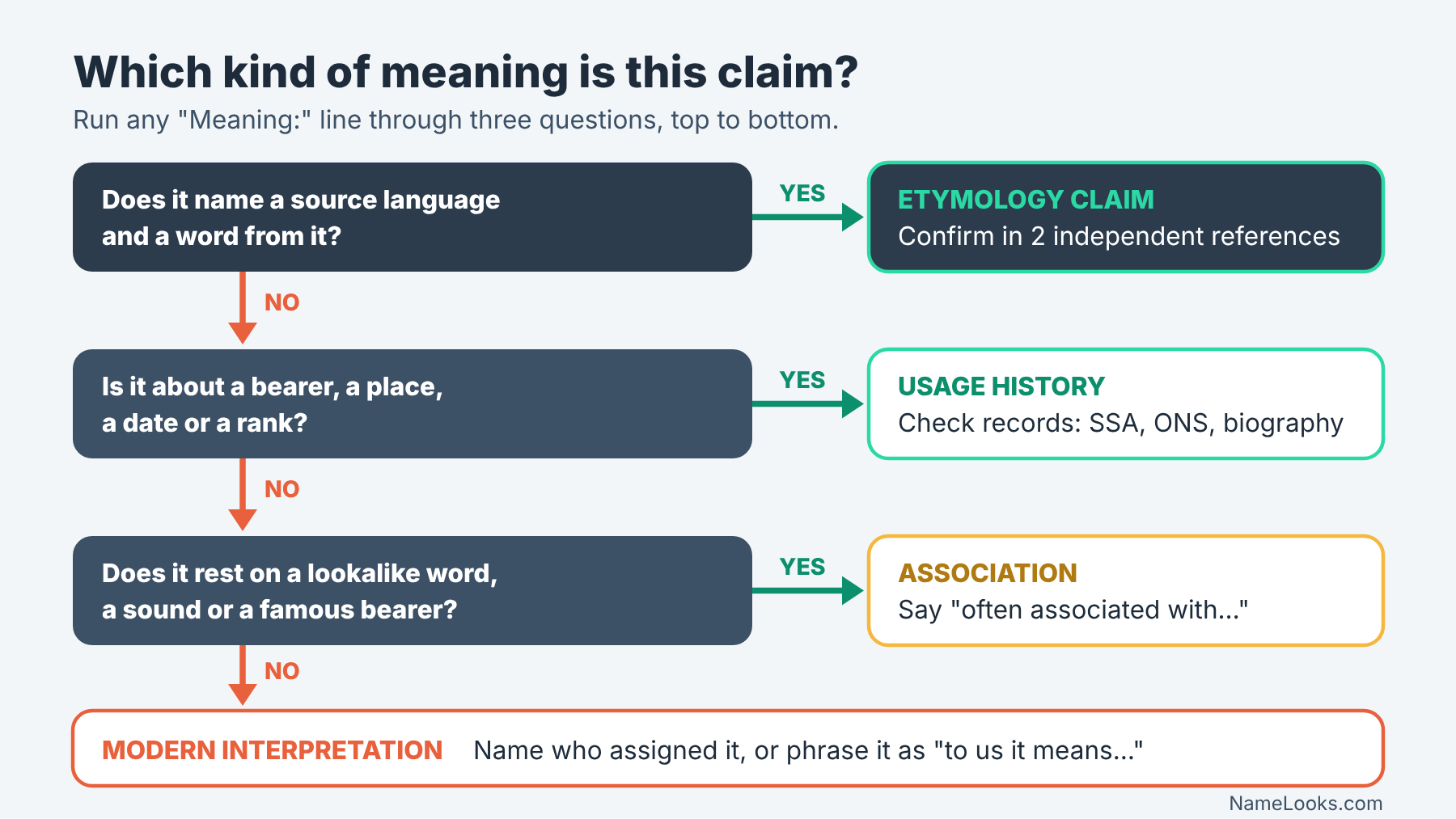
Once you can sort claims this way, the familiar warning signs start to stand out on their own: a one-word gloss with no language, three unrelated origins listed side by side, a cultural label with nothing behind it. Our list of name meaning red flags catalogs them in more detail.
Who’s the source, and did they show their work?
A reference that tells you what it relied on is more useful than one that doesn’t, even when it turns out to be wrong. Behind the Name publishes its list of references. Etymonline cites the dictionaries it draws from inside entries, as its Margaret entry does with the OED and Beekes. Wikipedia articles cite printed works you can look up. A page that offers a meaning with no visible source gives you nothing to check, so it can’t count as one of your two references.
It also helps to ask whether two sources are really independent. If three baby-name sites share the same odd phrasing, they’re probably copying one another or a shared database. That’s one source repeated three times, not three confirmations.
The two-reference rule, in practice
For any etymology you plan to repeat, find two references that are independent of each other and that cite their own sources. If they agree, state the claim plainly. If they disagree, state both. If you can find only one, phrase it as “according to [source]” and keep looking before you print it anywhere permanent.
When the sources disagree
Disagreement between good references is normal, and it’s usually informative. The trick is to work out what kind of disagreement you’re looking at, because each kind gets written up differently.
Three kinds of disagreement
Different readings of the same element. Linda is the model here. Both references trace it to a Germanic element lind; they differ on whether that element meant “soft, tender” or pointed to the linden tree. The origin is agreed. The gloss isn’t. Write it up as one origin with two proposed senses.
Different origin stories. Wendy is the model. One reference says Barrie coined it, another says it was used rarely before him and may connect to Gwen- names, a third cites earlier records as a male name and surname. These aren’t two glosses of one word. They’re competing accounts of where the form came from. Write it up as “accounts differ,” list them, and say what they agree on (Barrie made it common).
Omission. Daisy is the model. Etymonline and the Oxford Dictionary of First Names (as cited) record the Margaret connection, while Behind the Name’s Daisy page doesn’t mention it. An omission isn’t a denial. Write it up with the references that cover the point, and don’t treat silence as counter-evidence.
What to write down, and how to present it
For anything more than a casual answer, keep a short research note per name. It doesn’t need to be elaborate. A few lines will do.
- The exact form you looked up, and its language and script if not English.
- Each reference you opened, with the date you checked it.
- What each reference says, quoted or closely paraphrased, sorted by layer.
- Where they agree, where they differ, and which kind of disagreement it is.
- Your plain-English summary, phrased at the confidence the evidence supports.
When you present the result, lead with what’s solid and be specific about what isn’t. “Mary comes from Hebrew Miryam; its original meaning is uncertain” is better than either “Mary means beloved” or a page of hedges. Confidence and humility aren’t opposites here. You’re confident about the parts you’ve checked and candid about the parts nobody has settled.
If you want to keep going, our cornerstone on researching etymology without repeating myths pulls all of this into a single research workflow, from the first lookup to the final write-up.
Questions people actually ask
Does every name have a meaning?
Every inherited name has an etymology, but not every etymology is known, and some names were never built from a meaningful word. Coinages such as Vanessa have a creation story instead. Names formed by reversing or rearranging letters, like Nevaeh, carry whatever meaning their creator built in. So the accurate answer is “every name has a history,” which is a slightly different promise.
If two websites give different meanings, which one is right?
Possibly neither, possibly both. First check whether they’re talking about the same layer: one may give a source-word gloss and the other an association. Then check whether they cite anything. If two independent, sourced references disagree, the honest answer is to report both readings rather than pick the one you prefer.
Is a name’s meaning the same in every language that uses it?
The etymology is the same, because it’s a fact about the name’s history. The associations aren’t. A form that looks like a common word in one language can pick up that word’s sense for its speakers, as Linda does with Spanish and Portuguese linda. That’s why “meaning” needs a language attached.
Can I give my child a name for a meaning the references don’t support?
Of course. Families choose names for personal reasons all the time, and you don’t owe anyone a citation. The only thing worth avoiding is presenting that reason as the name’s historical meaning, especially in writing that will be passed on. “We chose it because, to us, it means…” keeps your reason intact and accurate.
What does name meaning mean on a baby-name site that also shows rankings?
Usually it means two databases stitched together: official popularity figures from one place and meaning lines from somewhere else. The ranking may be solid while the meaning is uncited. Judge each half separately, and look for the source of the meaning line specifically.
Do official baby-name datasets list meanings?
No. SSA publishes counts and ranks of names from Social Security card applications for U.S. births, with each spelling counted separately. It doesn’t publish etymologies. A site that combines SSA rankings with meanings has added the meanings from somewhere else, so check where.
Is Behind the Name a reliable source?
It’s a useful secondary reference that lists the dictionaries it draws on, and it often flags uncertainty, as its Mary entry does. Treat it as one of your two references, not both, and cross-check anything high-stakes against a scholarly dictionary or Etymonline. We found it omitting a point (the Daisy–Margaret link) that other references include, which is a normal limitation of any single reference.
Sources and further reading
- American Name Society — the professional body for onomastics; its definition of the field frames origin, history and use as separate questions.
- Stanford Encyclopedia of Philosophy: Names — the philosophical debate over whether proper names have meaning, including Mill’s view.
- Behind the Name: references used — the dictionaries behind a widely used secondary reference; useful for finding the printed sources.
- Online Etymology Dictionary — concise etymologies that often name the scholarship they draw on (Mary, Margaret, daisy, Vanessa and Wendy entries used here).
- SSA: top five names by year, 1926–2025 — official U.S. usage data; used here for Linda’s 1947–1952 run at number one.
- SSA baby-names background — how the U.S. data is collected, the five-occurrence threshold and the separate counting of spellings.
- Unicode CLDR Person Names (TR35) — the standard for formatting names across locales, including name order and name parts.
- Unicode CLDR transliteration guidelines — why transliteration is not translation, and why several valid systems exist.
- Wikipedia: Linda (given name) — used only as a pointer to the printed references it cites, such as Withycombe and the Duden lexicon of first names.
NameLooks provides general information about names and naming. Etymologies reflect the references cited as of October 2026 and may be revised by later scholarship; popularity data describes populations, not individuals.