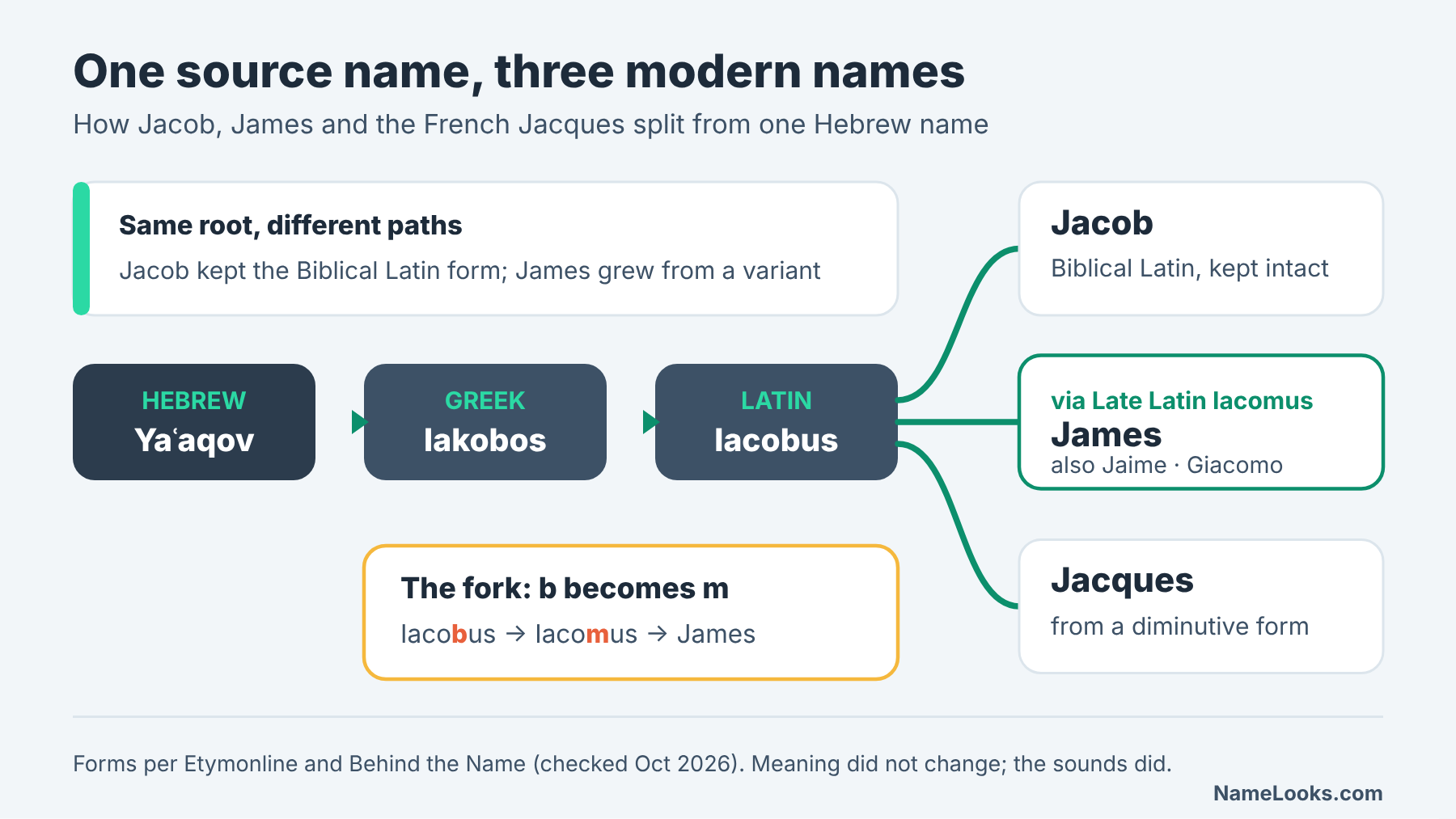
James and Jacob are the same name. Both go back to the Hebrew name behind Jacob, and James split off in Late Latin when one form, Iacomus, drifted away from Iacobus. That one fact explains most of how name meanings change: a name travels through languages and its sounds wear down. Translators swap it for an equivalent, and later readers give it a meaning it never had. This page walks through those four forces, using only well-documented cases you can check yourself.
The short version
- A name’s literal meaning usually belongs to one language and one period. When the name moves, the sounds go with it, but the meaning often stays behind. Most English speakers who hear “Peter” don’t hear “stone,” even though the Greek word meant exactly that.
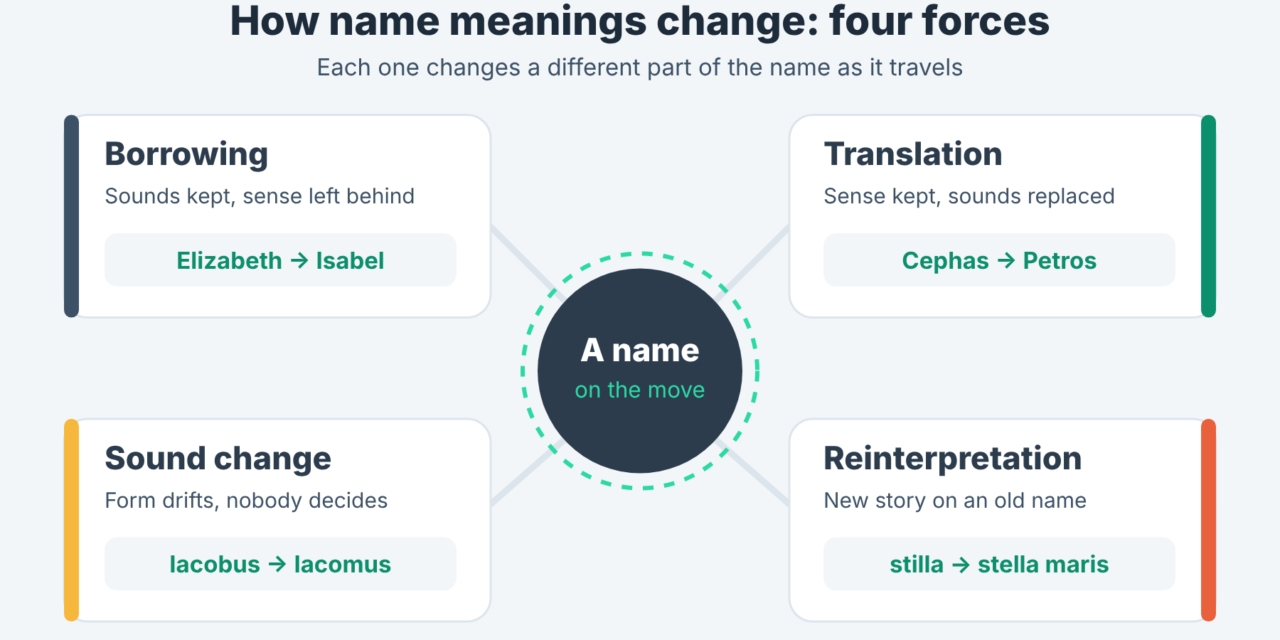
- Four forces explain most of how name meanings change. Borrowing carries a name into a new language. Translation swaps it for a word with the same sense. Sound change reshapes its form. Reinterpretation gives it a new explanation, sometimes through a copying mistake.
- Disagreement between good sources is normal, and it is information. Etymonline and Behind the Name don’t agree on where Jack comes from or whether Wendy existed before J. M. Barrie. A page that gives you one confident answer for either is hiding something.
- Old explanations are evidence about belief, not always about origin. The story in Genesis ties Jacob to the word for “heel.” That is a real, ancient interpretation. Some scholars still propose a different origin for the name itself.
- For your own naming decision, write the meaning line with its layers showing. “From the Greek word for stone, by way of Latin” is accurate and still lovely. “Means strong rock and leadership” isn’t something any dictionary says.
1What “the meaning of a name” turns out to be once it crosses a border
Here’s the core answer before the detail. When people ask how name meanings change, they usually picture one fixed meaning that gets distorted over time. The documented histories show something different. A name starts as a word, or a phrase, in a specific language. Then it gets used as a label for people, and the label travels much farther and longer than the word does.
Along the way, four things can happen. The name can be borrowed into another language with its sounds adapted. It can be translated, so the meaning survives but the sounds don’t. It can be worn down by ordinary sound change. Or it can be reinterpreted, when speakers who don’t know the source word supply a new story. Most well-known names have been through two or three of these.
This article stays inside that one problem: how and why meanings shift as names move. The broader method for researching any name’s origin lives in our guide to researching name etymology without repeating myths. If you’re unsure what “meaning” should even refer to, start with the difference between etymology, association and modern interpretation, then come back.
What people often assume about name meanings
The common assumption about how name meanings change has three parts. A name has one meaning. That meaning was fixed when the name was “created.” And every form of the name in every language carries the same meaning, like a passport that gets restamped at each border. Name-meaning sites encourage this picture because it fits a database row: name, origin, meaning, done.
The picture isn’t crazy. For some names it’s roughly true, at least for the stretch of history we can see. But it falls apart as soon as you follow one name through more than one language, and it gives no room for the most interesting part of the story, which is what each culture did with the name once it arrived.
The one-row model and where it comes from
Reference works of names are compressed by necessity. Behind the Name, one of the most cited free resources, gives each entry a short “meaning and history” paragraph, and its own list of sources used shows that it leans on scholarly dictionaries such as Hanks and Hodges’s A Dictionary of First Names (Oxford, 1990) and Withycombe’s Oxford Dictionary of English Christian Names (1945). Those books are careful. But compressing a 2,000-year path into one gloss, like “pearl” for Margaret, invites readers to treat the gloss as the whole story.
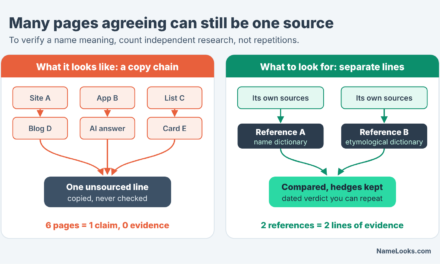
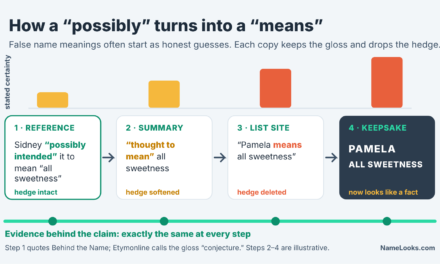
Copy-paste sites then compress it further. They drop the source language, drop the period, drop the “probably,” and sometimes add a personality trait. We cover how that chain produces outright myths in how folk etymology and copy-paste sites create false meanings. Here the concern is more basic: even an honest one-word gloss hides the movement.
A quick test: does the gloss name a language?
Take any meaning you’ve seen for a name and ask one question: “In which language, and roughly when, did this word mean that?” If the answer is “Greek, in antiquity,” you have something you can check. If the source can’t answer, the meaning has been detached from its language. That doesn’t make it wrong, but it means you can’t yet tell whether it’s an etymology, a translation, or a later story.
Run that test on “Peter means rock.” It passes, with an asterisk. The Greek word petros meant stone or rock. But the asterisk matters, because the Greek word was itself a translation of an Aramaic nickname, which is one of the cases below.
What the documented histories actually show
When you trace well-documented names through reputable references, a pattern shows up. The form of the name is usually traceable stage by stage. The meaning is often clear only at the earliest stage, sometimes not even there. And at each later stage, the meaning speakers attached to the name was whatever their language and culture made available.
Two short cases show the pattern. Both have at least two independent references that agree on the main line, and we name them so you can check.
James and Jacob: one name, two English outcomes
The Online Etymology Dictionary’s entry for James calls it the Middle English vernacular form of Late Latin Jacomus, “altered from Latin Jacobus,” and notes that the same Late Latin form is the source of Old French James, Spanish Jaime and Italian Giacomo. Behind the Name’s James entry independently gives the same chain: from Late Latin Iacomus, a variant of Biblical Latin Iacobus, from the Hebrew name Yaʿaqov.
So English ended up with two names from one source. Jacob came through the Bible’s Latin form more or less intact. James came through the Late Latin variant, by way of French. Nothing about the meaning changed between them. What changed was one consonant, and then centuries of separate use made the two feel like unrelated names.
Peter: a translation that became the name
Peter is a different kind of change. Etymonline’s Peter entry traces it to Latin Petrus, from Greek Petros, “literally ‘stone, rock,'” and calls that Greek form “a translation of Syriac kefa ‘stone’ (Latinized as Cephas).” Behind the Name’s Peter entry says the same in its own words: Petros is the translation used in most versions of the New Testament for Cephas, which it describes as meaning “stone” in Aramaic.
Notice the small disagreement already. One reference says Syriac, the other says Aramaic. Syriac is a later Aramaic dialect, so these aren’t contradictory, but they show how two careful sources can label the same thing differently. The New Testament text itself shows the translation happening: in John 1:42 (NRSVUE), Simon is told he will be called Cephas, and the verse adds that the name is translated Peter. The meaning survived the trip. The sound didn’t.
How we chose the cases on this page
Every name history here met three tests. At least two independent references we opened in October 2026 describe it. The references are named in the text, so you can check them. And where they disagree, we show the disagreement instead of picking a winner. That rules out a lot of appealing stories, which is the point.
2Four forces that reshape a name as it travels
The subtitle of this article names four mechanisms: borrowing, translation, sound change and reinterpretation. They’re worth keeping apart, because each one leaves a different kind of trace in the records, and each one changes a different part of the name. Borrowing changes the language a name lives in. Translation changes its sounds but tries to keep its sense. Sound change alters its form without anyone deciding to. Reinterpretation changes the explanation people give for it.
In real histories the forces stack. James was borrowed (Latin into French into English) and reshaped by sound change. Peter was translated and then borrowed. Keeping the four apart lets you say precisely which part of a name’s story a source is describing, and which part it’s skipping. That is most of what it takes to explain how name meanings change in any single case.
Borrowing: the name moves, and the new language adapts it
Borrowing is the most common force and the least dramatic. A name used in one language community is adopted by speakers of another, usually through religion, royalty, migration or literature. The new speakers fit it to their own sound system and spelling. They rarely know, or need to know, what it meant in the source language.
That last point is the important one for meanings. A borrowed name arrives as a name, not as a word. English speakers took up Margaret without any sense of the Greek word for pearl behind it, much as most people today use Isabel without connecting it to Elizabeth.
Isabel: Elizabeth after a regional makeover
Behind the Name’s entry for Isabel calls it a “Medieval Occitan form of Elizabeth” and notes that it is the usual form of Elizabeth in Spain and Portugal. Etymonline’s Isabel entry agrees on the essentials, describing it as a form of Elizabeth “that seems to have developed in Provence.” Two references, one line, with a “seems” that you should keep if you repeat it.
Behind the Name adds that Isabel became popular in England after Isabella of Angoulême married King John. That’s how borrowing usually works: a famous bearer carries a regional form across a border. In England the name arrived as a royal name, not as a local version of Elizabeth. The two then ran side by side as separate names, each building its own associations.
John’s family of forms: borrowing on a continental scale
John shows how one name, borrowed many times, becomes a family. Etymonline’s John entry runs it from Hebrew Yohanan, through Greek Ioannes and Latin Johannes, to Old French Jean and Jehan. It lists cognates such as Spanish Juan, Italian Giovanni, Portuguese João, Dutch Jan and Hans, German Johann and Russian Ivan. Behind the Name’s John entry gives the same Hebrew-Greek-Latin chain and names Scottish Ian, Irish Sean and Welsh Evan among the forms.
On the Hebrew meaning, the two phrase it a little differently. Behind the Name says “Yahweh is gracious.” Etymonline gives “Jehovah has favored” or “Jah is gracious.” Those are the same idea in different English, which is a good reminder that even a stable meaning reaches you through somebody’s translation. The finer distinctions between these related forms belong to our explainer on cognates, variants, diminutives and transcriptions.
Translation: keep the sense, change the sound
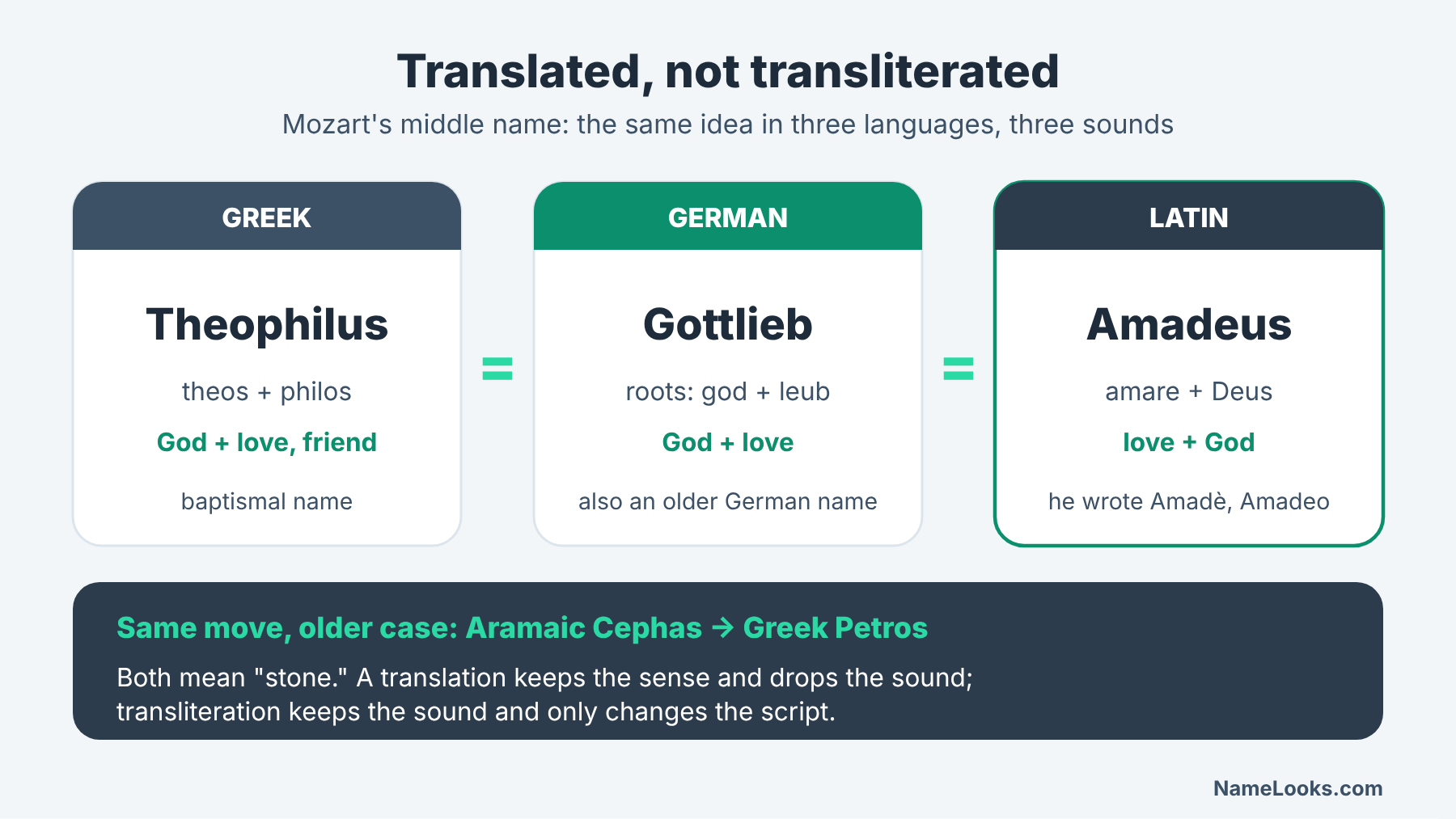
Translation is borrowing’s opposite. Instead of keeping the sounds and dropping the sense, it keeps the sense and replaces the sounds with a native word. That’s what happened when the Aramaic nickname behind Cephas became Greek Petros. It also happened, more playfully, to one of the most famous names in music.
Translation is also easy to confuse with transliteration, which converts letters from one script to another and leaves the meaning alone. The Unicode CLDR transliteration guidelines put it bluntly: “Transliteration is not translation.” For names, that distinction matters a lot, and our article on transliteration versus translation covers the spelling side in depth.
Mozart’s middle name in three languages
Britannica’s biography of Mozart gives his baptismal name as Johannes Chrysostomus Wolfgangus Theophilus Mozart, and says he most commonly called himself Wolfgang Amadé or Wolfgang Gottlieb. Wikipedia’s article on Mozart’s name, which cites Otto Erich Deutsch, adds that he used “Wolfgango Amadeo” in Italy from 1770 and “Wolfgang Amadè” from about 1777. It says he never signed a letter as “Wolfgang Amadeus Mozart.”
The point for us is that Theophilus, Gottlieb and Amadeus were treated as the same name. The Greek is built from the words for God and love or friendship. Wikipedia renders it “lover of God” or “loved by God.” The German and Latin forms were used as translations of it. Mozart was not changing his identity when he switched among them; he was translating his own middle name into whichever language he was living in.
When a “translation” is really a different name
Look closer and the neat equivalence wobbles, which is exactly what happens with translated names. Behind the Name glosses Theophilus as “friend of god” and Amadeus as “love of God.” Its entry for Gottlieb doesn’t call it a translation of Theophilus at all. It calls it the German form of an older Germanic name, Goteleib.
Both things can be true. Gottlieb had a history of its own, and it also served as a ready German equivalent for Theophilus. The three English glosses (“lover of God,” “loved by God,” “friend of God”) differ because Greek compounds like this can be read actively or passively. When a site prints one of them as “the” meaning, it’s choosing a reading, not reporting a settled fact.
Sound change: nobody decides, and the form drifts anyway
Sound change is the force people notice least, because nobody chooses it. Speakers simplify clusters, shift vowels, swap similar consonants, and over generations the name’s spoken form drifts. Spelling sometimes follows and sometimes freezes, which is why some names look older than they sound.
Sound change usually doesn’t touch meaning directly. What it does is cut the visible tie between the name and its source word. Once a form has drifted far enough, nobody can see the original word in it, and the meaning becomes something you only know by looking it up.
From Iacobus to James, step by step
The table below lays out the Jacob/James line by stage, using only the forms that Etymonline and Behind the Name both give or that one gives and the other doesn’t contradict. It’s the clearest documented example of sound change splitting one name into two.
| Stage and language | Form recorded | What changed | Caveat | Naming implication |
|---|---|---|---|---|
| Hebrew Bible | Yaʿaqov (Behind the Name); Ya’aqobh (Etymonline) | Starting point for both names | Its original meaning is disputed (see the reinterpretation section) | Jacob and James share this root, so either can honor the other |
| Greek | Iakobos (Etymonline) | Adapted to Greek sounds and endings | Behind the Name’s James entry skips this stage and goes straight to Latin | A Greek form like Iakovos belongs to the same family |
| Biblical Latin | Iacobus | Latin ending added | Spelled Jacobus or Iacobus depending on the source’s convention | The direct ancestor of English Jacob |
| Late Latin | Iacomus / Jacomus | The b sound became m in this variant | Neither source explains why the consonant changed | The fork where James separates from Jacob |
| Old French, Spanish, Italian | James; Jaime; Giacomo (Etymonline) | Each language reshaped Iacomus in its own way | French Jacques comes by a different route, from a diminutive of Iacobus (Etymonline) | Jaime and Giacomo are cognates of James, not of Jacob directly |
| Middle English | James, recorded from the late 12th century (Etymonline) | Borrowed into English from French | “Late 12c.” is Etymonline’s earliest English record, not a birth date for the name | English now has two names, each with its own nicknames and associations |
The useful thing about laying it out like this is that the meaning column would be empty after the first row. None of the later stages changed what the name meant, because by then it didn’t mean anything to its speakers. It was simply the apostle’s name, then a royal name, then a family name.
Joshua and Jesus: one Hebrew name, two English names
A second clear case of sound change producing two names involves Joshua. Etymonline’s entry for Jesus calls it “the Greek form of Joshua,” via Late Latin Iesus and Greek Iesous, which it describes as an attempt to render the Aramaic name Jeshua, a later form of Hebrew Yehoshua. Behind the Name’s Joshua entry agrees that Jesus comes from a Greek transcription of the Aramaic short form Yeshuaʿ, and gives the meaning of the fuller Hebrew name as “Yahweh is salvation.”
So the Hebrew form gave English Joshua, while the Aramaic short form went through Greek and Latin to give Jesus. Etymonline adds a small detail that shows sound change at work: the Late Latin form was “properly pronounced as three syllables.” The meaning is identical in both lines. The cultural use of the two names, in English and in many other languages, is completely different.
Molly to Polly, Meggy to Peggy: changes nobody can explain
Some sound changes are documented but unexplained. Behind the Name describes Polly as a “medieval variant of Molly” and says “the reason for the change in the initial consonant is unknown.” Wiktionary, which we use only as a pointer, describes Polly as a nickname for Mary formed by rhyming with Molly. Peggy shows the same M-to-P swap. Behind the Name calls Peggy a medieval variant of Meggy, a diminutive of Margaret, and again says the reason is unknown.
Here’s a small disagreement worth noticing. Etymonline’s Peggy entry calls it “an alteration of Maggie.” Meggy or Maggie: the sources agree that Peggy is a Margaret pet form with an M swapped for a P, but they name different starting points. If you’re writing about a grandmother named Peggy, “a pet form of Margaret” is safe on both readings. “From Meggy” is one source’s view.
Unknown is an acceptable answer
When a reputable reference says “the reason is unknown,” that is a finding, not a gap to fill. Sites that offer a confident explanation for the Molly-to-Polly swap are usually guessing. If you need an explanation for a family story, “nobody knows for sure, but it happened to more than one name” is both true and more interesting.
Reinterpretation: new explanations for old names
Reinterpretation is the force that most often produces the “meanings” printed on mugs and nursery wall art, and it’s the one people mean when they say a name’s meaning was “lost” or “changed.” It happens when later speakers, scholars or copyists supply an explanation for a name based on words they recognize. Sometimes that explanation is a learned guess. Sometimes it’s a story. And at least once, it began with a single letter changed by a copyist.
Reinterpretations aren’t worthless. They’re real historical evidence about how a culture understood a name, and some of them have shaped devotion, art and naming for centuries. The mistake is presenting them as the origin. For the wider problem of folk etymology, see our piece on how false name meanings spread; here we look at the mechanism.
Mary and the star of the sea
“Star of the sea,” or stella maris, is one of the most famous meanings ever attached to a name. The 1912 Catholic Encyclopedia article “The Name of Mary”, by Anthony Maas, calls it more popular than any other interpretation and traces it to St. Jerome. It then argues that Jerome probably wrote stilla maris, “drop of the sea,” since he translated the Hebrew mar as stilla (drop) in Isaiah 40:15. It points to a late-ninth-century manuscript at Bamberg that reads stilla.
Wikipedia’s article on Our Lady, Star of the Sea gives the same account: most manuscripts of Jerome’s work read stella maris, but the original was probably stilla maris, and a copyist’s change “became widespread.” It also notes a minority view that Jerome himself meant “star.” The two sources agree on the likely mechanism and on the fact that it isn’t proven.
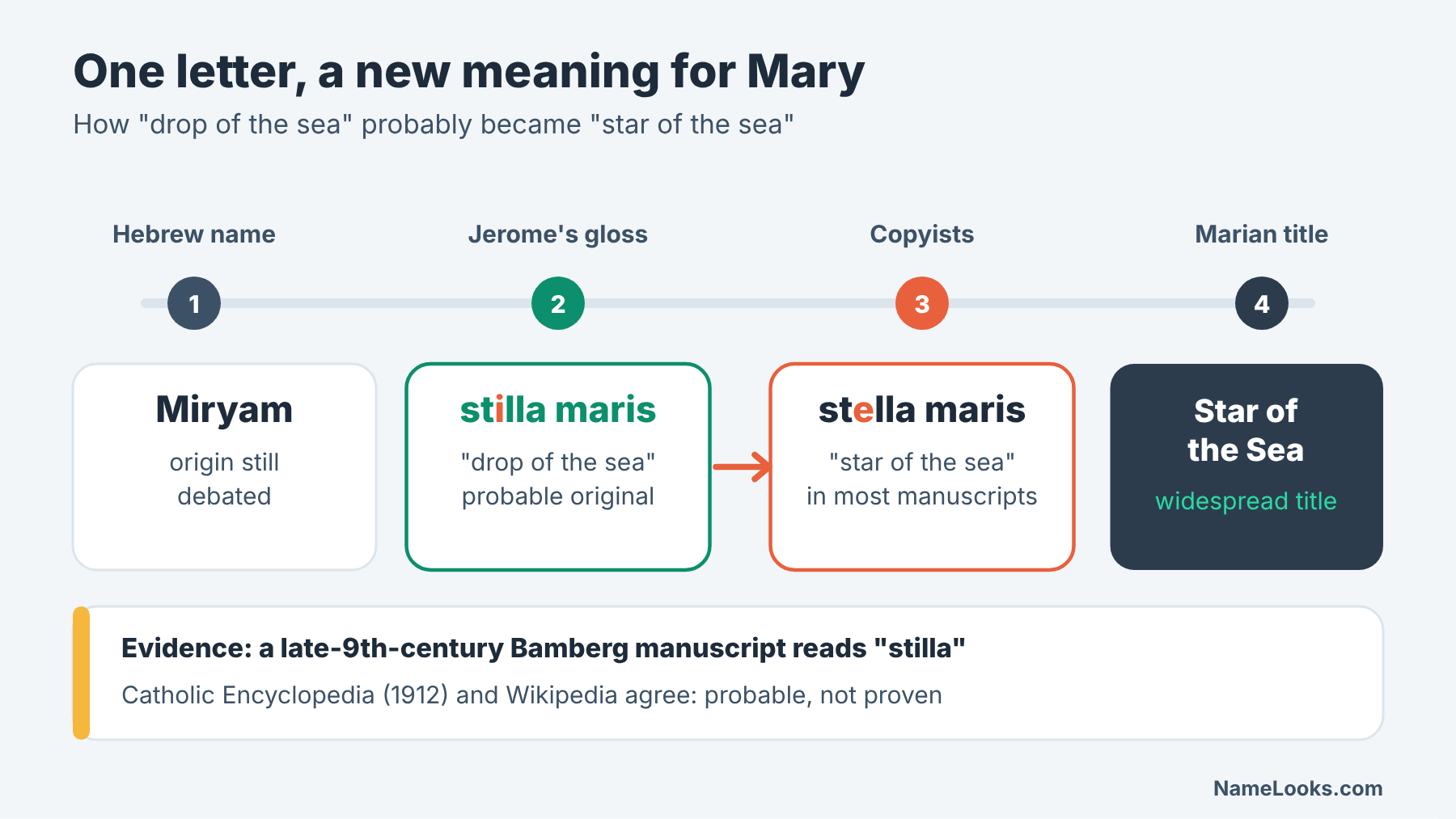
Meanwhile, the origin of the Hebrew name Miryam remains open. Etymonline’s Mary entry calls it “a word of unknown origin,” traditionally glossed as “rebellion.” Behind the Name’s Mary entry says the meaning “is not known for certain,” lists “sea of bitterness,” “rebelliousness” and “wished for child” as theories, and suggests a likely Egyptian origin, perhaps from mry “beloved.” The 1912 article reports that Otto Bardenhewer’s 1895 monograph discussed about seventy proposed meanings. Seventy explanations for one name is what reinterpretation looks like when it runs for two millennia.
Jacob and the heel: a story inside the source text
Some reinterpretations are as old as the name’s earliest record. Etymonline’s Jacob entry gives the Hebrew as “literally ‘one that takes by the heel; a supplanter,'” citing Genesis 25:26, and connects it to the word for heel. Behind the Name’s Jacob entry gives the same Genesis-based explanation, then adds an alternative: the name may come from a hypothetical form, Yaʿaqovʾel, meaning “may God protect.”
That’s a situation you’ll meet often with ancient names. The source text itself explains the name through a story, and the story connects the name to a word that sounds like it. Some scholars take the story as the etymology. Others see it as an early interpretation of a name that originally meant something else. A fair summary keeps both: “traditionally linked to the Hebrew word for heel; some scholars propose ‘may God protect.'” For older names generally, our guide to researching ancient names explains how to weigh the earliest forms against later explanations.
Dolores: when a title becomes a name
Reinterpretation can also run the other way, turning a phrase with a clear meaning into a name whose literal meaning people no longer focus on. Etymonline’s Dolores entry derives it from Spanish María de los Dolores, literally “Mary of the Sorrows.” Behind the Name’s Dolores entry gives “sorrows” and links it to the title Nuestra Señora de los Dolores, “Our Lady of Sorrows.”
Read flatly, “sorrows” sounds like an odd thing to name a baby. Read in context, the name pointed to a devotional title, and the literal word was never the reason for using it. Then the name traveled further, gaining the pet form Lola, which Behind the Name lists among its diminutives. A child called Lola today probably has no link to the word dolor at all, though the history is still there.
Marguerite and the daisy: which came first?
Margaret is a clear case where the source word is known. Etymonline’s marguerite entry links the name to Late Latin Margarita, “literally ‘pearl,'” from a Greek word “of unknown origin.” Behind the Name’s Margaret entry agrees on the Greek and says the word was probably borrowed from an Indo-Iranian language.
The French word marguerite also names a daisy, and it’s tempting to assume the flower was named after the women. Etymonline flags the trouble: according to French etymologists, the flower sense “is not from the personal name,” and may come from the pearl idea instead. So the daisy association is real in French, but the direction of influence is uncertain. If you love Margaret for the daisy link, enjoy it. Just don’t print that the name “means daisy.”
3Why careful sources still tell different stories
If the four forces were the whole picture, every good reference would print the same history for every name. They don’t. Some of the differences come from the evidence itself being thin. Others come from the questions each reference chooses to answer. Before you decide which version of a name’s history to trust, it helps to know where the differences usually come from. Two references can agree on how name meanings change in general and still tell one name’s story differently.
None of this means “all sources are equally unreliable.” It means a meaning claim is only as precise as the stage, language and evidence it refers to. Once you can see those three things, most disagreements stop looking like contradictions and start looking like different slices of the same history.
Language, period and script change what a meaning claim refers to
Every gloss refers to a stage. “Pearl” is the Greek and Late Latin stage of Margaret. “Stone” is the Greek and Aramaic (or Syriac) stage of Peter. If a source doesn’t say which stage it’s describing, two glosses that look contradictory may both be right, just for different centuries.
The earlier the stage, the thinner the evidence tends to be. For Margaret, both references stop at the Greek word and say its origin further back is uncertain. That’s not a weakness in the references. It’s where the documented record runs out.
Ask which stage is being glossed
When you compare two meanings for one name, write the language next to each. You’ll often find that one reference is describing an earlier stage than the other. Margaret is a good test. Etymonline calls the Greek word for pearl “of unknown origin.” Behind the Name says it was probably borrowed from an Indo-Iranian language. Those aren’t competing etymologies; one is simply more willing to look a step further back, with a “probably.”
The same goes for names that carry a theological meaning. “Yahweh is gracious” for John and “Yahweh is salvation” for Joshua describe the Hebrew stage only. No one in medieval France who used Jehan was thinking about Hebrew verb roots. Whether that matters to you depends on why you care about the meaning, which is a question we come back to in the decision section.
Scripts and transliteration multiply the spellings
A second confounder is the script. Hebrew, Greek and Aramaic names reach English readers through transliteration, and transliteration conventions differ. The references used on this page give the Hebrew behind John as Yohanan and Yoḥanan, with Yochanan listed as a variant. They give the Hebrew behind Jacob as Yaʿaqov and Ya’aqobh. These are spelling conventions for the same Hebrew name, not different words.
It’s easy to mistake a transliteration difference for an etymology dispute, especially when a site uses an unusual romanization that doesn’t match the others. Our guide to why one name can have several romanized spellings explains how systems differ, using names written in Cyrillic as the main case. For meaning research, the rule is short: compare the source-language form, not the English spelling.
Why a single source or anecdote can mislead
Two names show why checking one reference is never enough, even a good one. In both cases, Etymonline and Behind the Name, two references that usually agree on the main line, give different accounts. Neither is careless. They weigh the same thin evidence differently.
What follows isn’t a ruling on who’s right. It’s a demonstration of what an honest answer looks like when the experts split.
Jack: from John, from Jacques, or both?
Etymonline’s Jack entry says the name is attested by 1218, “probably via Anglo-French Jake, Jaikes, from Old French Jacques,” which would put Jack in the Jacob family. The same entry notes that in English, Jack has always been treated as a familiar form of John, and that some scholars argue it’s a native English formation.
Behind the Name’s Jack entry takes the other line. It calls Jack a medieval diminutive of John, from the form Jankin, possibly influenced slightly by French Jacques. So the two references agree on the usage (Jack works as a nickname for John in English) and disagree on the probable origin. A responsible sentence says exactly that: “traditionally a pet form of John; its origin is debated, with some linking it to French Jacques.”
Wendy: invented by Barrie, or older than Peter Pan?
Etymonline’s Wendy entry calls it “apparently coined by James M. Barrie,” citing Peter and Wendy (1911). Behind the Name’s Wendy entry says Barrie built the character’s name from the nickname “fwendy” (“friend”) given to him by a young friend. It adds that the name was used earlier, rarely, possibly in connection with Gwendolen, and only became common after the play.
These two accounts aren’t fully incompatible. Barrie may have created his character’s name independently of the rare earlier use. But they differ on a point that matters to anyone writing “Wendy was invented by J. M. Barrie.” Behind the Name says that isn’t quite right. Etymonline hedges with “apparently.” Neither supports the unhedged claim.
Famous-bearer stories that the evidence doesn’t support
A third kind of misleading anecdote attaches a name’s meaning to a specific person. Etymonline’s Isabel entry has a nice example of a reference refusing to play along. It notes that English has used Isabella since about 1600 as a color word for a greyish-yellow shade, and adds that “the Isabella who gave her name to it has not been identified.”
That caution is worth copying. When a site tells you a name or name-word comes from a specific queen, saint or celebrity, check whether two references name the person. If they don’t, treat the story as a story. The same habit applies to modern associations: a famous bearer can change how a name feels without changing what it means, which is the distinction our article on origin versus usage is built around.
| Claim | References checked | Language and stage | Type of change | Limitation | Editorial takeaway |
|---|---|---|---|---|---|
| James and Jacob are one name | Etymonline; Behind the Name | Hebrew to Late Latin to Old French | Sound change plus borrowing | Neither reference explains why b became m | Safe to state plainly |
| Peter translates Cephas, “stone” | Etymonline; Behind the Name; John 1:42 | Aramaic (or Syriac) to Greek | Translation | References label the source language differently | Safe; say “Aramaic” or “Syriac” as your source does |
| Theophilus, Gottlieb and Amadeus were used as one name | Britannica; Wikipedia (citing Deutsch); Behind the Name | Greek, German, Latin; 18th century | Translation | Gottlieb also has its own Germanic history; the English gloss varies | Safe for Mozart; don’t assume every Gottlieb is a translated Theophilus |
| “Star of the sea” began as “drop of the sea” | Catholic Encyclopedia (1912); Wikipedia | Latin manuscripts of Jerome’s work | Reinterpretation via copying | Probable, not proven; one view says Jerome meant “star” | Say “probably,” and keep the title separate from the etymology |
| Jacob means “supplanter” | Etymonline; Behind the Name | Hebrew Bible | Traditional explanation | Behind the Name records an alternative origin | Present as the traditional reading, not the only one |
| Jack comes from John | Etymonline; Behind the Name | Medieval English and French | Disputed origin | The two references weigh the evidence differently | Say “pet form of John; origin debated” |
| Wendy was invented by Barrie | Etymonline; Behind the Name | English, early 20th century | Coinage or popularization | Behind the Name reports earlier rare use | Say “popularized by Barrie,” not “invented” |
| Polly and Peggy came from Molly and Meggy or Maggie | Behind the Name; Etymonline (Peggy); Wiktionary as pointer | Medieval English pet forms | Sound change, reason unknown | No reference explains the M-to-P swap | State the change; don’t invent the reason |
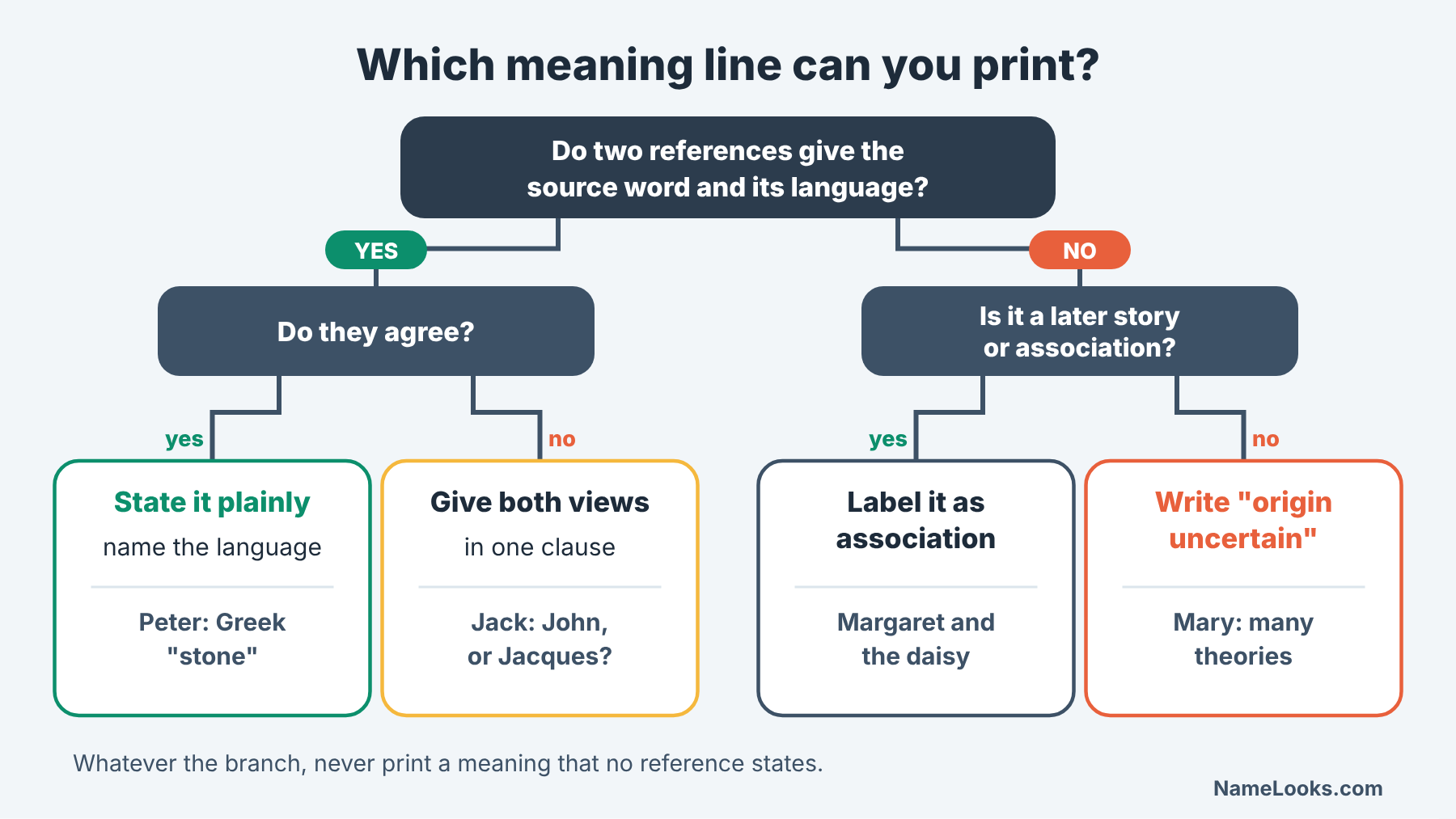
Read across any row and you’ll see the same rule: the strength of the claim should match the strength of the evidence column. Where two references agree, write plainly. Where they split, say so in a clause. Where nobody knows, say nobody knows. For a fuller set of warning signs to scan for, our list of name meaning red flags covers one-word glosses, piles of unrelated origins and unsupported cultural labels.
4Turning the evidence into a naming decision
Most people who look up how name meanings change aren’t writing a dissertation. They’re choosing a name, writing a birth announcement, honoring a relative, or settling an argument at dinner. So the practical question is what the evidence lets you say, and what it lets you choose.
The short answer is that meaning comes in layers, and you get to decide which layer matters to you, as long as you describe each layer honestly. The longer answer depends on the situation, so this section works through the common ones.
A reasonable takeaway: meaning lives in layers
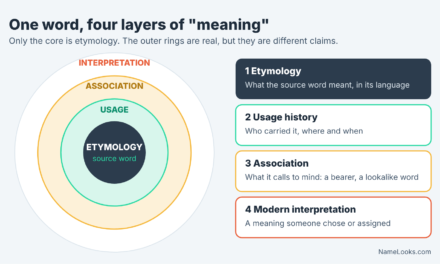
Think of any traveled name as having at least three layers. The bottom is the source word, in its source language. Above it sits the history of use: who bore the name, where it traveled, what forms it took. On top are the explanations and associations later speakers added, from stella maris to the daisy. All three are real. Only the bottom one is the etymology.
The documented cases on this page all point to the same conclusion about how name meanings change. The bottom layer is often the least certain and the least felt. The middle layer is usually the best documented. The top layer is what most people actually experience when they hear the name.
Write the meaning line with the layers showing
A meaning line that names its layer is both more accurate and more interesting than a one-word gloss. Compare these for Peter. “Means rock” is thin. “From the Greek word for stone, a translation of the Aramaic nickname Cephas” is accurate and gives you a story. For Margaret: “from the Late Latin and Greek word for pearl” instead of “means pearl and purity,” since no reference we opened mentions purity.
For names whose origin is disputed, put the dispute in a clause. “Traditionally explained as ‘supplanter,’ from the Hebrew word for heel; some scholars propose ‘may God protect'” works for Jacob. It fits on a card. It’s also the kind of sentence that survives a curious relative with a library card.
Source-word layer
“From the Greek word for pearl.” Name the language. Keep any “probably” your references use.
History-of-use layer
“The Occitan form of Elizabeth, brought to England by a queen.” Name the route or the bearer only if two references do.
Association layer
“In French, the same word names a daisy.” Label it as association, and say so when the direction of influence is unclear.
Honoring a relative across languages
The four forces are good news for families who want to honor someone without copying a name exactly. Because James, Jaime and Giacomo come from one Late Latin form, and Jacob shares the older root, all of them can reasonably point back to the same person. The same goes for John’s family of forms. Choosing a cognate is a translation in the borrowing sense: you keep the lineage and change the sound to fit your language.
Picture a hypothetical family whose grandfather was called Giacomo, now choosing a name in an English-speaking country. James is a well-documented counterpart. Jacob is a defensible one, a step further back. Jack is a looser choice, given that one reference ties it to Jacques and the other to John. If the family-name question is the real decision, our piece on family middle names versus new ones covers the honor-versus-individuality trade-off.
When the literal meaning is awkward
Sometimes a source-word meaning sounds unwelcome. Dolores literally means “sorrows.” Mary’s Hebrew original is traditionally glossed as “rebellion” by Etymonline, alongside several other theories. If you were planning to print the literal meaning, these can feel like problems.
They’re easier to handle than they look. For Dolores, the literal word was never the reason for the name; the devotional title was, and you can say so. For Mary, no single meaning is settled, so presenting one gloss would be misleading anyway. In both cases, the honest move and the kind move are the same: describe the name’s history instead of picking the grimmest gloss or the prettiest one.
What remains subjective or uncertain
The evidence can tell you which forms a name took and roughly when. It can sometimes tell you what the source word meant. It can’t tell you which of those layers should matter in your family, and it can’t close every open question. Being clear about that boundary saves a lot of arguing.
Three kinds of uncertainty come up again and again. They’re worth naming so you can recognize them in any name you research.
Which layer counts is a values question
Whether a source word from two thousand years ago should outweigh a name’s modern feel isn’t something a dictionary can answer. Some families care a great deal about the source language because it’s their heritage language or liturgical language. Others care mostly about how a name lands today. Both are legitimate. The only thing the evidence rules out is mislabeling: calling an association an etymology, or a probable origin a certain one.
If you and a partner disagree about how much meaning should weigh, it helps to agree on the facts first and argue about the weighting second. The broader decision framework in our guide to choosing a name treats meaning as one criterion among several, which is often where these conversations land.
Some origins will stay open
For names like Mary, the best references say the origin isn’t known for certain, and a scholarly monograph from 1895 already counted roughly seventy proposals. New evidence can shift the balance, but it’s unlikely to produce a single answer everyone accepts. The same is true, on a smaller scale, for Jack and for the earliest stage of Margaret.
An open origin isn’t a failure of research. It’s the result. When you reach a point where two careful references disagree and neither claims certainty, you’ve done the job. Writing “origin debated” is the accurate conclusion, not a placeholder until you find a better site.
Associations you can’t control
The top layer keeps moving. Etymonline notes slang senses for Peter and records that “Wendy house” for a children’s playhouse comes from Barrie’s books. Behind the Name notes that Jack became a general word for “man” in compounds like jack-in-the-box. None of these change the etymology, and all of them change how a name might sound in a given place and decade.
You can check for associations, but you can’t freeze them. That’s one reason a meaning line built on the documented history tends to age better than one built on a current association. The history doesn’t change; the associations will.
A sentence you can borrow
When someone at a family gathering announces that a name “means” something, try: “That’s one of the explanations. The older form is from [language], and the references disagree about [point].” It’s polite, it’s accurate, and it usually starts a better conversation than a flat correction.
5Trace a name’s journey yourself
The cases on this page are famous, which makes them easy to check. Your name of interest may not be. The good news is that the method for working out how name meanings change is the same for any name with a documented history, and it takes an evening rather than a degree. What it requires is patience with forms and a willingness to write “unknown” where the trail ends.
The method below borrows the structure of the table earlier on this page. You build the chain of forms first, then label the force at each link, and only then write a meaning line. Doing it in that order keeps the meaning from steering the research.
Tracking how name meanings change, one link at a time
Start by collecting forms, not meanings. A form is a spelling in a named language at a rough period. Meanings come later, and only for the stages where a reference gives one.
- Open two independent references. Etymonline and Behind the Name are a reasonable free pair for English-language names. Note that Behind the Name lists the printed dictionaries it draws on. Add a scholarly dictionary of names if you can get one through a library.
- Write each stage on its own line. Language, form, approximate period. If one reference skips a stage the other includes, keep it and note which source gives it.
- Mark the forks. Wherever the chain splits, as with Iacobus and Iacomus, note which modern names come from which branch.
- Label the force at each link. Borrowing, translation, sound change or reinterpretation. Some links have two.
- Attach meanings only where a reference states one. Put the language next to the meaning, and copy the reference’s hedges.
- Write the meaning line last. Name the layer it describes. If references disagree, put the disagreement in a clause.
Getting the forms right
Most errors creep in at step two. Sites often give a form without its language, or give a modern spelling as if it were ancient. If a reference gives a form in a non-Latin script, keep the source-language form alongside the romanization so you can compare like with like. Our guide to verifying a name meaning across multiple sources covers how to grade references; here the main job is to keep each form tied to its language.
Another trap: a later stage can look older than an earlier one. “Jehan” looks archaic, but Etymonline places it in Old French, long after Greek Ioannes. Order the chain by the dates your references give, not by how old a spelling looks.
Spotting the forks
Forks are where most “same name or different name?” questions get answered. James and Jacob fork at Late Latin. Jesus and Joshua fork at the Hebrew-Aramaic stage. Isabel forks from Elizabeth in medieval Provence. Once you see the fork, you can say exactly how close two names are. That’s often what a family actually wants to know.
If you can’t find a fork, don’t create one. Two names that look alike may simply be unrelated, and one reference listing them on the same page isn’t proof that they share a source.
Telling the four forces apart in your notes
Labeling each link sounds fussy, but it’s where the method earns its keep. The label tells you what to expect from the meaning at that stage. After a borrowing, the meaning usually stays in the source language. After a translation, it travels. After a sound change, it’s untouched but harder to see. After a reinterpretation, there’s a new meaning on top of the old one.
Two pairs of forces are commonly confused. The questions below help separate them.
Borrowing or translation?
Ask whether the sounds survived. If the new form sounds like the old one, adapted to new spelling and grammar, it’s a borrowing: Johannes to Jean, Elizabeth to Isabel. If the new form is a native word with the same sense, it’s a translation: Cephas to Petros, Theophilus to Amadeus. A name can be translated once and then borrowed many times, which is exactly Peter’s history.
Be careful with apparent translations that have their own history. Gottlieb worked as a German equivalent of Theophilus for Mozart, but Behind the Name traces it to an older German name. When a reference gives a native origin for the “translation,” record both.
Sound change or reinterpretation?
Ask whether anyone needed to understand the name for the change to happen. Sound change happens without understanding. The b in Iacobus became m in Iacomus, and the M in Molly became P in Polly, without anyone reinterpreting a meaning. Reinterpretation needs someone to read meaning into a name, whether a copyist writing stella for stilla or a later reader connecting Margaret to a flower.
The line can blur. A copying error is a mechanical change, but it only spread because readers found the new reading meaningful. In your notes, it’s fine to write “copying change, then reinterpretation.” That’s what most sources say about stella maris.
A worked example you can follow
Here is a hypothetical walk-through, using a name already documented above so you can check every step. The person and situation are invented; the forms and sources are the ones cited on this page.
The example shows the method doing what it should: turning a vague question (“what does this name mean?”) into a precise answer about forms, forces and layers.
The question and the chain
Imagine someone choosing between Jack and James to honor a great-grandfather named Giacomo. They open Etymonline and Behind the Name. Step two gives them Hebrew Yaʿaqov, Biblical Latin Iacobus, Late Latin Iacomus, Italian Giacomo and English James on one branch, with Jacob on the other. Step three marks the fork at Late Latin.
For Jack, the chain is shakier. One reference runs it through Anglo-French Jake from Jacques, a diminutive of Iacobus. The other runs it through Jankin from John. Step four labels Giacomo to James as borrowing plus sound change, and Jack’s link as disputed.
The finished note
Step five adds meanings only at the Hebrew stage, with the dispute about Jacob intact. Step six produces this note: “James comes from the same Late Latin form as Giacomo; both go back to the Hebrew name behind Jacob, traditionally linked to the word for heel. Jack is traditionally a pet form of John; one reference connects it to French Jacques instead.” That note settles the honor question (James is the closest documented counterpart) without inventing a meaning.
It also shows when to stop. Nothing in the note claims a personality trait, a symbolic meaning, or a certainty the references don’t share. If you want the mechanics of how scholars study names in general, our introduction to onomastics covers the field, and the cluster guide to name meanings and origins is the place to start for any name not covered here.
Questions people actually ask
Does a name lose its meaning when it’s borrowed into another language?
It doesn’t lose it from the record, but it usually stops being felt. Speakers of the new language use the name as a label and rarely know the source word. The meaning survives in dictionaries and in families who speak the source language, which is why the same name can feel transparent to one person and opaque to another.
Is a cognate the “same name” as the original?
Historically, yes, in the sense that it descends from the same source form. Socially, not always. James and Jacob share a root, yet in English they’ve had separate histories for centuries, with different bearers and nicknames. Whether a cognate counts as “the same name” for honoring someone is a family decision the etymology can inform but not make.
Can a name’s meaning change during one person’s lifetime?
That depends on which layer you mean, which is the whole question of how name meanings change in miniature. Its etymology can’t, because that describes the past. Its associations can change quickly, through a famous bearer, a fictional character or a new slang sense. Etymonline’s notes on “Wendy house” and on later slang senses of some names show how fast that top layer moves.
Why do name sites give different meanings for the same name?
Usually for one of three reasons: they gloss different stages of the name, they copy from each other without checking, or the experts themselves disagree. The first is harmless once you see it. The second is the main source of myths. The third should be reported as a disagreement, not resolved by picking the nicest answer.
Is “star of the sea” a false meaning for Mary?
It’s better described as a historic interpretation that probably began with a copying change. The references we opened treat it as unlikely to be the original sense of the Hebrew name. But it’s a genuine, centuries-old Marian title, and using it as a title or association is perfectly accurate. Calling it the etymology isn’t.
Should I trust a meaning given in a religious text?
Treat it as the oldest recorded interpretation, which is valuable evidence in its own right. Some scholars accept these explanations as the origin; others see them as early wordplay on an older name. A good reference will tell you which view it takes, as Behind the Name does for Jacob.
Sources and further reading
- Online Etymology Dictionary — dated English first-records and source chains; we used its entries for James, Jacob, Jack, Peter, John, Jesus, Mary, Elizabeth, Isabel, Peggy, Dolores, Wendy and marguerite.
- Behind the Name: sources used — the printed name dictionaries behind this secondary reference; useful for finding a scholarly source to check.
- “The Name of Mary,” Catholic Encyclopedia (1912) — a detailed historical discussion of the stilla/stella maris question and of Bardenhewer’s survey of proposed meanings.
- Wikipedia: Our Lady, Star of the Sea — a second account of the likely copying change, with a minority view noted.
- Britannica: Wolfgang Amadeus Mozart — the baptismal name and the forms Mozart used himself.
- Wikipedia: Mozart’s name — how the Greek, German, Latin, Italian and French forms were used, citing Otto Erich Deutsch.
- Unicode CLDR transliteration guidelines — the technical distinction between converting a script and translating a word.
- John 1:42 (NRSVUE) — the verse in which the Cephas–Peter translation is stated in the text itself.
NameLooks provides general information about names and their histories. Etymologies reflect the cited references as of October 2026 and can be revised as scholarship changes; a name’s history describes the name, not the person who bears it.