Picture someone with two browser tabs open. One says the name Boadicea means “victory.” The other spells it Boudica and says nothing about meaning at all. Which tab is right, and how would you even check? This guide shows how to research ancient name etymology the way a careful editor would: find the earliest written form, work out which language and script it was written in, trace how it reached English, and grade every source before you repeat a single meaning.
The short version
- Start from the oldest written form, not from the meaning. A meaning is a conclusion. The earliest attestation is the evidence it should rest on.
- Know the script before you trust the spelling. Egyptian hieroglyphs recorded only consonants, and Hebrew vowel points were added centuries after the consonantal text. Familiar English spellings of ancient names are conventions, not recordings.
- Two references only count as two if they’re independent. If both quote the same book, or neither cites anything, you have one claim, not a consensus.
- Copy the hedge words along with the meaning. “Probably,” “perhaps” and “of unknown origin” are findings in their own right. Leaving them out is how myths start.
- Write down what you couldn’t find. A dated research note listing the gaps is more useful to the next person than a confident one-word gloss.
1How to research ancient name etymology in six steps
Here is the whole method before the detail. Each step answers one question, and the order matters. The most common mistake is doing step six first: finding a meaning you like, then looking for anything that seems to support it.
- Pin down the exact name and bearer. Which spelling are you asking about, and which person, place or text is it tied to? “Helen” and “Helen of Troy” are different research questions.
- Identify the language and the script. A Brittonic name known only from Latin and Greek writers is a different problem from a Greek name carved in Greek letters.
- Find the earliest attestation and who reports it. An inscription, a papyrus, a manuscript tradition, a coin. Note whether you saw the text itself, a modern edition, or someone’s summary of it.
- Trace the transmission chain. List each language and script the name passed through on its way to the form you know, and what changed at each hop.
- Consult references by tier and log what each says. Specialist lexicons and etymological dictionaries first, general name references second, wikis as pointers only. Record agreement, disagreement and hedges.
- Write the claim at the strength the evidence supports. Keep the source word’s literal meaning, the name’s historical use, and later symbolic readings in separate sentences.
That sequence is a narrower, more demanding version of the general method in our guide to researching name meanings without repeating myths. Older names add three complications that a modern name rarely has: the script may not record what the name sounded like, the surviving copies may be centuries younger than the person, and the original language may be known only through fragments. The rest of this page is about handling those three problems.
What counts as evidence for an ancient name
Before you can research anything, you need to know what kind of material exists. For an ancient name, the evidence falls into two broad piles: the things people wrote at the time (or copied from those writings), and the modern reference works that collect and interpret them. The first pile is evidence. The second is expert opinion about evidence, which is valuable, but it isn’t the same thing.
Primary witnesses: inscriptions, papyri, coins and manuscripts
Primary witnesses are the surviving texts that contain the name. For the ancient Mediterranean world they include stone inscriptions, graffiti, papyri, coins, painted pottery and the literary works that came down to us through manuscript copying. Each type has its own reliability problem. An inscription is usually contemporary but may be damaged. A literary text may be more complete, but what we read today is a chain of hand copies, and any copyist could slip.
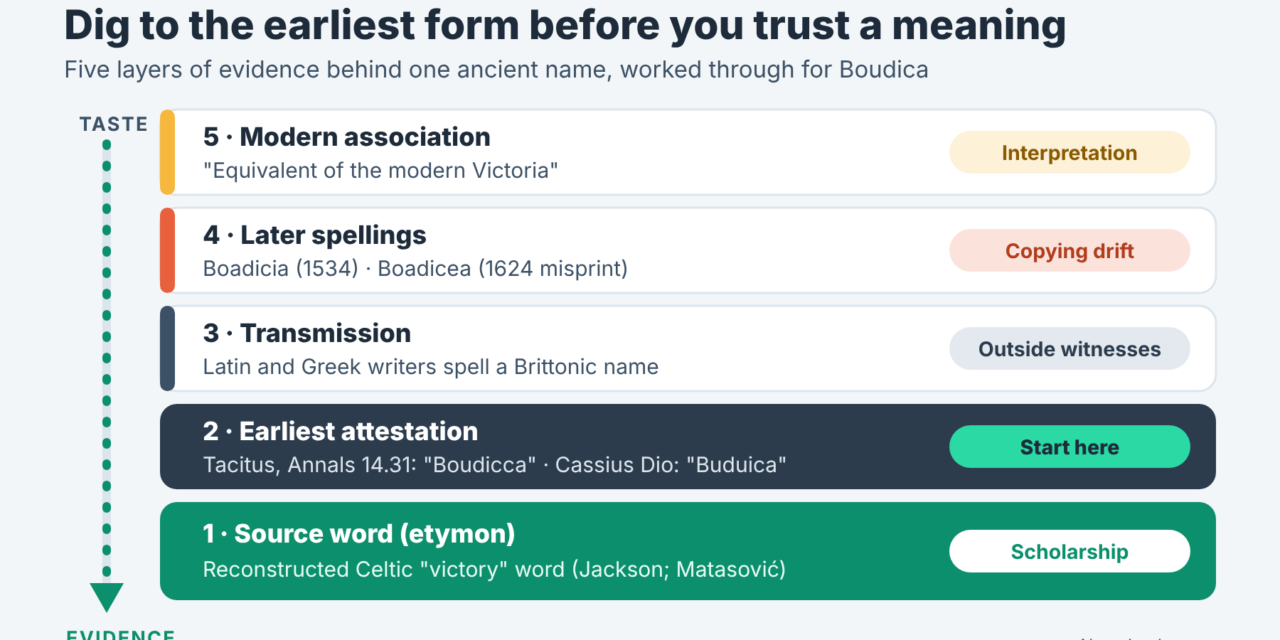
Take Boudica, the queen who led a revolt against Roman rule in Britain in 60 or 61 CE, as Britannica’s biography dates it. No text in her own language survives that names her.
What we have are two classical historians. In the Latin of Tacitus, Annals 14.31, the standard text reads “uxor eius Boudicca”, “his wife Boudicca.” The Greek historian Cassius Dio, in the 1925 Loeb translation hosted on the University of Chicago’s LacusCurtius site, gives the name as “Buduica”, with an editor’s note that she is “commonly known as Boadicea.”
So the oldest evidence is two foreign writers, in two languages, spelling the name two ways. That’s the honest starting point, and it’s already more interesting than any one-word meaning.
Modern reference works and name databases
The second pile is the scholarship. For many ancient naming traditions, specialists have built databases that gather every known attestation of a name, which saves you from hunting through scattered editions. Two examples show what these tools do and what they leave out.
The Lexicon of Greek Personal Names (LGPN) began in 1972 with British Academy support and has been based at Oxford since 1996. It collects documented personal names from the earliest Greek records to around the sixth century AD, drawn from literature, inscriptions, graffiti, papyri, coins and vases. Its about page is just as clear about the exclusions: mythological and heroic names, Mycenaean names, later Byzantine names and place names are out of scope. The project’s data is published under a Creative Commons Attribution 4.0 licence, which means you can cite and reuse it openly.
Trismegistos, based on texts from Egypt and the Nile valley, covers roughly 800 BC to AD 800. Its People database, which grew out of the Prosopographia Ptolemaica, holds about 555,000 attestations of personal names of non-royal individuals in Egypt in that window, in any language or script. Note the word “attestations”: it counts occurrences in texts, not distinct people and certainly not meanings.
What a name database can and can’t tell you
LGPN and Trismegistos tell you that a name was used, where, when and in what form. They’re the closest thing ancient names have to a birth register. What they don’t do is settle what a name meant. For that you still need etymological dictionaries, and you need to read them carefully.
Normalization: deciding which forms count as the same name
Once you’ve found forms of a name in old texts, you have to decide which ones belong together. Modern datasets face a version of this problem too: the U.S. Social Security name data treats each spelling as a separate entry, and somebody has to decide whether Sofia and Sophia are one name or two. With ancient names, the grouping decision is harder, because the spellings are shaped by scripts that didn’t record the same sounds and by scribes who didn’t share our spelling rules.
Scripts that leave out the vowels
Several ancient writing systems wrote consonants and left vowels to the reader. Egyptian hieroglyphic writing is the textbook case. The Fitzwilliam Museum’s schools fact sheet puts it plainly: “Hieroglyphs only recorded consonants; the system did not include vowels.” University College London’s Digital Egypt resource says the same and adds that, by convention, “Egyptologists insert an ‘e’ between the letters” to make the words sayable.
That convention explains a lot about familiar names. Behind the Name gives the Egyptian form of Nefertiti as the consonantal transliteration nfrt-jjtj, citing Hermann Ranke’s 1935 reference Die ägyptischen Personennamen. The pronunciation English speakers use is a modern scholarly convention laid over consonants, not a recording of how the queen’s court said it. Two references agree on the general sense but word it differently: Behind the Name glosses it “the beautiful one has come,” while Britannica’s biography renders it “A Beautiful Woman Has Come.” Neither is wrong. They show that even a well-attested gloss is a translation choice.
Hebrew is a related but different case. The biblical text was transmitted as consonants for centuries. According to a Biblical Archaeology Review sidebar, the Masoretes, scribal scholars best known from Tiberias, “added vowel pointings and cantillation marks to the consonantal text” between the sixth and tenth centuries C.E. The Biblical Hebrew site biblicalhebrew.org gives the same window, circa sixth to tenth centuries AD. So the vowels you see in a pointed Hebrew name are an early medieval reading tradition, very old and very careful, but still later than the consonants beneath them.
When two spellings are one name, and when they aren’t
The grouping rule we’d suggest is simple to state and fiddly to apply: forms are the same name when you can show the path between them, step by step, in sources. Resemblance isn’t enough. Plenty of unrelated names look alike in English, and plenty of related ones don’t.
The Jesus and Joshua pair is the cleanest example of related names that look different.
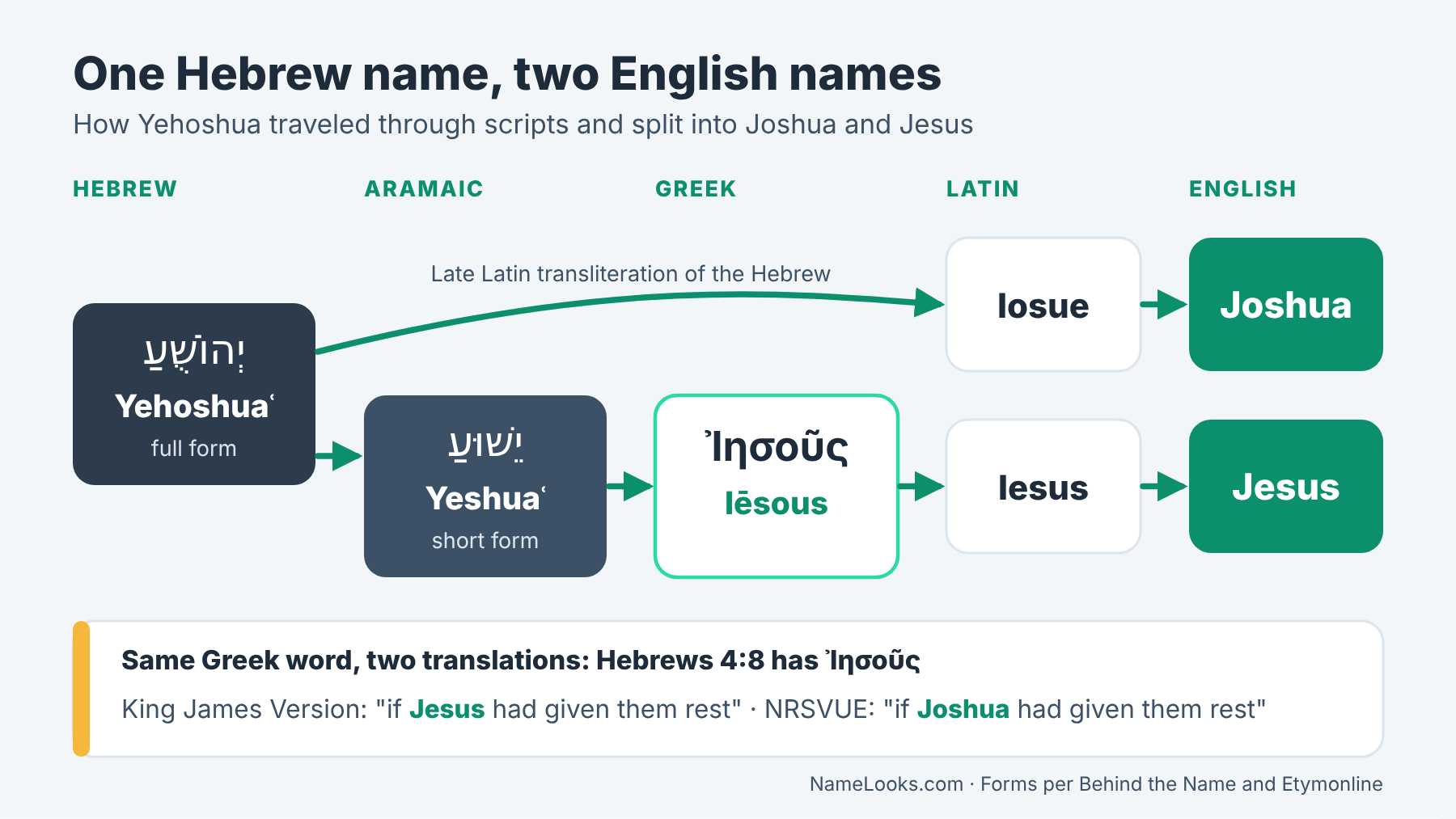
Behind the Name explains that Jesus comes from the Greek Iēsous, which renders the Aramaic short form Yeshuaʿ, a contraction of the Hebrew Yehoshuaʿ, and that Yehoshuaʿ is also the Hebrew original of Joshua. Etymonline traces the same chain from the Hebrew and Aramaic forms through Greek Iesous to Late Latin Iesus. In Latin the paths split: Behind the Name lists Iesus and Iosue as the Biblical Latin forms. English inherited both branches, which is why one source name now looks like two.
You can watch the grouping problem happen in a single verse. The Greek text of Hebrews 4:8, as printed in the SBL Greek New Testament on Bible Gateway, has Iēsous. The King James Version translates it “For if Jesus had given them rest”. The NRSV Updated Edition reads “For if Joshua had given them rest,” because the verse is about the successor of Moses. Same Greek word, two English names. Translators made a grouping decision, and they made it differently. If you’re researching an ancient name, that’s the decision you’re making too, and you should make it visibly.
For the mechanics of how one source form becomes several Latin-alphabet spellings, our article on transliteration versus translation goes further. The Unicode Consortium’s CLDR transliteration guidelines make a point that matters here: “Transliteration is not translation,” and transliterated letters often follow tradition rather than sound. Their own example is Greek β, conventionally written “b” even though modern Greek says it as “v.”
A grouping rule you can write down
Treat two forms as one name only when a source shows the step between them (a transliteration, a contraction, a translator’s rendering). Treat look-alikes as separate until proven otherwise. Record the relationship type each time: our explainer on cognates, variants, diminutives and transcriptions sets out the vocabulary.
2Separate what the evidence shows from what you’d like it to mean
When you research ancient name etymology, the hardest discipline is keeping three things apart. Every name-meaning claim mixes them: a fact about an old word, a judgment about how that word relates to the name, and, often, a modern feeling about what the name stands for. The first can be checked. The second can be argued. The third is taste. Trouble starts when all three arrive in one confident sentence.
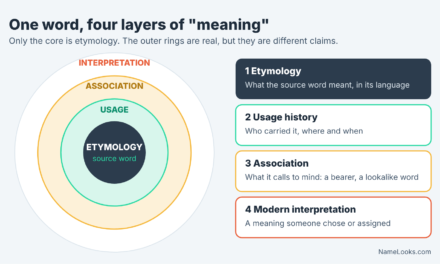
Our sibling piece on what a name’s “meaning” really means lays out the difference between etymology, association and modern interpretation in general terms. With ancient names, the separation needs to be even stricter, because the gap between the evidence and the popular gloss tends to be wider.
What a source actually establishes
Read a reference entry the way you’d read a lab report. Ask what it observed, what it inferred, and how sure it says it is. Good etymological references tell you all three, usually in a few small words that are easy to skim past.
Reading the hedge words
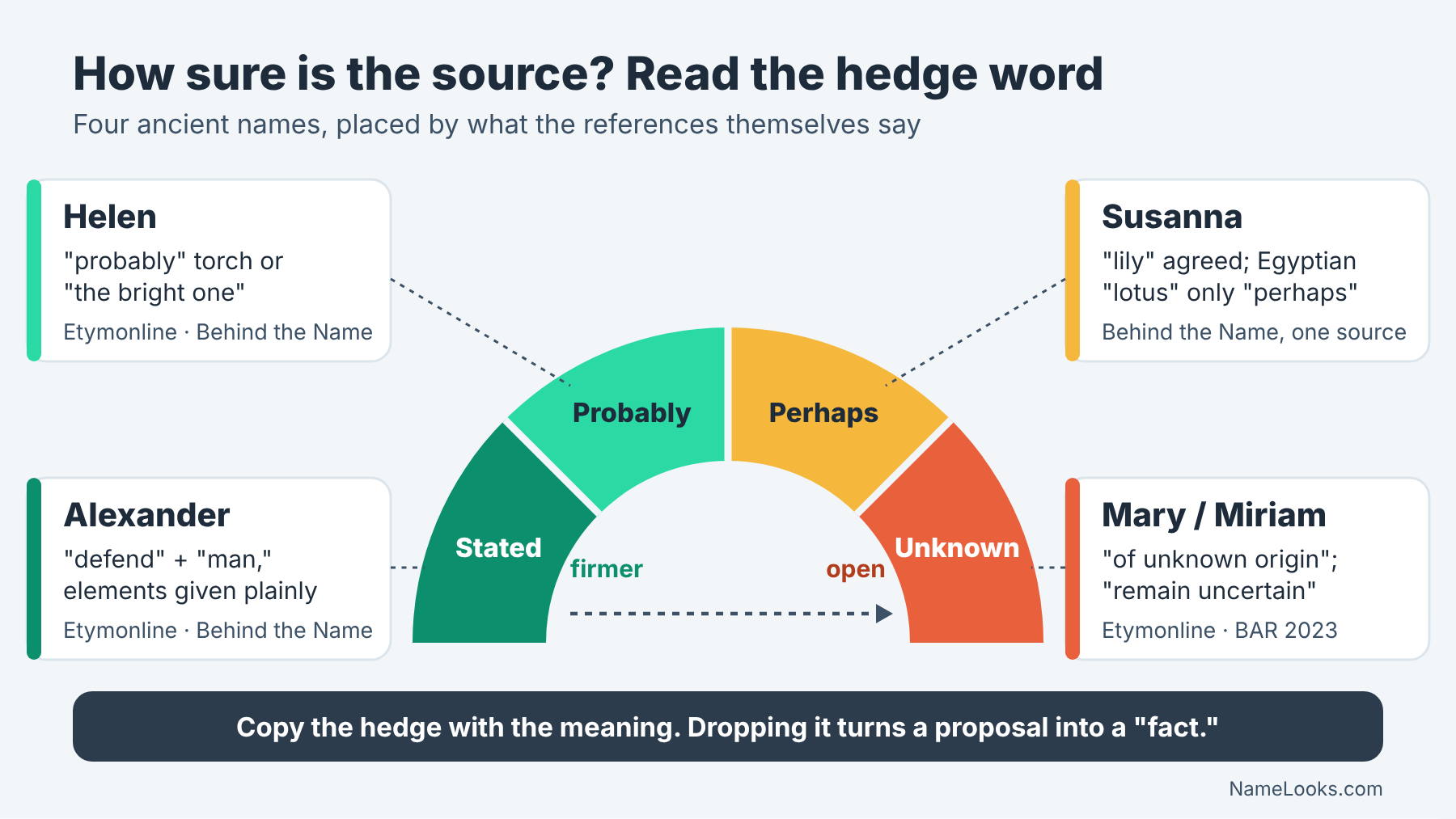
Look at how two general references handle Helen. Etymonline says the Greek Helenē is “probably” a feminine form of helenos, “the bright one.” Behind the Name says the name is “probably” from a Greek word it glosses as “torch,” citing the Liddell-Scott-Jones lexicon and Robert Beekes’s Etymological Dictionary of Greek, and that it is “possibly” related to selēnē, “moon.” It also files the name under uncertain etymology.
Notice what happened. Both references hedge, and they don’t hedge toward the same answer. “Bright one” and “torch” are close in spirit, but they’re different glosses. “Moon” is a weaker possibility in one source and absent from the other. A baby-name site that prints “Helen means light” has chosen one reading, rounded it off, and deleted the word “probably.” That’s three editorial moves dressed up as one fact.
Susanna shows a different pattern: agreement on one layer, silence on another. Etymonline traces the name back through Late Latin Susanna to the Hebrew name glossed “a lily.” Behind the Name agrees on shoshan, “lily,” and adds a deeper, tentative layer: the Hebrew word may itself come from Egyptian sšn, “lotus.” The word it uses is “perhaps.” So the well-supported claim is the Hebrew lily. The Egyptian lotus is a hypothesis carried by one of your two sources. If you repeat it, carry the “perhaps” with it.
Case file: Miriam, three references and three levels of confidence
Miriam, and the Mary that descends from it, is the best example we know of a famous ancient name whose meaning is genuinely open. It’s worth working through slowly, because nearly every possible source behavior turns up.
Start with the transmission chain, which the references agree on. Etymonline’s Mary entry traces Hebrew Miryam to Aramaic Maryam, then to Greek Mariam and Maria, then Latin Maria. Behind the Name’s Mary entry gives the same path from the Hebrew through the New Testament Greek forms to Latin. Good: that part is on firm ground.
Now the meaning. Etymonline calls the Hebrew name “a word of unknown origin” and mentions “rebellion” only as something it is said to mean. Behind the Name lists several proposals, including “sea of bitterness,” “rebelliousness” and “wished for child,” and says the name may come from Egyptian, possibly mry, “beloved,” or mr, “love.” A 2023 column in Biblical Archaeology Review titled “What’s in a Name? Miriam” breaks the name into mr(y), “beloved,” and yām, “sea,” discusses an Egyptian verb, and still states that the origins and meaning of the name “remain uncertain.”
So what do the sources establish? A secure chain of forms. A secure fact that the meaning is debated. A cluster of proposals, with an Egyptian connection favored by two of the three but asserted by none of them as settled. What they don’t establish is any single meaning you could print on a nursery wall without a qualifier. An honest summary says the meaning is uncertain, names the leading proposals, and says who favors which.
The “sea of bitterness” trap
Old glosses survive long after scholars stop favoring them, because they’re memorable. If a site gives a single dramatic meaning for an ancient name and doesn’t cite anything, assume it’s repeating an old proposal without the context. Our piece on how folk etymology and copy-paste sites create myths shows how that copying works.
Where interpretation takes over
Interpretation isn’t a dirty word. Families choose names for what they stand for, and a name’s symbolism can be real and meaningful without being etymology. The job is labeling, not banning. A reader should always be able to tell which sentence is a dated fact and which is a reading someone chose.
Symbolic readings and later associations
Boudica is a good test. Behind the Name derives the name from a Brythonic element meaning “victory,” citing Ranko Matasović’s Etymological Dictionary of Proto-Celtic (Brill, 2009). Wikipedia’s article, citing Kenneth Jackson’s 1979 note “Queen Boudica?” in the journal Britannia, reports his conclusion that the name comes from a Proto-Celtic adjective meaning “victorious,” built on a word for “victory,” and points to later Welsh Buddug and Irish Buaidheach as related forms. Those two references lean on different scholars, and they agree. That’s about as good as it gets for a name known only through foreign writers.
Then come the readings layered on top. The Encyclopaedia Romana, hosted on the University of Chicago’s Penelope server, has a page on the queen’s name that calls it “the equivalent of the modern ‘Victoria.'” That’s a fair comparison of meanings.
It’s also an interpretive bridge, not a historical link: Victoria comes from Latin, Boudica from Celtic, and nobody is claiming one descends from the other. Wikipedia adds a further caution, citing two books: Boudica may have been an honorific title, so her personal name during most of her life is unknown. A “victorious” title would be a very different thing from a name given at birth.
Phrasing a meaning honestly for a card, a page or a speech
Most readers of this page need a sentence, not a dissertation. Here are three phrasings that hold up, ranging from the firmest to the most tentative. Swap in your own sources.
- Well supported: “Alexander comes from the Greek Alexandros, usually explained as ‘defender of men,’ from words for ‘to defend’ and ‘man’ (Etymonline; Behind the Name).” Etymonline gives the elements alexein and anēr, genitive andros. Behind the Name, on its Alexandra entry, gives the same pair.
- Probable but debated: “Helen is probably from a Greek word for ‘torch’ or ‘bright one’; scholars aren’t certain.”
- Open question: “The meaning of Miriam is uncertain. Several scholars favor an Egyptian origin, possibly linked to a word for ‘beloved.'”
Each of those keeps the hedge, names a source family, and stays short. If you’re writing for a wider audience, the step-by-step checking process in how to verify a name meaning across multiple sources pairs well with these templates.
| Claim | Source checked | Language / script | Date of evidence | What the source states | Limitation | Editorial takeaway |
|---|---|---|---|---|---|---|
| The queen’s name was written “Boudicca” | Tacitus, Annals 14.31 (Latin Library text) | Latin, Roman script | Events of 60 or 61 CE; text known through later manuscript copies | “uxor eius Boudicca” | A Roman writer’s spelling of a Brittonic name | Cite as the earliest Latin form, not as her own spelling |
| The same name appears in Greek | Cassius Dio, Book 62 (Loeb 1925, LacusCurtius) | Greek, rendered “Buduica” in translation | Same events | “Buduica, a Briton woman of the royal family” | Second foreign rendering; no native-language text | Two outsiders, two spellings: present both |
| Boudica relates to a Celtic word for “victory” | Behind the Name (citing Matasović 2009); Wikipedia (citing Jackson 1979) | Brythonic / Proto-Celtic, reconstructed | Scholarship of 1979 and 2009 | Derivation from a “victory” element | Reconstructed forms; name may have been a title | Firm enough to state, with attribution and the title caveat |
| Mary / Miriam has a known meaning | Etymonline; Behind the Name; BAR 2023 | Hebrew, possibly Egyptian | Modern references | “Unknown origin”; several proposals; “remain uncertain” | Proposals compete; none settled | Say “uncertain,” then list leading proposals with sources |
| Nefertiti means “the beautiful one has come” | Behind the Name (citing Ranke 1935); Britannica | Egyptian, consonant-only hieroglyphic script | Modern references | Same sense, worded differently | Vowels and pronunciation are modern conventions | Safe to state; don’t imply we know how it sounded |
| Susanna comes from Egyptian “lotus” | Behind the Name; Etymonline | Hebrew, possibly Egyptian | Modern references | “Lily” in both; Egyptian “lotus” only “perhaps,” in one | Deeper layer carried by a single source | State “lily”; give “lotus” only as a tentative proposal |
3Grade your sources before you count them
Most of the work when you research ancient name etymology is source work, not word work. The rule in our cluster is that every meaning or origin claim needs two independent references you have actually opened. That rule only works if you’re honest about two words in it: “independent” and “references.” A forum post isn’t a reference. Two sites that copied the same paragraph aren’t independent. This section is about telling the difference quickly.
A ladder from the original text to the copy-paste site
Think of sources as rungs on a ladder. The higher the rung, the closer it is to the ancient evidence and the more expertise it applies. You don’t always need to climb to the top to research ancient name etymology well. You do need to know which rung you’re standing on, and say so.
Top rungs: the texts themselves and the specialist tools
At the top sit the primary texts in a reliable edition: the Latin of Tacitus, the Greek of Cassius Dio, an inscription in a published corpus. Just below are the specialist name databases and lexicons built from those texts, like LGPN for Greek names and Trismegistos for names in Egyptian documents, and the scholarly etymological dictionaries for a language family. Behind the Name’s own references page is a useful map of this rung: it lists Robert Beekes’s Etymological Dictionary of Greek (Brill, 2010) and the Liddell-Scott-Jones lexicons for Greek, and Ranko Matasović’s Etymological Dictionary of Proto-Celtic (Brill, 2009) for Celtic.
You won’t always be able to read these tools directly. Some are expensive books; some are in languages you don’t read. That’s fine. What matters is that you can see that the reference you’re using cites them, and for what claim.
Middle and lower rungs: general references, wikis and name sites
In the middle are carefully edited general references: Etymonline for words and names that entered English, Behind the Name as a secondary index, encyclopedias like Britannica, and general name dictionaries such as Patrick Hanks and Flavia Hodges’s A Dictionary of First Names (Oxford, 1990), which Behind the Name also lists. These are good for the transmission chain and for a first read on meaning. They’re weaker for disputed origins, because they have to compress.
Wikipedia and Wiktionary sit lower. They’re excellent pointers when they cite their sources, and you should follow those citations rather than citing the wiki. At the bottom are baby-name sites, listicles and social posts that give one-word meanings with no references at all. They aren’t evidence of anything except that a claim is circulating, which, to be fair, is sometimes worth knowing.
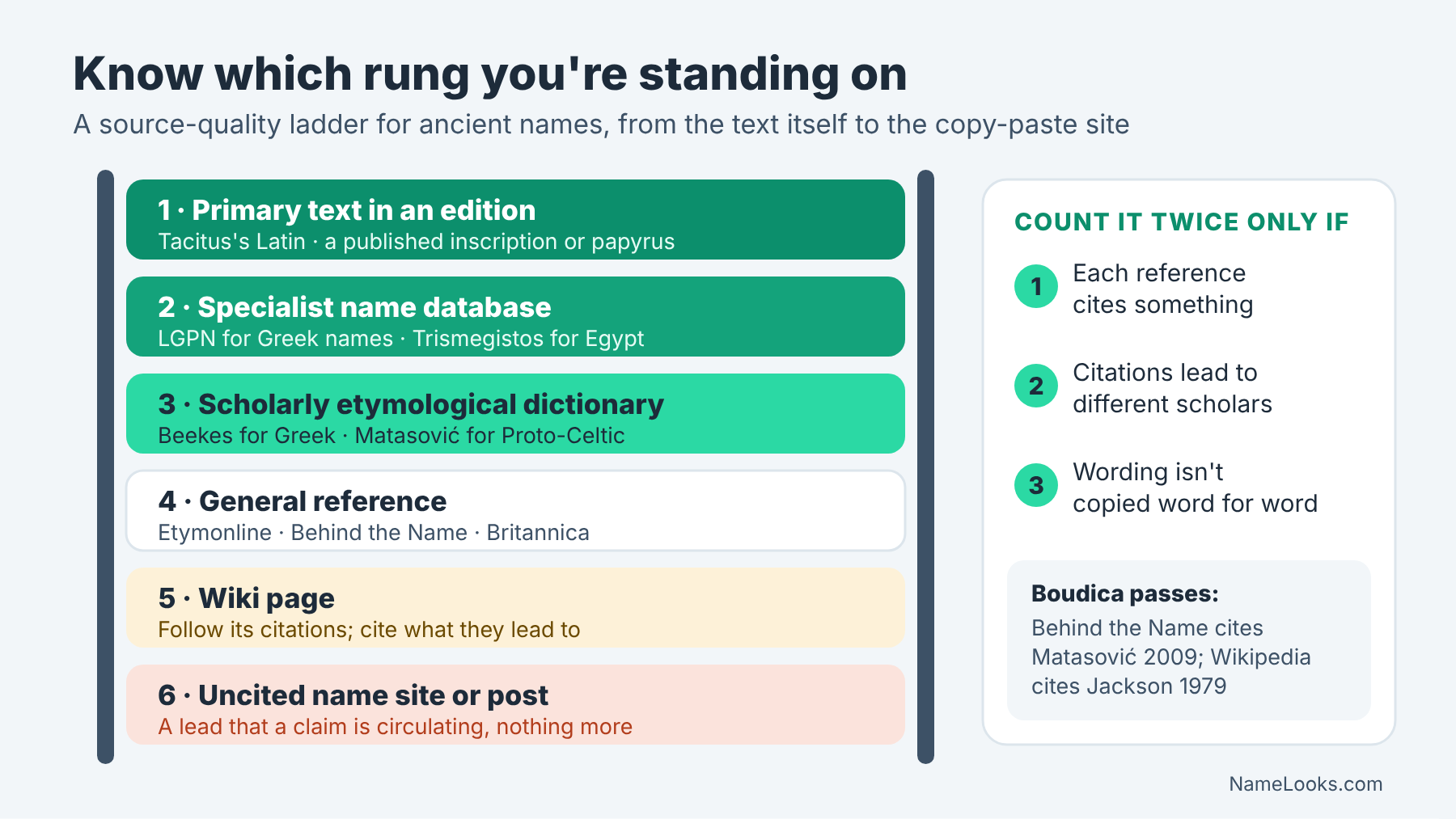
Testing whether two references are really independent
Independence is the part people skip. Two references are independent when they reached their conclusion through different chains of evidence or scholarship. If they share one upstream source, they count once. If neither cites anything, you can’t tell, and you should treat them as one unverified claim.
Follow the citation trail: the Linear B Alexandra
Here’s a real example of how this goes wrong, and it’s one we ran into while preparing this page. Mycenaean Greek, the oldest known form of Greek, was written in the Linear B syllabary on clay tablets that Britannica dates to roughly 1400 to 1200 BC, in a spelling system quite unlike the later Greek alphabet. Wiktionary’s entry for Alexandros mentions a Mycenaean form, a-re-ka-sa-da-ra, which it says seemingly corresponds to the feminine Alexandra and calls the earliest attested form of the name. Palaeolexicon, an online word database for ancient languages, also lists a-re-ka-sa-da-ra with the gloss “alexandra.”
Two sources, same claim. Done? Not yet. When we opened both, neither gave a tablet number, an excavation site or a published edition for the reading. Neither showed the chain of evidence.
They may well be right, and a Linear B specialist could likely confirm it in minutes. But on what we could see, we have two pointers without a trail, and we can’t tell whether they’re independent. So this page doesn’t present the Linear B Alexandra as established. It presents it as a lead: something to check against a published Linear B corpus or lexicon before repeating. Note, too, that LGPN excludes Mycenaean names by design, so the most obvious Greek-names database won’t settle it.
When every trail ends at the same book
The opposite problem is subtler. Sometimes two respectable references agree because they’re both relying on the same older work. That’s not a scandal. Reference works build on each other. But it means you have one line of evidence, not two.
The Boudica case shows what real independence looks like. Behind the Name’s derivation points to Matasović’s 2009 dictionary. Wikipedia’s derivation points to Jackson’s 1979 article in Britannia. Those are different scholars writing three decades apart, and they reach compatible conclusions. That counts. By contrast, if two baby-name sites both say a name means “victory” and neither cites anything, you can’t rule out that one copied the other, or that both copied a third site. Treat them as one claim of unknown origin, which is a slightly ironic place for a name meaning to end up.
Three quick independence checks
- Does each reference cite something? If not, it can’t count toward your two.
- Do the citations lead to different works or authors? If they lead to the same one, count it once.
- Is the wording suspiciously similar? Identical phrasing across “different” sites usually means copying, which our article on name meaning red flags covers in detail.
4Publish your limitations so someone else can retrace the work
If you research ancient name etymology for anyone besides yourself, the write-up matters as much as the findings. A research note on an ancient name is finished when someone else could repeat it. That means listing the sources you checked, the forms you found, the dates you checked them, and, just as important, the things you looked for and didn’t find. Gaps are findings. A note that hides them looks more confident and is less useful.
Missing data and edge cases
Ancient names rarely fail because a source is wrong. They fail because the evidence has a shape, and people forget the shape. Here are the edge cases that come up most often, and what to write when you hit one.
Names that survive only in someone else’s language
Boudica is known to us through Latin and Greek writers. That’s common for people from cultures that wrote little or whose writing didn’t survive. When the only witnesses are outsiders, the spelling tells you how a Roman or Greek ear heard the name and how their alphabet could represent it. It doesn’t tell you how the bearer spelled it, because there may have been no spelling at all.
Sometimes there’s indirect help. Wikipedia’s Boudica article, citing Graham Webster’s 1978 book, reports related forms in inscriptions from elsewhere in the Celtic-speaking world: Boudiga at Bordeaux, Boudica in Lusitania, Bodicca in Algeria. We haven’t seen those inscriptions ourselves, so we’d record them as “reported by Webster 1978 via Wikipedia; not checked against an epigraphic corpus.” That one line tells the next researcher exactly where to dig.
Titles, epithets, gods and heroes
Not every ancient name is a personal name in the modern sense. Some are titles. Some are epithets of gods. Some belong to mythological figures who may never have had birth certificates of any kind. These categories behave differently in the evidence and in the reference works.
LGPN, as noted above, leaves out mythological and heroic names entirely, so a search there for a legendary figure will come back empty even though historical people bearing the name may appear. Behind the Name notes that Alexandra was an epithet of the goddess Hera and an alternate name of Cassandra. Britannica lists Neferneferuaten-Nefertiti as another name for the Egyptian queen. And Wikipedia, citing two books, raises the possibility that Boudica was an honorific title rather than a birth name.
In each case the right move is to say which kind of name you’re dealing with before you say what it meant.
Royalty and the edges of a database
Databases also have scope rules that can mislead you if you don’t read the about page. Trismegistos People, by its own description, covers non-royal individuals in Egypt between roughly 800 BC and AD 800. A pharaoh or queen won’t be represented there the way a scribe or landowner is. LGPN stops at around the sixth century AD and excludes later Byzantine names.
“Not in the database” can mean “rare,” but it can just as easily mean “out of scope.” Always check which before you write the word rare. The same discipline applies to modern data, where SSA’s rules about spelling and thresholds shape what you can see.
Freshness: when to recheck an ancient name
It’s tempting to think an ancient name’s history is settled. The people are long dead; what could change? Quite a lot, as it turns out. New texts are published, databases add volumes, and dictionaries are revised. A note written today should carry a date and a rule for when it gets checked again.
Why old names keep getting new evidence
LGPN’s own about page describes eight published volumes, a ninth on Syria, Arabia and regions further east listed as forthcoming, and further volumes on Egypt planned. It also notes that Volume VI data will be added online after print publication. Every one of those changes can add attestations, places or dates for a name you’ve already researched.
Reference works turn over too. Behind the Name’s references page lists E. G. Withycombe’s Oxford Dictionary of English Christian Names from 1945 alongside Hanks and Hodges from 1990 and Matasović from 2009. Etymological thinking moves over decades like that. A meaning you found in a 1940s book may since have been revised or abandoned, which is exactly how the old “sea of bitterness” gloss of Miriam keeps resurfacing. When two sources from different eras disagree, give extra weight to the more recent specialist work, and say that’s what you did.
A dated research note anyone can pick up
Here is the format we’d suggest whenever you research ancient name etymology, whether for a family tree, a novel or a name page. It takes ten minutes and saves the next person hours.
- Name and bearer: exact form researched, and which person or text it attaches to.
- Earliest forms found: each with language, script, source and the edition or translation you read.
- Transmission chain: each hop from the earliest form to the modern spelling, with a source per hop.
- Etymology as reported: each reference’s claim in its own hedge words, with what it cites.
- Independence check: which references share an upstream source, and which don’t.
- Gaps: what you looked for and couldn’t find or couldn’t verify.
- Checked on: the date, plus a recheck date. For a disputed name, we’d recheck yearly or whenever a major reference releases a new edition or volume.
| Period and source | Form recorded | What changed | Caveat | Naming implication |
|---|---|---|---|---|
| Events of 60 or 61 CE; Tacitus, Annals 14.31 | Boudicca | Earliest surviving Latin form | Read through later manuscript copies; the double c reflects the Latin text, not any native spelling | The best-attested ancient spelling |
| Same events; Cassius Dio, Book 62 (Loeb, 1925) | Greek form rendered “Buduica”; Behind the Name gives Boudouika | Different alphabet, different vowels | Transliterating Greek back to Latin letters adds another layer of choice | A second independent witness to the same name |
| 1534, Polydore Vergil (per Encyclopaedia Romana) | Boadicia | Introduces the queen to English readers with altered vowels | Reported secondhand; we did not consult the 1534 text | Shows the drift had begun before the famous misprint |
| 1624 (per Encyclopaedia Romana) | Boadicea | Appears as a misprint | Wikipedia, citing several books, also describes medieval scribal changes behind the a and e | The best-known modern spelling has the weakest ancient basis |
| 1658, Thomas Browne, Hydriotaphia; 1782, William Cowper, Boadicea: An Ode | Boadicea | Adopted deliberately by literary writers | Literary use, not linguistic evidence | Explains why the spelling feels “traditional” in English |
| 1979, Kenneth Jackson, “Queen Boudica?”, Britannia (per Wikipedia) | Boudica | Argues this is the correct Brittonic spelling | A reconstruction based on Celtic cognates | A scholarly case for one c; reference works still vary |
| Today, Britannica headword | Boudicca, with Boadicea and Boudica as alternatives | All three coexist in reference works | No modern authority has the final word on spelling | Pick a spelling on purpose and say why |
The table is the whole argument of this page in miniature. The spelling most English speakers grew up with came from a chain of copying and a printing error. The spelling scholars prefer comes from comparing Celtic languages. And the meaning, “victory” or “victorious,” survives the spelling mess because it rests on a different kind of evidence. For more on how names reshape themselves as they travel, see our piece on how name meanings change through borrowing and sound change.
5When an ancient name becomes a modern choice
Most people who research ancient name etymology have a practical reason. They’re naming a child, a character, a pet, a boat or a business, or they’re writing a page that other people will quote. The research method doesn’t change, but the decisions at the end do. This section covers the two most common ones.
If you’re giving the name to someone
An ancient name in modern use is, legally and socially, a modern name. Whatever the research says, the person carrying it will spell it on forms and correct people’s pronunciation for decades. The broader trade-offs of choosing any name are covered in our decision framework for choosing a name. Here we stick to the issues that are specific to old names.
Choosing among historical spellings
With Boudica, you could defensibly choose Boudicca (Tacitus), Boudica (Jackson’s reconstruction) or Boadicea (the long English literary tradition). None is wrong. They signal different things. Boudicca says “I went to the classical source.” Boudica says “I followed the Celtic linguistics.” Boadicea says “I’m drawing on the English tradition of the name,” the one Cowper’s 1782 ode used. If someone asks why, you’ll have an answer that’s true.
What we’d avoid is choosing a spelling because a site claimed that spelling carries a special meaning. In this case, all three spellings refer to the same name, and the meaning evidence doesn’t depend on the vowels. The same reasoning applies whenever variants come from transliteration: a different Latin-alphabet spelling of the same source form usually doesn’t change what the name meant. Our explainer on romanization variants shows how one source form spreads into several spellings.
Pronunciation when nobody alive has heard it spoken
For many ancient names, there’s no living tradition that reaches back to the original speakers. What exists instead is a modern convention, sometimes several. Behind the Name gives English pronunciations for Nefertiti, with a slightly different final vowel in American and British speech. Those are how English speakers say the name now. They aren’t a reconstruction of ancient Egyptian, which, as the UCL and Fitzwilliam resources explain, didn’t write its vowels.
So separate two questions. “How do English speakers say this name?” has a checkable answer from a pronunciation reference. “How did the original bearer say it?” may have only a scholarly reconstruction, or none. For a child’s name, the first question is the one that matters day to day. Our guide to researching a name’s pronunciation without guessing from spelling walks through how to check it.
A name still living in a community
Some ancient names have long histories of use. Behind the Name notes, for instance, that Miriam has long been popular among Jews, that Susanna was used occasionally in medieval England, and that English speakers have used Joshua since the Protestant Reformation. For those names, the living community’s spelling and pronunciation are part of the evidence, and often the most important part for a modern bearer. Our piece on origin versus usage explains why a name’s source language and its present home can differ.
If you’re publishing what the name means
Anything you publish about an ancient name will be copied, trimmed and pasted elsewhere. Write it so that it stays true when someone quotes only one sentence.
Wording that survives being quoted out of context
Put the hedge inside the same sentence as the meaning. “Miriam’s meaning is uncertain; one proposal links it to an Egyptian word for ‘beloved'” survives being quoted. “Miriam means beloved. However, this is disputed” doesn’t, because the second sentence is the first thing a copier drops. Put the source in the same sentence too, at least by name. And keep the literal meaning of the source word separate from symbolic readings: “from a Celtic word for victory” is a claim about language; “a name for a fighter” is an interpretation.
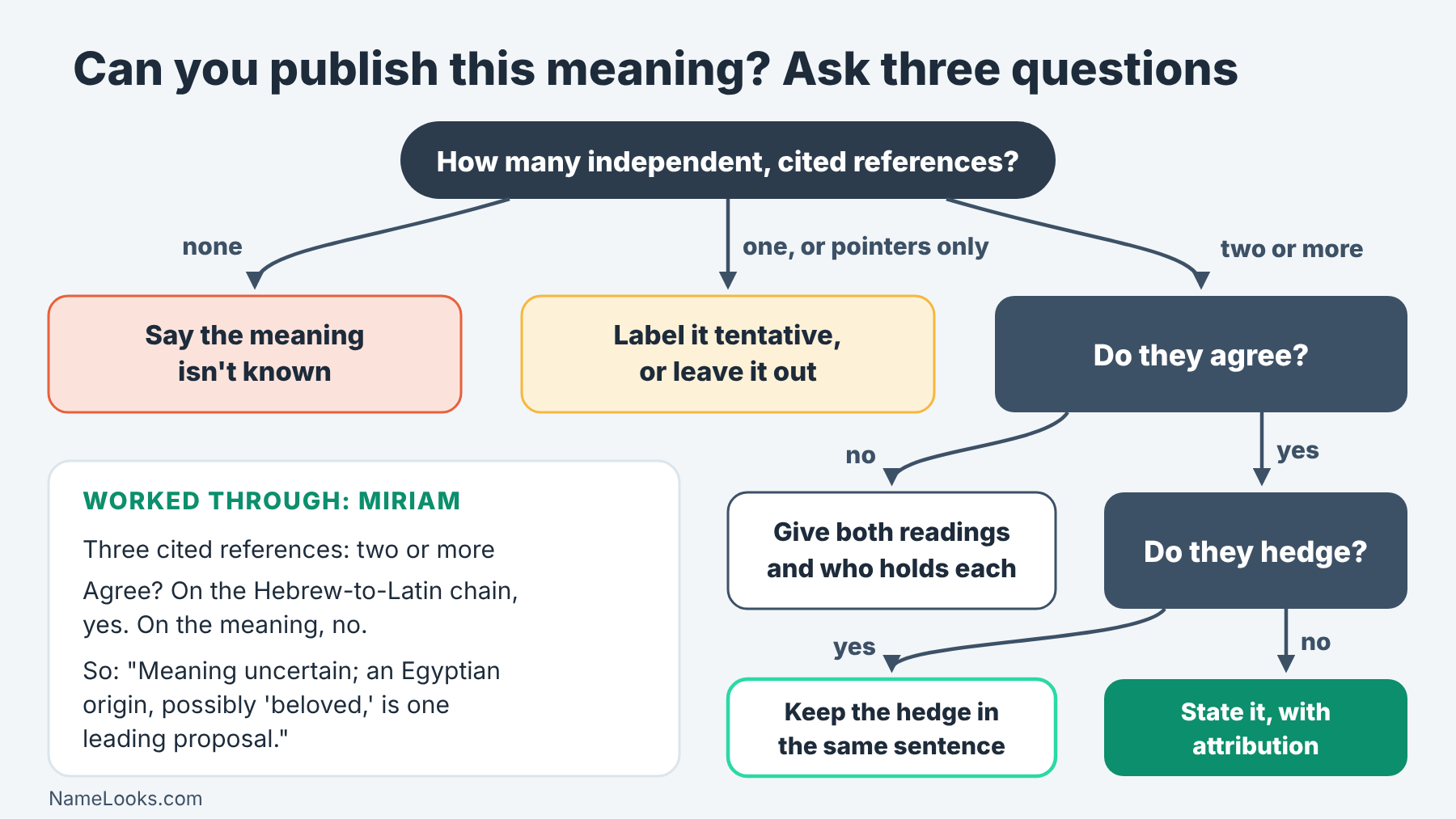
The decision tree above is the version we use. If two independent references agree and neither hedges, state the meaning with attribution. If they agree but hedge, keep the hedge. If they disagree, present both readings and who holds each. If you have only one reference, or only pointers without citations, label the claim tentative or leave it out. And if no source gives a meaning, say the meaning isn’t known. That last sentence is underrated. It’s accurate, it’s short, and it can’t spread a myth.
Correcting a meaning you’ve already published
If you find that something you published was wrong, or stated more firmly than the evidence allows, fix it in place and add a dated correction note that says what changed. Don’t silently swap the text. People who quoted the old version need a way to see that it moved. If the old meaning was popular, say explicitly that it’s widespread but unsupported, so readers who’ve seen it elsewhere understand the change.
For the wider context, including how scholars study names as a field, see our introduction to onomastics, the study of names. And when you want the full cluster method, from modern names to the oldest ones, start with our cornerstone on name meanings and origins, which this page builds on.
Questions people actually ask
Can I trust a name meaning if the site doesn’t list any sources?
You can’t verify it, which isn’t the same as it being false. Treat it as a lead, then look it up in a reference that cites its sources, such as Behind the Name or Etymonline, and ideally a specialist dictionary they cite. If you can’t find any cited support, don’t repeat the meaning as fact.
Is Wiktionary good enough as one of my two references?
On its own, no. Wiktionary is useful for finding forms and pointers, and its better entries cite scholarship. Follow those citations and count the work they lead to, not the wiki page. Our Linear B example shows why: a wiki claim with no tablet or edition cited can’t be checked.
Why do ancient names have so many English spellings?
Usually because they passed through several scripts and languages before reaching English, and each step involved choices about how to represent sounds. Printers, scribes and literary fashion added more variation. Boudicca, Boudica and Boadicea all refer to one queen.
Does the oldest spelling tell me the correct pronunciation?
Not reliably. Scripts like Egyptian hieroglyphs recorded consonants only, and Latin or Greek writers spelled foreign names as best their alphabets allowed. The oldest spelling is the best evidence for the form, but pronunciation needs separate evidence, and for many ancient names only modern conventions exist.
What if the scholarly references disagree with each other?
Say so and give both readings, with who holds each. If one reference is a recent specialist dictionary and the other is a general or older work, it’s reasonable to give more weight to the specialist, but explain that choice rather than hiding the disagreement.
Do name databases like LGPN tell you what a name means?
Mostly not. They document where, when and in what form a name was used, which is the raw evidence etymologists work from. For meanings, you need etymological dictionaries. Use the database to confirm that a name existed and how it was written, then turn to the lexicons for its origin.
Sources and further reading
- Lexicon of Greek Personal Names (Oxford): about the project — scope, sources and exclusions of the main Greek-names database.
- Trismegistos: about — coverage of texts and personal-name attestations from Egypt, about 800 BC to AD 800.
- Tacitus, Annals 14 (The Latin Library) — the Latin text with the earliest form, Boudicca.
- Cassius Dio, Book 62 (LacusCurtius, Loeb 1925) — the Greek historian’s account in English translation.
- Encyclopaedia Romana: Boudica and Boadicea — the history of the English spellings, including the 1624 misprint.
- Etymonline: Mary and Behind the Name: Mary — two general references that trace the same chain and hedge the meaning differently.
- Biblical Archaeology Review: What’s in a Name? Miriam — a short 2023 column on the uncertain origin of Miryām.
- UCL Digital Egypt: the writing system and Fitzwilliam Museum fact sheet — why Egyptian names lack recorded vowels.
- Unicode CLDR transliteration guidelines — why transliteration isn’t translation or a pronunciation guide.
- Behind the Name: references — a list of the dictionaries behind a widely used secondary index.
NameLooks provides general information about names and naming research. Etymologies of ancient names are often reconstructed and can be revised as new evidence appears; popularity data describes populations, not individuals.