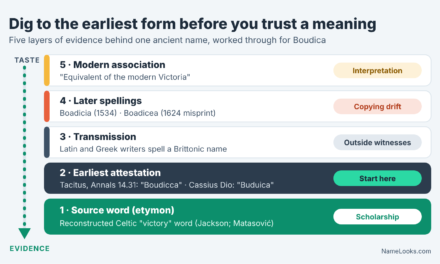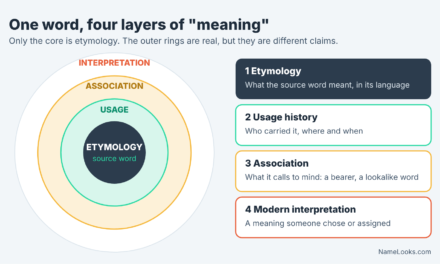
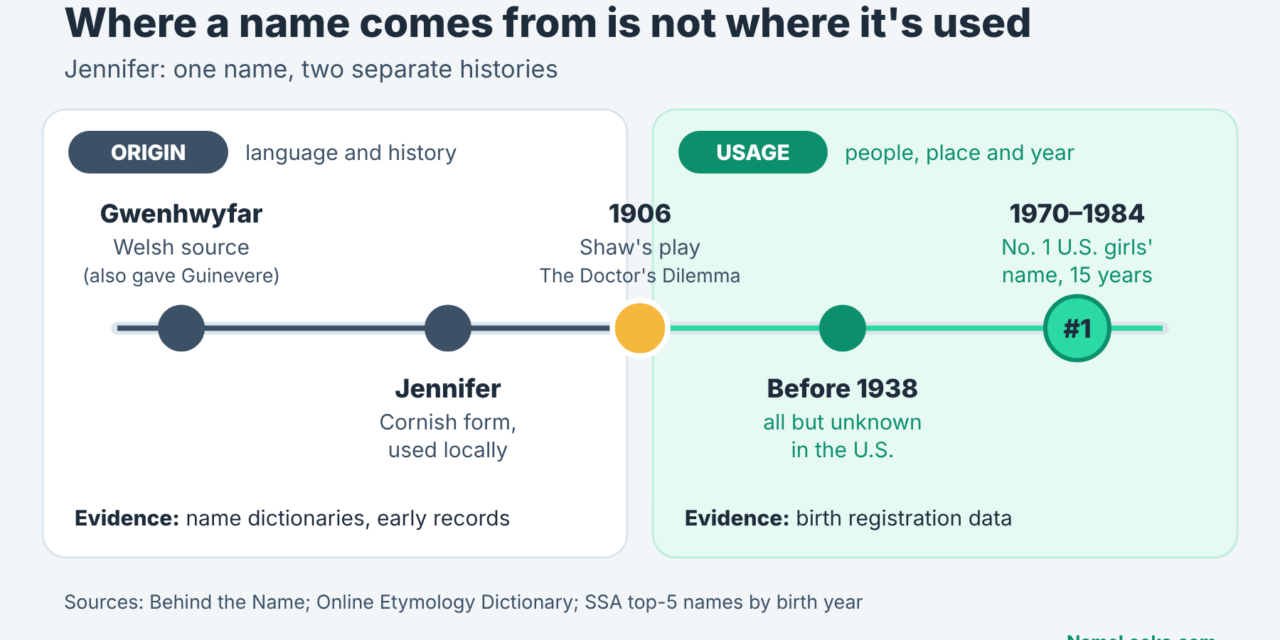
For fifteen straight years, from 1970 through 1984, the most popular name for baby girls in the United States was Jennifer, according to Social Security Administration rankings. Its source is not English at all: reference works trace it to a Cornish form of the Welsh name behind Guinevere, and one etymological dictionary says it was all but unknown in America before 1938. That gap is the whole subject of this page. The name origin vs usage question asks two different things, where a name came from and who uses it now, and this guide shows how to research each side without letting one answer stand in for the other.
What to take away before you read on
- Origin and usage are separate facts with separate evidence. Origin comes from historical dictionaries and early records. Usage comes from registration data, censuses and observation of living communities.
- A name’s “nationality” label usually describes one of the two, and rarely says which. “An Irish name” can mean Irish-language in form, Irish in its source words, or popular in Ireland. Liam is Irish in form but Germanic in its source words.
- Usage can rewrite a name’s daily life. Spelling, accent marks, pronunciation and social associations follow the community that uses the name, not the language it started in.
- Official popularity data never records origin. SSA and ONS count exact spellings. They can tell you a name was given; they cannot tell you why, by whom, or what it means.
- When references disagree, show the disagreement. Two respected sources give different meanings for the second half of Jennifer’s Welsh ancestor. A careful label says so.
1Origin and usage answer two different questions
Here is the short answer to the name origin vs usage question, up front. A name’s origin is a historical claim about language: which words or earlier names it was built from, and in what language those pieces lived. A name’s usage is a social claim about people: which communities give the name today, or gave it in a particular period, and how they spell and say it. Neither one predicts the other. A name can come from Latin, be shaped by an English playwright, and top the charts in two countries that have nothing Latin about their everyday naming.
Most confusion about names starts when these two claims get squeezed into one word. “Celtic,” “Hebrew,” “Irish” and “Italian” all get used as if they settle both questions at once. They don’t. If you want the broader research method that sits underneath this page, our guide to researching name meanings and origins covers it from the ground up. Here we stay on one distinction and show what changes when you keep it.
Origin: where the name’s material came from
Origin work looks backward. It asks what the earliest recoverable form of a name was, which language it belonged to, and what its parts meant to the people who first used them. That is an etymological question, and it has the same evidence standards as any other word history. A name is not exempt because it’s personal.
Origin also has layers. A single modern name may have a deep source (the language its elements came from), a transmission route (the languages it passed through), and a proximate source (the specific form that the using culture borrowed). Each layer can be right or wrong independently, which is why “the origin” is often several claims stacked on top of each other.
What counts as evidence of origin
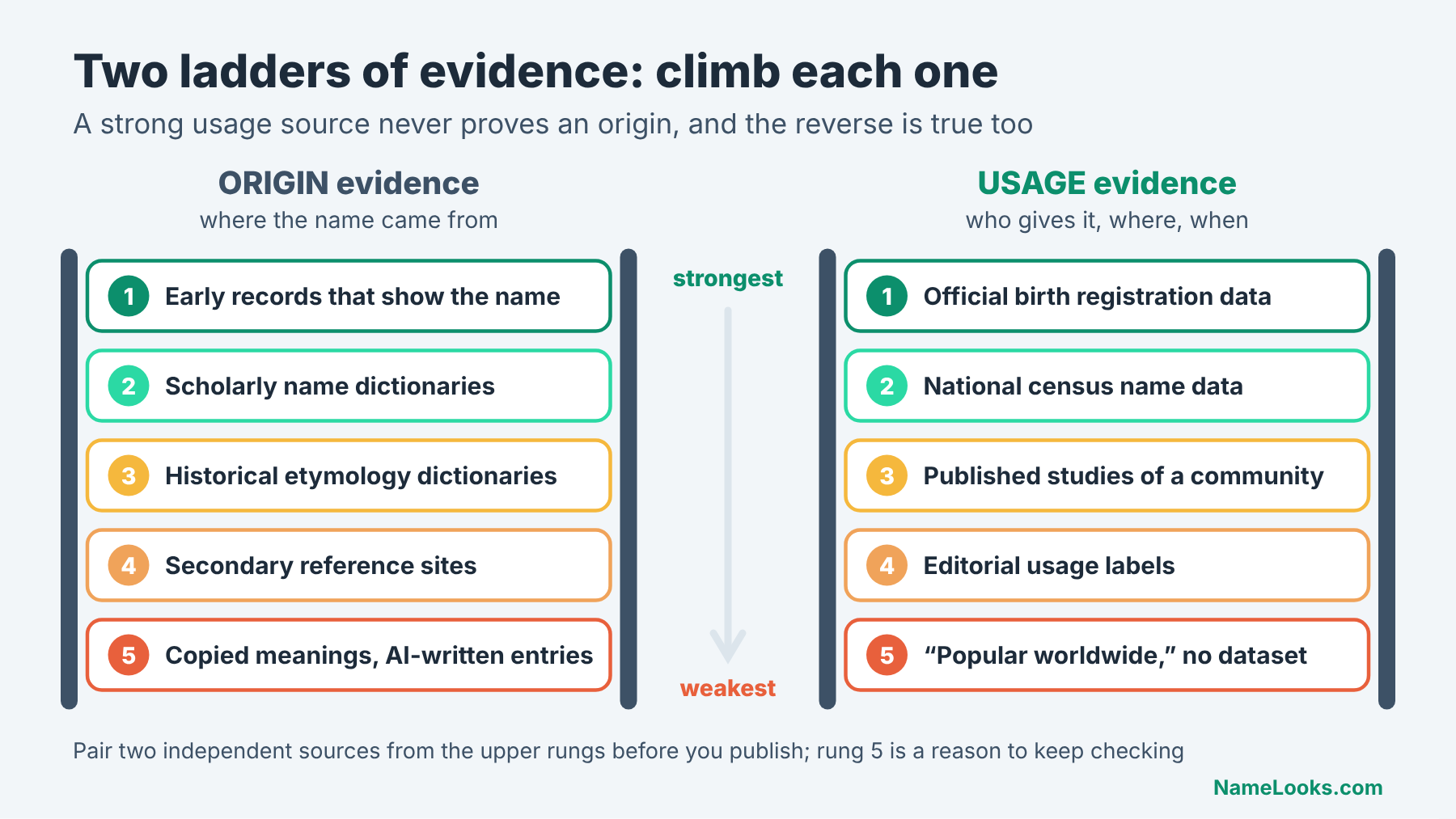
Good origin evidence comes from scholarly name dictionaries, historical etymological dictionaries, and early written records where the name actually appears. The reference list that Behind the Name publishes for its own entries is a useful map of what that literature looks like: Hanks and Hodges’s A Dictionary of First Names from Oxford, Withycombe’s Oxford Dictionary of English Christian Names, Ó Corráin and Maguire’s Irish Names, Woulfe’s Irish Names and Surnames, Förstemann’s Altdeutsches Namenbuch, and language-specific lexicons such as Wehr for Arabic and Monier-Williams for Sanskrit.
What doesn’t count: a meaning repeated across ten baby-name sites, a gloss with no language named, or a confident one-word “meaning” with no route back to a source. Those are signs of copying, not research. Our sibling article on red flags in name meaning claims catalogs the patterns, and they show up most often on the origin side of the ledger.
Notice too that origin evidence is mostly written evidence. That gives it an inherent bias toward cultures and periods with surviving records. A name with no early documentation isn’t necessarily young; it may simply come from a community whose naming wasn’t written down by the people who kept archives.
Case 1: Jennifer, a Cornish form that America made famous
Jennifer is the clearest documented case of origin and usage pulling in opposite directions. Behind the Name’s entry for Jennifer describes it as coming from a Cornish form of the Welsh name Gwenhwyfar, the source of Guinevere. It adds that the name was common mainly in Cornwall until after George Bernard Shaw used it in his 1906 play The Doctor’s Dilemma. The Online Etymology Dictionary’s Jennifer entry independently traces it to Welsh Gwenhwyvar and adds the striking usage note that it was “all but unknown” in America before 1938.
Then the usage side takes over. The SSA’s table of the top five names by birth year lists Jennifer as the No. 1 girls’ name in the United States every year from 1970 through 1984. So the origin is Welsh, the proximate form is Cornish, the literary launch was English, and the peak usage was American. Four places, and only one of them is where the name “comes from.”
Where the two references part ways
Both sources agree the first element is Welsh gwen, “white” or “fair.” They disagree about the second. Etymonline glosses it as “smooth, yielding.” Behind the Name’s Guinevere entry instead reconstructs an Old Celtic element glossed “phantom, magical being,” giving “white phantom.” An honest label for Jennifer gives the shared part confidently and the disputed part as disputed.
Usage: who gives the name, where, and when
Usage work looks at people rather than words. It asks which communities use a name, how often, in which period, with which spelling and pronunciation, and with what associations attached. Usage is always local and always dated. “Popular” without a place and a year is only half a sentence.
Usage is also the side that changes fastest. An origin, once established, rarely moves; new evidence can revise it, but the name’s history doesn’t change because fashion did. Usage can flip within a generation, and the records that measure it are refreshed every year.
What counts as evidence of usage
For birth names, the strongest usage evidence is official registration data. In the United States that’s the Social Security Administration’s baby names data, built from Social Security card applications. The SSA’s background notes say different spellings of similar names are not combined, and names with fewer than five occurrences are withheld for privacy. In England and Wales, the Office for National Statistics compiles first names from live birth registrations; its quality and methodology notes say it counts the exact spelling on the birth certificate, doesn’t group names, removes accents in processing, and doesn’t release names with fewer than three occurrences.
Look at what those rules leave out. Neither agency records where a name comes from or what it means. Neither records the family’s language, the parents’ reasons, or how the child’s name is pronounced. Registration data is excellent usage evidence and no origin evidence at all. If you want the mechanics in more depth, see how SSA counts birth-year names and spellings.
Case 2: Olivia, a Latin word routed through Shakespeare
Olivia shows how far usage can travel from a modest origin. The Online Etymology Dictionary traces it to Italian Olivia, from Latin oliva, “olive.” Behind the Name notes that Shakespeare used the spelling for a noblewoman in Twelfth Night, calls it rare in his time, and presents the Latin link more cautiously: it may come from Oliva or Oliver, or straight from the Latin word for olive.
On the usage side, SSA’s top-five table lists Olivia as the No. 1 U.S. girls’ name every year from 2019 through 2025. In England and Wales, ONS birth registration figures for 2025, as reported in coverage of the July 2026 release, again put Olivia first for girls, with 2,386 babies. Neither country’s naming culture is Latin or Italian in any everyday sense. The name’s present life is Anglophone, and its source is a Mediterranean tree.
The careful label writes itself: Latin source word, Italian and English literary transmission, and contemporary top-ranked usage in the U.S. and in England and Wales, each with its dataset and year. If you’re comparing those two countries’ lists directly, our piece on reading U.S. and England and Wales rankings side by side explains why the systems aren’t identical.
Why the two keep getting collapsed into one label
If origin and usage are so plainly different, why do name listings blur them constantly? Partly convenience: a single tag fits a filter on a website. Partly the language itself: English uses “an Irish name” or “a French name” for both claims without flagging the switch. And partly commerce, because a romantic origin sells better than “popular in Ohio since 2011.”
The “it’s a ___ name” shorthand
The phrase hides at least three possible meanings. It can mean the name is in a language (its form follows that language’s spelling and sound rules). It can mean the name is from a language (its building blocks are that language’s words). Or it can mean the name is used in a place (people there give it often). A single name can satisfy one, two or all three for different languages.
When you see the shorthand, it’s worth asking which one the writer meant. Very often they meant the third and wrote it as if it were the second. That’s how a usage fact becomes a pseudo-origin and then gets copied as etymology.
How reference sites already separate the two, if you read closely
The better reference sites keep the claims apart in their layout, even when casual readers don’t notice. Behind the Name puts a separate Usage line at the top of each entry and the history underneath. Its Jennifer entry lists usage as English, German, Dutch, Swedish and Spanish, while the history paragraph sends you to Cornish and Welsh. The usage line is a list of where the name is in use; the history is where it came from.
That separation is only as good as the editing behind it, and the site is open about its own structure: its FAQ explains that the main collection is curated by the site’s main editor, while user-submitted names carry checkmarks showing whether their usages or descriptions have been verified. Treat a usage line as an editorial summary to test against data, not as a measurement.
2How does a name cross from one language into another culture?
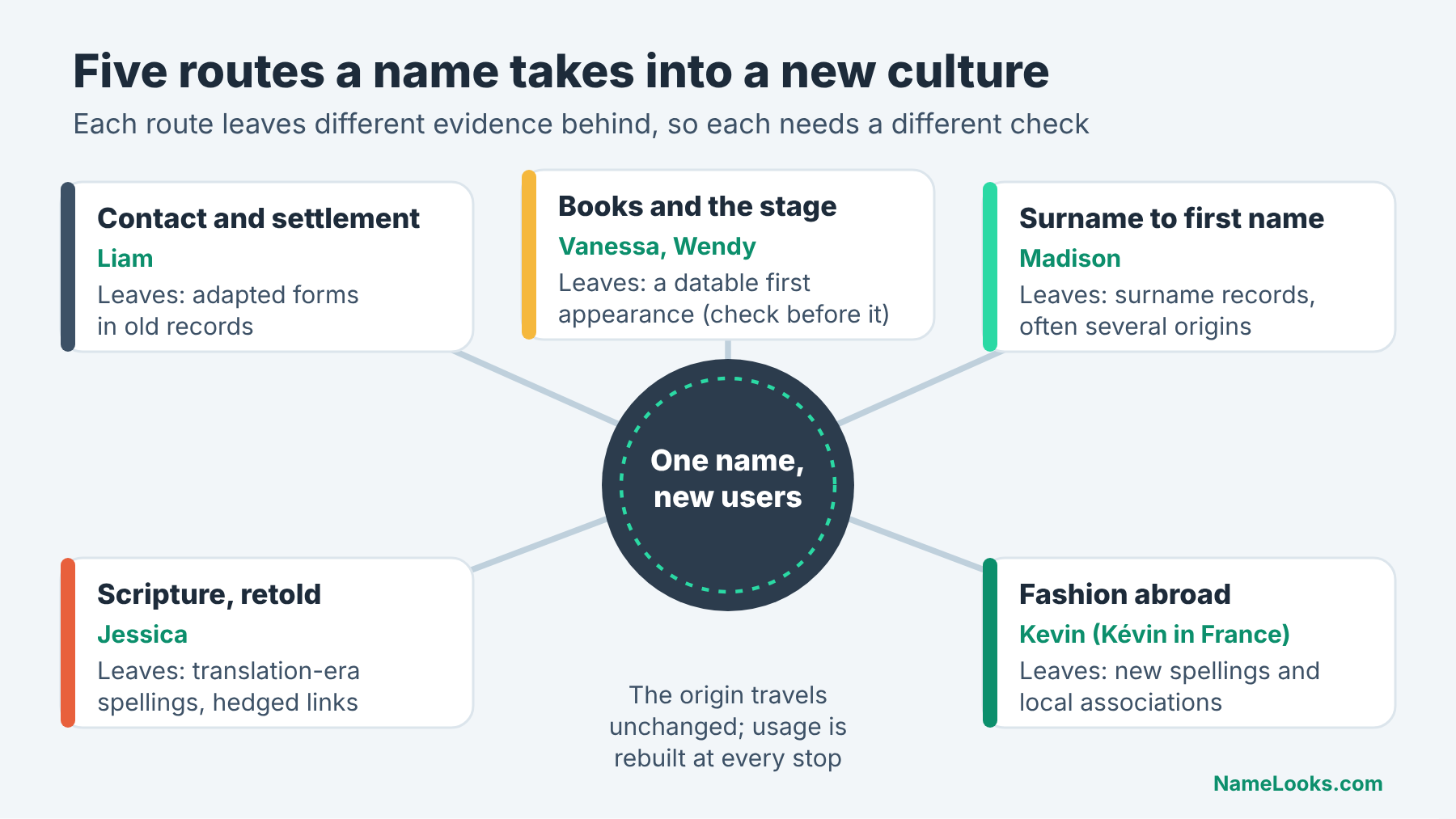
Names don’t drift between languages at random. In the well-documented cases, you can usually point to a mechanism: people moved and brought names with them, a writer put a name in front of a large audience, a surname was repurposed as a first name, a religious text was translated, or a name became fashionable abroad for reasons of its own. Knowing the mechanism matters, because each one leaves a different kind of evidence behind.
This section walks through those routes with documented cases. It doesn’t try to explain how the meanings drift along the way; that’s the job of our article on how name meanings change through borrowing, translation and sound change. Here the focus is narrower: how a name ends up used by people who don’t speak its source language.
Through contact, conquest and administrative habit
The oldest and best-documented route is plain human contact. When one group settles among another, its names get heard, borrowed and reshaped to fit the local language. Often the reshaping goes so far that the borrowed name starts to look native, which is exactly when the origin gets forgotten.
Case 3: Liam, a Germanic name that took an Irish shape
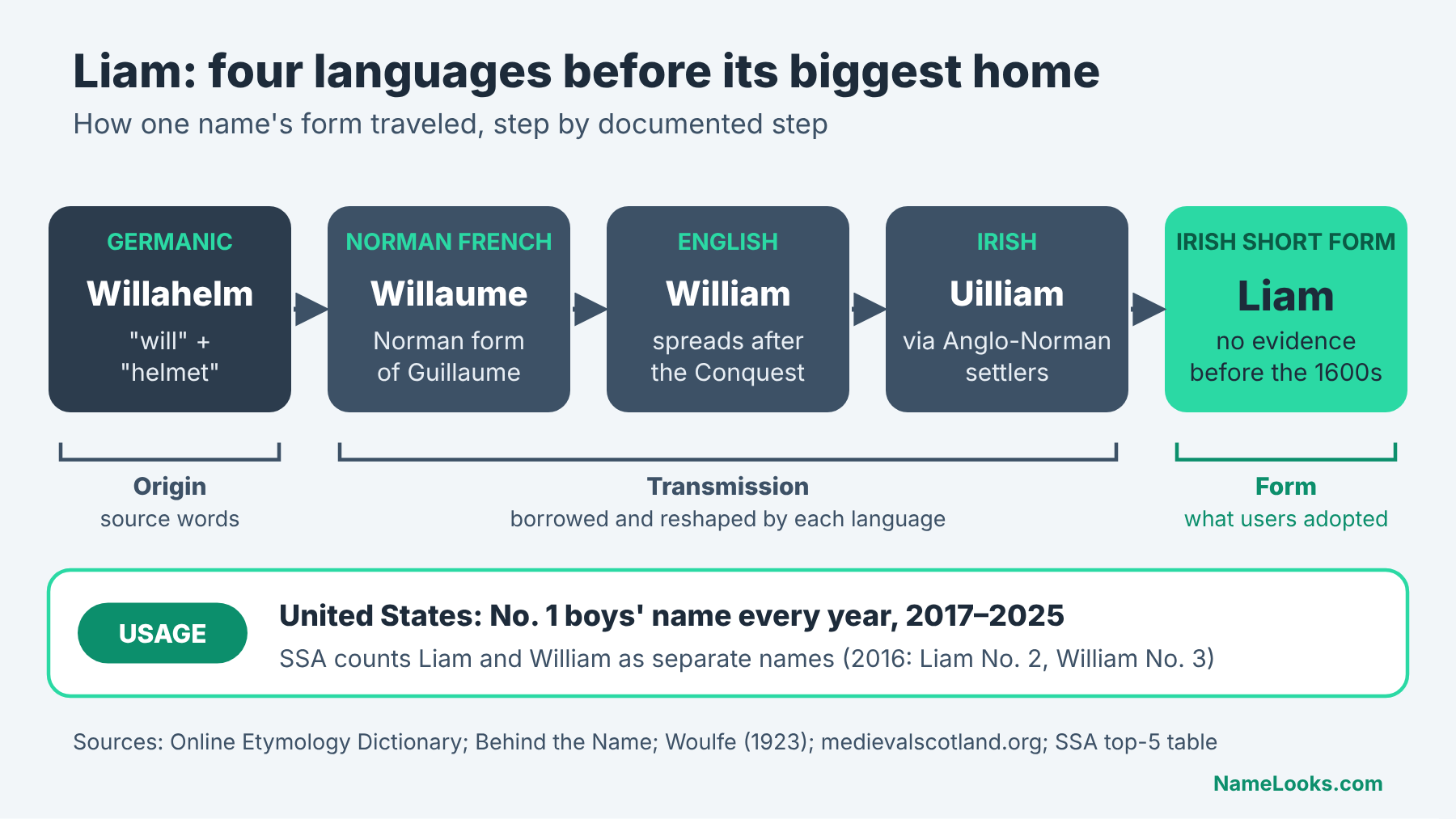
Liam is now so strongly associated with Ireland that many people assume its roots are Irish. The evidence says otherwise. Behind the Name calls Liam an Irish short form of William. The Online Etymology Dictionary’s William entry traces William to a Germanic compound of “will” and “helmet,” with Old High German Willahelm among its cognates, and says it reached English through Old North French Willaume, the Norman form of French Guillaume.
The Irish step is documented too. Rev. Patrick Woulfe’s 1923 Irish Names and Surnames, which Library Ireland reproduces online, gives Uilliam as the Irish form of William and calls it the most common name among the early Anglo-Norman settlers in Ireland. The short form came much later. A detailed review of the historical record in the “problem names” series at medievalscotland.org, written to advise on historical name registration for the Society for Creative Anachronism, found no persuasive evidence for Liam before the 17th century.
So Liam’s origin is Germanic, its route ran through Norman French and English into Irish, and its form is Irish. Its peak usage, though, is far from Ireland: the SSA top-five table lists Liam as the No. 1 U.S. boys’ name every year from 2017 through 2025. A short form coined in one language, from a name borrowed from another, became the most-registered boys’ name in a third country.
What adaptation changes, and what it keeps
Adaptation usually keeps the name’s identity in the minds of the people using it and changes almost everything audible. Willaume, William, Uilliam and Liam don’t look much alike, yet each was understood as the same name by someone. That is the kind of relationship our article on cognates, variants, diminutives and transcriptions sorts out in detail.
The data has no such memory. In the SSA top-five table for 2016, Liam ranks second and William third among U.S. boys. Historically they’re one name; administratively they’re two unrelated strings. Neither the SSA nor the ONS merges spellings, let alone short forms. If your question is “how many children carry some form of William,” the official tables can’t answer it without your own, clearly disclosed grouping. That grouping is a research choice, and it should be labeled as one.
Through books, stage and screen
The second route is cultural publicity. A name appears in a successful play, novel or film and people who have never met anyone with it start choosing it. This route matters for origin work because it can create names that have no deep source at all, and because the story of the launch is often retold with more confidence than the evidence supports.
Case 4: Vanessa, built by a writer from someone else’s name
Vanessa is the textbook literary coinage. Behind the Name says Jonathan Swift invented it for his poem Cadenus and Vanessa, forming it from the opening parts of the first and last names of his friend Esther Vanhomrigh. The Online Etymology Dictionary’s Vanessa entry agrees on the method and adds that the butterfly genus Vanessa was named by the Danish entomologist Johan Christian Fabricius in 1808, for reasons nobody knows, and with no clear link to Swift.
The two references don’t give the same date. Behind the Name attaches the poem to 1726. Etymonline says Swift used the name around 1711 and published the poem in 1713. We haven’t resolved which date belongs to which stage of the poem’s life, so we won’t print one as settled. What both agree on is the part that matters for origin: Vanessa was assembled in English, from a personal name, by a known author. It has no older “meaning” to recover.
That’s a useful corrective to sites that assign Vanessa a meaning by borrowing the butterfly’s. Behind the Name also notes the name stayed uncommon until the mid-20th century. Its usage history and its origin are separated by more than two hundred years.
Case 5: Wendy, and the trouble with “invented by”
Wendy is often filed next to Vanessa as a name a writer invented. The references are more careful than that. Behind the Name ties it to J. M. Barrie’s Peter Pan, which it dates to 1904, and repeats the account that Barrie built it from the nickname fwendy, “friend,” used by a young friend. But it also says the name was rarely used before the play and may connect to Welsh Gwendolen. “Rarely used before” is not “never used before.”
The Online Etymology Dictionary says the name was “apparently coined” by Barrie in Peter and Wendy, which it dates to 1911, the title of the novel version. The hedge word “apparently” is doing real work. Etymonline adds a usage fact checkable in public data: Wendy first appears on the U.S. Social Security list in 1936.
The fair summary: Barrie’s work clearly launched the name’s usage. Whether he created it from nothing or popularized a rare existing form is unsettled in the sources we checked. That distinction between “launched” and “invented” is a version of the name origin vs usage split that shows up again and again.
A quick test for literary-origin stories
Ask whether the source shows the name before the famous work. If it does, the work is a usage event, not an origin. If it doesn’t, ask whether anyone has looked. Absence of evidence in a modern name book is weaker than a documented search of earlier records, which is what the problem-name review of Liam provides.
Through surnames, places and titles
A third route turns a family name or place name into a given name. English-speaking naming cultures have done this for centuries, and the U.S. has done it at scale. The result is a whole class of first names whose origin is a surname’s origin, which is often a different kind of question from a given name’s.
Case 6: Madison, from patronymic surname to a top U.S. girls’ name
Behind the Name derives Madison from an English surname meaning “son of Matthew” or “son of Maud.” The Online Etymology Dictionary traces it to surnames first appearing in the early 1400s, probably usually a variant of Mathieson, and in some cases perhaps from a pet form of Maud. Both agree it’s a surname built on a parent’s name. They differ on how confidently to choose between the two parents.
The usage story is one Behind the Name tells: the name wasn’t commonly used for girls until the 1984 film Splash, in which a character takes it from a Madison Avenue street sign. We couldn’t open a second independent reference for that causal claim, so we’re passing it along as Behind the Name’s account rather than as established fact. The outcome, by contrast, is in official data. The SSA top-five table places Madison second among U.S. girls in 2001 and 2002.
So the meaning “son of” belongs to the origin, the feminine usage belongs to late-20th-century America, and the two don’t conflict. They’re simply answers to different questions. A parent drawn to Madison for its sound isn’t choosing a meaning, and a site that headlines “means son of Matthew” isn’t describing why anyone picked it.
Why surname origins come in layers
Surnames often have more than one independent origin, because different families in different places formed similar-sounding names from different sources. That’s why careful references hedge with “probably usually,” as Etymonline does for Madison. A single-origin statement for a surname-turned-first-name is a mild red flag in itself.
There’s also a separate layer: the famous bearer or place that made the surname familiar. Etymonline notes that Madison Avenue and Madison, Wisconsin, both take their names from President James Madison. Those associations are part of the name’s usage profile in the U.S., not its etymology. A family surname and a famous namesake can sit in the same word without one explaining the other.
3Name origin vs usage, compared on the things that change a decision
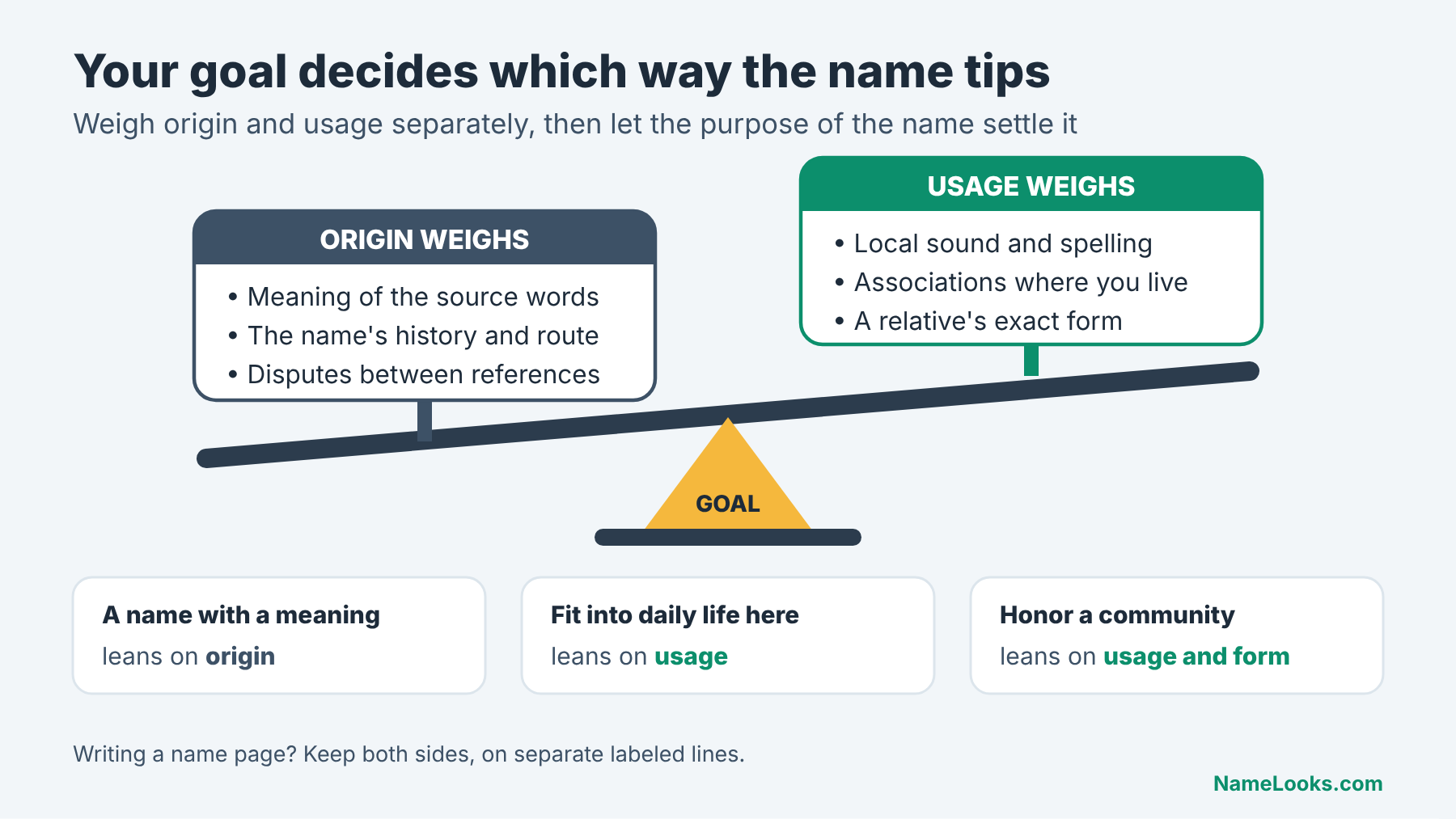
A comparison is only useful if it’s on dimensions that matter. “Origin is old, usage is new” is true and helps nobody. The useful question is which side controls each practical feature of a name: its meaning, its sound, its spelling, the data you’ll find about it, and the associations people bring to it. The answer is surprisingly lopsided.
Origin owns one thing outright: the literal source meaning and the history behind it. Usage owns nearly everything a child, a colleague or a form will actually encounter. That doesn’t make origin unimportant. It makes it a specific kind of importance, closer to a family story than to an everyday feature.
Meaning, sound and spelling: who controls what
Think of a name as carrying two bags. The origin bag holds source words, earlier forms and historical bearers. The usage bag holds how the name is pronounced in the local language, how it’s spelled on local documents, and what people in that community associate with it. When a name moves, the origin bag travels unchanged and the usage bag is repacked at every stop.
Case 7: Kevin, whose associations were made abroad
Kevin’s origin is well documented. Behind the Name calls it an Anglicized form of Irish Caoimhín, from Old Irish Cóemgein, and links it to the 6th-century saint who founded the monastery at Glendalough. Woulfe’s Irish Names and Surnames, in the Library Ireland transcription of the Caoimhghin entry, gives the Old Irish form Coemgen and the Latin Coemgenus, ties the name to the abbot of Glendalough, and glosses it “comely birth.” Behind the Name says “beloved birth.” Both point at the same elements and translate the first one a little differently, which is normal and worth showing.
Now watch the usage bag get repacked. Behind the Name says Kevin spread across continental Europe in the second half of the 20th century, and its French ranking data lists both Kevin and Kévin, with an accent French spelling supplies. In Germany, the name picked up social baggage with no connection to Ireland at all. A 2009 University of Oldenburg press release on a study by Astrid Kaiser and Julia Kube, which analyzed 500 questionnaires from primary school teachers, reported that teachers linked Kevin with weaker performance and behavior problems; one respondent wrote that Kevin “is not a name but a diagnosis.”
The study’s point was that teacher prejudice is real and harmful, not that the stereotype is true. For this article the lesson is different and simpler. No amount of research into Caoimhín would have predicted those associations, because they were produced entirely by the usage culture. A name’s meaning lives in its origin; its reputation lives where it’s used.
Spelling and pronunciation follow the user, not the source
Once a name settles in a new language, local spelling rules take over. The accent in French Kévin is one small example. The ONS removes accents from names during processing, according to its methodology notes, so in England and Wales data the same pair would collapse into one string. The SSA, for its part, counts each spelling separately. A name’s visible form in a dataset is a product of usage and of the agency’s processing rules, never of its origin.
Pronunciation follows the same rule. The way a name is said in its source language is a fact about origin; the way it’s said by the people who use it now is a fact about usage. Both can be correct for different speakers. Our guide to researching a name’s pronunciation without guessing from spelling explains how to find evidence for each, and why “the original pronunciation” isn’t automatically the right one for a particular person.
Data, documents and identity
This is where the distinction stops being academic. People make inferences from names all the time: about where someone’s family is from, what language they speak, which religion they practice. Almost all of those inferences treat an origin fact as if it were a usage fact about one person. They’re unreliable, and on NameLooks we don’t make them.
What popularity data can and cannot tell you
Registration data tells you how many babies of a recorded sex, in a defined geography and year, were registered with an exact spelling. That’s a precise usage measurement and nothing more. It can show that Jennifer surged in the U.S. long after its Welsh and Cornish history was written, or that Madison rose as a girls’ name. It can’t show who those families were, why they chose the name, or whether they knew its origin.
It also can’t measure a name’s usage in a community that isn’t defined by geography. There’s no SSA table for “families who speak Irish at home” or “Welsh speakers in the U.S.” Claims like “popular among X” without a dataset that actually measures X are guesses wearing a statistic’s clothing.
Why a name’s origin says nothing reliable about the person who has it
Liam’s source words are Germanic, its form is Irish, and its recent chart-topping run is a fact about U.S. birth registrations. None of that tells you anything about an individual Liam’s ancestry. The same is true in every direction: a name’s language of origin doesn’t establish a bearer’s ethnicity, nationality, religion or first language. Usage data is about populations, and origin data is about words. Neither is about the person in front of you.
That rule matters most when the name is from a language associated with a minority or a faith. The respectful default is to ask how a person says and spells their name, and not to read a biography into it. Our gender cluster applies the same principle to a different kind of guess; see why one country’s gender pattern for a name doesn’t transfer to another.
| Feature | Origin side | Usage side | Where the evidence lives | Practical trade-off |
|---|---|---|---|---|
| Meaning | Literal source meaning of the elements, with disputes shown | Associations, stereotypes, famous bearers, local symbolism | Origin: name dictionaries and early records. Usage: observation, studies, media | A beautiful origin meaning can be invisible locally; a neutral one can carry strong local associations |
| Sound | How earlier forms were pronounced in the source language | How the name is said by speakers who use it now | Origin: historical linguistics. Usage: dictionaries with IPA, native speakers | Choosing the source pronunciation can mean correcting people for life |
| Spelling | Original script and earlier spellings | Local orthography, accent marks, transliteration choices | Origin: historical sources. Usage: registration data, which counts exact strings | An authentic spelling may be stripped, misread, or counted separately in data |
| Data | Not recorded by any birth registry | Counts and ranks by exact spelling, sex, place and year | SSA (U.S.), ONS (England and Wales) | Popularity numbers never confirm or deny an origin claim |
| Identity | Says which language the name came from | Says which communities give it, collectively | Neither measures individuals | Using either to guess a person’s background is unreliable |
Where the comparison breaks down
The two-bag picture is a simplification. Some names have origins that are genuinely unsettled, so the origin bag itself contains rival claims. Others have been reborrowed back into their source culture after a spell abroad, which tangles the two sides together. A good researcher notices when the tidy model stops fitting.
Case 8: Jessica, where sources disagree about certainty
Jessica is a case where references agree on the likely origin but not on how sure to be. Behind the Name says Shakespeare appears to have first used this spelling in The Merchant of Venice, and that he probably based it on the biblical name Iscah, which some translations of his era spelled Jescha. The Online Etymology Dictionary states the line of descent flatly: Late Latin Jesca, Greek Ieskha, Hebrew Yiskah, a daughter of Haran in Genesis.
Both point the same way, so you could write “probably from Hebrew Iscah, via Shakespeare” with a clear conscience. What you shouldn’t do is drop the “probably” because one source did. The SSA top-five table shows the usage side clearly: Jessica was the No. 1 U.S. girls’ name from 1985 through 1990 and again from 1993 through 1995, with Ashley first in 1991 and 1992. A name possibly built by a playwright from a minor biblical figure became a decade-defining American name.
When usage loops back and changes the origin story
Names sometimes return to the culture they came from after becoming popular elsewhere, and the return trip can be mistaken for continuity. A name that was rare in its source language for centuries and then reappears there, because of foreign fashion, looks “traditional” in a listing but is actually a new usage event. The same applies to spellings: a form invented in one country can be adopted in another and then described as the original.
The fix is chronology. Before saying a name is “traditional” in a culture, find evidence of use there before the modern fashion. If the earliest evidence you can find is recent, say that plainly. The cluster’s main research guide lays out how to build that kind of timeline from earliest attestation forward.
4Put the distinction to work in three real situations
The name origin vs usage distinction earns its keep when you have to decide something or write something down. Below are three common situations, each written as a labeled hypothetical so nobody mistakes it for a case study. The documented facts inside them come from the cases above. What changes from one situation to the next is which side of the name the decision should lean on.
Scenario one: honoring heritage with a name whose source is elsewhere
Picture a couple in Chicago with grandparents from County Cork. They want a name that “feels Irish” and they’ve landed on Liam. A relative, armed with a name site, announces that Liam isn’t really Irish because William is Germanic. The couple feel deflated. Should they?
What the evidence lets them say
No. The evidence supports a perfectly good claim, just not the one the relative attacked. Liam is an Irish-language form of a name that came into Ireland with Anglo-Norman settlers, per Woulfe, and the short form itself appears to be an Irish development, per the medievalscotland.org review. It’s Irish in form and in its history of use. It isn’t Irish in its deepest source words. All three statements can be true at once.
Heritage naming usually honors usage and form: the names a community actually used, in the shapes its language gave them. Very few traditions demand that a name’s source words be native. If the family’s goal is “a name our grandparents’ community would recognize as one of theirs,” the usage evidence is what matters, and the origin is an interesting footnote.
Wording that settles the argument kindly
A short, accurate line tends to end these debates faster than a lecture. Something like: “It came into Ireland from the Normans centuries ago and the Irish made it their own. That’s the part we’re honoring.” It acknowledges the origin, claims the usage, and doesn’t pretend either is the other.
If the relative wants to go further, the honest answer is that most names in most languages have a borrowed ancestor somewhere. The decision framework in our guide to choosing a name beyond endless lists treats heritage as one criterion among several, and that’s a helpful frame when one family member wants it to be the only one.
Scenario two: choosing a name for its meaning
Now imagine a parent who loves the meaning “fair one” and has seen it attached to Jennifer. They’re drawn to the idea of a name whose meaning they can explain to their child one day. Meaning-first choosers lean almost entirely on the origin side, which makes them the most exposed to bad origin information.
Check whether the meaning survives scrutiny
For Jennifer, part of the meaning holds up and part doesn’t. Both references we used agree that the first element is Welsh gwen, “white” or “fair.” The second element is disputed: “smooth, yielding” in Etymonline, a reconstructed “phantom, magical being” in Behind the Name’s Guinevere entry. “Fair one” is a defensible simplification of the first half and silent about the second.
That doesn’t disqualify the name. It changes what the parent can honestly tell the child: “Part of your name goes back to an old Welsh word for white or fair; scholars disagree about the rest.” That’s more interesting than a one-word meaning, and it won’t collapse the day the child looks it up. Our step-by-step method for verifying a name meaning across several sources is the right tool here.
Weigh what the name means where you live
The second check is usage. A meaning chooser should still ask what the name signals locally, because that’s what the child will actually experience day to day. A Welsh gloss won’t come up on a playground in Ohio; the fact that Jennifer was the top girls’ name of the 1970s and early 1980s, per SSA, very well might. Among U.S. parents of a certain age, the name reads less “Welsh legend” and more “my classmates.”
The Kevin study from Oldenburg is the extreme version of the same lesson: a name’s local reputation can be unrelated to anything in its origin. You can choose a name in spite of its local associations; just choose knowingly.
Scenario three: writing the label for a name page, a family tree or a school project
The third situation is about writing rather than choosing. A teacher asks students to report where their names come from. A genealogist adds notes to a family tree. An editor builds a name page. Each of them has to compress origin and usage into a few lines without turning one into the other.
A two-line label that keeps the claims apart
The simplest reliable way to handle name origin vs usage on a page is two lines, each with its own evidence. Line one: Origin, with the source language, the earliest form, and the sources. Line two: Usage, with the places and periods where the name is documented in use, and the dataset for any number. For Madison it might read: “Origin: English surname, probably usually a form of Mathieson, ‘son of Matthew,’ possibly in some cases from Maud (Etymonline; Behind the Name). Usage: given to girls in the U.S. in large numbers from the late 20th century; No. 2 for U.S. girls in 2001 and 2002 (SSA).”
That format makes the disagreement visible and keeps statistics attached to their datasets. It also scales down. A school project can say “comes from” and “used in” in plain words; the principle is identical. If a source covers only one of the two lines, you’ve learned something about that source.
Phrases worth retiring
Some common phrases nearly always mix the two sides. “A traditional ___ name” usually means “currently used in ___” and implies an old origin it hasn’t shown. “Means ___ in ___” often translates a modern association rather than a source word. “A popular ___ name worldwide” makes a usage claim that no single dataset supports; our cluster on international data explains why “popular worldwide” is usually an overclaim.
Better replacements are boring and accurate: “from ___,” “first recorded in ___,” “used in ___ since ___,” “ranked ___ in ___ (dataset, year).” Boring is fine. The interesting part of a name is its real history, and accurate wording lets that show.
| Your goal | Side to lean on | Why | Downside | Fact that changes the choice |
|---|---|---|---|---|
| Honor a heritage community | Usage and form | Communities recognize names they used, whatever the deep source | A relative may object on origin grounds | Evidence the name was not used in that community before modern fashion |
| Honor a specific relative | Usage (the relative’s exact form) | The honor is in the person’s spelling and pronunciation | Local spelling may differ from the relative’s | Learning the relative used a different form on official records |
| Give a name with a meaning | Origin | Meaning lives in source words | Most meanings online are simplified or wrong | Two good references disagreeing on the key element |
| Fit smoothly into local life | Usage | Sound, spelling and associations are local | The origin story may be thin or unknown | A strong negative association in your area |
| Write a name page or profile | Both, labeled separately | Readers need each claim with its evidence | Takes more space and more sourcing | Finding only one source for the origin |
| Record a name in a family tree | Usage on the original record | The document’s spelling is the evidence | Spellings vary across records | Records in another script or language needing transcription |
5Research both halves of a name, in this order
Every name origin vs usage question in the cases above was answered with the same routine, and it’s worth making explicit. Origin first, because it’s the slower and more error-prone half. Usage second, because it’s the half with the cleanest data, as long as you match the dataset to the question. Keep the two sets of notes physically separate, on different lines or in different columns, until you write the final label.
Trace the origin
Origin research is mostly about resisting the first answer you find. The first answer is usually the most-copied one, and copying is how myths spread. Our article on how folk etymology and copy-paste sites create false meanings shows the mechanism; the steps below are the antidote.
Five steps for the origin side
- Find the exact form. Write down the spelling you’re researching and any forms it might be a short form or adaptation of. Liam can’t be traced without William and Uilliam.
- Open two independent references. A historical etymological dictionary plus a name dictionary is a good pair. Two websites copying the same book count as one.
- Separate source words from transmission. Note the deepest source language, then each language the name passed through, then the form the using culture adopted.
- Record every hedge. “Probably,” “apparently,” “may derive” are part of the claim. Copy them over exactly.
- Write down disagreements. If two references gloss an element differently, as with Jennifer’s second element, keep both and name who said what.
When the trail goes cold
Some names simply don’t have a documented origin. A recent coinage may have no source words at all; an older name may come from a community whose records weren’t preserved or haven’t been studied in reference works you can reach. In both cases, the honest label is “origin not documented in the sources we checked.” That isn’t a failure. It’s a finding.
What you shouldn’t do is fill the gap with a resemblance. Two names that look alike in English spelling can come from unrelated languages, and a word that sounds similar in some language isn’t evidence of anything until a reference connects them. For names from scripts other than Latin, the gap is often a transcription problem as much as an etymology problem; our guide to transliteration vs translation in names explains why. For older names, the cluster has a dedicated method for researching ancient names through earliest forms and scripts.
Map the usage
Usage research is easier in one way and harder in another. The data is cleaner, but it’s narrow: it only covers the places and periods that collect it, and only in the categories the agency records. The trick is to ask the data only questions it can answer.
Match the dataset to the place and period
For U.S. birth names, use the SSA. For England and Wales, use the ONS, whose July 2026 release covers 2025 registrations and comes with a dataset of ranks and counts back to 1996, according to its 2025 release page. Elsewhere, use the national statistics office or registry if one publishes name data, and say plainly when none does.
Then state every usage claim with four parts: dataset, geography, year, and metric. “Jennifer, No. 1 U.S. girls’ name, 1970–1984 (SSA top-five table, rank)” passes. “Jennifer was hugely popular” doesn’t. Remember that a rank is not a count, and a count is not a share. Each spelling is its own line in both SSA and ONS data, so a name family’s real footprint is often larger than any single entry.
Read usage labels, and machine-written entries, with suspicion
Editorial usage labels, like Behind the Name’s, are informed summaries, not measurements. Test them against data where data exists. Be warier still of entries nobody edited. When we checked in October 2026, Dictionary.com’s page for “liam” said the word wasn’t yet in its dictionary and that the definition shown was generated using artificial intelligence. That generated text gives Liam the meanings “resolute protector” and “strong-willed warrior.”
Neither phrase is a translation of anything in the references we opened. They read like an interpretive dressing-up of William’s “will” and “helmet,” attached to a short form that the Irish created centuries after the Germanic compound existed. It’s a compact illustration of what this whole page is about: an origin gloss for one name, reworded as a modern association, presented as the meaning of a different name. The difference between etymology, association and modern interpretation is exactly what such entries erase. For a fuller version of the routine across many names, return to the cluster’s guide to researching etymology without repeating myths.
Before you publish or print a name’s origin
Check that you can name two references you actually opened, that every hedge survived, that every number has a dataset and year, and that nothing in the label makes a claim about a particular person. If any of those fail, shorten the label rather than guessing.
Questions people actually ask
If a name comes from another language, is it wrong to use it?
Not in itself. Most widely used names in English-speaking countries have a source outside English; Olivia, Jennifer and Liam all do. What deserves thought is how the name is used in its source community today, especially if it carries religious or ceremonial weight there. That’s a usage question, and it’s best answered by people in that community rather than by a name site.
Does SSA or ONS data say which names are “Irish,” “Hebrew” and so on?
No. Both agencies publish counts and ranks of exact spellings by sex and year, and the ONS adds breakdowns such as region and month. Neither records origin, language or meaning. Any site that labels SSA names by origin has added that label itself, and the label needs its own sources.
Can a name have two origins at once?
Yes, in two different ways. Sometimes scholars genuinely disagree, and a careful label shows both analyses. Sometimes two unrelated names from different languages happen to converge on the same modern spelling. In that case, the “origin” depends on which name a particular family meant, which only they can say.
Why do two respected references give different meanings for the same name?
Reconstructing the meaning of very old name elements involves judgment, and specialists can read the same evidence differently. Translation choices also vary: Woulfe’s “comely birth” and Behind the Name’s “beloved birth” for Kevin are different English renderings of the same Old Irish element. When references disagree, report both rather than choosing the prettier one.
Is a name “traditional” in a culture if it’s popular there now?
Not necessarily. Popularity is a current usage fact; tradition implies use over a long period. To call a name traditional somewhere, look for evidence of use there before its recent rise. If the earliest evidence is recent, the honest word is “popular,” with a dataset and year.
Does name origin vs usage matter if I just like how a name sounds?
Mostly the usage side matters for you, because sound, spelling and associations are local. It is still worth a quick origin check if the name comes from a living language, so you know whether it carries a meaning or a religious use there that speakers of that language would notice. In the name origin vs usage split, sound-first choosers can lean on usage without ignoring origin entirely.
How should I describe my own name’s origin when people ask?
However you like; it’s your name. If you want to be precise, the two-part answer works well in conversation: where it comes from, and where your family got it. “It’s from an old Welsh name, and I’m named after my aunt” covers both sides in one breath and invites no guesswork about anything else.
Sources and further reading
- SSA, Top 5 names in each of the last 100 years — the source for every U.S. No. 1 and top-five fact on this page.
- SSA, background information on the baby names data — how the counts are built, including the five-occurrence privacy rule and separate spellings.
- ONS, baby names quality and methodology information — exact-spelling counts, accent removal and the three-occurrence threshold for England and Wales.
- ONS, Baby names in England and Wales: 2025 — the release page and datasets for 2025 registrations.
- Online Etymology Dictionary — Douglas Harper’s historical dictionary; we used its Jennifer, William, Olivia, Vanessa, Wendy, Madison and Jessica entries.
- Behind the Name, references — a secondary reference whose source list is a good guide to the scholarly name literature.
- Woulfe, Irish Names and Surnames (1923), via Library Ireland — a historical reference for Irish forms such as Uilliam and Caoimhghin.
- medievalscotland.org, “Liam” — a source-by-source review of the earliest evidence for the short form.
- University of Oldenburg press release 390/09 — the 2009 report on teacher assumptions about first names (in German).
NameLooks provides general information about names, not genealogical proof or advice about any individual. Popularity figures describe registered births in a stated place and year, not the people who carry a name, and origin claims reflect the references cited as of October 2026.